Abstract
This technical note demonstrates a sensitive method for the quantitation of bimatoprost in human plasma using accurate mass spectrometry. The method uses a simple liquid-liquid sample preparation method for analysis. A lower limit of quantitation (LLOQ) of 1 pg/mL was achieved using 400 µL of human plasma (Figure 1).
Introduction
Bimatoprost is a synthetic prostamide similar in structure to prostaglandin F2α (PGF2α). It functions by substituting an electrochemically neutral amide group for the carboxylic acid group in PGF2α. Glaucoma and other eye conditions caused by high blood pressure can be effectively treated with bimatoprost. The typical dosage is one drop of 0.03% bimatoprost. It predominantly resides in plasma and has an 88% plasma protein binding rate. Bimatoprost has an estimated Cmax of 60-80 pg/mL and the maximum plasma concentration is often reached in less than 10 minutes.1 Therefore, it is essential to have a sensitive bioanalytical method to quantify bimatoprost across a wide range of concentrations in biological matrices to support pharmacokinetic studies.2
This technical note presents a reliable and highly sensitive workflow to support routine quantitative analysis using an accurate mass spectrometer with increased MS/MS sampling efficiency provided by the Zeno trap on the ZenoTOF 7600 system.
Key features for the analysis of bimatoprost using the ZenoTOF 7600 system
- Low pg/mL level of quantitation: Achieve 1 pg/mL LLOQ for the quantitation of bimatoprost in human plasma
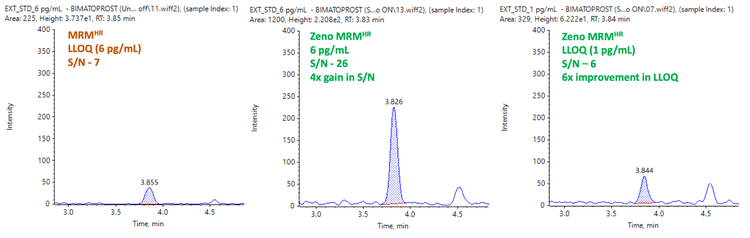
- Enhanced sensitivity: Achieve a 6-fold improvement in LLOQ and a 4-fold improvement in signal-to-noise (S/N) using the ZenoTOF 7600 system compared to a conventional TOF system due to improved MS/MS sampling efficiency with the Zeno trap
- Improved selectivity: Reduce high background and boost selectivity with the higher resolution provided by the ZenoTOF 7600 system compared to triple quadrupole mass spectrometers
- Robust analytical performance: Achieve accurate quantitative performance with %CV <13% at all concentration levels across a linear dynamic range (LDR) spanning 3.3 orders of magnitude
- Streamlined data management: Data acquisition and processing are simplified with SCIEX OS software, a 21 CFR Part 11 compliance-ready platform
Methods
Spiked sample preparation: Bimatoprost was spiked into 400 µL of human plasma at concentrations ranging from 1 to 2000 pg/mL. A 100 µL aliquot of 0.1N sodium hydroxide in water was added to the sample and vortexed for 2 minutes. A 4 mL aliquot of 80:20 (v/v), ethyl acetate/n-hexane was added to the samples, vortexed for 10 minutes and centrifuged at 1204 rcf for 5 minutes. The supernatant was collected and dried under a nitrogen stream at 40°C. The dried samples were reconstituted using 150 µL of 30:70 (v/v), acetonitrile/5mM ammonium formate in water. A 20 µL sample injection was used for analysis. 3
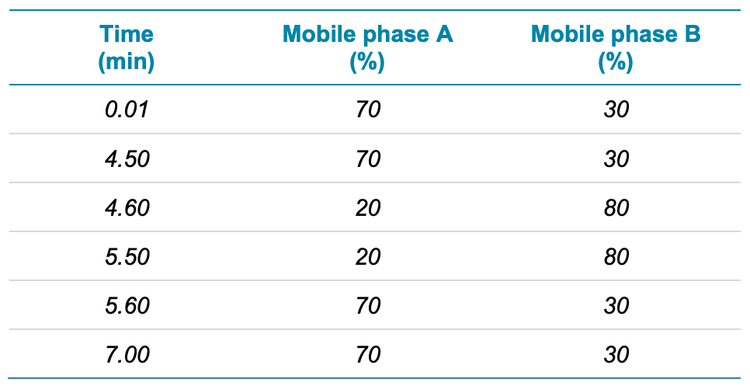
Chromatography: An ExionLC system with a Phenomenex Kinetex Biphenyl column (3 mm x 100mm, 2.6 µm, 100 Å) was used for chromatographic separation at a flow rate of 0.6 mL/min. The column was operated at 40°C. Mobile phase A was 5mM ammonium formate in water, and mobile phase B was acetonitrile. A 20 µL injection volume was used for analysis. Table 1 summarizes the LC gradient used.
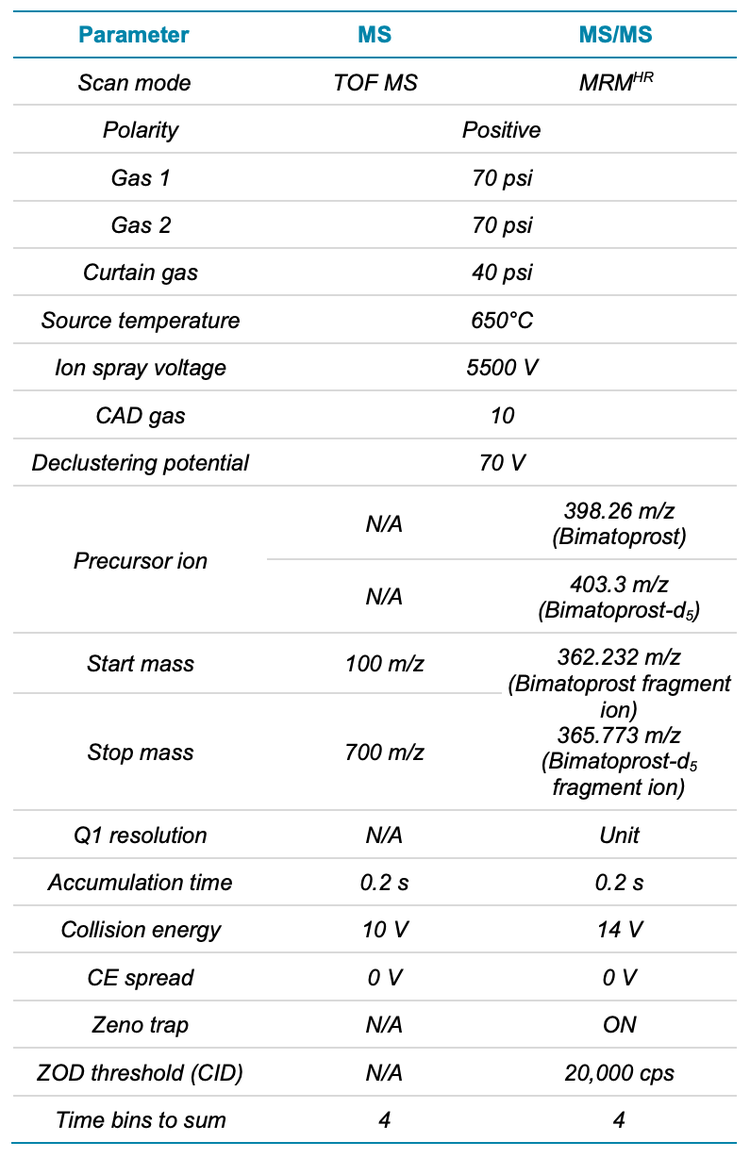
Mass spectrometry: Samples were analyzed using the SCIEX ZenoTOF 7600 system in Zeno MRMHR mode. The system was controlled by SCIEX OS software. The optimized MS parameters are listed in Table 2.
Data processing: Data processing was performed using SCIEX OS software, version 3.1. Peaks were automatically integrated using the MQ4 algorithm with a weighting of 1/x2 . The XIC peak width applied for quantitation was 0.02 Da
Quantitative performance
A calibration curve was analyzed for concentrations from 1 to 2000 pg/mL. To evaluate reproducibility, each calibration standard was analyzed in triplicate.
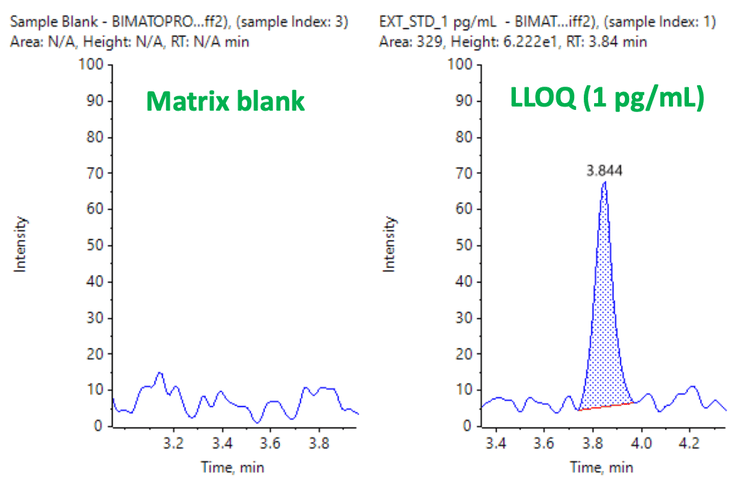
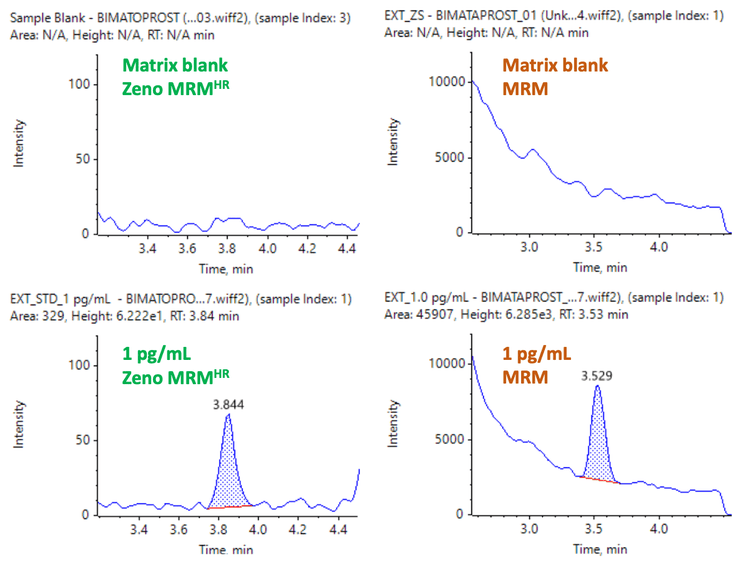
The LLOQ achieved for bimatoprost in human plasma was accurately measured at 1 pg/mL. No interferences were observed in the blank matrix (Figure 2).
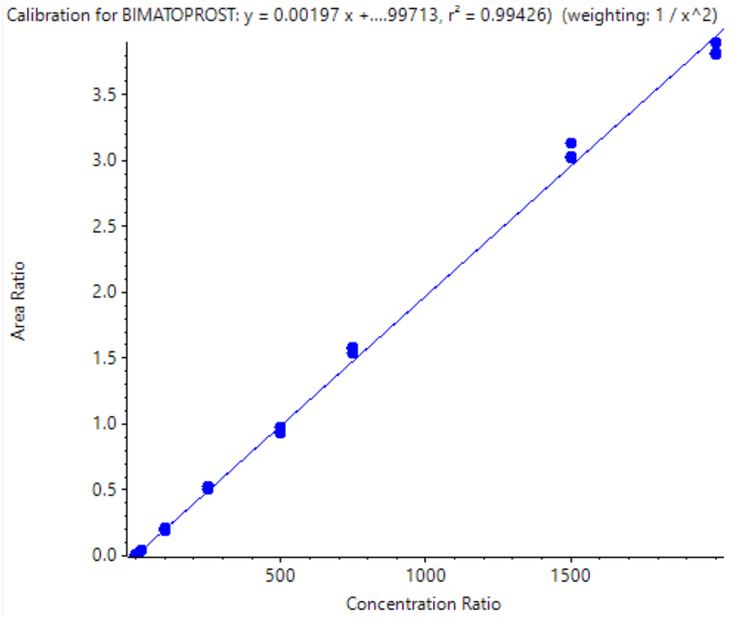
Linearity was achieved across a range of concentrations from 1 to 2000 pg/mL with a correlation of determination (r2 ) of 0.994 for bimatoprost in human plasma (Figure 3). An LDR of 3.3 orders of magnitude was reached.
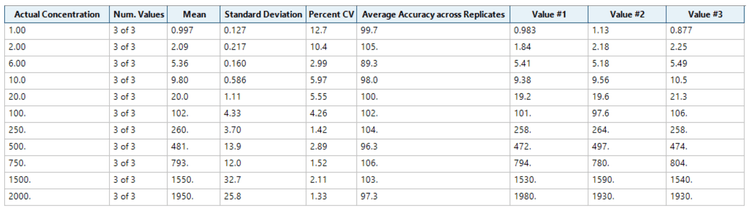
Analytical performance was evaluated based on the criteria that the accuracy of the calculated mean should be between 80% and 120% at the LOQ and between 85% and 115% at the higher concentrations. In addition, the %CV of the calculated mean of the concentration should be <20% at the LOQ and <15% at all higher concentrations.
The assay accuracy was within ±11% of the actual concentration and the %CV was <13%. Calculated percent accuracy and %CV values were within the acceptance criteria at each concentration level (Figure 4).
Gain enhanced selectivity with Zeno MRMHR
A matrix-extracted blank sample and a 1 pg/mL sample were also analyzed in MRM mode using a SCIEX triple quadrupole mass spectrometer. Data were compared between the 2 systems. The results showed that the Zeno MRMHR data had lower matrix background noise levels than the conventional MRM data obtained from the triple quadrupole mass spectrometer, thus demonstrating better selectivity (Figure 5).
Compliance-ready SCIEX OS software
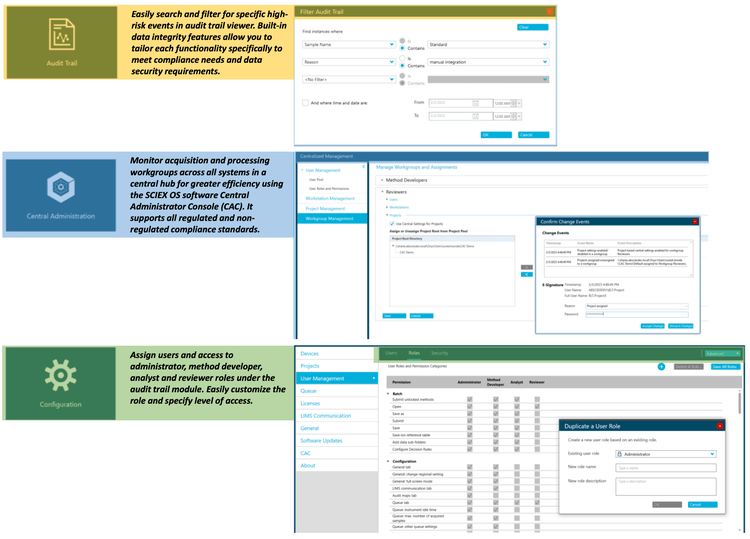
SCIEX OS software is a closed system and requires records and signatures to be stored electronically, meeting the regulations outlined in 21 CFR Part 11. SCIEX OS software can open raw data files from any visible storage location within a closed network by using designated processing workstations. Figure 6 illustrates the features on the SCIEX OS software for monitoring the audit trail, performing acquisition, processing data and configuring user access. The audit trail feature enables users to monitor any high-risk events and evaluate the data integrity. The Central Administrator Console (CAC) feature allows users to centralize acquisition and processing in a single platform to enable higher efficiency for multi-instrument laboratories, whether for meeting regulated or non-regulated compliance standards. Users can assign roles and access for the administrator, method developer, analyst and reviewer in the configuration module.
Conclusion
- An LLOQ of 1 pg/mL was achieved to quantify bimatoprost in human plasma using the ZenoTOF 7600 system
- Zeno MRMHR showed a 6x lower LLOQ compared to the conventional MRMHR experiment
- Linearity was achieved at concentrations ranging from 1 pg/mL to 2000 pg/mL, generating an LDR of 3.3 orders of magnitude with an r2 of 0.994
- The method demonstrated accurate and highly reproducible (%CV <13%) quantitative performance at all concentration levels
- SCIEX OS software is compliance-ready to support 21 CFR Part 11 and integrates with an accurate mass spectrometer to support data acquisition, processing and management on a single platform
References
- Assessment report for Lumigan, 7 Jan 2010, Doc. Ref:EMA/105752/2010
- Clinical pharmacology and biopharmaceutics review(s), 211911Orig1s000
- A sensitive method for the quantitation of bimatoprost in human plasma. SCIEX technical note, MKT-28441-A.