Elevating sensitivity for high-throughput intact protein analysis using next- generation technologies in acoustic ejection and HRMS
Abstract
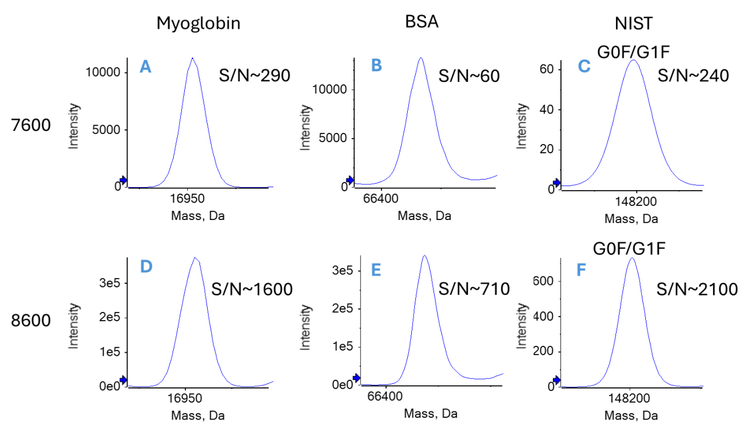
This technical note demonstrates a sensitive method for high-throughput (HT) intact protein analysis using the Echo® MS+ system with ZenoTOF 8600 system . Overall, >5X gain in signal-to-noise (S/N) at MS1 level for intact analysis of myoglobin , Bovine Serum Albumin (BSA), and NISTmAb was observed using the Echo® MS+ system with ZenoTOF 8600 system compared to the Echo® MS+ system with ZenoTOF 7600 system (Figure 1).
The development of protein- based therapeutics and vaccines requires analytical technologies that keep pace with modern research demands. HT methods are essential for performing simultaneous multicomponent analyses, enabling rapid candidate selection and formulation under tight timelines.
While LC-MS remains a trusted approach, its inherently low-throughput nature makes it unsuitable for workflows that require processing thousands of samples quickly. To address this limitation, the Echo ® MS+ system with ZenoTOF 8600 system presents an alternative approach for analyzing intact proteins with higher throughput and lower sample consumption.
Key benefits for HT intact protein analysis using the Echo® MS+ system with ZenoTOF 8600 system
- Sensitive intact protein analysis: The improved hardware provides >5X S/N gain at MS1 level, enabling confident and sensitive analysis of intact proteins with varying sizes and at sub-µM concentration, compared to the Echo® MS+ system with ZenoTOF 7600 system .
- High throughput: The sample analysis speed was 1.4 sec/sample , highlighting fast sample analysis and meeting throughput needs
- Low sample consumption: Analyze as low as 3 µL per sample with nanoliter-sized sample consumption per ejection.
- Streamlined data management: Acquire data in batches or individually and process data with protein reconstruction in SCIEX OS software using Analytics and Explorer modules.
- Well- based monitoring: Using a target list within SCIEX OS software, different proteins can be monitored and tracked in different wells, giving greater flexibility and delivering information within a few minutes.
Introduction
The analysis of intact proteins and their impurities is critical to ensuring drug quality, safety, and efficacy throughout development and manufacturing. Biotherapeutics, including monoclonal antibodies and complex protein - based drugs, present unique analytical challenges due to their structural heterogeneity and the presence of low- abundant proteoforms or impurities.1 Traditional LC-MS workflows have been widely adopted for intact mass analysis; however, the growing demand for higher throughput and improved sensitivity has necessitated innovative approaches.2
This technical note introduces an advanced workflow that combines Echo® MS+ system with ZenoTOF 8600 system, delivering significant improvements in sensitivity and throughput for intact mass analysis and determination of limit of quantitation (LOQ). Echo® MS+ system leverages acoustic droplet ejection for rapid, contact-free sample introduction, eliminating chromatographic separation and enabling ultra -fast analysis. When paired with ZenoTOF 8600 system’s enhanced ion optics and Zeno trap, this workflow achieves >5X S/N increase relative to previous platforms, enabling confident detection of low- concentration species in complex biotherapeutic samples.
In this work, intact protein analyses of myoglobin, BSA , and NISTmAb were performed using the Echo® MS + with ZenoTOF 7600 system and Echo® MS+ system with ZenoTOF 8600 system to evaluate the benefits of MS sensitivity improvements provided by the new platform.
Methods
Sample preparation: Myoglobin (M1882, Sigma) and BSA (A9418, Sigma) were prepared in Milli-Q water to prepare 1 mM stock solutions . Serial dilutions of myoglobin and BSA from 0.01 µM to 50 µM were prepared from the stock solution for linear dynamic range (LDR) analysis. A serial dilution of 0.6 µM to 33.5 µM NISTmAb (RM8671, NIST) was prepared using the histidine buffer.
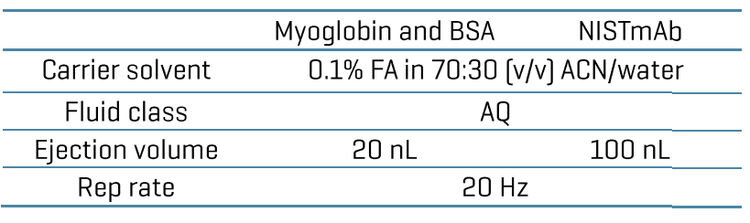
Acoustic ejection: The 70% acetonitrile (ACN) and 30% water with 0.1% formic acid (FA) as the modifier were chosen as the carrier solvent for all the experiments (Table 1). The flow rate was optimized based on the probe and electrode coupled to the mass spectrometer.
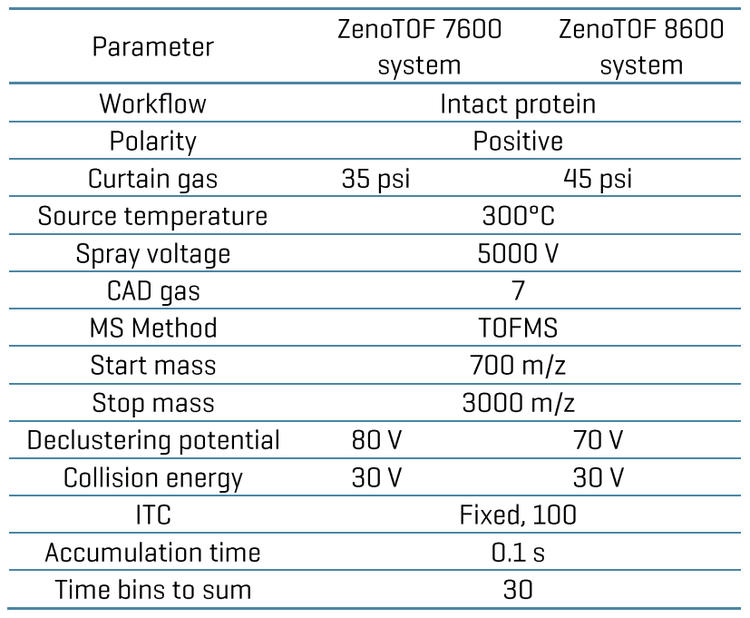
Data processing: Data was processed in SCIEX OS software 4.1.2.13 using the Explorer and Analytics modules.
Intact analysis of myoglobin and BSA
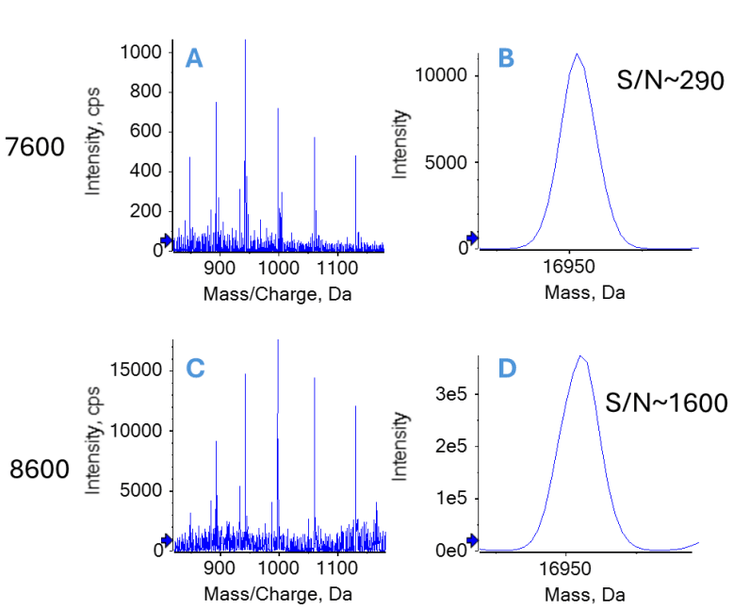
To evaluate the sensitivity improvement for Myoglobinanalysis using the Echo® MS+ system with ZenoTOF 8600 system over the Echo® MS+ system with ZenoTOF 7600 system, the S/Ns for the 1 µMmyoglobin sample were calculat ed from the reconstructed protein spectra (Figures 2A and 2B). A S/N of ~1600 was obtained using the Echo® MS+ system with ZenoTOF 8600 system (Figure 2D). This value is > 5X of the S/N (~290) measured on the Echo® MS+ system with ZenoTOF 7600 system .
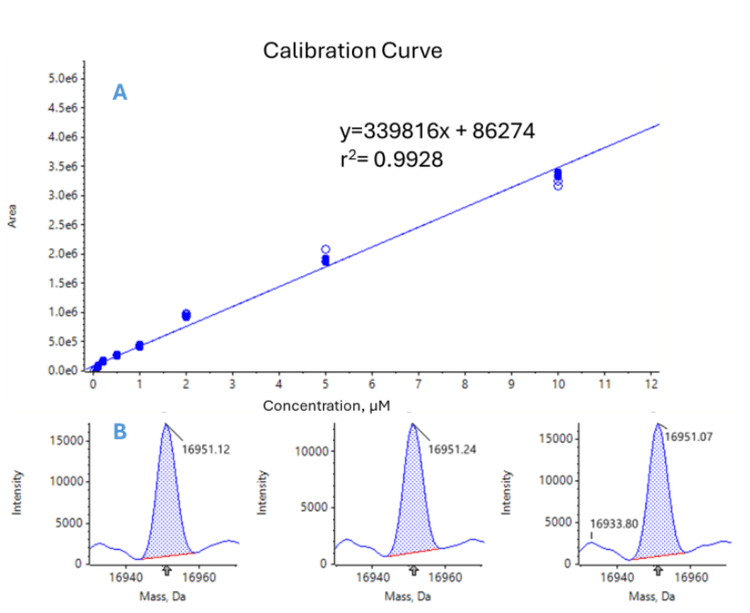
To assess the quantitative performance for high -throughput analysis , calibration curves were generated for myoglobin , using the Echo® MS+ system coupled with ZenoTOF 8600 system . For myoglobin, good linearity was achieved across 0.1– 10 µM with an excellent correlation coefficient (r²), 0.9928, without the use of an internal standard for normalization. And the LOQ was determined to be 0.1 µM(Figure 3A).
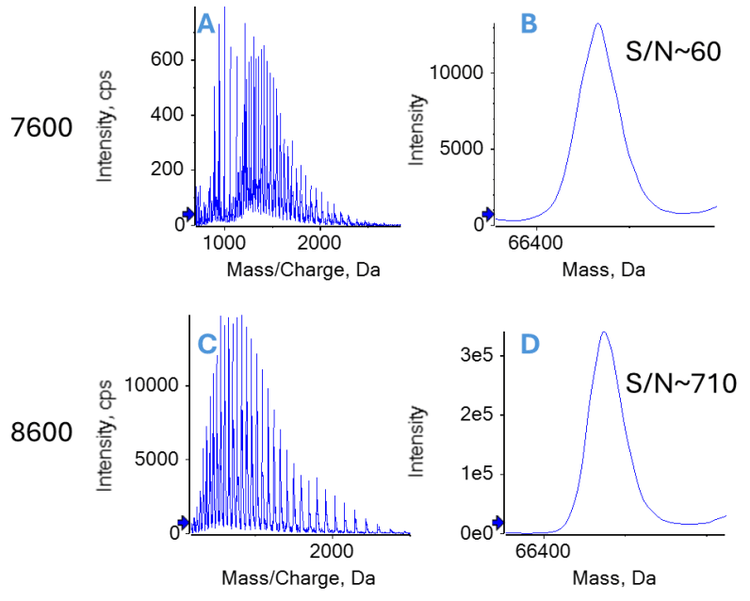
The same analysis was also performed on BSA. Nearly a 12-fold improvement based on S/N (~60 vs. ~710) was achieved for 20 µMBSA as displayed in Figure 4 . The results of both Myoglobin and BSA demonstrate the enhanced intact mass analysis using the Echo® MS+ system with ZenoTOF 8600 system . Therefore, the S/N gain at the MS1 level offered by the Echo® MS+ system with the ZenoTOF 8600 system can enable improved detection of low- abundance proteins, particularly when low sample consumption is required.
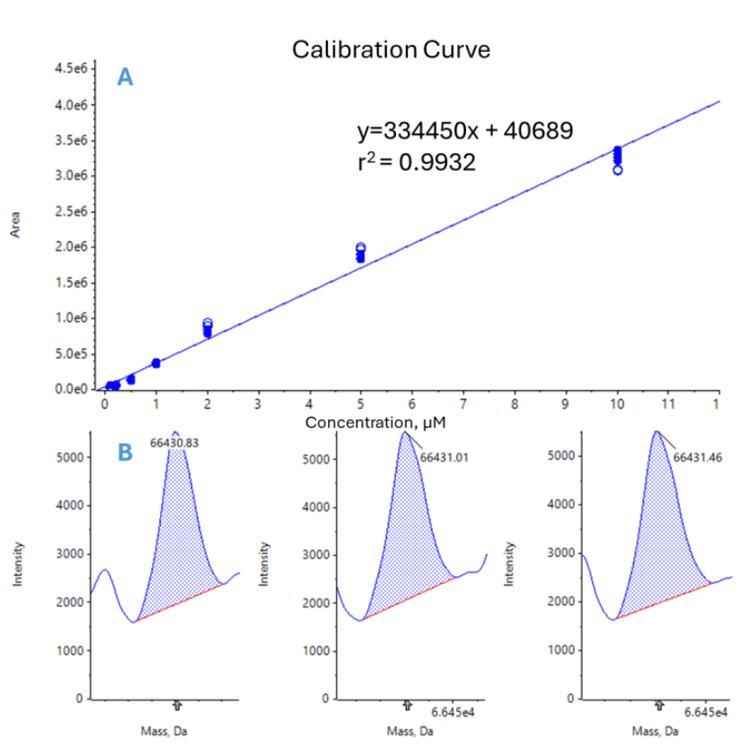
Similarly, BSA exhibited high linearity (r² = 0.9932) across concentrations ranging from 0.2 to 10 µM (Figure 5A). The LOQ for BSA was 0.2 µM with the ejection volume of 20 nL. Performance can be further improved by increasing the ejection volume, as indicated in Figures 3B and 5B.
For the reproducibility assessment, a concentration of 1 µM was evaluated for both myoglobin and BSA.
Utilizing a predefined target list, a full 384 -well plate containing myoglobin and BSA samples was analyzed within 14 minutes. The target list was configured such that:
- Well 1 monitored myoglobin
- Well 2 monitored BSA
- Well 3 monitored both myoglobin and BSA \
Where the same pattern was repeated across all wells.
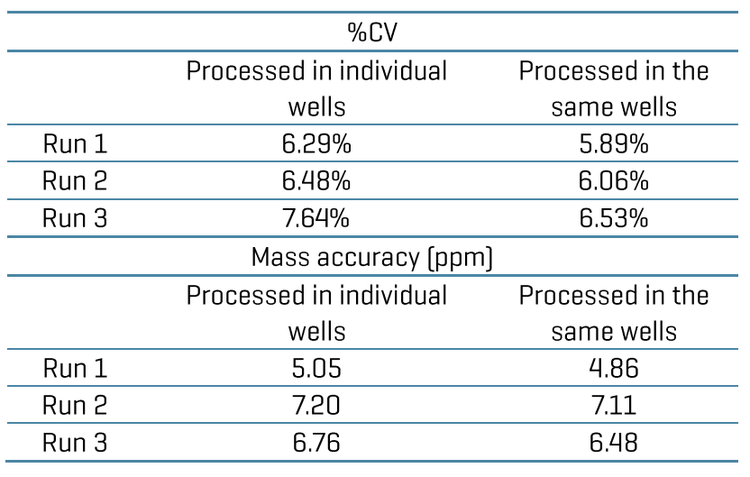
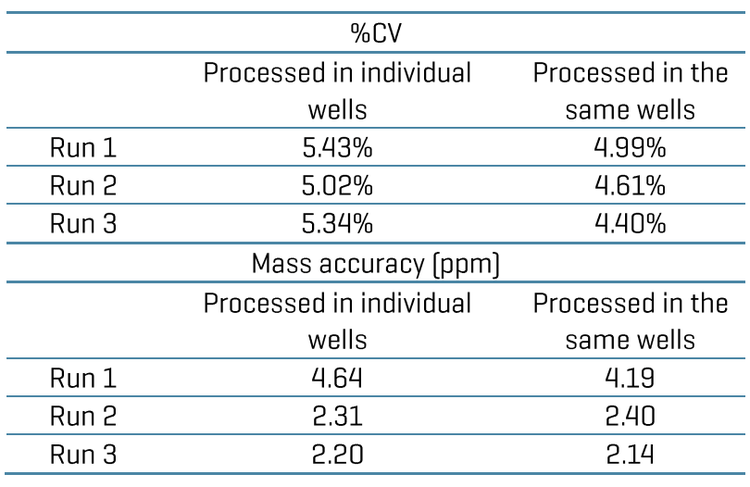
As summarized in Tables 4 and 5, the reproducibility for 1 µM myoglobin across 3 replicate runs was <8% coefficient of variation (CV), with mass accuracy <8 ppm. Similarly, BSA demonstrated reproducibility of <6% CV across 3 replicate runs, with mass accuracy <5 ppm.
Intact analysis of NISTmAb
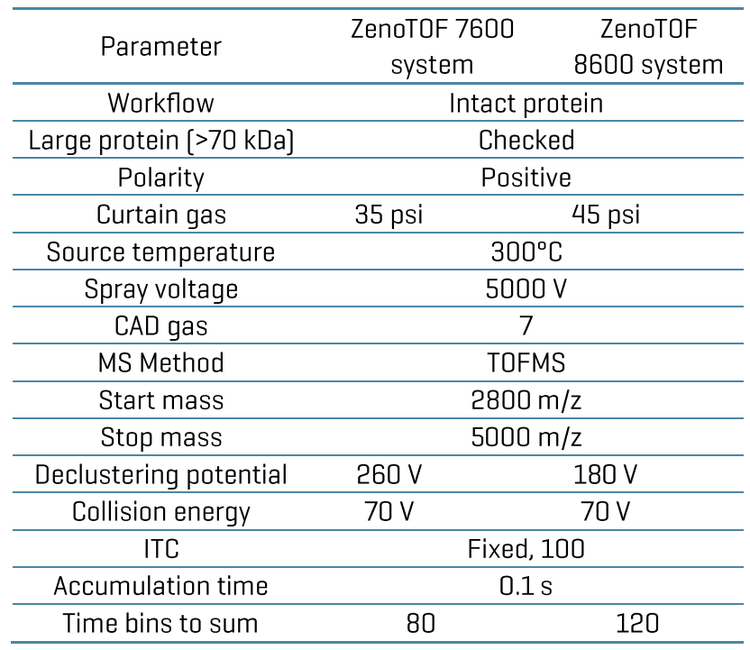
In addition to proteins smaller than 70 kDa, such as myoglobin and BSA, the Echo® MS+ system can analyze intact proteins exceeding 70 kDa, including intact monoclonal antibodies (mAbs).
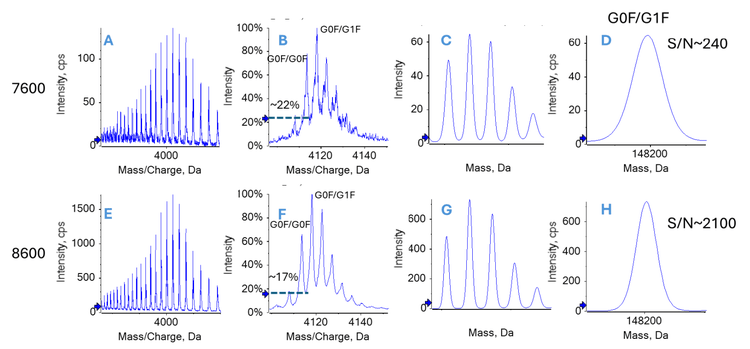
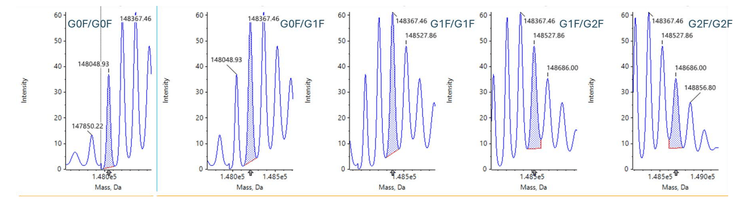
Figure 6 shows data for 33.5 µM NISTmAbacquired using the Echo® MS+ system with ZenoTOF 7600 system and Echo® MS+ system with ZenoTOF 8600 system . Similar charge-state distributions of NISTmAb were observed in both systems (Figures 6A and 6E). However, a close inspection of the 36+ charge state show that the Echo® MS+ system with ZenoTOF 8600 system provided a lower “valley -to- peak” ratio (i.e., better peak resolution) of ~17% between the G0F/G0F and G0F/G1F glycoforms (Figure 6B), as compared to ~ 22% for Echo® MS+ system with ZenoTOF 7600 system (Figure 6F), indicating better desolvation using the Echo® MS+ system with ZenoTOF 8600 system.
To evaluate the sensitivity improvement on the Echo® MS+ system with ZenoTOF 8600 system , we calculated the S/N of the G0F/G1F glycoform. A9-fold improvement in S/N (~2100) was obtained compared to that measured on the Echo® MS+ system with ZenoTOF 7600 system (~240) (Figure 6D and 6H).
A concentration range of NISTmAb was introduced to the Echo® MS+ system with ZenoTOF 8600 system to determine the LOQ , where as low as 0.6 µMwas quantified when ejecting 100 nL (Figure 7). Previous testing of NISTmAb on the Echo® MS+ system with ZenoTOF 7600 system established a n LOQ of 33.5 µM.3 Therefore, about 56-fold improvement in LOQ was achieved.
Compliance -ready SCIEX OS software
Equivalent SCIEX OS software capabilities for regulated bioanalysis can be executed on the QTRAP 7500+ system , ensuring high fidelity when performing method transfers while retaining critical compliance features.
SCIEX OS software is a closed system and requires records and signatures to be stored electronically, meeting the regulations outlined by 21 CFR Part 11. SCIEX OS software can open raw data files from any visible storage location within a closed network by using designated processing workstations.
Figure 7 illustrates the features of SCIEX OS software used to monitor the audit trail, acquire and process data, and configure user access. The audit trail feature enables users to audit critical user actions and locks in data integrity.
The Central Administrator Console (CAC) feature allows users to centralize acquisition and processing on a single platform, maximizing efficiency for multi -instrument laboratories, regardless of compliance standards. The configuration module allows users to assign roles and access as the administrator, method developer, analyst, and reviewer.
Conclusion
- More than 5-fold improvement in S/N at MS1 level was achieved using Echo® MS+ system with ZenoTOF 8600 system compared to the previous platform, enabling enhanced intact mass measurements of proteins.
- Detection of lower- concentration, low- abundance species (0.1- 0.6 µM) with reduced sample load was demonstrated on the Echo® MS+ system with ZenoTOF 8600 syste m.
- When combined with the Echo® MS+ system, the ZenoTOF 8600 system demonstrates great linearity with r2 greater than 0.99 across concentrations from 0.1 µM to 10 µM without using an internal standard for normalization.
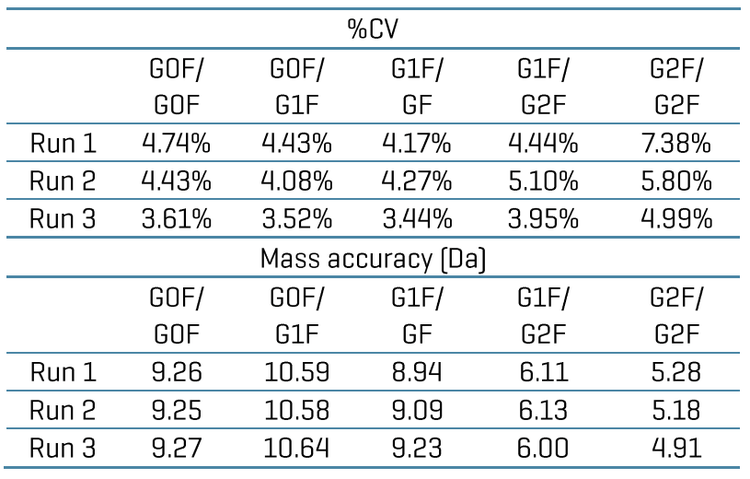
- High analytical throughput (1.4 sec per sample) , high signal reproducibility (CV <10%), high mass accuracy (<10 ppm for myoglobin and BSA and <11 Da for NISTmAb), and low sample volume requirements (as low as 3 µL per sample) were easily achieved on the Echo® MS+ system with ZenoTOF 8600 system , demonstrating a powerful platform for the HT analysis at the intact protein level.
- • All core workflows, including batch calibration, data acquisition, protein reconstruction (via BioToolKit and Intact Quant), and data processing (via Target list and Analytics)— are supported and can be executed within a single integrated environment using SCIE X OS software.
References
- Liu, C. High-throughput MS for intact protein analysis. Bioanalysis. 2023 Aug;15(16):1017 - 1019.
- Enhanced sensitivity of intact LC -MS approaches to expand the capability of biotherapeutics analysis . SCIEX technical note, MKT- 35364 -A.
- Accelerating intact biotherapeutic analysis using acoustic ejection mass spectrometry (AEMS). SCIEX Poster, MKT - 36402 -A.