Abstract
This technical note describes a n integrated workflow for metabolic stability assays on Echo® MS+ system with SCIEX Triple Quad 6500+ system. This workflow features a seamless progression from method development to endpoint calculations, highlighting efficient compound optimization with LeadScape® software and automated data processing with AI Quantitation software (Figure 1).
Metabolic stability assays are a critical component of early drug discovery, providing rapid insight into compound clearance, half-life, and overall suitability for progression. However, conventional workflows can be limited by sequential compound optimization, fixed acquisition methods, and manual data processing steps that slow turnaround times. These challenges are amplified in high-throughput (HT) ADME environments, where large numbers of structurally diverse compounds must be evaluated efficiently and reproducibly. The integration of LeadScape® software and AI Quantitation software with acoustic ejection mass spectrometry (AEMS) offers a HT solution with minimal method development and automated data processing, accelerating drug discovery pipelines.
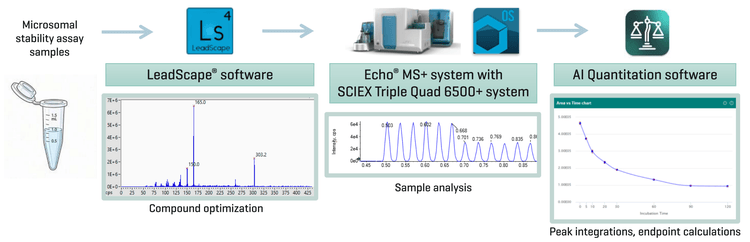
Key benefits of metabolic stability analysis using LeadScape® software and AI Quantitation software on Echo® MS+ system with SCIEX Triple Quad 6500+ system:
- Streamlined compound tuning: Streamline MRM transition optimization with LeadScape® software, reducing development effort.
- Streamlined data processing: Perform integrations and automate endpoint readouts without manual intervention with AI Quantitation software.
- Ultra-high throughput: HT analysis (up to 1 second per sample) with no residual carryover effects enabled by acoustic ejection technology.
- Confident metabolic stability profiling: Generate intrinsic clearance (CLint), half-life (t1/2), and percent remaining values consistent with published clearance ranges across diverse compounds.
Introduction
Metabolic stability assessment is critical in early drug discovery but is often constrained by sequential method development, static acquisition, and fragmented data processing. This study demonstrates an integrated workflow that connects streamlined compound optimization, sample-driven MRM acquisition, and automated endpoint generation on the Echo® MS+ system with SCIEX Triple Quad 6500+ system. This approach is designed to improve throughput, reproducibility, and confidence while accelerating data-driven compound progression decisions.
The presented metabolic stability workflow demonstrates reduced need for manual intervention from method setup through data review. LeadScape® software drives compoundspecific MRM optimization and automated peak integration with endpoint calculations using AI Quantitation software provides a direct path from raw acquisition to decision-ready results. Together, these capabilities support the rapid analysis of multiple compounds within a single sample batch while maintaining the assay performance required for metabolic stability measurements.1
Methods
Standard preparation: 6 small molecule compounds spanning a range of intrinsic clearance values (prazosin, chlorpromazine, diltiazem, erythromycin, buspirone, verapamil) were evaluated. Samples containing compound (1 µM), human liver microsomes (0.5 mg/mL), and an NADPH-regenerating system in 100 mM potassium phosphate buffer were incubated at 37 °C for 0, 5, 10, 20, 30, and 60 minutes. Reactions were stopped with 3 volumes of ice- cold acetonitrile, followed by vortexing, centrifugation, and supernatant recovery for analysis.
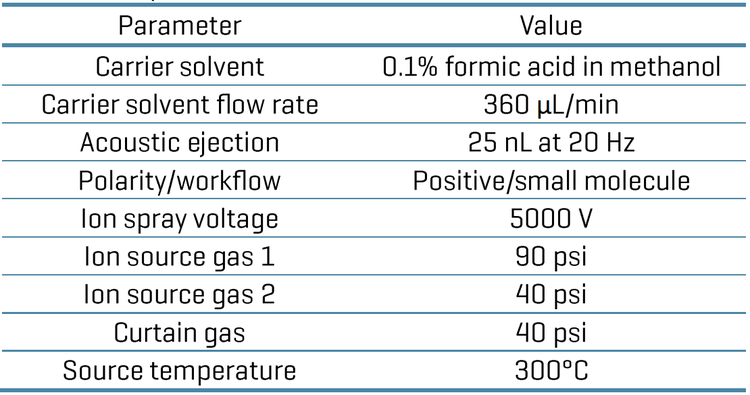
AEMS analysis: Samples were transferred to an Echo® MS qualified 384-well plate for AEMS analysis using Echo ® MS+ system (SCIEX). Carrier solvent was 0.1% formic acid in methanol with a flow of 360 µL/min. 25 nL of each sample was ejected using wide peak mode at 20 Hz. AEMS parameters are shown in Table 1.
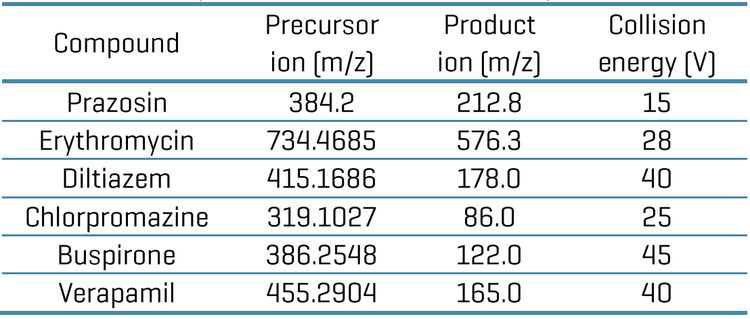
MRM optimization: LeadScape ® software was used to optimize MRM transitions for each target compound using neat standards (Table 2). Assay sample data were acquired with SCIEX OS software using the Echo® MS+ system with SCIEX Triple Quad 6500+ system.
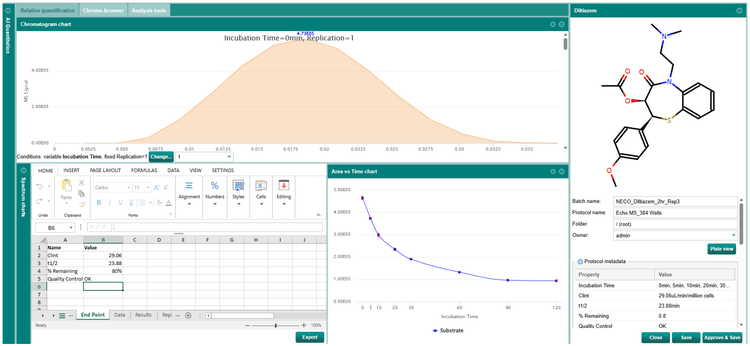
Data processing: Data were processed using AI Quantitation software, which performed all integrations and endpoint calculations, including Clint, t1/2, and parent compound depletion over time (% remaining).
Optimization with LeadScape ® software
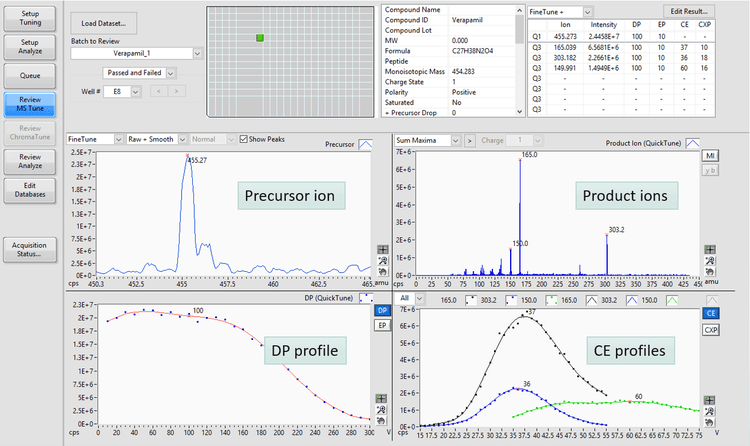
High analytical sensitivity is crucial for stability assays as parent compound concentrations decrease over incubation time, particularly for high-clearance molecules. Optimization of MRM transitions through compound tuning is essential to ensure low-abundance compounds are accurately measured. To streamline this process for ADME workflows, LeadScape ® (Optimize) was used to tune target compounds, determining optimal product ions and collision energies (CEs) in positive mode. Neat compounds were tuned directly from the Echo® MS+ system, bypassing the need for time-consuming manual infusion. Tuning results were evaluated through a graphical review panel that displayed the corresponding spectra along with the optimized CEs and declustering potentials (DPs) (Figure 2). LeadScape ® software imports text files to create a batch for tuning and generate tuning results, allowing integration with both upstream and downstream workflow processes.
Data processing with AI Quantitation software
AI Quantitation software automates data processing, quickly converting HT metabolic stability measurements into reliable data with minimal human intervention. Determination of Clint, t1/2, and % remaining are among the multitude of output possibilities enabled by AI Quantitation software (Figure 3).
Stability profiles obtained in this study are consistent with published values2, demonstrating the suitability of this workflow for metabolic stability profiling. Table 3 lists Clint values obtained in this study, along with published values and their clearance classification.

Conclusions
- Metabolic stability assessments of 6 small molecules demonstrated intrinsic clearance values consistent with expected ranges when evaluated on Echo® MS+ system with SCIEX Triple Quad™ 6500+ system.
- Enable faster compound optimization with automated tuning in LeadScape® software, reducing development effort while maintaining data quality.
- Accelerate automated data processing and endpoint calculation with AI Quantitation software, reducing time from analysis to results for metabolic stability assays.
- Increase sample throughput for high-volume ADME workflows using acoustic ejection technology for rapid, contactless sample introduction.
References
- Accelerating ADME workflows: AEMS for high-throughput metabolic stability studies, SCIEX technical note, MKT-35763-A
- Cyprotex. Microsomal Stability Assay. https://www.evotec.com/solutions/drug-discovery-preclinical-development/cyprotex- adme-tox-solutions/adme-pk/drug-metabolism/microsomal-stability