Abstract
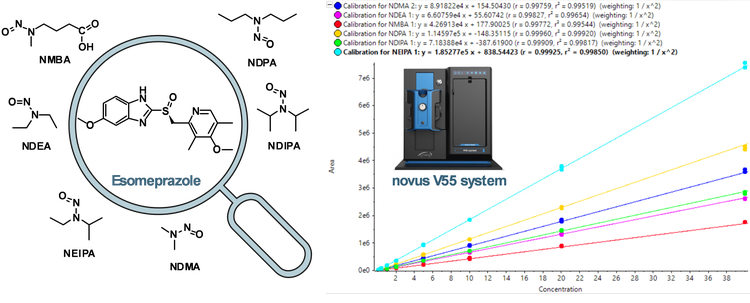
This technical note demonstrates a method for quantitation of 6 nitrosamines in a model API, esomeprazole, using the novus V55 system (Figure 1).1 Limits of quantitation (LOQs) as low as 0.08 ng/mL were achieved with reliable quantitative performance offered by the novus V55 system in a new, compact design.
Nitrosamines are a major concern in the pharmaceutical industry, given their potential for carcinogenic health effects.2 LC-MS has been widely used for nitrosamine testing, given the sensitivity, reproducibility, and selectivity it provides. Moreover, LC-MS methods have offered adequate separation between the nitrosamines and API, thereby increasing quantitative confidence when measuring multiple impurities.
Quality control (QC), process, and manufacturing laboratories often require multiple MS systems to conduct routine, high-volume testing daily. As a result, sensitive, selective, reliable, and sustainable analytical methods are essential for accurate quantitation of nitrosamines to ensure drug product safety throughout the development lifecycle.
Key benefits for nitrosamine analysis using the novus V55 system
- Low level of quantitation: Reach LOQs as low as 0.08 ng/mL for the quantitation of nitrosamines in esomeprazole API.
- Robust analytical performance: Achieve accurate and highly reproducible (%CV <15) quantitative performance at all concentration levels.
- Baseline separation: Good chromatographic separation of the esomeprazole API and nitrosamines was demonstrated, enabling reliable quantitation.
- Small footprint without compromising quantitative fidelity: Reach optimal bioanalytical quantitative performance using the most compact triple quadrupole mass spectrometer in its class.
- Streamlined data management: Easily acquire, manage, and process data using SCIEX OS software, a 21 CFR Part 11-compliant platform.
Introduction
Nitrosamine analysis has commonly relied on mass spectrometry-based methods. The regulatory thresholds for nitrosamine testing are stringent, necessitating sensitive and reliable detection. In addition to threshold requirements, QC and analytical laboratories are continually expanding efforts to reduce energy consumption, instrument footprint, and overall operational costs.
In this study, 6 nitrosamines including NDMA, NDEA, NMBA, NDPA, NDIPA, and NEIP were evaluated in esomeprazole API. Analysis was performed using the novus V55 system, which enables reliable monitoring of impurities and quantitative performance. Additionally, the novus V55 system empowers pharmaceutical laboratories with enhanced energy efficiency solutions.
Methods
Standard preparation: Nitrosamine mix in methanol was purchased from Accustandard (Catalog # FDA-001S). Calibration points ranging from 0.08 to 40 ng/mL were prepared in a 95:5 (v/v) water/methanol mixture.
Sample preparation: A concentrated esomeprazole API stock was prepared in methanol and subsequently diluted to 80 mg/mL in water. The solution was vortexed, briefly centrifuged, and transferred to a 1.5 mL centrifugal filter unit. The sample was centrifuged at 12,000 rpm for 5 minutes. Supernatant was transferred to a new tube. For the recovery experiment, API stock was diluted to 40 mg/mL using 95:5 (v/v) water/methanol and used as API blank. Spiked samples were prepared by spiking 1 ng/mL nitrosamine mix in API blank.
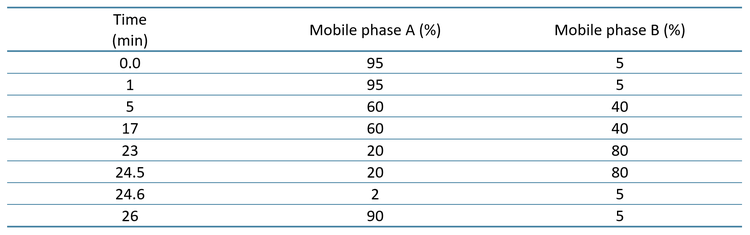
Chromatography: Sample separation was performed using a Shimadzu X3 system at a flow rate of 1.2 mL/min on a Phenomenex Biphenyl column (4.6 x 150 mm, 2.6 µm, 100 Å). The column temperature was maintained at 40°C. A 26-minute gradient was run using 0.1% formic acid in water as mobile phase A and 0.1% formic acid in methanol as mobile phase B (Table 1). A high organic wash was applied when running the API samples. An injection volume of 15 µL was used for analysis. A 90:10 (v/v) methanol/water mixture was used as the needle wash solvent.
UV chromatography: UV data were collected using a Shimadzu UV-SPD-40 equipped with a D2 lamp. The API detection wavelength was set to 300 nm.
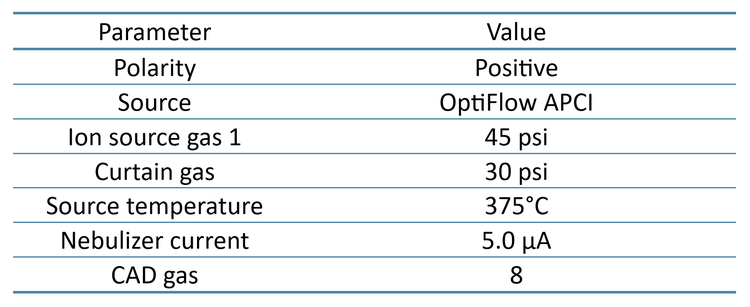
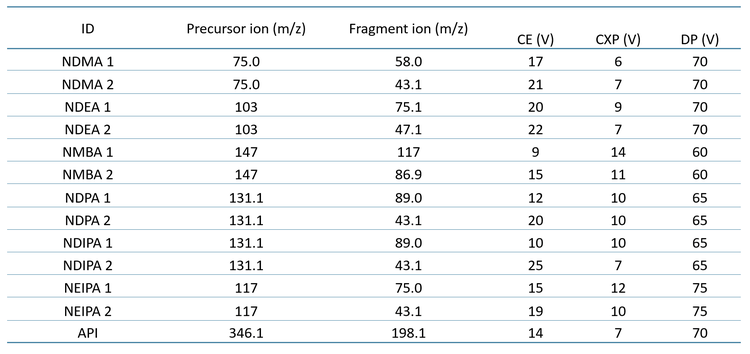
Mass spectrometry: Analysis was performed on the novus V55 system (SCIEX). The optimized source and gas parameters are listed in Table 2, and the MRM parameters are discussed in Table 3. For all transitions, the dwell time and EP values were set to 40 msec and 10 V, respectively.
Quantitative performance on the novus V55 system
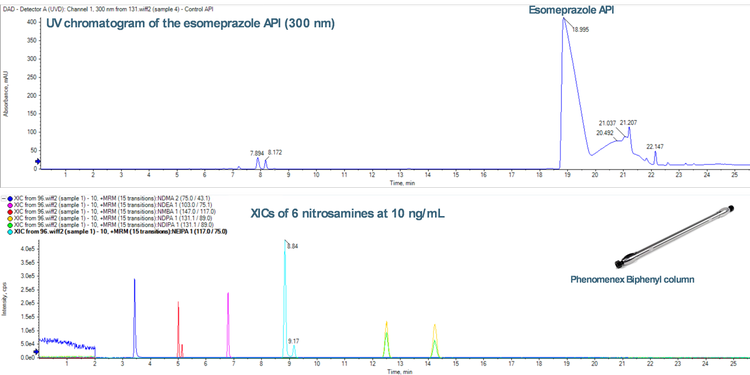
Baseline separation was achieved between the esomeprazole API and the 6 nitrosamines (Figure 2). The UV chromatogram shows the analysis of esomeprazole API at 300 nm, while the XIC traces show the elution of the nitrosamine compounds. The retention time of the esomeprazole API was 18.99 min, indicating baseline separation relative to the nitrosamine peaks. Three impurity peaks were observed in the UV chromatogram of the esomeprazole API between 7 and 8.5 min. None of the nitrosamine compounds were detected at that retention timeframe. Therefore, no impact on the quantitation of nitrosamine compounds was observed.
Figure 3 shows the XICs of the blank and the LOQ levels for all 6 nitrosamines. An LOQ of 0.2 ng/mL was reached for NDMA, NDPA, and NDIPA, while for NDEA, NMBA, and NEIPA, an LOQ of 0.08 ng/mL was achieved. The blank XICs did not indicate any interferences at the retention times of the nitrosamine analytes.
The evaluated calibration curve range for NDMA, NDPA, and NDIPA was 0.2 ng/mL to 40 ng/mL, while NDEA, NMBA, and NEIPA were evaluated from 0.08 ng/mL to 40 ng/mL (Figure 1). Replicate analysis (N = 3) was performed at each concentration level. Overall, excellent linearity was observed with r2 values of >0.995 and a weighting factor of 1/x2 (Figure 1).
Analytical performance was evaluated for accuracy and precision. The accuracy of the calculated mean was expected to be between 80% and 120% at the LOQ and between 85% and 115% at higher concentrations. The %CV of the calculated mean for each concentration was expected to be <20% at the LOQ.3
Assay accuracy at the LOQ levels was within ±4% of the actual concentration, and %CV was <15. The calculated percentage accuracy and %CV values were within the acceptance criteria at each concentration level (Table 4).
Recovery was evaluated at 1 ng/mL in 6 replicates. Overall, recovery across 6 nitrosamines was >98% with a %CV <7, indicating a highly reliable and reproducible assay for nitrosamine analysis in esomeprazole API (Table 5).
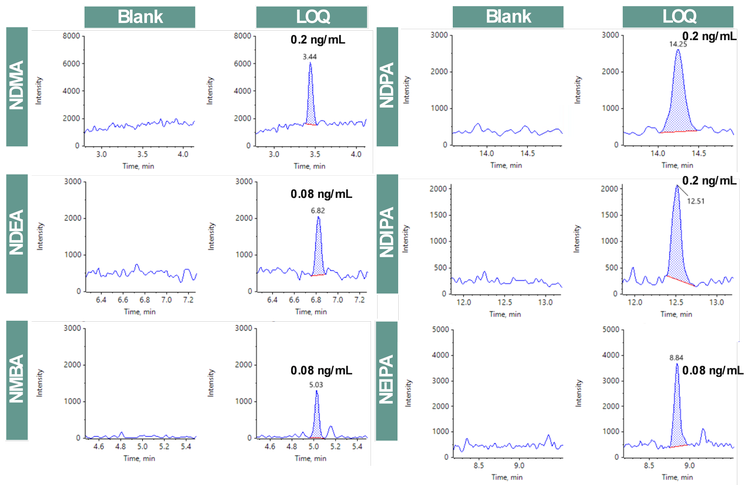
| Figure 3. Representative XICs of the blank and LOQ levels. LOQ of 0.2 ng/mL was reached for NDMA, NDPA, and NDIPA, while an LOQ of 0.08 ng/mL was achieved for NDEA, NMBA, and NEIPA. No interferences were observed in the blank samples. |
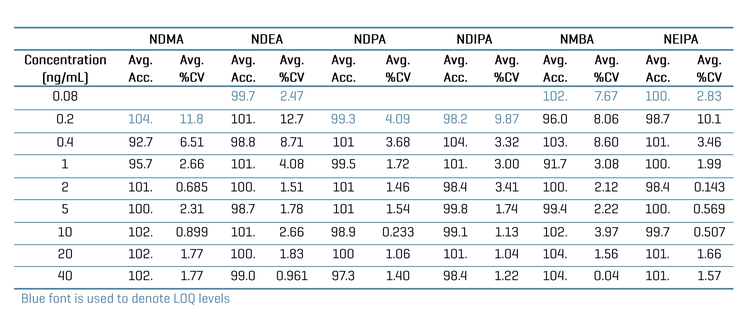
| Table 4. Quantitative performance of the evaluated nitrosamines. Average accuracy and precision were calculated across all concentration levels in triplicate. |
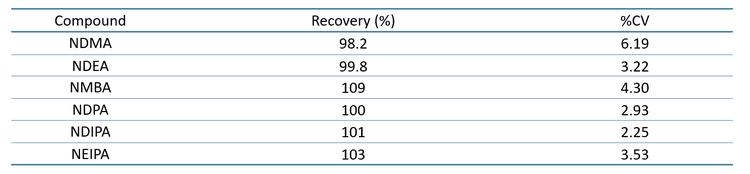
| Table 5. Recovery was evaluated at 1 ng/mL in 6 replicates. |
Compliance-ready SCIEX OS software
Equivalent SCIEX OS software capabilities for nitrosamine analysis can be executed on the novus V55 system, ensuring high fidelity when performing method transfers while retaining critical compliance features.
SCIEX OS software is a closed system and requires records and signatures to be stored electronically, meeting the regulations outlined by 21 CFR Part 11. SCIEX OS software can open raw data files from any visible storage location within a closed network by using designated processing workstations.
Figure 4 illustrates the features of SCIEX OS software used to monitor the audit trail, acquire and process data, and configure user access. The audit trail feature enables users to audit critical user actions and locks in data integrity.
The Central Administrator Console (CAC) feature allows users to centralize acquisition and processing using a single platform to maximize efficiency for multi-instrument laboratories, independent of compliance standards. The configuration module allows users to assign roles and access as the administrator, method developer, analyst, and reviewer.
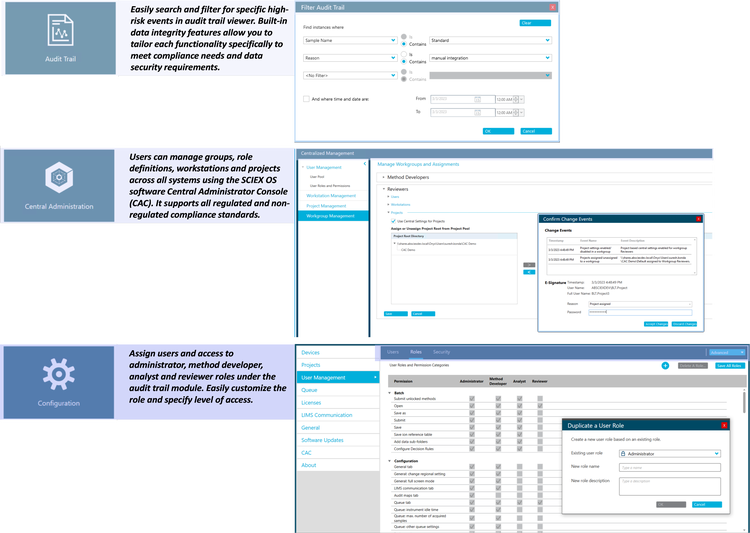
| Figure 4. Features of the SCIEX OS software for monitoring user access and evaluating the audit trail. The audit trail view allows users to filter for high-risk events easily and enables data integrity features to meet compliance requirements. The software features a Central Administrator Console (CAC) to manage users and groups, role definitions, workstations, and projects across all systems. The CAC feature supports both regulated and non-regulated compliance standards. The configuration module enables users to quickly set up roles and levels of access for the administrator, method developer, analyst, and reviewer levels. |
Conclusions
- An LOQ of 0.2 ng/mL was demonstrated for NDMA, NDPA, and NDIPA, while an LOQ of 0.08 ng/mL was reached for NDEA, NMBA, and NEIPA.
- Quantitative performance was demonstrated with accurate and highly reproducible (%CV <15) results on the novus V55 system.
- Excellent linearity was achieved with r2 >0.995. NDMA, NDPA, and NDIPA were evaluated between 0.2 ng/mL to 40 ng/mL, while NDEA, NMBA, and NEIPA were evaluated from 0.08 ng/mL to 40 ng/mL.
- Baseline separation was achieved between the 6 measured nitrosamine compounds and the esomeprazole API, enabling accurate quantitation.
- Overall, recovery was >98% when evaluating all 6 nitrosamines at 1 ng/mL with a %CV <7, demonstrating high quantitative fidelity.
- Maintain quantitative rigor and lower operational costs with the novus V55 system, the most compact triple quadrupole mass spectrometer in its class.
- Data management and compliance-readiness (21 CFR Part 11) features were shown using the SCIEX OS software to support nitrosamine quantitation on the novus V55 system.
References
- The SCIEX novus V55 system. SCIEX brochure, MKT-38393-A.
- Control of Nitrosamine Impurities in Human Drugs. US Food and Drug Administration Guidance for Industry, September 2025.
- Bioanalytical Method Validation, May 2018.