Abstract
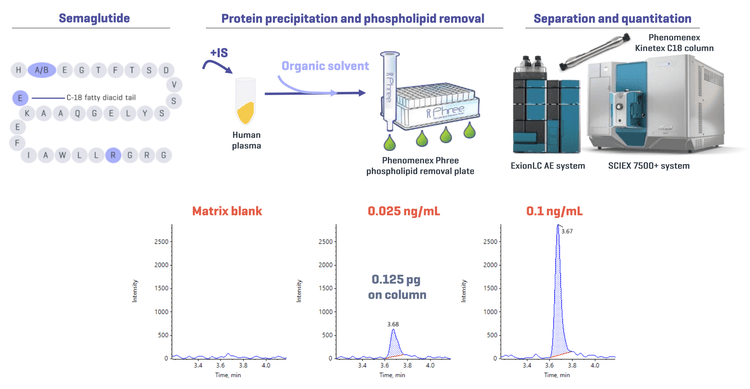
This technote demonstrates a sensitive quantitation workflow for a glucagon-like peptide-1 (GLP-1) analog, semaglutide, in human plasma on the SCIEX 7500+ system. A lower limit of quantitation (LLOQ) of 0.025 ng/mL (0.125 pg on column) for semaglutide analysis in human plasma was achieved using a simplified sample preparation with protein precipitation followed by phospholipid removal (Figure 1).
Incretin-based therapies, including GLP-1 analogs, are rapidly reshaping the therapeutic landscape for metabolic disease1 and weight management2, driving the need for sensitive, reliable, and efficient bioanalytical methods.
Achieving very low limits of quantitation for peptide therapeutics often relies on solid phase extraction ( SPE)-based sample preparation to improve recovery and reduce matrix background. However, SPE method development can be time-consuming , limiting sample throughput.
This technical note demonstrates a simplified LC–MS/MS workflow for semaglutide quantitation that combines protein precipitation with phospholipid removal, enabling low-ng/mL level detection with minimal sample preparation. This approach enables efficient bioanalysis while maintaining robust chromatographic performance and reliable quantitation across a wide dynamic range.
Key benefits or semaglutide quantitation using the SCIEX 7500+ system
- Low level of quantitation: Reach an LLOQas low as 0.025 ng/mL for the analysis of semaglutide in human plasma.
- Simplified sample preparation: Combining protein precipitation with phospholipid removal using the Phenomenex Phree plates simplifies sample clean up and accelerate s method development.
- Robust analytical performance: Achieve accurate and highly reproducible (%CV <9) quantitative performance at all concentration levels.
- Streamlined data management: Easily acquire, manage, and process data using SCIEX OS software, a 21 CFR Part 11- compliant platform.
Introduction
Sensitive LC–MS/MS workflows are essential for GLP-1 receptor agonists as they are often administered at low doses and can circulate at low plasma concentrations. Reliable quantitation at low levels is needed to accurately define pharmacokinetic parameters. In addition, GLP-1 analogs present analytical challenges due to their large peptide structure, amphiphilic character, strong protein binding, adsorption tendency, and susceptibility to matrix effects. Therefore, LC–MS/MS methods must provide low LLOQs while maintaining clean chromatography and robust performance in complex biological matrices.
Efficient sample cleanup is a critical step in LC–MS/MS bioanalysis of peptide therapeutics, where plasma proteins and endogenous phospholipids can contribute to matrix effects, ion suppression, and chromatographic interferences. Solid phase extraction (S PE) is often used to improve sample cleanliness and sensitivity; however, SPE method development can be time-consuming because retention, wash, and elution conditions must be optimized for each analyte.
In this workflow, the Phenomenex Phree phospholipid removal plate was used as a simplified alternative to traditional SPE for semaglutide quantitation in human plasma. Phenomenex Phree enables protein precipitation and phospholipid removal in a streamlined format, helping reduce matrix background while minimizing sample preparation complexity. By supporting robust semaglutide quantitation in human plasma, Phenomenex Phree phospholipid removal plates demonstrate the ability to accommodate complex GLP-1 therapeutic structures while providing rapid sample cleanup that accelerates bioanalytical workflows in combination with sensitive semaglutide quantitation on the SCIEX 7500+ system.
Methods
Commercially available semaglutide and leuprolide were reconstituted in dimethyl sulfoxide (DMSO) and diluted in 1:2:2 (v/v/v) water: methanol: acetonitrile. Semaglutide was spiked into 100 μL human plasma at a concentration range of 0. 025 ng/mL to 50 ng/mL. Leuprolide was used as an internal standard and was spiked at 10 ng concentration . Protein precipitation was performed with 400 μL of methanol and processed using the Phenomenex Phree phospholipid removal plate according to the manufacturer’s recommended protocol. Eluents were dried under nitrogen flow at 40°C and reconstituted in 1% formic acid in a 1:2:2 (v/v/v) water: methanol: acetonitrile mixture.
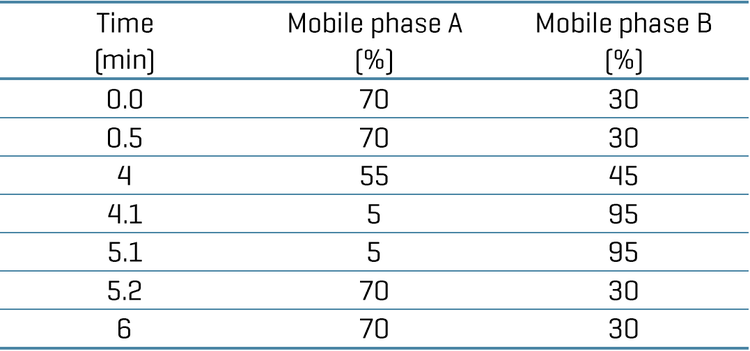
Chromatography: Chromatographic separation was performed using an ExionLC AE system (SCIEX) at a flow rate of 0.4 mL/min on a Phenomenex Kinetex C18 column (2.1 x 50 mm, 1.7 µm, 100 Å). The column temperature was maintained at 55°C. A 6- minute gradient was used using 0.1% formic acid in water as mobile phase A and 0.1% formic acid in acetonitrile as mobile phase B (Table 1). An injection volume of 5 µL was used for analysis. A 90:10 (v/v) methanol: water mixture was used as the needle wash solvent.
Quantitation of semaglutide in human plasma using the SCIEX 7500+ system
This technote demonstrates streamlined sample preparation and sensitive quantitation for semaglutide in human plasma using the SCIEX 7500+ system.
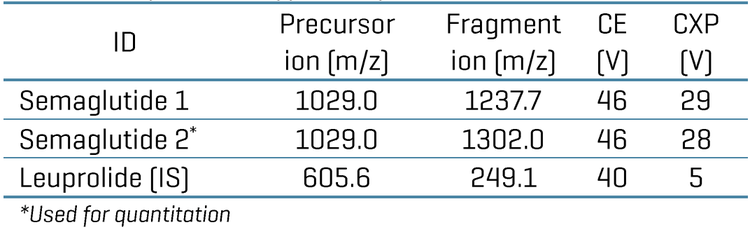
An LLOQ of 0.025 ng/mL for semaglutide was achieved using the Phenomenex Phree phospholipid removal kit ( Figure 1). A precursor ion at m/z 1029 (charge state 4 +) and a fragment ion at m/z 1302 (charge state 3+) were selected for quantitation of semaglutide. No interferences were observed in the human plasma matrix blank (Figure 1).
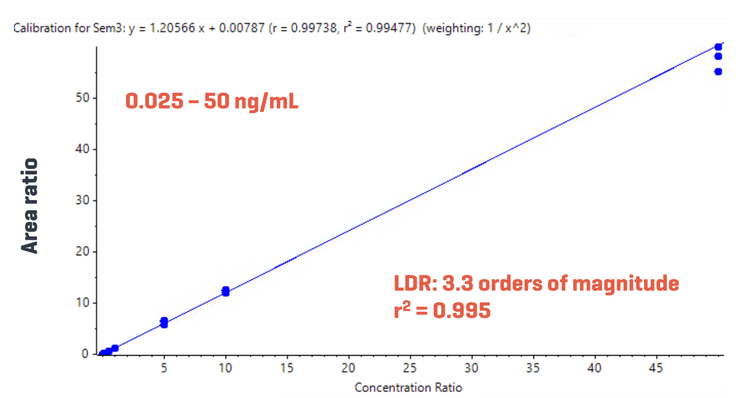
The calibration range for semaglutide was between 0.025 and 50 ng/mL (Figure 2). Linearity was achieved with an r2 of 0.995, across a linear dynamic range (LDR) of 3.3 orders of magnitude.
Analytical performance was evaluated for accuracy and precision. The accuracy of the calculated mean was expected to be between 80% and 120% at the LLOQ and between 85% and 115% at higher concentrations. The %CV of the calculated mean for each concentration was expected to be <20% at the LLOQ.2
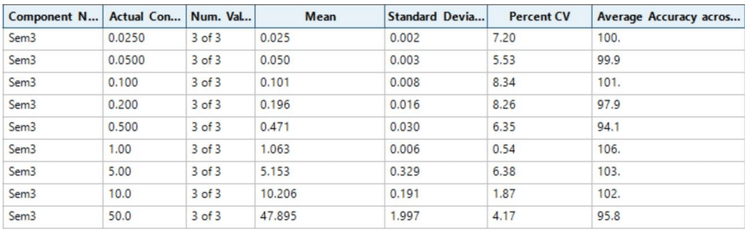
The assay accuracy was within ±8% of the actual concentration, and the %CV was less than 9%. The calculated percentage accuracy and %CV values were within the acceptance criteria at each concentration level (Figure 3).
Compliance-ready SCIEX OS software
Equivalent SCIEX OS software capabilities for GLP-1 bioanalysis can be executed on the SCIEX 7500+ system, ensuring high fidelity when performing method transfers while retaining critical compliance features.
SCIEX OS software is a closed system and requires records and signatures to be stored electronically, meeting the regulations outlined by 21 CFR Part 11. SCIEX OS software can open raw data files from any visible storage location within a closed network by using designated processing workstations.
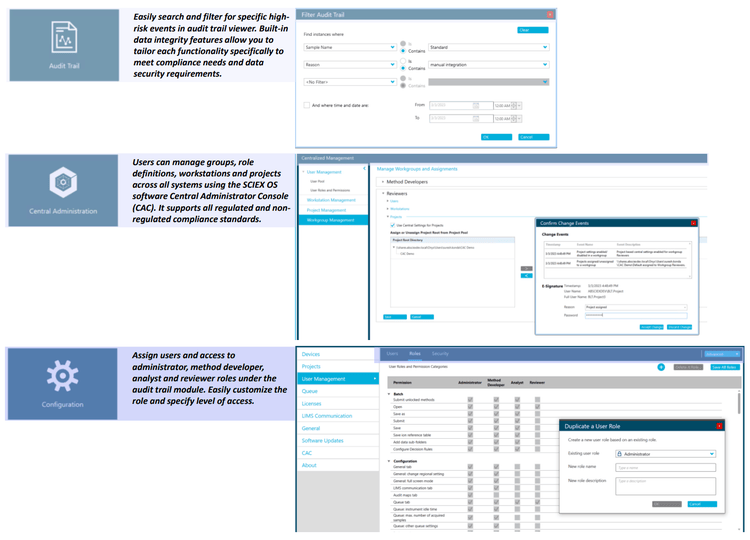
Figure 4 illustrates the features of SCIEX OS software used to monitor the audit trail, acquire and process data, and configure user access. The audit trail feature enables users to audit critical user actions and locks in data integrity.
The Central Administrator Console (CAC) feature allows users to centralize acquisition and processing using a single platform to maximize efficiency for multi -instrument laboratories, independent of compliance standards. The configuration module allows use rs to assign roles and access as the administrator, method developer, analyst, and reviewer.
Conclusions
- Sensitive semaglutide quantitation was achieved using a simple sample preparation workflow, reducing the need for more complex SPE-based sample preparation, achieving an LLOQ of 0.025 ng/mL with linearity across 3.3 orders of magnitude (r² = 0.995).
- Reduced method development time was demonstrated without compromising the sensitivity and quantitative performance using Phenomenex Phree phospholipid removal 96-well plate.
- Accurate and highly reproducible semaglutide quantitation in human plasma was demonstrated with %CV <9 on the SCIEX 7500+ system.
- Data management and compliance-readiness (21 CFR Part 11) features were shown using the SCIEX OS software to support bioanalysis workflows on the SCIEX 7500+ system.
References
- Jean-Claude Henquin, Christian Boitard, Erol Cerasi, Ele Ferrannini, Donald F Steiner, Suad Efendic (2004). Impact of treatment on islet function in type 2 diabetes. Diabetes. Dec;53 Suppl 3:S1-5.
- Maria J. Gonzalez-Rellan and Daniel J. Drucker (2025). The expanding benefits of GLP-1 medicines. Cell Reports Medicine, Volume 6, Issue 7
- Q2(R1) Validation of Analytical Procedures: Text and Methodology Guidance for Industry.