Abstract
This technical note describes a QTRAP LC-MS/MS method for the identification and MRM-based quantitation of N-nitroso sitagliptin (NTTP) impurity in sitagliptin (SG) API using the novus V55 system — QTRAP (Figure 1). A lower limit of quantitation (LLOQ) of 0.008 ng/mL was achieved on the novus V55 system, with reliable quantitation and confident MRM > EPI-based identification (IDA-driven) within a compact design.
SG is a dipeptidyl peptidase-4 (DPP- 4) inhibitor used for the treatment of type 2 diabetes.1 The structure of SG contains a tertiary amine, which poses a potential risk for the formation of nitrosamine drug substance-related impurities (NDSRIs) such as NTTP. As a result, regulatory bodies have set strict limits on the daily acceptable intake (AI, 37 ng/day).2 The AI was recently changed to 100 ng/day,3 but for the purposes of this study, 37 ng/day was used. This is equivalent to a maximum daily SG dose of 100 mg/day.4 A specification limit of 1.1 ng/mL of NTTP is required to be quantified in the API. Therefore, sensitive assays are crucial for assessing NTTP levels in SG to ensure drug safety and efficacy.
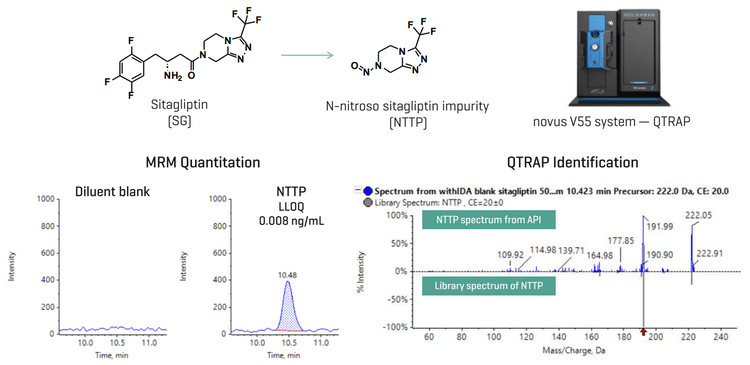
Key benefits for analysis of NDSRIs using the novus V55 system — QTRAP
- Low-level quantitation: Achieve 0.008 ng/mL LLOQ for the quantitation of NTTP using the novus V55 system — QTRAP.
- Identification of unknown impurities in API: NTTP impurity was confidently identified using reliable full scan MS/MS data acquisition with IDA-driven MRM > EPI (enhanced product ion) scan, with a spectral match of 100%.
- Small footprint with out compromising quantitative fidelity: Reach optimal bioanalytical quantitative performance with high reproducibility (%CV <10) using the most compact triple quadrupole mass spectrometer in its class.
- Streamlined data management: Acquire and process quantitative and qualitative data under 1 platform using SCIEX OS software .
Introduction
NDSRIs are highly potent probable carcinogens that are structurally linked to the API.3 NDSRIs are classified into various categories (class 1 -5) using the Carcinogenic Potency Categorization Approach (CPCA). The severity is determined based on the AI and the activating or deactivating features defined in the structures. Based on the structure of SG, it is placed in the Class 2 category under the CPCA guidelines.5
The formation of NTTP in SG is highly likely due to the presence of a tertiary amine (Figure 1). Given the high probability of forming an NDSRI, there is a set regulatory limit of 100 ng/day.2,3 Although for this study, the original 37 ng/day limit was applied2,3, where with a maximum daily dose of 100 mg/day, NTTP should be analy zed below 1.1 ng/mL.4
In this study, a quantitative evaluation of an NDSRI, NTTP, was performed in SG API. Here, the novus V55 system was applied for the analysis of NTTP. Reliable MRM quantitation paired with confident MRM > EPI-based identification was achieved using the novus V55 system — QTRAP, empowering streamlined NDSRI workflows in pharmaceutical laboratories with enhanced energy efficiency solutions.
Methods
Standard preparation: Calibration curve dilutions of NTTP was prepared across a range of concentrations (0. 008 ng/mL to 1.3 ng/mL) and analyzed using 4 replicates.
Sample preparation: A concentrated SG API stock was prepared in methanol. The solution was vortexed, briefly centrifuged, and transferred to a 1.5 mL centrifugal filter unit. The sample was centrifuged at 12,000 rpm for 5 minutes. Supernatant was transferred to a new tube.
For the recovery experiment, API blank and spiked samples at the specification limit (1.1 ng/mL of NTTP) were prepared at 3 mg/mL of SG API in methanol.
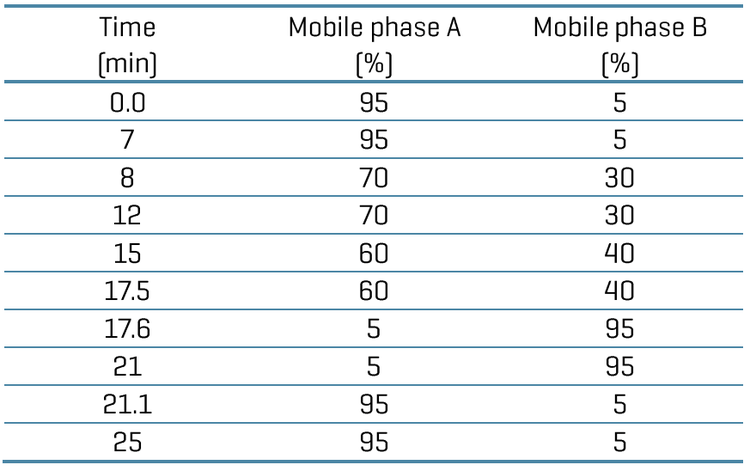
Chromatography: Sample separation was performed using a Shimadzu X3 system at a flow rate of 1.2 mL/min on a Phenomenex Biphenyl column (4.6 x 150 mm, 2.6 µm, 100 Å). The column temperature was maintained at 40°C. A 26-minute gradient was run using 0.1% formic acid in water as mobile phase A and 0.1% formic acid in methanol as mobile phase B (Table 1). A high-organic wash was applied for 5 minutes after the gradient during API sample runs . An injection volume of 15 µL was used for analysis. A 90:10 (v/v) methanol/water mixture was used as the needle wash solvent.
UV chromatography: UV data were collected using a Shimadzu UV- SPD- 40 equipped with a D2 lamp. The API detection wavelength was set to 267 nm.
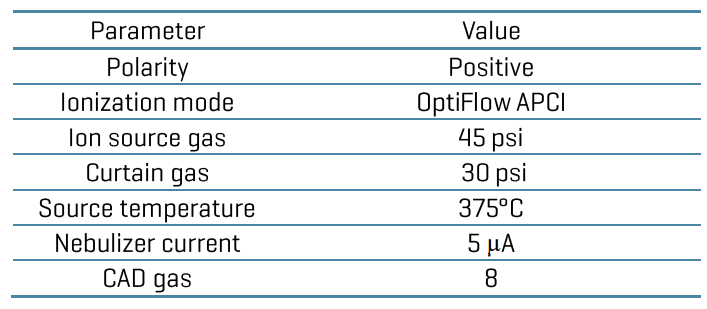
Mass spectrometry: Analysis was performed on the novus V55 system — QTRAP (SCIEX) . The optimized source and gas parameters used for the analysis are listed in Table 2, and the MRM parameters are included in Table 3.

Data processing: Data collection and analysis were performed using SCIEX OS software, version 4 .0. Peaks were integrated using the MQ4 algorithm for NTTP quantitation.
Identification of N TTP using QTRAP
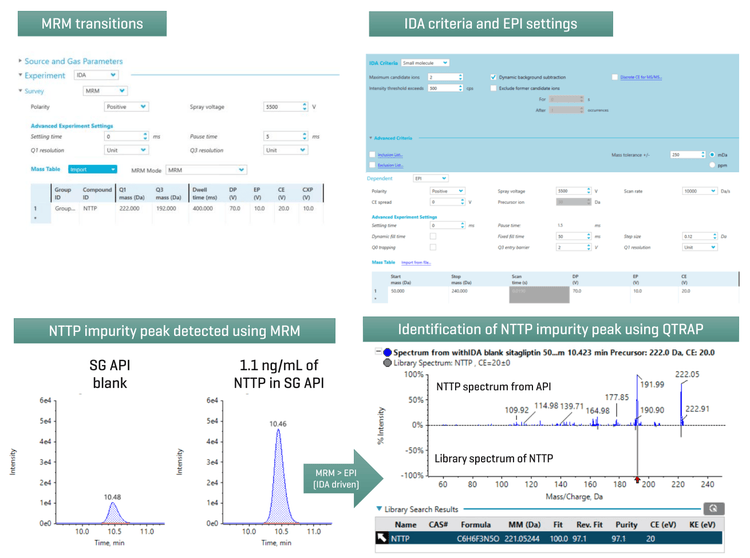
NTTP impurity was observed in the SG API sample as shown in the extracted ion chromatogram (XIC) in Figure 2 . Therefore, an MRM > EPI (IDA driven)method was developed to confirm and verify the identity of the impurity peak. Here, the MRM transition was used to trigger an IDA event to acquire an EPI MS/MS spectrum (Figure 2) .
The SG API blank and an API sample spiked with 1.1 ng/mL of NTTP were analyzed. The fragment ion spectra obtained from the API blank was compared with that of the NTTP reference standard. A 100% spectral match was obtained, confirming the presence of NTTP in the SG API blank. Thus, the MRM > EPI workflow on the novus V55 system — QTRAP can be reliably employed to confirm and verify the presence of NDSRI impurities in API samples.
MRM quantitative performance
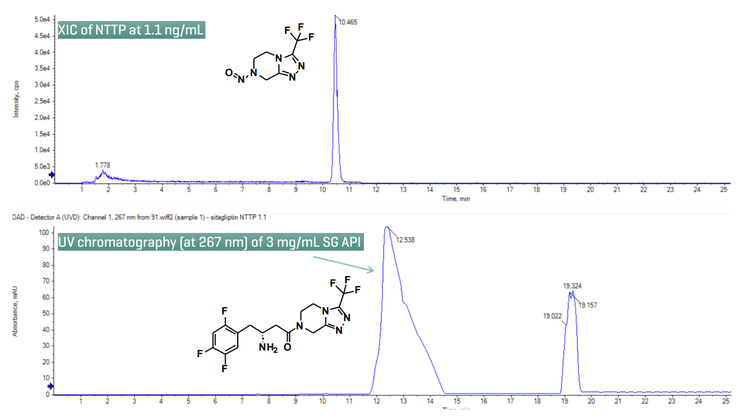
Baseline separation of SG API and NTTP was achieved using the Phenomenex Biphenyl column (4.6 x 150 mm, 2.6 µm, 100 Å). A retention time of 10.4 min was observed for NTTP by LC-MS/MS analysis (Figure 3). Furthermore, UV chromatography analysis of SG API at 267 nm yielded a retention time of 12.5 min . As a result, ~2.1 min difference in the retention time between SG and NTTP was observed, demonstrating good baseline separation and optimal setup for reliable quantitative performance.
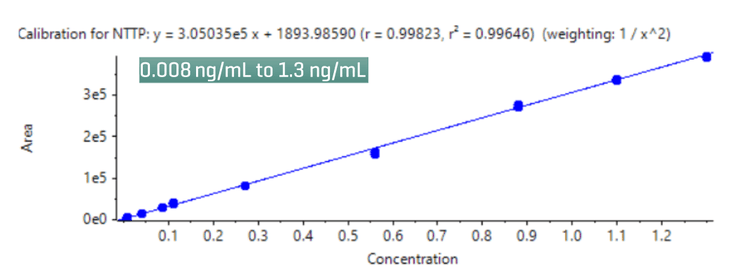
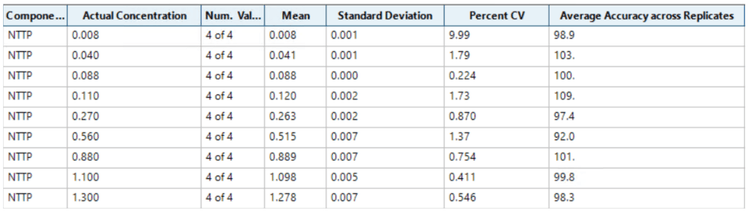
NTTP was analyzed across the concentration range of 0. 008 ng/mL to 1.3 ng/mL. To evaluate reproducibility, each calibration standard was analyzed using 4 replicates.
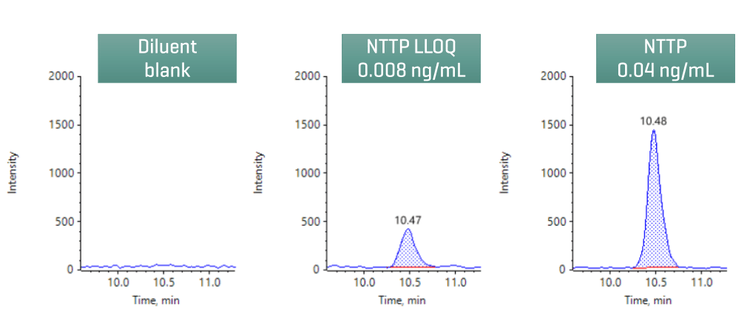
An LLOQ of 0.008 ng/mL was achieved for the quantitation of NTTP with no interference in the diluent blank (Figure 5). The specification limit ( 1.1 ng/mL) was calculated based on the maximum daily dose of 100 mg/day. Therefore, NTTP was analyzed at 1.1 ng/mL at the specification limit.
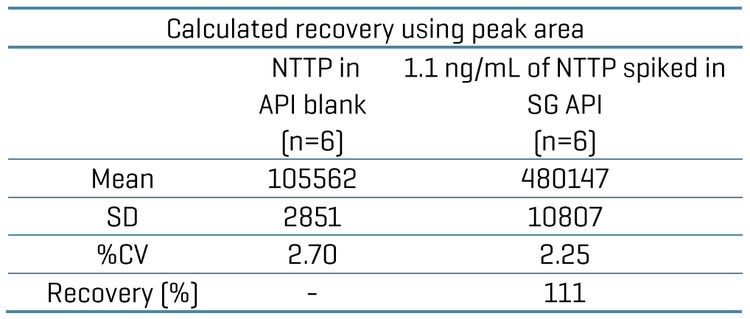
Since NTTP was detected in the SG API (Figure 2), recovery was calculated as the difference between the peak area of NTTP in the control SG API and that in the spiked sample (Table 4). The average recovery for the sample spiked with 1.1 ng/mL NTTP was 111%. Here, the %CV was <3 for the NTTP in the SG API blank and the NTTP spiked in the SG API.
Analytical performance was evaluated based on the criteria that the accuracy of the calculated mean should be between 80% and 120% at the L LOQ and between 85% and 115% at the higher concentrations. In addition, the %CV of the calculated mean of concentration should be <20 at the L LOQ and <15 at all higher concentrations.
The assay accuracy was within ± 9% of the actual concentration, and the %CV was <10 for NTTP. The calculated percentage accuracy and %CV values were within the acceptance criteria at each concentration level (Figure 6).
Conclusions
Quantitation of NTTP
- An LLOQ of 0.008 ng/mL was achieved for the quantitation of NTTP. Good quantitative performance was demonstrated with high accuracy and high reproducibility (%CV <10) for NTTP using the novus V55 system — QTRAP.
- Linearity was achieved at concentrations ranging from 0.008 ng/mL to 1.3 ng/mL with an r2 >0.996 for NTTP.
- Maintain quantitative rigor while reducing operating costs with the novus V55 system, the most compact triple quadrupole mass spectrometer in its class.
Analysis and identification of NTTP in SG API
- NTTP impurity in SG API was identified and verified by comparing the impurity MS/MS spectra with the NTTP standard MS/MS spectra. A library fit of 100% was achieved, demonstrating accurate identification of NTTP in SG API.
- Accurate quantitation with good baseline separation of NTTP in SG API was achieved.
- An average recovery of 111% was achieved with %CV <3 for NTTP, which was analyzed at 1.1 mg/mL at the specification limit.
Streamlined data management
- Easily acquire, process, and visualize results for NDSRI analysis using SCIEX OS software.
- Utilize library matching on SCIEX OS software for seamless identification of unknown NDSRI impurities.
References
- Gallwitz, B. Review of Sitagliptin Phosphate: A Novel Treatment for Type 2 Diabetes. Vascular Health and Risk Management 2007, 3 (2), 203–210.
- Center. FDA works to avoid shortage of sitagliptin. U.S. Food and Drug Administration.
https://www.fda.gov/drugs/drug-safety-and-availability/fda-works-avoid-shortage-sitagliptin-following-detection-nitrosamine-impurity - Center. CDER Nitrosamine Impurity Acceptable Intake Limits. U.S. Food and Drug Administration.
https://www.fda.gov/regulatory-information/search-fda-guidance-documents/cder-nitrosamine-impurity-acceptable-intake-limits - Highlights of prescribing information.
https://www.accessdata.fda.gov/drugsatfda_docs/label/20 19/021995s046lbl.pdf - Goods, T. Established acceptable intake for nitrosamines in medicines. Therapeutic Goods Administration (TGA).
https://www.tga.gov.au/how-we-regulate/monitoringsafety-and-shortages/industry-information-about-specific-safety-alerts-recalls-and-shortages/nitrosamine-impurities-medicines/established-acceptable-intake-nitrosamines-medicines