Rapid and reliable structural confirmation and comprehensive impurity analysis of cyclic peptides
Abstract
This technical note demonstrates the structural confirmation of cyclosporine A (CysA), a representative cyclic peptide drug, and the comprehensive CysA-related impurity analysis. MS-level identification and MS/MS-level structural confirmation, including unexpected impurities, were demonstrated at concentrations as low as 0.01% (w/w) and 0.04% (w/w), respectively. Impurities assigned as isocyclosporine A (IsoCysA) and cyclosporine C (CysC) based on MS and MS/MS fragments were by co-elution and MS/MS comparison with standards.
Development of cyclic peptides is rapidly gaining not only for new therapeutic modality but DDS systems. The sequence confirmation and in-depth impurity analysis are important due to their high specificity. But the analysis is complex because of the molecular size, the cyclic structures, composed isomeric amino acids and various modifications, and lack of processing software.
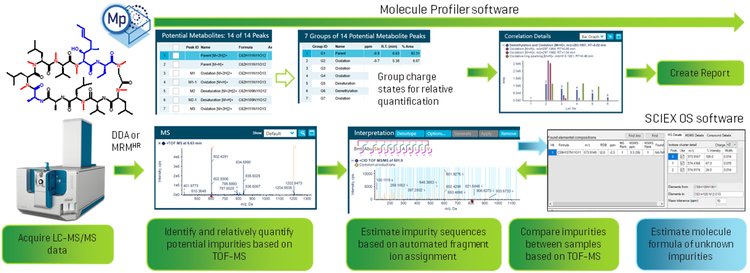
Here, a rapid and sensitive analysis of CysA and related impurities are demonstrated using ZenoTOF 7600+ system with Molecule Profiler software and SCIEX OS software. Sensitive, high-quality MS and MS/MS spectra and Molecule Profiler software enable comprehensive impurity identification and rapid and confident sequencing results.3-6
Key benefits for analysis of cyclic peptides using the ZenoTOF 7600+ system
- Rapid and reliable sequence confirmation of target peptide using fragment assignment: Fragment ions are automatically assigned to the sequence and sequence coverage is calculated. Target peptides can be confirmed not only by accurate mass but also by sequence confidence (e.g., achieving 100% sequence coverage for CysA).
- Enhanced sensitivity and increased confidence in impurity identification: Generate fragment-rich spectra, enabling more confident identification of low-abundant impurities using Zeno trap on the ZenoTOF 7600+ system
- Rapid and comprehensive impurity identification: Search for impurities using a variety of peak search strategies, including software-generated accurate mass lists of potential variations in different charge states, and common product ions and neutral losses with main components in molecule profiler software.
Introduction
- Cyclic peptides are more stable in structure than linear peptides and are rapidly becoming more common not only in new therapies but also in DDS systems.
- Impurity analysis is important to ensure the safety of pharmaceutical products but are complicated for cyclic peptides due to the molecular size, cyclic structure, isomeric amino acids, presence of various modifications and lack of processing software and strong UV absorption.
- MS/MS is a promising approach for analysing small molecule therapeutics, but the size and complex structure of cyclic peptides make it difficult to perform structural analysis.
MS/MS-based peptide sequencing is widely used for protein identification, but the cyclic structures, various synthetic amino acids, modifications and linkers, and lack of processing software make this technique difficult to apply.
Therefore, there is strong demand for methods that can quickly and easily identify impurities of cyclic peptides and confirm their structures. In this technical note, a method using the amino acid analysis mode of the software is demonstrated. By registering the main components as sequences, the detected impurities are also expressed as sequences. Being able to confirm MS/MS analysis from sequence notation rather than complex chemical structures also makes it easier to verify the structures.
Methods
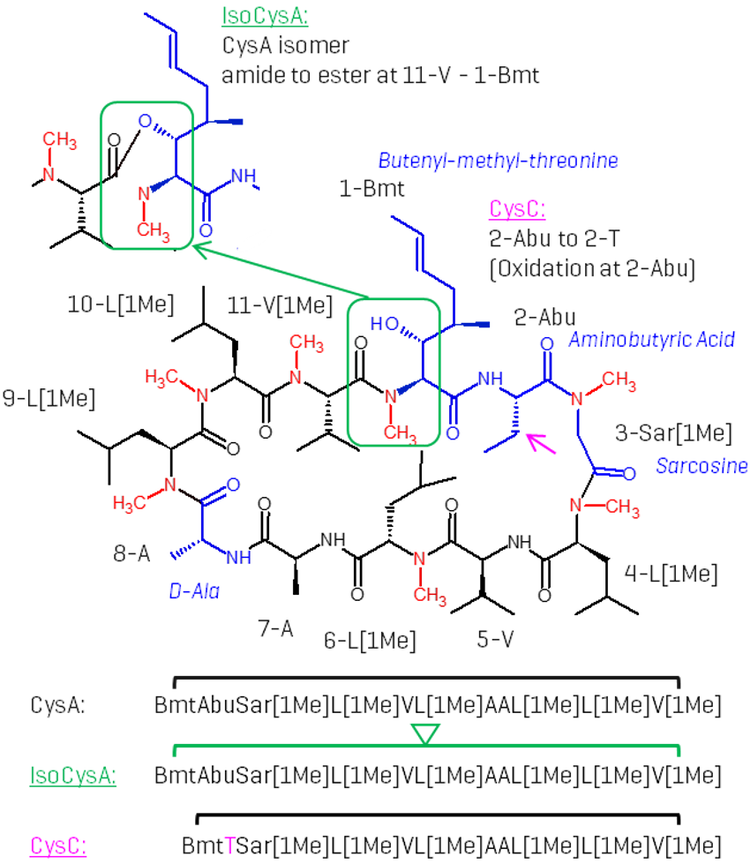
Samples: CysA and the 2 known impurities, the oxidized impurity CysC2 and the isomeric impurity IsoCysA1,2 (Figure 2), as standards for CysA impurities were prepared. The samples were dissolved in 2 mg/mL ethanol, and then 10 µg/mL CysA and 500 ng/mL CysC and IsoCysA were diluted in 50% (v/v) ethanol/water and used for impurity analysis and confirmation, respectively. Samples for co - elution testing of CysC and IsoCysA were prepared by spiking the 10 µg/mL CysA solution with 0.02–10% (w/w, concentrations 2 ng/mL–1 µg/mL) of CysC and IsoCysA.
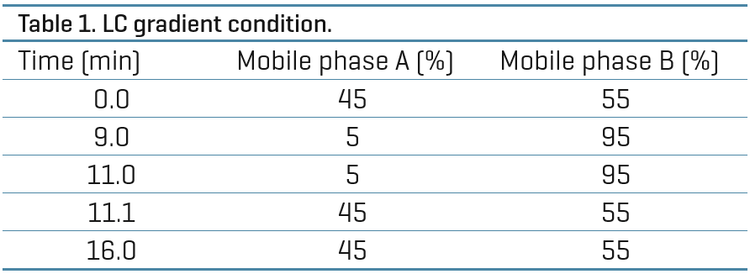
Chromatography: An ExionLC AE system was used with gradient elution using 0.1% (v/v) formic acid in water as mobile phase A and 0.1% (v/v) formic acid in acetonitrile as mobile phase B. Analysis was performed at a flow rate of 0.3 mL/min using a YMC Triart C18 metal-free column (2.1 × 150 mm, 3 µm) at 60ºC. An injection volume of 2 µL was subjected to analysis. The gradient conditions are summarized in Table 1.
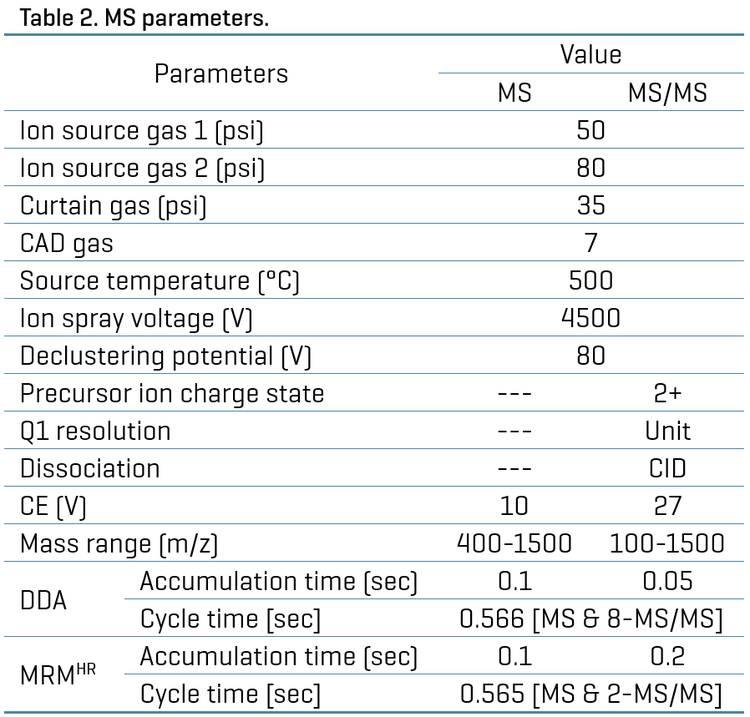
Data processing: Structural confirmation and purity confirmation of CysA, as well as identification, structure assignment, and relative quantitation of impurities were performed using Molecule Profiler software and SCIEX OS software, version 1.3.4. The latest version of molecule profiler (version 1.3.4) officially supports data processing for cyclic peptide analysis.
MS and sequence confirmation and purity check of target compound, CysA
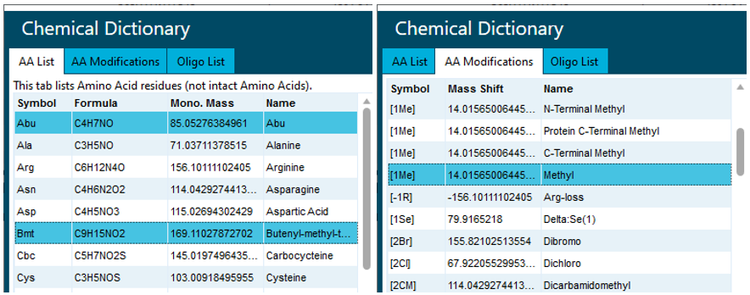
Therapeutic cyclic peptides generally contain modifications, such as N-alkylation, to improve their permeability and stability. The amino acids used for sequence registration, including common modifications, are pre-registered in Molecule Profiler software. User-specific amino acids and modifications can also be freely registered in the chemical dictionary of the software (Figure 3). The software combines the list of possible transformations with the catabolites to create a list of potential impurities for all the specified charge states and searches for the impurities within the list. Additionally, Molecule Profiler software can also search for impurities that produce product ions or neutral losses common to a predefined number of main components (5 in this technical note) as main component-related impurities. Peaks with different charge states from the same impurity can be grouped together and the total area of all detected charge states is calculated. The area % is the total area divided by the total area of all detected impurities in all charge states. By using the amino acid analysis mode of the software and registering the main components as sequences, all components are represented by sequences, making them easy to analyse without the need for structural elucidation from complex chemical structures.
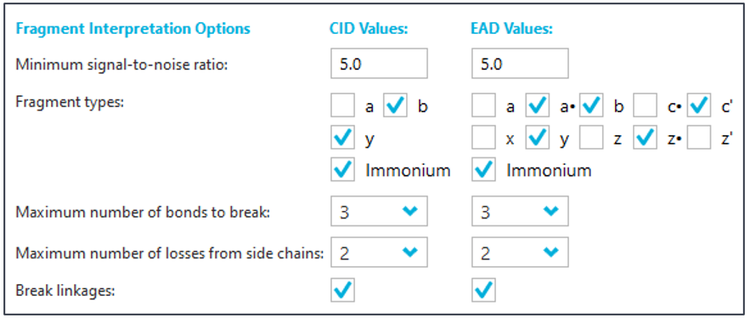
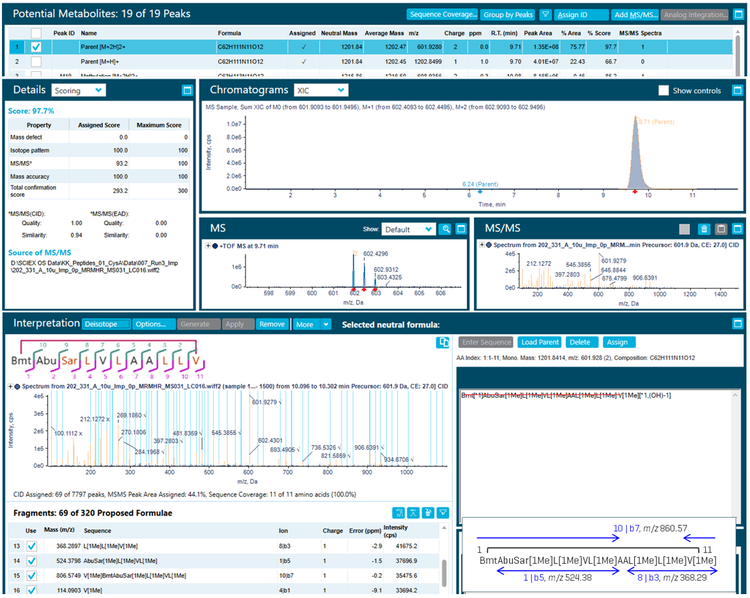
Based on the selected options (Figure 4) and the specified sequence, a list of theoretical fragment ions is generated, MS/MS peaks are assigned based on the list, and sequence coverage is calculated automatically. The assigned fragments are displayed in a table along with their corresponding sequence and ion type. The sequence confirmation of CysA was achieved with 100% (11/11) coverage in this case (Figure 6, bottom).
Impurity profiling
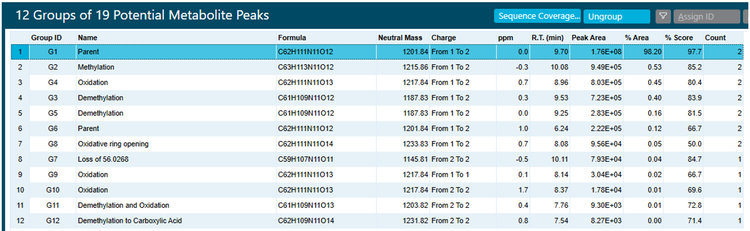
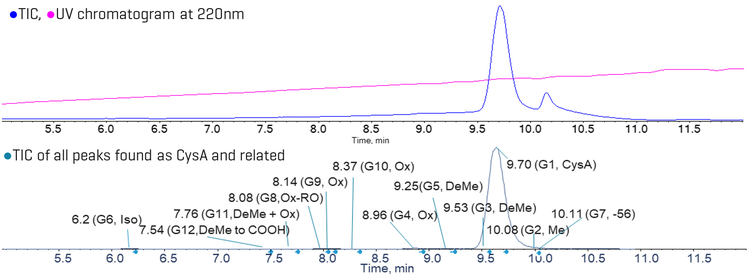
The target compound CysA and the 11 detected impurities are shown in Figure 5 and Figure 7 (bottom). These impurities were detected with high mass accuracy within 2 ppm and high scores above 50%, including a low-level impurity (G12) with a relative intensity of less than 0.01%. These impurities were not detected by UV or TIC (Figure 7, top). MS/MS spectra of the impurities were automatically acquired by DDA, where the fragmentation patterns confirmed that the impurities were related to CysA. Additionally, an unexpected impurity (G7) was detected, resulting in 5 fragments identical to CysA. These results demonstrate that the ZenoTOF 7600+ system can detect and confirm trace-level impurities with high sensitivity and accuracy, enabling comprehensive identification of unexpected impurities. Methylated, demethylated, oxidative, and isomeric impurities were detected as high-abundance impurities, which were in good agreement with the literature information1,2.
Determining modification site of impurities based on CID-MS/MS data
As a further investigation, structural elucidation of methylated (G2), the most intense and oxidized (G4), isomer (G6, detected as parent), and unexpected impurity (G7) were performed using MS/MS data.
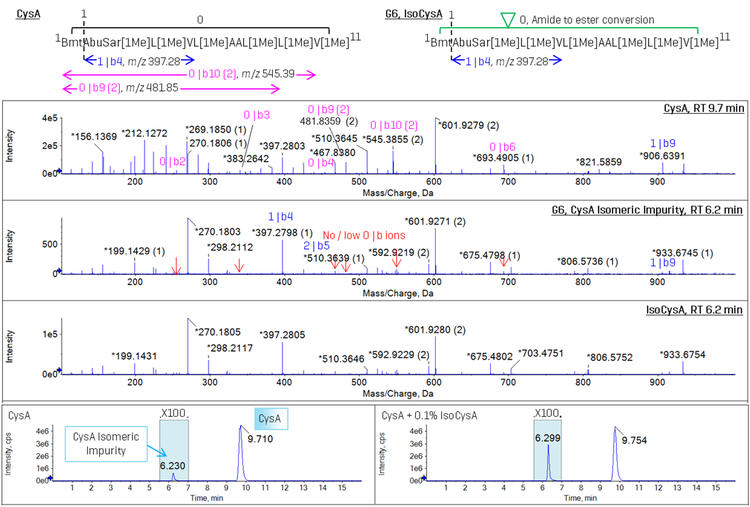
The results of structural analysis of the isomeric impurity (G6) are shown in Figure 9. Comparing the MS/MS spectra of CysA and G6, the strong 0 | b ion series observed in CysA—such as 0 | b9 and 0 | b10—which are derived from cleavage of bond 0 (i.e., the 11-V(1Me)–1-Bmt[_NMe] bond), either disappeared or showed a significant decrease in sensitivity in G6. This suggested that the bond between 11-V(1Me) and 1-Bmt[_NMe] had changed to a different bond that was less susceptible to cleavage. Because the known impurity IsoCysA matched these characteristics, the MS/MS spectrum of impurity G6 was compared with that of IsoCysA. Furthermore, a coelution test was performed by spiking CysA with IsoCysA. Based on the MS/MS spectral match and the coelution test results, G6 was identified as IsoCysA.
The identification of the oxidation site in G4, the most strongly detected oxidized impurity, is shown in Figure 10. A comparison of the MS/MS spectra of CysA and G4 revealed that the intense 0 | b2 ion (m/z 269.1850) and 1 | b5 ion (m/z 510.360) observed for CysA were not detected in G4. Instead, ions at m/z 285.1790 and 526.3583 were detected, consistent with oxidized forms of the 0 | b2 and 1 | b5 ions, respectively. These observations suggest that the Abu residue may be the site of oxidation. Sequence analysis using Molecule Profiler software indicated that Abu is the most likely site of oxidation, which is further supported by the observed b-ion series.

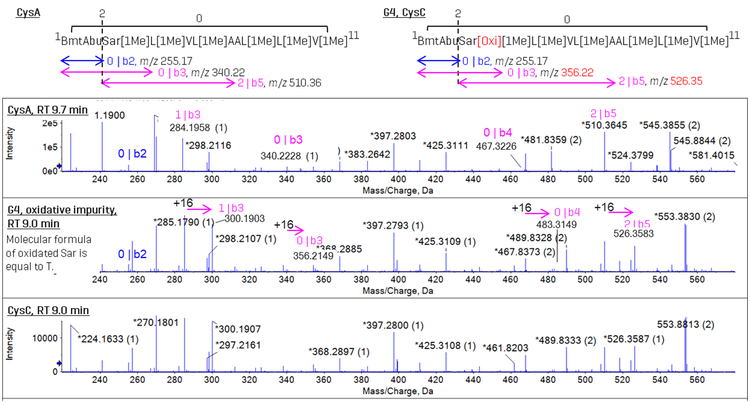
The impurity in which Abu is oxidized is known as CysC. Based on the MS/MS spectral match and the results of the coelution test (data not shown), G4 was identified as CysC.
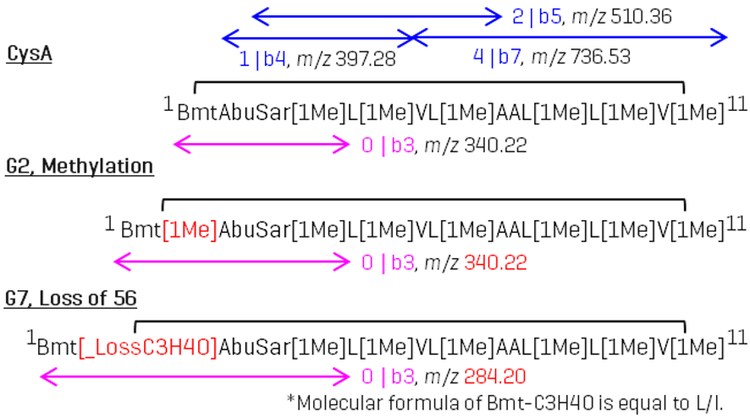
The methylation site in G2 was estimated to be Bmt. The fragment ions at m/z 510.36 and 863.63, assigned as the 1 | b5 and 3 | b8 ions of CysA, were conserved in G2, whereas the fragment ions at m/z 269.19, assigned as the 0 | b2 ions, were detected with a +14Da shift in G2 (see Figure 13; data not shown).
Structure elucidation of unknown impurity
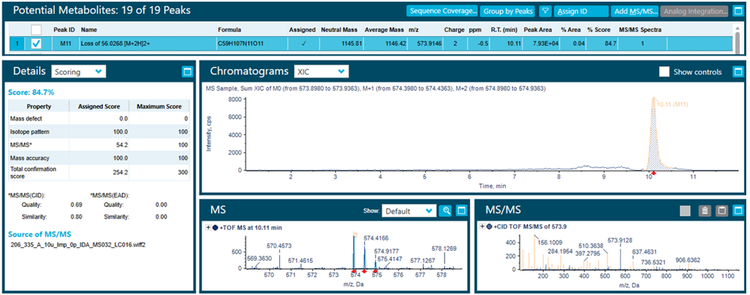
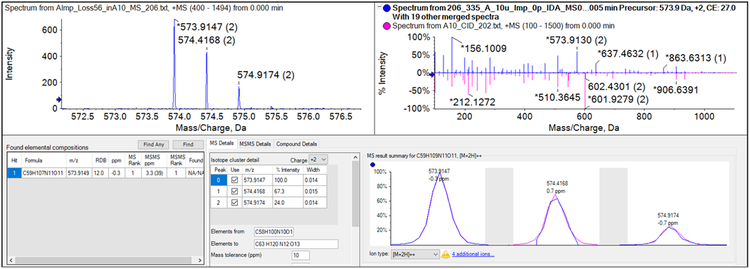
Figure 11 shows the results for the unexpected impurity G7. This impurity was detected as a CysA-related impurity because it generated at least five common product ions with CysA. The MS/MS of G7 was very similar to that of CysA (see the spectrum in the lower right and the score in the lower left of Figure 11). Compositional analysis using SCIEX OS software revealed that G7 was composed of CysA with less C3H4O (Figure 12). Additionally, MS/MS analysis suggested that the modification site was Bmt, as in G2, because, like G2, the fragment ions of CysA at m/z 510.36 and 863.63 were conserved in G7, whereas the fragment ion at 269.19 was shifted by -56 Da (see Figure 13, data not shown).
Comparison of impurities between samples
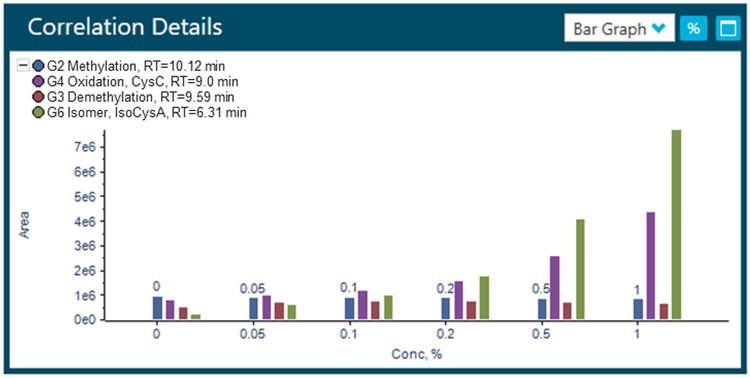
Figure 14 shows an example of impurity profile comparison between samples spiked with CysC (G4) and IsoCysA (G6) at concentrations of 0, 0.05, 0.1, 0.2, 0.5, and 1%. The areas of unspiked impurities G2 (blue) and G3 (red) do not change between samples, while the areas of G4 (purple) and G6 (green) increase with increasing spike concentration, clearly demonstrating the differences in impurity profiles. Molecule Profiler software facilitates impurity profile comparison between samples, supporting time - course analysis and lot management .
Conclusion
- Confirmation of main component, and impurity analysis and profiling of cyclic peptide are shown using the ZenoTOF 7600+ system integrated with Molecule Profiler software and SCIEX OS software .
- Fast MS/MS scanning speed and high MS/MS data quality enhanced using the Zeno trap with the ZenoTOF 7600 + system, allows the identification of even very low abundant impurities.
- Analysing peptides in sequence notation simplifies the workflow, reduces manual effort, and provides clear, interpretable results. This accelerates impurity identification, modification - site localization, and correlation studies such as time - course analyses and lot- to- lot comparisons —all of which can be efficiently performed using the Molecule Profiler software
References
- Bonifacio, F. N., Giocanti, M., Reynier, J. P., Lacarelle, B., & Nicolay, A. (2009). Development and validation of HPLC method for the determination of Cyclosporin A and its impurities in Neoral® capsules and its generic versions. Journal of pharmaceutical and biomedical analysis, 49(2), 540 - 546. doi: 10.1016/j.jpba.2008.11.027.
- Yueling, N. I., Xing, H. A. N., Min, S. O. N. G., & Taijun, H. A. N. G. (2019). Identification of the related substances of cyclosporin A by LC - MS techniques. Journal of China Pharmaceutical University , 50(4), 423- 437. doi: 10.11665/j.issn.1000 -5048.20190407
- Karasawa, K., Rapid and comprehensive metabolite identification of cyclic peptides. SCIEX technical note MKT-35513- A.
- Baghla R., Galermo E., & Zhang Z., Empowering peptide catabolite discovery: software - aided orthogonal fragmentation analysis on the ZenoTOF 7600 system with Molecule Profiler software. SCIEX technical note MKT- 32184 -A.
- Van Soest, R ., Pohl K., Zou Y., & Jones E., Characterization of oligonucleotides and related impurities to support the development of drug substances. SCIEX technical note RUO -MKT- 02- 13263-A.
- Baghla R., Selen E., Causon J., Galermo E., & Zhang Z., Breaking the limits_ An ultra- sensitive complementary fragmentation for confident identification and characterization of drug metabolites. SCIEX technical note MKT-34517-A.