Abstract
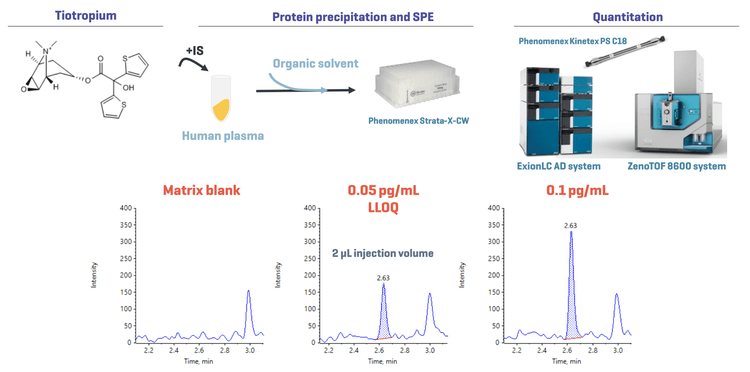
This technical note demonstrates a sensitive quantitation workflow for tiotropium, a long- acting bronchodilator, in human plasma on the ZenoTOF 8600 system. A lower limit of quantitation (LLOQ) was reached at 0.05 pg/mL using a solid phase extraction (SPE) method in a 96-well format (Figure 1).
Tiotropium is an inhaled long-acting muscarinic antagonist used for maintenance treatment of obstructive airway diseases. Despite its favorable positive-ion MS response as a permanently charged quaternary ammonium compound, bioanalysis remains challenging due to its low systemic exposure2 and poor chromatographic behavior.3 Reliable characterization of the pharmacokinetic profile requires the quantitation of tiotropium at sub-pg/mL concentrations, particularly at later time points when circulating drug levels rapidly approach the quantitation limit.2
Key benefits or tiotropium quantitation using the ZenoTOF 8600 system
- Low level of quantitation: Reach an LLOQas low as 0.05 pg/mL in human plasma using the ZenoTOF 8600 system
- Robust analytical performance: Achieve accurate and highly reproducible (%CV <6) quantitative performance at all concentration levels
- Streamlined data management: Easily acquire, manage, and process data using SCIEX OS software, a 21 CFR Part 11-compliant platform
Introduction
Tiotropium is administered as an inhaled therapy, resulting in low pg/mL systemic plasma exposure. As plasma concentrations can decline rapidly after dosing, insufficient low-end sensitivity can lead to missing or poorly defined PK time points, limiting accurate characterization of exposure, elimination, and bioequivalence.2,4 Despite favorable ionization behavior associated with its permanently charged quaternary ammonium structure, tiotropium remains challenging to quantify at sub-pg/mL levels due to chromatographic and matrix-related challenges . At these concentrations, chromatographic performance becomes critical because poor retention, peak broadening, matrix interference, nonspecific adsorption or carryover can directly compromise sensitivity, reproducibility, and quantitative accuracy. Therefore, sensitive and robust LC-MS methods are required to achieve sub-pg/mL level LLOQs for reliable pharmacokinetic characterizatio n in complex biological matrices.
Efficient sample cleanup is critical for bioanalysis requiring sub-pg/mL sensitivity. In this workflow, WCX SPE was used to isolate tiotropium from human plasma through cation-exchange interaction between its permanently charged quaternary ammonium group and the carboxylate sites of the WCX sorbent. This selective retention enables strong organic washes for matrix cleanup, while acidic elution disrupts the ion-exchange interaction , thereby supporting efficient recovery.
A Phenomenex Kinetex PS C18 column was selected to improve chromatographic performance for tiotropium. The C18 phase provides reversed-phase retention, while the positively modified surface helps minimize secondary interactions between cationic tiotropium and negatively charged sites on the stationary phase. Reducing these interactions supports improved peak shape, reproducibility and carryover performance, which are critical for reliable sub-pg/mL quantitation.
The HRMS-based workflow plays a critical role in addressing matrix-related selectivity challenges that can remain even after SPE cleanup and chromatographic optimization. High mass resolution and accurate-mass detection enhance selectivity by enabling better differentiation of the analyte from co-eluting matrix components. This capability is especially valuable for reliable low-level quantitation in complex biological matrices, making HRMS an increasingly attractive option for quantitative bioanalysis in challenging matrices. The ZenoTOF 8600 system provides the selectivity needed to distinguish tiotropium from endogenous interferences in human plasma. Improved frontend design enhances sensitivity through efficient ion generation, capture, and transmission, while advanced TOF optics support robust detection across a wide concentration range.1 Together, these workflow elements enable reliable quantitation of tiotropium in human plasma across 3.6 orders of magnitude, with an LLOQ of 0.05 pg/mL.
Methods
Commercially available tiotropium bromide and ipratropium bromide monohydrate (IS) were reconstituted in DMSO and diluted in 70:30 (v/v) methanol:water containing 2% formic acid. Tiotropium was spiked into 100 μL of human plasma at concentrations ranging from 0.05 pg/mL to 200 pg/mL. Ipratropium was used as an internal standard and was spiked at 10 pg. Protein precipitation was performed using 200 μL of methanol. Supernatant was diluted with water (pH 6.5) to reach a final 15% organic content before loading on the Phenomenex WCX microelution SPE plate. The plate was activated and equilibrated with methanol and water (pH 6.5), respectively. Wells were washed with water (pH 6.5), then with 100% methanol. Elution was performed using methanol containing 5% formic acid. Eluents were dried under a nitrogen flow at 40°C and reconstituted in 50 µL of 1% formic acid in methanol and diluted in 50 µL of water.
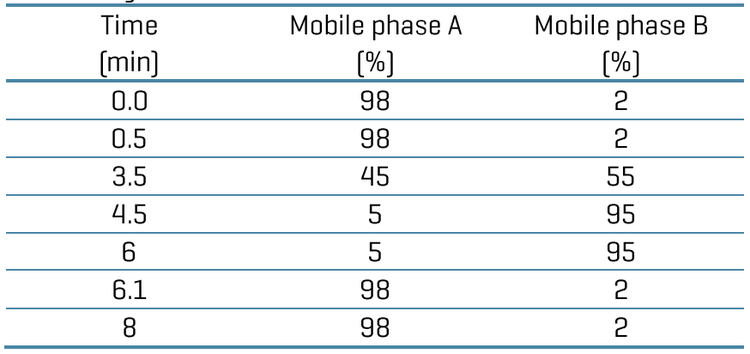
Chromatography: Sample separation was performed using an ExionLC AD system (SCIEX) at a flow rate of 0.4 mL/min on a Phenomenex Kinetex PS C18 column (2.1 x 50 mm, 2.6 µm, 100 Å). The column temperature was maintained at 55°C. An 8-minute gradient was run using 0.1% formic acid in water as mobile phase A and 0.1% formic acid in acetonitrile as mobile phase B (Table 1). An injection volume of 2 µL was used for analysis. A 1:1:1 (v/v/v) acetonitrile/methanol/water containing 0.02% difluoroacetic acid (DFA) was used as the needle wash solvent.
Quantitation of tiotropium on the ZenoTOF 8600 system
This technical note demonstrates streamlined sample preparation and sensitive quantitation of tiotropium in human plasma using the ZenoTOF 8600 system. An LLOQ was reached at 0.05 pg/mL for tiotropium. No interferences were observed in the human plasma matrix blank (Figure 1).
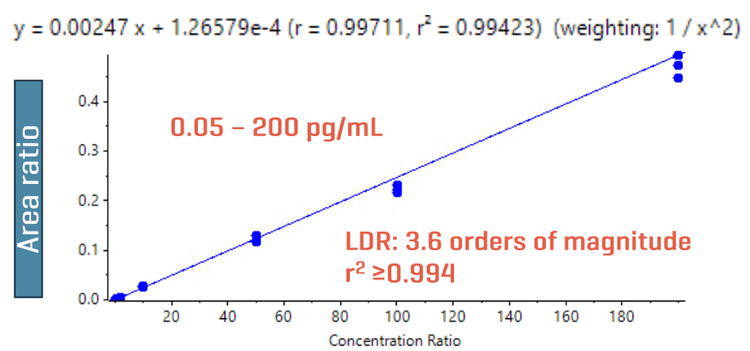
The calibration range for tiotropium was between 0.05 and 200 pg/mL (Figure 2). Linearity was achieved with a coefficient of determination (r2) of ≥0.994, across a linear dynamic range (LDR) of 3.6 orders of magnitude.
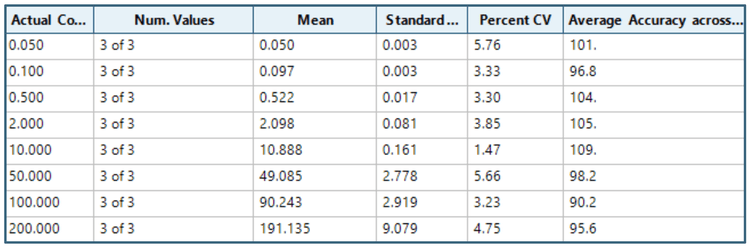
Analytical performance was evaluated for accuracy and precision. The accuracy of the calculated mean was expected to be between 80% and 120% at the LLOQ and between 85% and 115% at higher concentrations. The %CV of the calculated mean for each concentration was expected to be <20% at the LLOQ.5
Compliance-ready SCIEX OS software
Equivalent SCIEX OS software capabilities for small molecule analysis can be executed on the ZenoTOF 8600 system, ensuring high fidelity when performing method transfers while retaining critical compliance features.
SCIEX OS software is a closed system and requires records and signatures to be stored electronically, meeting the regulations outlined by 21 CFR Part 11. SCIEX OS software can open raw data files from any visible storage location within a closed network by using designated processing workstations.
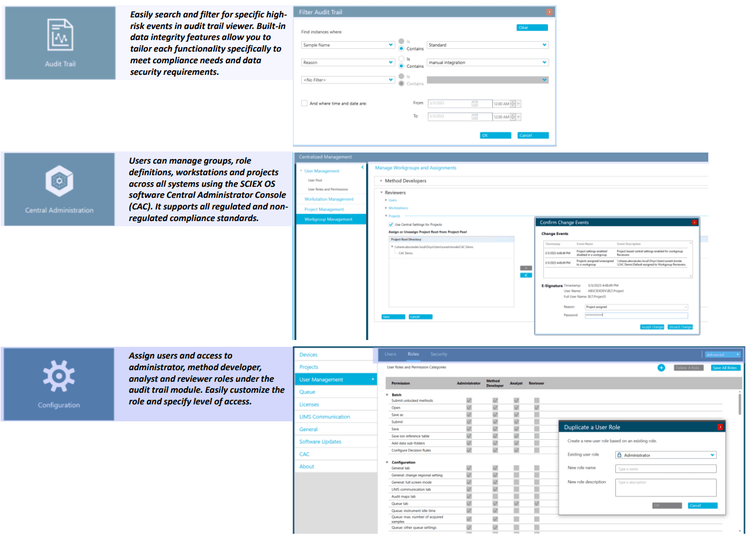
Figure 4 illustrates the features of SCIEX OS software used to monitor the audit trail, acquire and process data, and configure user access. The audit trail feature enables users to audit critical user actions and locks in data integrity.
The Central Administrator Console (CAC) feature allows users to centralize acquisition and processing using a single platform to maximize efficiency for multi-instrument laboratories, independent of compliance standards. The configuration module allows users to assign roles and access as the administrator, method developer, analyst, and reviewer.
Conclusions
- Sensitive tiotropium quantitation was achieved with an LLOQ of 0.05 pg/mL using only a 2 µL injection volume on the ZenoTOF 8600 system
- Linearity was demonstrated across 0.05 to 200 pg/mL, resulting in a wide LDR of 3.6 orders of magnitude (r2 ≥0.994)
- Robust sample preparation and conventional chromatography, paired with the inherent selectivity of the ZenoTOF 8600 system, supported reliable tiotropium quantitation in human plasma at sub-pg/mL levels
- Accurate and highly reproducible tiotropium quantitation in human plasma was demonstrated on the ZenoTOF 8600 system, with %CV <6 across all concentration levels
- Data management and compliance-readiness (21 CFR Part 11) features were shown using the SCIEX OS software to support small molecule quantitation on the ZenoTOF 8600 system
References
- Transforming small molecule quantitative sensitivity with a novel quadrupole time-of-flight mass spectrometer. SCIEX technical note, MKT-33827-A.
- Trancart M, Penot M, Meesemaecker G, Boffy R, Hanak AS, Calas AG, Taudon N. Quantitative Analysis of Muscarinic Antagonist Atropine and Tiotropium in Microvolume Plasma Using Liquid Chromatography-Mass Spectrometry: Application for Pharmacokinetic Studies. J Anal Methods Chem. 2025 Apr 8;2025:9923229..
- Chi J., Li F., Jenkins R. Ultrasensitive sub-pg/mL determination of tiotropium bromide in human plasma by 2D-UHPLC-MS/MS: challenges and solutions. Bioanalysis .2016;8(5):385-95.
- Hohlfeld JM, Sharma A, van Noord JA, Cornelissen PJ, Derom E, Towse L, Peterkin V, Disse B. Pharmacokinetics and pharmacodynamics of tiotropium solution and tiotropium powder in chronic obstructive pulmonary disease. J Clin Pharmacol. 2014 Apr;54(4):405-14
- Q2(R1) Validation of Analytical Procedures: Text and Methodology Guidance for Industry.