Abstract
Protein aggregation reduces the purity and efficacy of biotherapeutics, increasing the risk of immunogenicity in patients.1,2 The analysis of these aggregates is challenging due to their low abundance, large size and the presence of non-covalent interactions. This technical note highlights the capabilities of an enhanced native size-exclusion chromatography-mass spectrometry (SEC -MS) workflow for sensitive detection and rapid quantitative assessment of aggregates in bispecific antibody (bsAb) samples from different clones or a forced degradation study (Figure 1). The aggregate profiles from native SEC-MS analysis can help select the clones possessing the highest quality when combined with expression and cell culture data.
Native SEC-MS is a powerful approach for intact mass analysis of non-covalently bound molecules, such as Cys-linked antibody-drug conjugates (ADCs), protein complexes and aggregates, under non-denaturing conditions.3- 6 Traditional native SEC-MS workflows suffer from low sensitivity and hence require a high sample load.5 The ZenoTOF 8600 system addresses this challenge with hardware improvements that lead to MS sensitivity increase with reduced sample consumption.6,7 In addition, this system provides soft source conditions to minimize the gas-phase fragmentation of the non- covalent assemblies, such as Cys -linked ADCs and aggregates.7
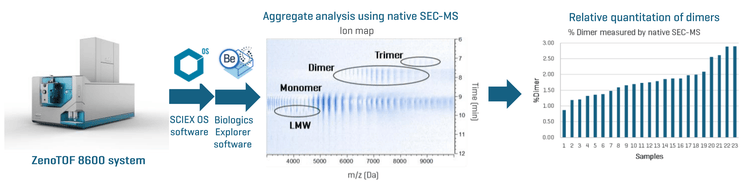
Key benefits of the enhanced native SEC-MS workflow for aggregate analysis
- High sensitivity: MS sensitivity gain leads to enhanced native MS analysis of intact biotherapeutics with reduced sample consumption
- Preservation of non-covalent interactions: The workflow employs soft chromatographic and source condition s to preserve non-covalent interactions in aggregates for accurate mass measurement
- Rapid impurity assessment: The enhanced MS sensitivity and the preservation of non- covalent interactions enable rapid assessment of aggregate level in biotherapeutics
- Streamlined: The enhanced native MS workflow is streamlined from data acquisition using SCIEX OS software to automatic data analysis using intuitive Biologics Explorer software
Introduction
Aggregation of protein therapeutics can reduce drug purity and efficacy, increasing the risk of immunogenicity in patients.1,2 It is important to measure, monitor and control the level of aggregation in antibody development and manufacturing to ensure the safety and efficacy of biotherapeutics.
Aggregate analysis using LC-MS based approaches is challenging due to the low abundance, large size, and noncovalent assembly of the aggregates. Native MS is an effective approach for aggregate analysis due to its ability to preserve non-covalent interactions under non-denaturing conditions.3-6 However, traditional native SEC-MS workflows require high MS sensitivity and high sample consumption.5 In this work, the high MS sensitivity capabilities offered by the ZenoTOF 8600 system were leveraged to detect and quantify aggregates in bsAb samples from different clones and a forced degradation study.
Methods
Sample preparation: ~5 µg of bsAb samples from 23 different clones or a forced degradation study were analyzed using native SEC-MS without further purification. A bsAb reference material was used in the forced degradation study. The thermally stressed sample was prepared by incubating the bsAb in 100 mM sodium acetate ( pH 3.5) at 47°C for 2 weeks.
Size- exclusion chromatography (SEC): Native SEC separation was conducted using a Phenomenex Biozen dSEC - 2 column (150 x 2.1 mm, 1.8 µm) with an isocratic gradient. The mobile phase consists of 100 mM ammonium acetate. The total run time was 15 minutes with a flow rate of 0.15 mL/min.
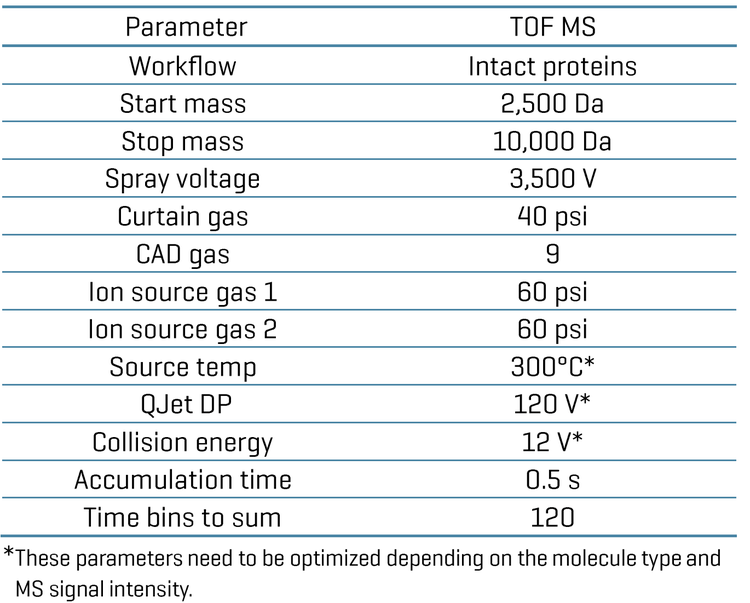
Mass spectrometry: The native SEC-MS data were acquired using the ZenoTOF 8600 system (SCIEX). The key source and TOF MS settings are shown in Table 1.
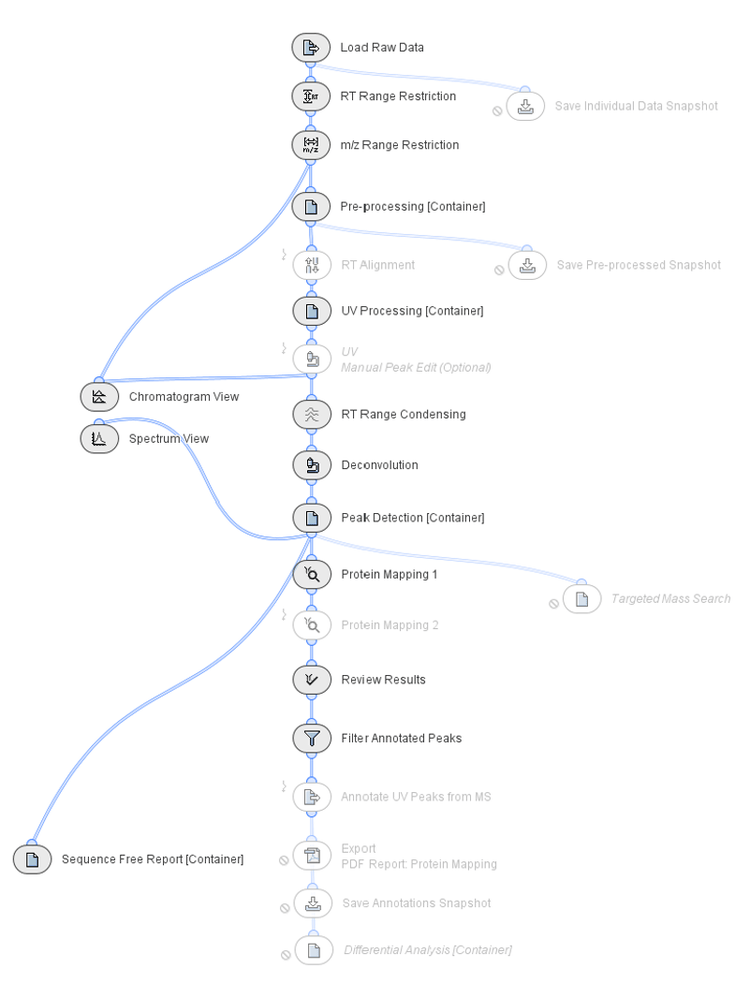
Data analysis: The data were interpreted using the Bio Tool Kit within SCIEX OS software (SCIEX) and an intact protein analysis workflow (Figure 2) within Biologics Explorer software (SCIEX ). Relative quantitation of the dimer was performed by dividing the peak area from the extracted ion chromatograms (XICs) of the dimer by the total peak area of the monomer and dimer.
Sensitive detection of HMW and LMW species
In this work, the enhanced native SEC -MS workflow was leveraged to assess the aggregate level in the bsAbs from 23 different clones (Sample 1-23).
Figure 3 shows the representative native SEC-MS data of Sample 1 and Sample 23 with a low and high level of aggregates, respectively. The total ion chromatograms (TICs, Figures 3A and 3D), ion maps (Figures 3B and 3E) and mass spectra (Figures 3C and 3F) revealed an increased level of HMW species, including dimer and trimer, in Sample 23 compared to Sample 1. The ion map within Biologics Explorer software offers excellent visualization of the HMW and LMW species detected in these bsAbs samples, enabling rapid impurity and aggregate assessment. The relative abundances of the dimer in Samples 1 and 23 were estimat ed to be ~0.9% and ~2.9%, respectively (Figures 3C and 3F).
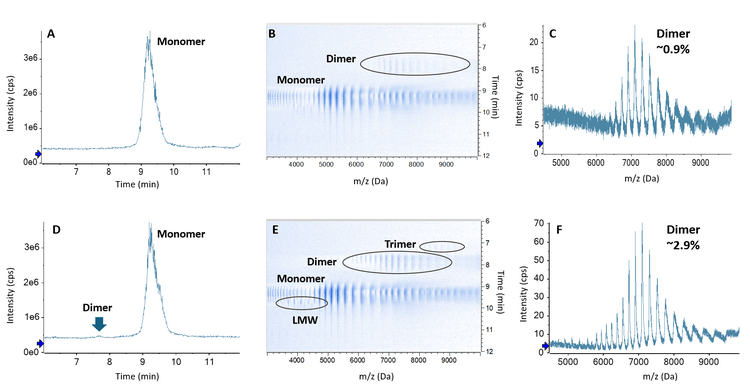
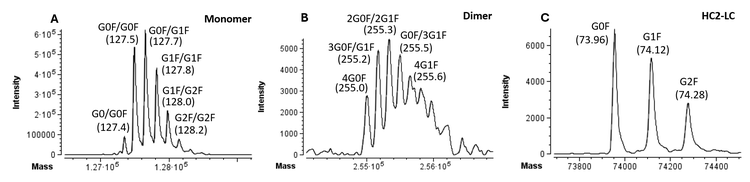
Figure 4 shows the deconvolution spectra of the monomer, dimer and HC2-LC−a LMW species−detected in Sample 23 using Biologics Explorer software. The measured masses of these species , e.g. 127.5 kDa for 2G0F of the monomer, 255.0 kDa for 4G0F of the dimer and 73.96 kDa for G0F of HC2-LC, confirmed the identities of these species.
Relative quantitation of aggregates
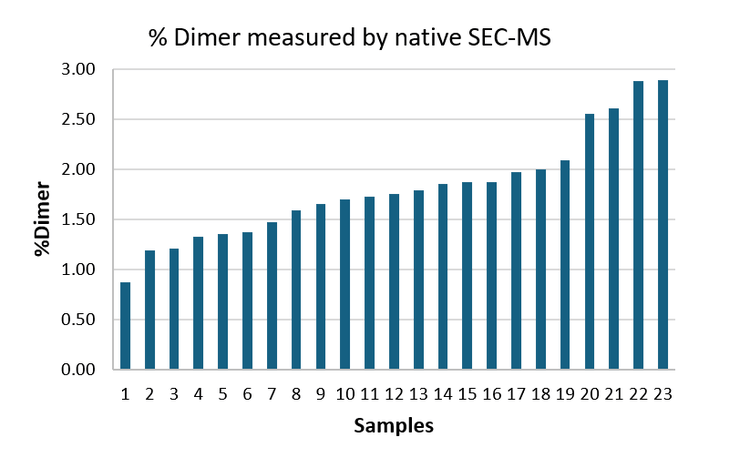
Relative levels of the dimer in the bsAb samples from 23 clones were determined by dividing the summed peak area of the XICs of the dimer by the total peak area of the monomer and dimer. The calculated percentages of the dimer (%Dimer) range from ~1% to ~3%, indicating different propensity of aggregation of the bsAbs from different clones (Figure 5). When combined with expression and cell culture data , such as viable cell density (VCD) and viability, the aggregate profiles obtained using native SEC -MS may help choose the clones possessing the highest quality.
Forced degradation study
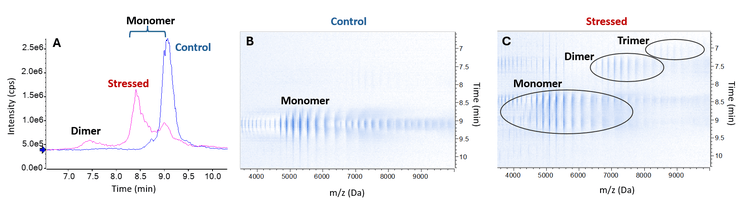
Native SEC-MS was employed to study the impact of thermal stress on the aggregation of the bsAb. Native SEC -MS analysis of the control sample revealed a negligible level of dimer (blue trace in Figure 6A and the ion map shown in Figure 6B). A significant increase in the level of dimer (~7%) was detected in the thermally stressed bsAb sample (pink trace in Figure 6A and ion map shown in Figure 6C), indicating accelerated aggregation under thermal and low pH conditions. Interestingly, thermal stress of the bs Ab led to the detection of 2 SEC peaks for the monomer (pink trace in Figure 6A). The presence of the early-eluting peak may be explained by structural changes of the bsAb from a globular shape to a more extended form with an apparent larger size than the native species. These results demonstrate that native SEC-MS is a powerful approach not only for rapid aggregate analysis and impurity assessment of biotherapeutics, but it may also provide insights into structural changes caused by forced degradation.
Conclusions
- Sensitive detection and rapid analysis of aggregates in bsAbs using the enhanced native SEC-MS workflowon the ZenoTOF 8600 system
- Relative quantitation of the dimer in the bsAbs from 23 clones revealed a broad range of %Dimer (~1 -3%), indicating different propensity of aggregation for these bsAbs, providing valuable information for clone selection
- The enhanced native SEC-MS can be a viable approach for rapid aggregate analysis, impurity assessment, and study of structural changes induced by forced degradation
- The native SEC -MS workflow is streamlined from data acquisition to result visualization using the ZenoTOF 8600 system coupled with SCIEX OS software and Biologics Explorer software
References
- Lundahl, M. L. E. et al. (2021). Aggregation of protein therapeutics enhances their immunogenicity: causes and mitigation strategies. RSC chem. Biol. 2(4), 1004–1020.
- Pang, K. T. et al. (2023) Understanding and controlling the molecular mechanisms of protein aggregation in mAb therapeutics. Biotech. Adv. 67: 108192.
- MojumdarA. et al. (2024) Advances in mass spectrometry‑based approaches for characterizing monoclonal antibodies: resolving structural complexity and analytical challenges. J. Anal. Sci. Tech. 15: 23.
- Karch K. R. et al. (2022). Native mass spectrometry: recent progress and remaining challenges Annual Rev. Biophys. 51, 157-179.
- In-depth characterization of monoclonal antibodies and antibody-drug conjugates using native and middle-down mass spectrometry. SCIEX technical note, MKT-31742-A.
- Native mass spectrometry analysis of biotherapeutics and aggregates with enhanced sensitivity. SCIEX technical note, MKT-36146-A.
- Enhanced sensitivity of intact LC MS approaches to expand the capability of biotherapeutic analysis. SCIEX technical note, MKT-35364-A.