Abstract
This technical note presents a comparative analysis of the 3 detection modes available on the BioPhase 8800 system—UV, laser-induced fluorescence (LIF), and native fluorescence (NF)—applied to the CE-SDS lightning separation method. The evaluation includes reduced infliximab (Figure 1) and non-reduced NISTmAb (Figure 2).
Key learning points
- Lightning CE-SDS separation method on the BioPhase 8800 system is compatible with UV, LIF, and NF detection
- Greater sensitivity and improved baseline observed in NF and LIF detection modes allow for better integration of low abundance species compared to UV
- NF offers a simpler sample prep, no fluorescence dye bias/optimization needed
- Expected minor impurity species observed in UV and LIF detection were also observed with NF detection
- Lightning CE-SDS is up to 1.5× faster than the original SCIEX CE-SDS workflow, enabling 192 IgG standard injections in 14 hours (reduced) or 18 hours (non-reduced)
Introduction
Early-stage drug development involves screening hundreds to thousands of candidate molecules, creating a significant demand for analytical workflows with fast turnaround times and high data reliability to enable data-driven decision making. Robust analytical platforms with rapid separation methods and multiplexing capabilities are essential to address this challenge. Capillary electrophoresis–sodium dodecyl sulfate (CE-SDS) remains the gold-standard technique for assessing drug purity, structural integrity, and stability as selection criteria for candidates and process parameter optimization.
Two validated CE-SDS workflows are available on the BioPhase 8800 system: CE-SDS and Lightning CE-SDS. The key difference is the pre-injection capillary rinse sequence—CE-SDS uses longer, more conservative rinsing steps, while Lightning CE-SDS uses shorter steps. This reduced conditioning time makes the Lightning method approximately 1.5× faster than the standard CE-SDS workflow. The Lightning method is compatible with UV, LIF, and NF detection modes and can analyze 192 reduced IgG samples in approximately 14 hours.1,2
The purpose of this study is to compare the UV, LIF and NF detection modes for CE-SDS and determine the suitability of NF for early development high-throughput CE-SDS analysis.
Materials
he BioPhase CE-SDS Protein Analysis Kit (P/N: C30085), the BioPhase BFS capillary cartridge - 8 x 30 cm (P/N 5080121), BioPhase sample and reagent plates (4,4,8) (P/N 5080311), NISTmAb (P/N 5089359) and the pre-assembled bare-fused silica capillary cartridge (P/N A55625) were from SCIEX (Marlborough, MA). The β-mercaptoethanol (β-ME) (P/N: M3148-25ML), Iodoacetamide (IAM) (P/N A3221) and Chromeo P503 dye (P/N 30693) were obtained from Sigma-Millipore. Infliximab was purchased from Myonex (Horsham, PA).
Sample preparation for UV or NF detection: Take 10 mL of a 10 mg/mL NISTmAb or infliximab and mix with 90 mL of sample buffer, add 2 mL of the 10 kDa Internal Standard and 5 mL of β-ME for reduced condition or 5 mL of 250 mM of IAM for non-reduced condition. The mixture was incubated at 70°C for 10 minutes.
Sample preparation for LIF detection: Chromeo P503 dye stock solution preparation: Add 200 µL reagent-grade methanol to lyophilized Chromeo P503 (1 mg) to make a 5 mg/mL stock solution. Make 10 µL aliquot and store at -20°C. This makes a 5 mg/mL solution.
Chromeo P503 dye working solution preparation: Take one 5 mg/mL aliquot from the freezer and dilute in water to make a 1 mg/mL solution and keep in the dark until use.
Preparation of labeled reduced infliximab: Take 10 µL of a 10 mg/mL of infliximab and mix with 90 µL of sample buffer and 5 µL of β-ME. Incubate at 70°C for 10 minutes.
To the reduced sample add 2 µL of Chromeo P503 dye working solution and incubate for 10 min at 70°C.
Take 10 µL of the reduced sample and add 45 µL of double-deionized water and incubate in the dark for 5 minutes to stop the reaction.
Finally, add 45 µL of sample buffer prior to CE separation.
Preparation of labeled non-reduced NISTmAb: The non-reduced NISTmAb sample was prepared similarly to the labeled reduced sample, except the reducing agent was replaced by the alkylating solution – 250mM IAM.
Capillary electrophoresis instrument: The BioPhase 8800 system (P/N: 5314860) equipped with UV, LIF and NF was from SCIEX (Marlborough, MA). The BioPhase 8800 system and the BioPhase 8800 software, version 1.5 e-license, were used to create methods and sequences for data acquisition and analysis.
Instrument methods: Lightning CE-SDS separation for the BioPhase 8800 system was used as described in the application guide and can be downloaded at SCIEX.com/support.
Discussion
Instrument methods conditions used in UV, NF and LIF detection modes are identical
Table 1 shows that the core separation conditions are identical across the 3 modes of detection available on the BioPhase 8800 system. This is critical to maintain the same data quality, reproducibility, and robustness of the traditional CE-SDS method with a significantly higher throughput.
The lightning CE-SDS method,1 similar to the traditional CE-SDS method, offers a highly reproducible method under both reduced and non-reduced samples with a higher throughput.
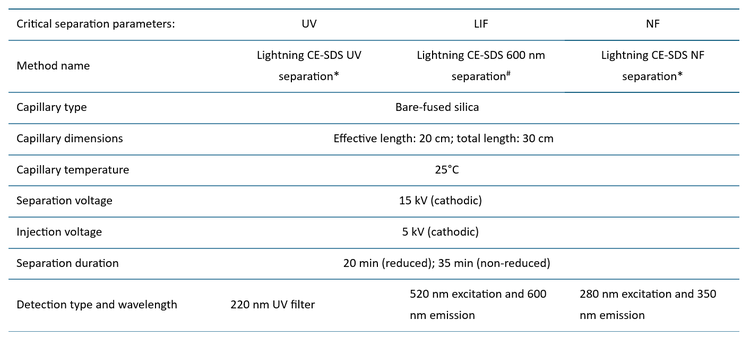
*Methods available at SCIEX.com/ #Lightning CE-SDS LIF separation method is in the material section.
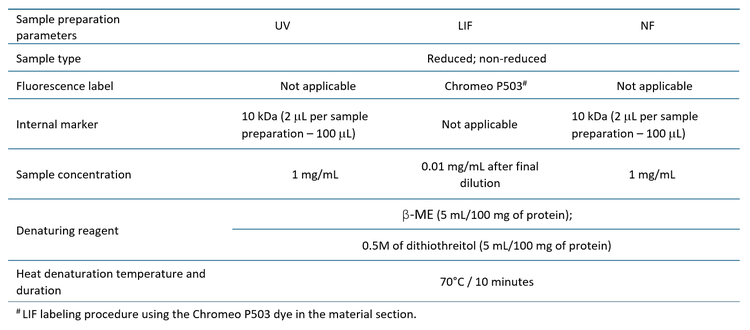
Table 2 shows the sample preparation conditions for the lightning method. The sample preparation is the same for UV and NF detection schemes, and a separate labeling step is required for LIF detection (see material section).
Separation profile comparability of reduced infliximab and non-reduced NISTmAb using UV, NF and LIF detection modes
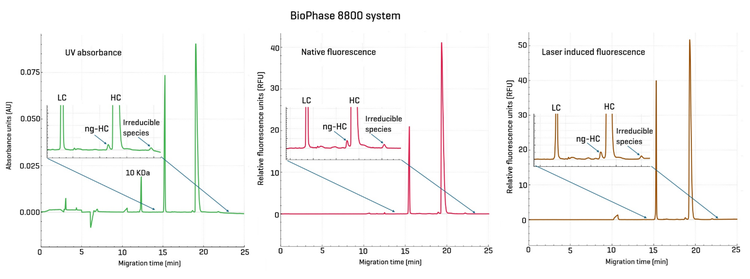
Figure 1 compares the reduced infliximab separation profiles obtained on the BioPhase 8800 system using UV, LIF and NF detection with the lightning CE-SDS method. The insets demonstrate the major differences between these 3 detection modes are associated with the baseline noise. The expected clipped products migrating between the LC and HC, as well as the irreducible species migrating after the HC were observed in all three detection modes.
Similarly, Figure 2 shows the non-reduced NISTmAb separation profiles obtained on the BioPhase 8800 system using UV, LIF and NF detection with the lightning CE-SDS method. The minor species typically found under non-reducing conditions such as LC, HC, heavy-light chain (HL), heavy-heavy chain (HH) and heavy-heavy-light chain (HHL) were observed in all three detection modes. Consistently with the separation obtained under reduced conditions (Figure 1), the insets in Figure 2 show a significant improvement in the baseline noise observed for the LIF and NF detection.
As expected, the measured root mean square (RMS) noise is the lowest for the separations obtained using NF and LIF detection (0.016 and 0.0021, respectively) and highest for UV detection at 12.656. The RMS noise under non-reduced conditions was 0.0013 for NFD, 0.002 for LIF and 3.7839 for UV detection. Consequently, peak integration and quantitation, of the lower abundance species observed under reduced (Figure 1) and non-reduced conditions (Figure 2), is faster, more reliable and reproducible using LIF or NF detection.
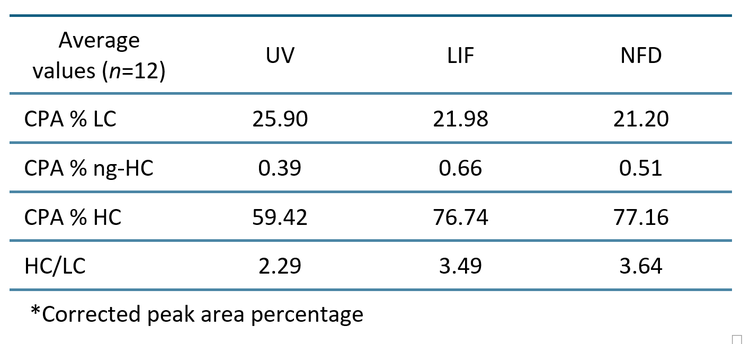
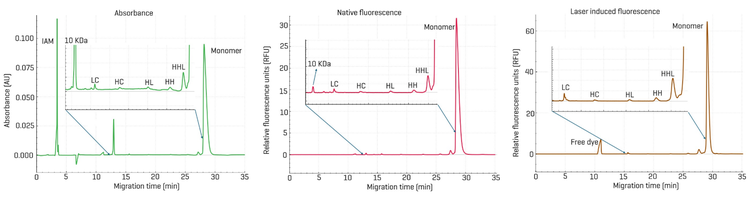
Table 3 summarizes the critical quality attributes for infliximab under reduced conditions, namely the corrected peak area percentage (CPA%) for LC, ng-HC and HC and the HC/LC ratios for UV, LIF and NF. The results highlight the consistency between NFD and LIF but are distinct from UV detection. These differences stem from the different physico-chemical mechanisms that underline each technique. UV detection at 220 nm measures the strong absorbance of peptide bonds, a feature shared broadly across protein species. In contrast, LIF signal intensity depends on the fluorescence dye quantum yield and the number of accessible primary amines available for labeling – Lysine (Lys), which can differ across protein fragments. Native fluorescence (NF) detection is governed by the intrinsic fluorescence of aromatic residues, especially tryptophan (Trp), within each analyte.
Because LIF and NF rely on molecular characteristics that vary from one protein fragment to another, these approaches do not provide the uniform response that UV absorbance offers across diverse analytes.
Purity analysis
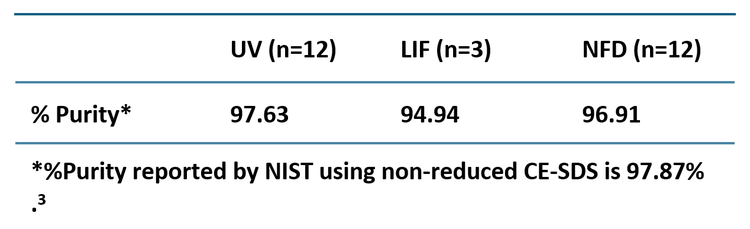
Table 4 shows the purity and CPA% of impurities for NISTmAb under non-reducing conditions. The average purity values of non-reduced NISTmAb obtained using the lightning CE-SDS separation method on the BioPhase 8800 system show close agreement across detection modes. Most notably, the purity using UV detection is very close to that reported by NIST.3 As expected, with NF and LIF the purity numbers are lower for higher sensitivity methods because of the ability to detect and integrate more accurately lower abundance impurity species.
LC to HC ratio and signal normalization to correlate detector response4
A strategy to normalize the HC/LC ratio differences is to divide the corrected peak area obtained from each detection mode by the relevant number of Trp for NF, Lys for LIF and number of amino acids (aa) for UV detection. The amino acid composition of infliximab shows distinct differences between the light chain (LC) and heavy chain (HC). As reported by National Library of Medicine – National Center for Biotechnology Information, the LC contains 3 Trp residues, 10 Lys residues, and a total of 214 aa, whereas the HC includes 9 Trp residues, 33 Lys residues, and 450 aa overall.
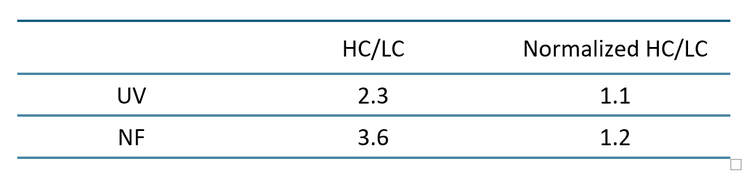
Table 5 compares HC/LC ratios before and after normalization. Ideally, the normalization factor should be close to one because the molar ratio of HC to LC is 1. However, the data shows the HC/LC normalized ratios are, in average, 1.1 for UV and 1.2 for NF detection. Even though the normalized ratios are close, they are above the ideal 1, possibly due to the nature of each detection type, explained earlier.
NF detection mode enables improved peak integration
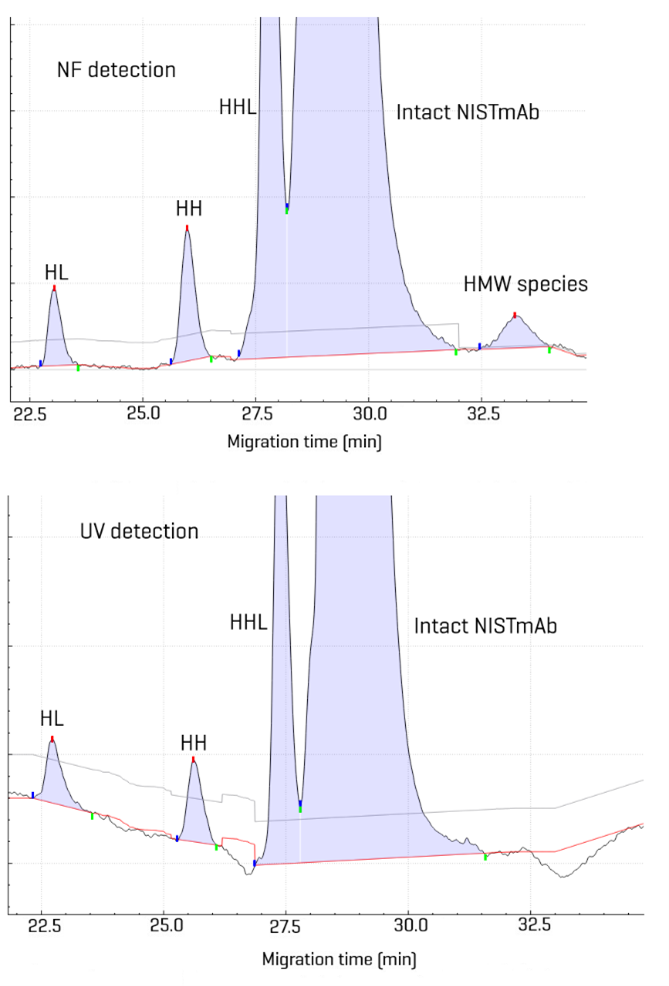
Figure 3 compares the UV (bottom) and NF (top) baselines for the non-reduced NISTmAb separation from 18-35 minutes. This region is typically challenging for robust and reproducible integration because of the low-abundance species migrate near large high-abundant species. For example, the high molecular weight (HMW) species migrating at ~33 minutes is clearly resolved with a flat baseline in NF detection, while baseline instability in UV detection, makes accurate integration difficult.
Conclusions
-
The higher throughput of the BioPhase 8800 system combined with the lightning method is well suited for process development samples as it achieves ~1.5X faster separation compared to the traditional CE-SDS workflows greatly increasing the throughput to 192 reduced IgG samples in ~ 14 hrs.
-
Benefits of NF detection:
- Flatter baseline – reduced baseline noise leading to easier and more reproducible data integration especially of low abundance species compared to UV
- NF requires no sample labeling facilitating sample preparation workflows using liquid handlers supporting the high-throughput requirement of the upstream bioprocessing environment5
- No missing peaks despite NF’s reliance on aromatic groups, all low-abundance species in reduced and non-reduced mAb samples were detected
- Comparability with UV detection of the data presented in this work supports equivalent results between UV and NF detection
-
The compatibility of the lightning CE-SDS method on the BioPhase 8800 system with UV, LIF and NFD offers great flexibility for different analytical needs
-
Core instrument conditions remain identical across all detection modes ensuring reproducibility and robustness and data comparability
References
- Z. Yang, M. Santos, T. Li, M. Pulido, J. Luo and S. Mollah; Lightning capillary electrophoresis sodium dodecyl sulfate (CE-SDS) workflow for high-throughput analysis of biotherapeutics, 2022, RUO-MKT-02-14803-A.
- M. Santos and Z Zhang; A comparison between IgG HR CE-SDS on the PA 800 Plus system and the equivalent assay on the BioPhase 8800 system, 2026, RUO-MKT-37272-A.
- A. Turner, K. Yandrofski, S. Telikepalli, J. King, A. Heckert, J. Filliben, D. Ripple and J. E. Schiel; Development of orthogonal NISTmAb size heterogeneity control methods; Analytical and Bioanalytical Chemistry, 410(2018)2095–2110.
- T. Li and S. Mollah, Enhanced AAV capsid protein analysis using CE-SDS with Native Fluorescence (NF) detection on the BioPhase 8800 system, 2025, MKT-36129-A.
- M. Santos and S. Savant, High throughput CE-SDS protein analysis using fully automated sample and reagent preparation workflow, 2022, MKT-29652-A