Abstract
This technical note describes a comprehensive characterization of adeno associated virus [AAV] capsid proteins using orthogonal techniques, intact MS, top-down MS/MS, and peptide mapping workflows with improved MS sensitivity (Figure 1). Intact MS and top-down MS/MS with electron activated dissociation (EAD) confirmed the identities of 3 viral proteins (VP1, VP2, and VP3) and N-terminal acetylation on VP1 and VP3. EAD-based peptide mapping enabled confident sequence confirmation, accurate post-translation modification (PTM) localization, and unambiguous isomer differentiation. AAVs are widely used vectors for in vivo gene therapy because of their high infectivity, non-pathogenicity to humans, low immunogenicity , and long-term gene expression.1,2 Comprehensive VP characterization is challenging due to limited sample quantity of AAVs, sequence similarity of 3 VPs, the presence of multiple PTMs, and difficulty in isomer differentiation. In this work, high MS sensitivity offered by the ZenoTOF 8600 system was leveraged to comprehensively characterize VPs of AAV8 using intact MS and EAD-based top-down and peptide mapping workflows (Figure 1).
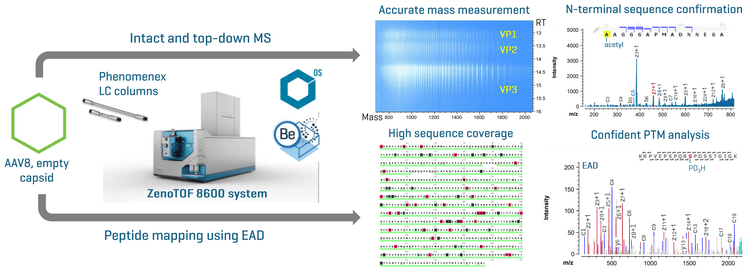
Key features of orthogonal LC-MS workflows for VP characterization using the ZenoTOF 8600 system
- High sensitivity: MS sensitivity offered by the ZenoTOF 8600 system leads to enhanced LC-MS analysis of AAVs with low protein concentration and limited sample quantity
- Rapid identification: Intact MS offers rapid and accurate mass measurement of 3 VPs while top-down MS/MS further confirms the state of N-terminal ace tylation
- Unique capabilities of EAD: EAD preserves labile PTMs for their accurate localization and generates diagnostic fragments for unambiguous isomer differentiation
- Streamlined data analysis: Biologics Explorer software provides optimized workflows and powerful visualization tools to improve user experience with data analysis
Introduction
AAVs are the most popular vectors for in vivo gene therapy.1,2 The AAV capsid is assembled with VP1 (~81 kDa), VP2 (~65 kDa), and VP3 (~60 kDa) in a ratio of 1:1:10. The VP1 contains the entire sequence of VP2, which covers the full sequence of VP3. Each VP can carry a variety of PTMs, such as acetylation, phosphorylation, oxidation, and deamidation. These PTMs can have a profound impact on the stability and function of the AAVs.1-5 Hence, it is important to fully characterize the VPs to ensure AAV product quality and safety. In this work, the high MS sensitivity provided by the ZenoTOF 8600 system was leveraged to fully characterize VP1-VP3.
Methods
Sample preparation: For intact mass analysis, AAV8 empty capsids (Charles River Laboratories; 5.1 × 10¹² VP/mL) were diluted to ~10 ng/µL in protein content. 2 µL (20 ng) and 5 µL (50 ng) of this solution were injected for intact MS and top-down MS/MS analyses, respectively. In peptide mapping experiments, 300 µL of AAV8 sample were concentrated using an Amicon Ultra Centrifugal Filter, 10 kDa MWCO (Millipore), followed by denaturation using guanidine-hydrochloride, reduction using dithiothreitol, and alkylation using iodoacetamide. The reduced solution was processed with the Amicon filter and diluted using the Tris-HCl buffer before the trypsin/Lys-C (Promega) mix was added. The digestion sample was incubated at 37°C overnight. 20 µL of the final sample (~0.5 µg) was injected for peptide mapping analysis.
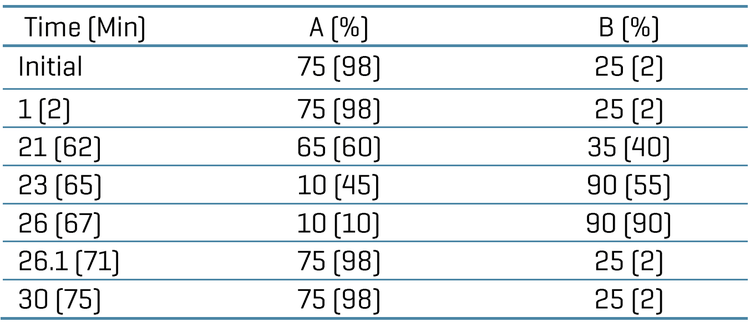
Chromatography: LC-MS separation was performed at a flow rate of 0.25 mL/min using an ExionLC AD system (SCIEX). Intact VP1-VP3 were separated using an ACQUITY UPLC protein BEH C4 column (2.1 mm × 50 mm, 1.7 µm, 300 Å, Waters) with an LC gradient provided in Table 1. During peptide mapping analysis, VP peptides were separated using a Phenomenex Biozen Peptide XB-C18 column (150 x 2.1 mm, 1.7 µm) with a 60-minute gradient shown in the parentheses in Table 1. The mobile phases A and B consist ed of 0.1% formic acid (FA) in water and 0.1% FA in acetonitrile, respectively.
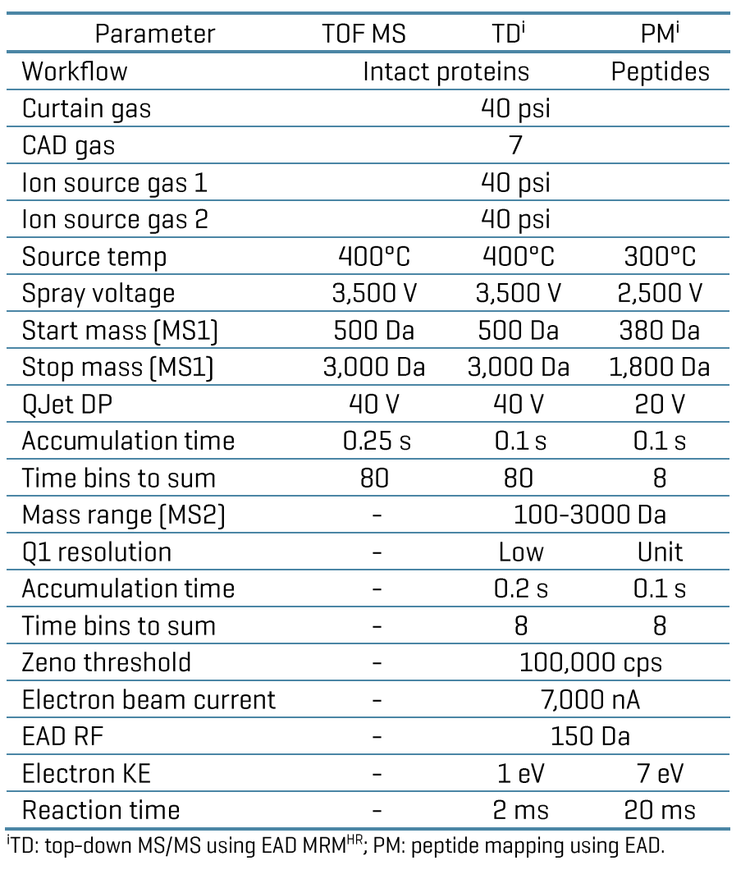
Mass spectrometry: LC-MS data were acquired using the ZenoTOF 8600 system (SCIEX). Top- down data of VP1-VP3 were acquired using an EAD MRMHR method, while peptide mapping was performed using a data dependent acquisition (DDA) method with CID or EAD. Selected peptides were analyzed using an MRMHR method with EAD.The key source and selected MS settings for top- down and DDA methods are shown in Table 2.
Data analysis: The data were acquired using SCIEX OS software (SCIEX) and interpreted using intuitive data analysis workflows within Biologics Explorer software (SCIEX ).
Intact mass analysis
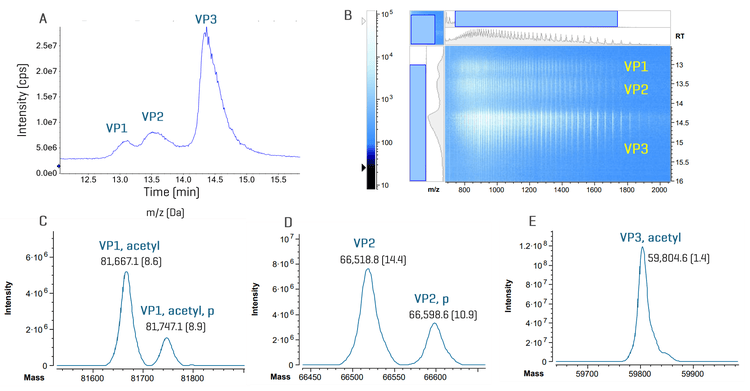
Figure 2 shows the result from intact LC -MS analysis of empty AAV8 under the denaturing conditions. Intact VPs were separated chromatographically in the order of VP1, VP2, and VP3 (Figure 2A). The ion map within Biologics Explorer software offers an excellent visualization of 3 VPs across the RT and m/z spaces (Figure 2B). Spectrum deconvolution showed that VP1 and VP3 are predominantly acetylated, while the dominant form of VP2 is not modified (Figures 2C - 2E). A prominent phosphorylated species was detected for VP1 and VP2 but not VP3, indicating that the primary phosphorylation site (s) is within the sequence shared by VP1 and VP2 (residues 138 to 203 in VP1). The precise sites of phosphorylation can be determined from peptide mapping, as will be described in the later section.
Top-down MS/MS analysis
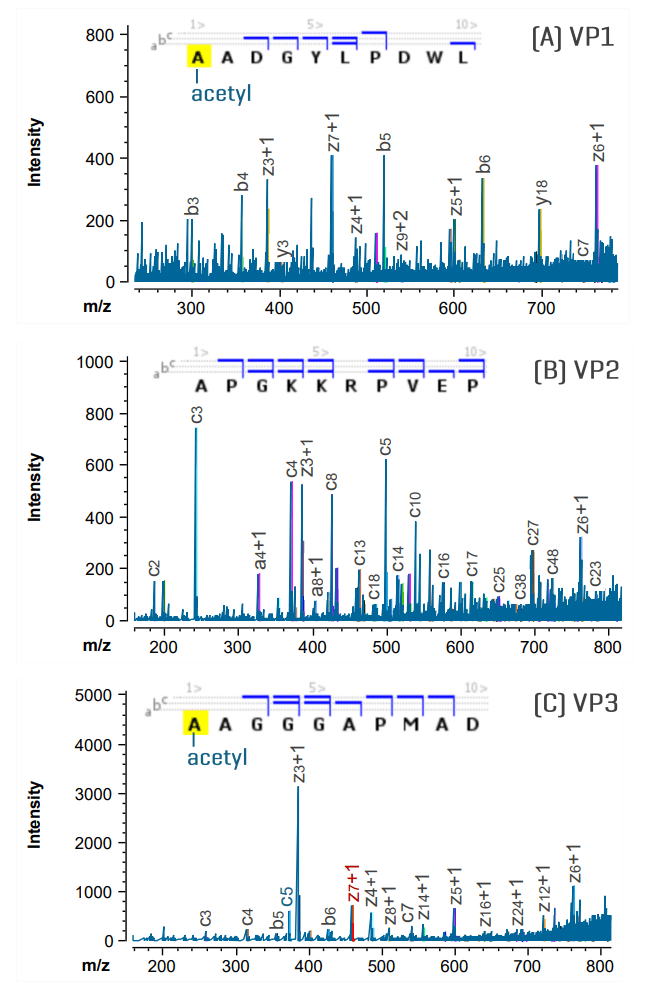
The acetylation sites in VP1 and VP3 can be rapidly determined using top-down MS/MS with EAD. In the top-down experiments, 3 charge states per VP were targeted for EAD fragmentation using an MRMHR method. EAD led to efficient fragmentation of N- and C-terminal parts of the VP sequences. Figure 3 shows the annotated EAD spectra in the low mass ranges and N-terminal sequence coverages of VP1-VP3. The detection of b-and c-series fragments provided direct evidence for the N-terminal acetylation on VP1 and VP3 and unmodified N-terminus on VP2. The generation of C-terminal y and z fragments (e.g. z3) with identical masses for 3 VPs confirmed that these proteins share the same C-terminus. Taken together, top-down MS/MS withEAD can be a viable approach for rapid sequence confirmation and characterization of VPs or proteins in similar sizes.
Peptide mapping analysis
A. Sequence coverage
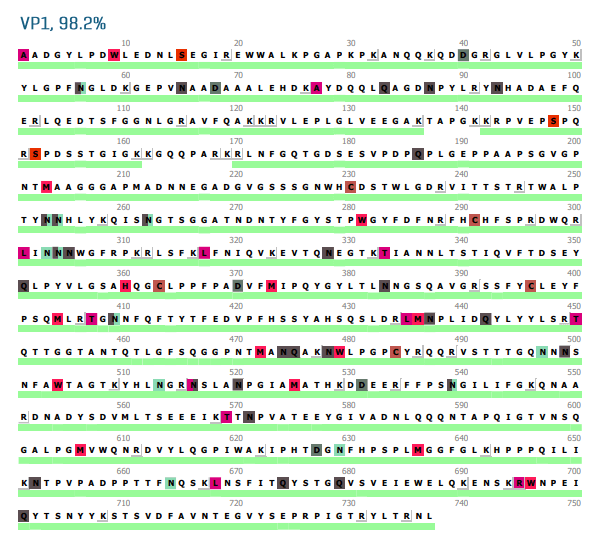
The ZenoTOF 8600 system offers highly sensitive DDA methods with CID or EAD, delivering high sequence coverage and comprehensive characterization of VPs with minimal sample consumption . Figure 4 shows high sequence coverage (>98%) of VP1 obtained from a single injection using the DDA method with EAD. Similar sequence coverage was obtained using the DDA method with CID (data not shown). While CID offers high sensitivity and efficient fragmentation of singly charge species, EAD provides benefits for fragmenting long peptides, localizing labile PTMs, and differentiating amino acid isomers. The ZenoTOF 8600 system allows flexibility in building DDA methods with CID, EAD, or joint CID/EAD, offering an all- around platform to achieve comprehensive protein characterization.
B. N-terminal sequence
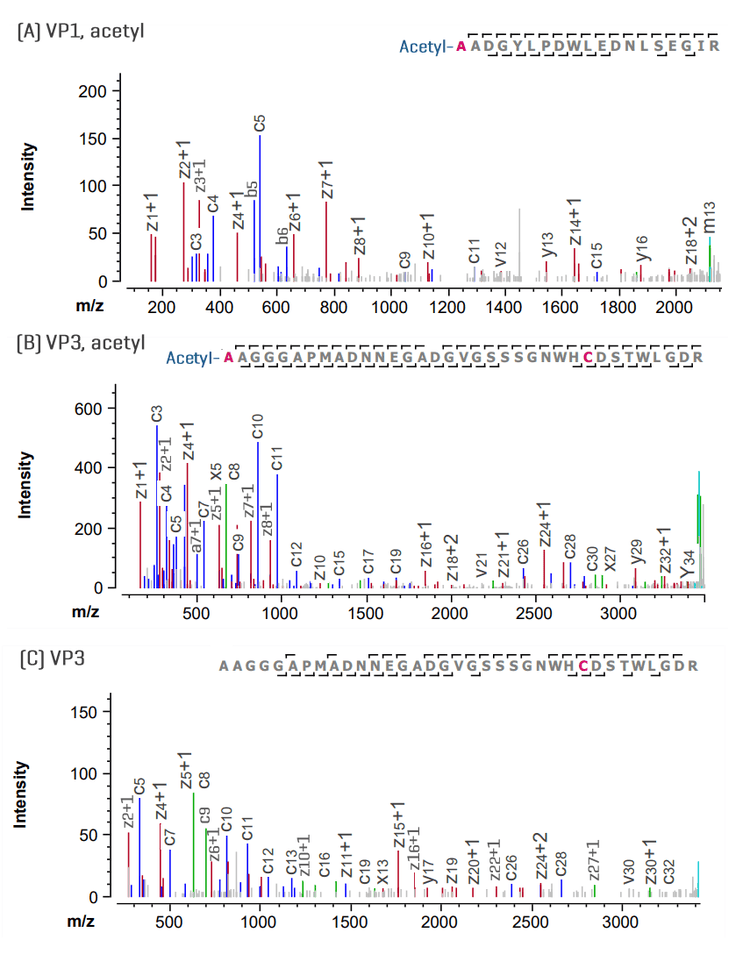
Figure 5 shows the fragment-rich EAD spectra of N-terminal peptides of VP1 and VP3. The detection of c-series fragments confirmed the N-terminal acetylation on VP1 and VP3 (Figures 5A and 5B). An unmodified N-terminal peptide with a relative abundance of ~1.9% was also confident ly identified for VP3 (Figure 5C).
C. Phosphorylation
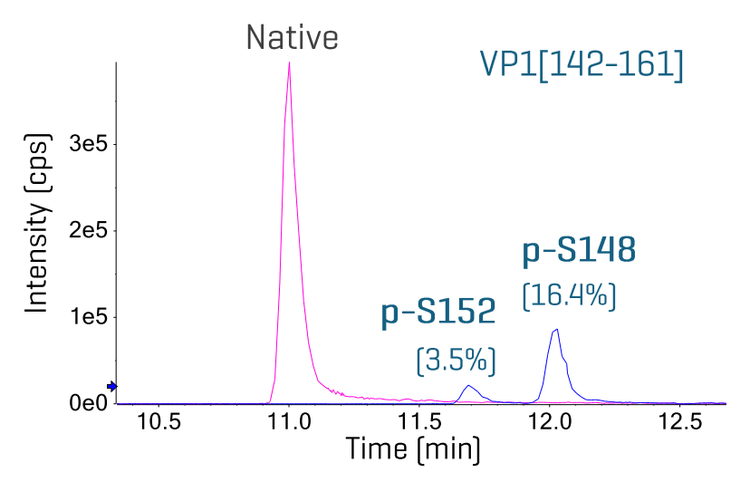
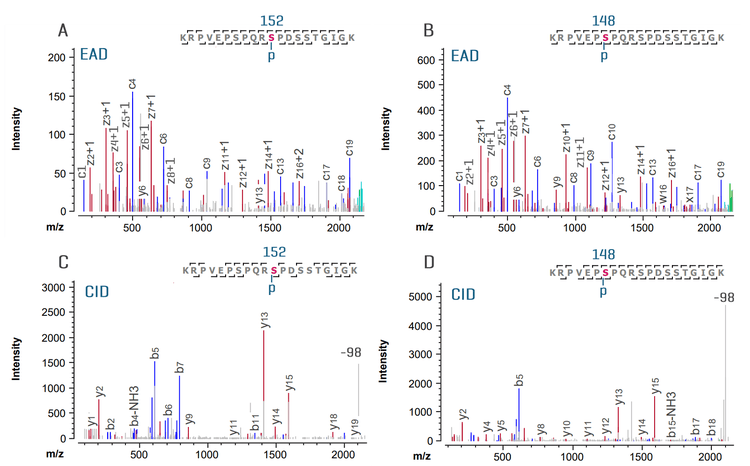
The deconvolution results shown in Figure 2 indicate that the primary phosphorylation sites are located between amino acid residues 138 and 203, the sequence shared by VP1 and VP2. A singly phosphorylated peptide VP1[142-161] within this sequence region was identified using the DDA method with CID or EAD. The extracted ion chromatogram (XIC) of this phosphopeptide reveals the presence of 2 positional isomers (Figure 6). The ZenoTOF 8600 system produced high-quality EAD and CID data to localize the phosphate group to S148 or S152 on these 2 isomers (Figure 7). Compared to CID (Figures 7C and 7D), EAD delivered richer fragments and more extensive sequence fragmentation, increasing the confidence in peptide identification and PTM localization (Figures 7A and 7B).
D. Amino acid isomers
One of the limitations with traditional collision-based MS/MS approaches, such as CID, is their inability to differentiate isomeric peptides. EAD addresses this challenge with the ability to generate diagnostic fragments for unambiguous differentiation of amino acid isomers, such as Leu vs Ile,6 Asp (D) vs isoAsp (isoD),5,7 and 3- vs 4-hydroxyproline8.
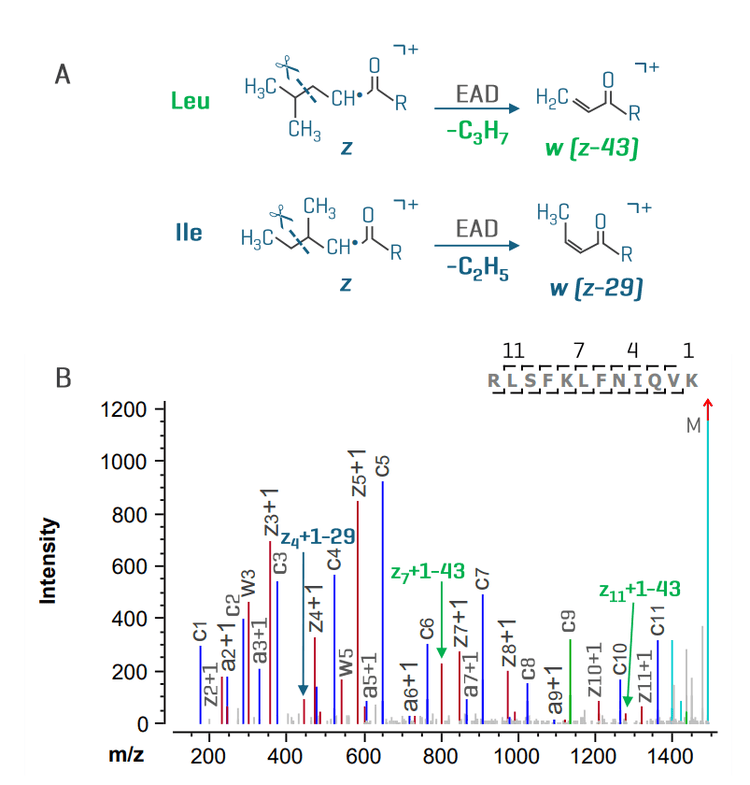
Figure 8 shows the differentiation of Leu vs Ile using EAD. EAD cleaves the side chain of Leu or Ile to generate diagnostic z – 43 fragment for Leu and z – 29 fragment for Ile (Figure 8A). Figure 8B shows the EAD spectrum of a VP peptide containing 1 Ile and 2 Leu residues. These 3 isomeric residues can be differentiated based on the detection of the corresponding z – 43 or z – 29 fragments (highlighted in bold in Figure 8) .
Deamidation can impact the transduction efficiency of AAVs.2 Therefore, it is important to characterization AAV deamidation to ensure product quality and safety. Detection and differentiation of deamidation isomers (D/isoD) in VPs, including those present at low abundance, were reported in the previous technical note.5 Confident assignments of multiple D/isoD isomers were demonstrated for 2 deamidated peptides, including VP1[51-60] ( YLGPFNGLDK ) and VP1[246-258] TWALPTYNNHLYK.5 Here, the EAD results of 2 additional challenging deamidated peptides were shown in Figures 9 and 10.
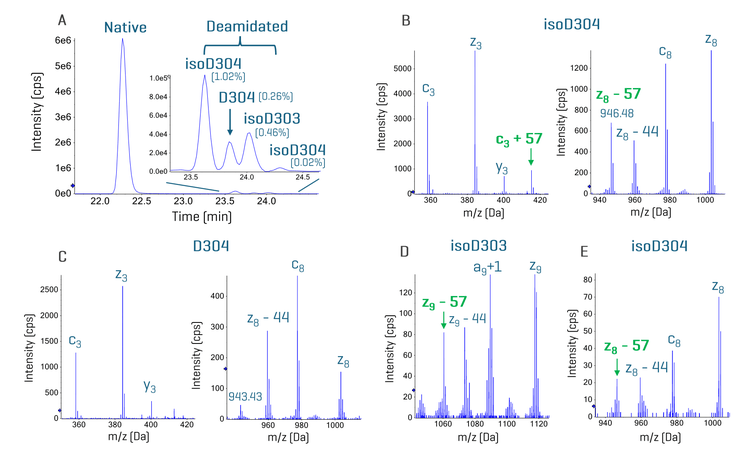
Figure 9 shows the characterization of 4 low-abundance deamidated species for the peptide VP1[301 -311] (LINNNWGFRPK). The Phenomenex Biozen Peptide XB-C18 column provided excellent separation of these deamidation isomers. The identification and differentiation of these isomers is highly challenging due to the ir low abundance (0.02 -1.02%) and the presence of 3 potential sites (Asn) of deamidation in this peptide. Despite these challenges, EAD generated high-quality spectra for confident identification and differentiation of 4 deamidation isomers (Figures 9B - 9E). For the most abundant isomer eluting at the earliest, the detection of c3 + 57 and z8 -57 fragments enabled the assignment of isoD for the deamidated Asn304 (Figure 9B). By compa rison, these 2 diagnostic fragments were not present in the EAD spectrum of the D304 counterpart (Figure 9C). Similarly, EAD generated a signature z – 57 fragment for the assignment of isoD303 and another isoD304 eluting at the latest (Figures 7A, 7D, and 7E). The presence of 2 isoD304 can be attributed to racemization of the naturally occurring L- to D-form, as described previously.7
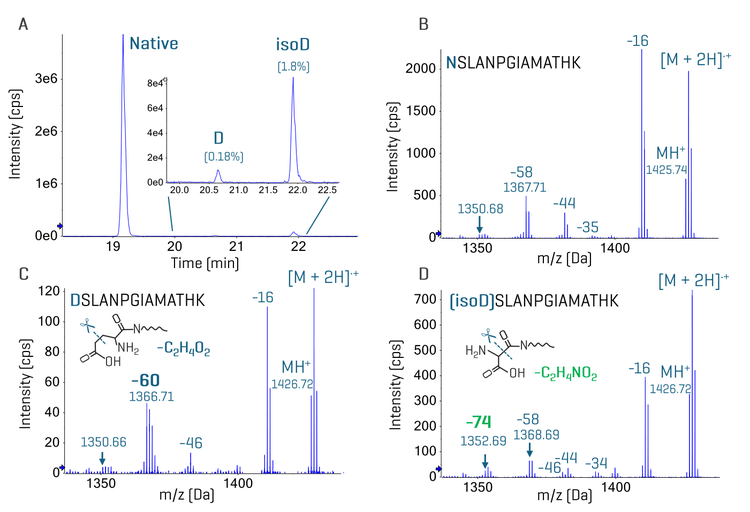
The differentiation of N-terminal D/isoD isomers is achieved through the detection of diagnostic neutral-loss fragments from the charge reduced species, as reported in literature.9 In this work, two N-terminal deamidation isomers of the peptide VP1[516-529] (NSLANPGIAMATHK) were detected and identified using DDA with CID (not shown) or EAD (Figure 10). While CID does not produce diagnostic fragments for isomer differentiation, EAD generated a signature -60 Da fragment for D and a -74 Da fragment for isoD from the charge reduced species (MH+) for confident differentiation of these 2 challenging isomers. It should be noted that t he 2 N-terminal isomers of VP1[516-529] were characterized in an MRMHR experiment using EAD with electron KEs of 1-7 eV. The MRMHR result showed that EAD with an electron KE of 1 eV delivered the optimal signal of signature neutral-loss fragments for the differentiation of N-terminal deamidation isomers.
Conclusions
- Comprehensive characterization of VPs in AAVs was achieved using orthogonal techniques, including intact MS, top-down MS/MS, and peptide mapping
- High MS sensitivity offered by the ZenoTOF 8600 system equipped with the Zeno CID or EAD enabled comprehensive characterization of AAV capsid proteins in low concentration and low quantity
- Intact MS workflow provided accurate mass measurement of VP1-VP3 with or without PTMs, while top-down MS/MS using EAD offered rapid characterization of the N-terminal sequences of these VPs to determine the state of N-terminal acetylation
- EAD-based peptide mapping workflow enabled a complete characterization of VPs by providing high sequence coverage, confident PTM identification and localization, and unambiguous isomer differentiation
- EAD produced diagnostic c/z fragments or neutral-loss fragments from the charge reduced species for the differentiation of isomeric Leu vs Ile or D vs isoD
- Phenomenex Biozen Peptide XB-C18 column provided excellent separation of deamidation isomers for clear differentiation of these challenging species
References
- Gimpel, A. L. et al. (2021). Analytical methods for process and product characterization of recombinant adeno-associated virus-based gene therapies. Mol Ther. 20: 740-754.
- Serrano, M. C. et al. (2023) Understanding and controlling the molecular mechanisms of protein aggregation in mAb therapeutics. Drug Dis. Today.28: 103442.
- Giles, A.et al. (2018) Deamidation of amino acids on the surface of adeno-associated virus capsids leads to charge heterogeneity and altered vector function. Mol. Ther. 26 (12): 2848 - 2862.
- Liu, A. P. et al. (2020) Characterization of adeno-associated virus capsid proteins using hydrophilic interaction chromatography coupled with mass spectrometry. J. Pharm. Biomed. Anal. 119: 113481.
- Intact LC-MS analysis and peptide mapping of recombinant adeno associated virus (rAAV) capsid proteins. SCIEX Technical Note, RUO-MKT-02-14244-B.
- Differentiation of leucine and isoleucine for enhanced sequence variant analysis using electron activated dissociation. SCIEX Technical Note, MKT-30799-A.
- Comprehensive differentiation of deamidation isomers from forced degradation by electron activation dissociation (EAD). SCIEX Technical Note, RUO-MKT-02-14730-A.
- Site-specific differentiation of hydroxyproline isomers using electron activated dissociation (EAD). SCIEX Technical Note, MKT-30610-A.
- Sargaeva N. P. et al. (2011) Differentiating N-terminal aspartic and isoaspartic acid residues in peptides. Anal. Chem. 83: 6675-6682.