Abstract
This technical note highlights an orthogonal mass spectrometry (MS) analysis approach for rapid and comprehensive characterization of a cysteine-linked ADC using the ZenoTOF 8600 system. Coordinating native MS analysis and peptide mapping results delivers both intact and site-specific insights. Native MS preserves non-covalent interactions, enabling direct analysis of intact species and accurate determination of heterogeneous drug-to-antibody ratio (DAR) distributions. Complementarily, electron-activated dissociation (EAD)–based peptide mapping provides detailed sequence information and enables precise localization of payload conjugation sites and post-translational modifications (PTMs). In this work, size-exclusion chromatography (SEC)–coupled native MS and EAD-based peptide mapping were applied to brentuximab vedotin (Figure 1), to generate intact mass, DAR analysis, and site-specific insights, establishing an efficient and comprehensive platform for advanced ADC characterization.
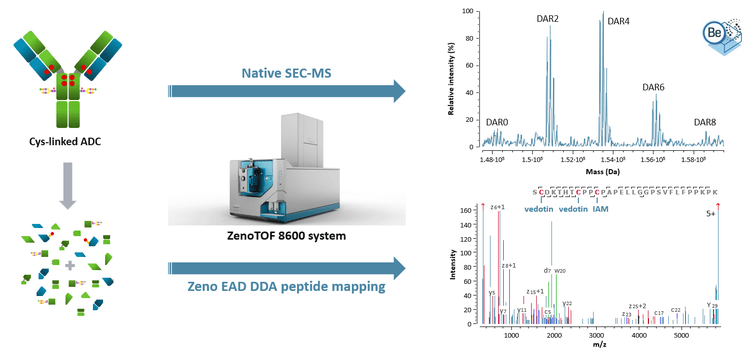
Key features of orthogonal LC-MS workflows for Cys-linked ADC characterization
- Comprehensive ADC characterization: Native SEC–MS and EAD-based peptide mapping workflows with the ZenoTOF 8600 system enable comprehensive ADC characterization from intact mass to site-specific details
- DAR determination: Non-covalent interactions in the Cys-linked ADCs are preserved under native MS conditions, allowing direct profiling of heterogeneous DAR distribution and average DAR determination
- Accurate localization: EAD gives complete protein sequence coverage and preserves labile PTMs and ADC payloads for their accurate localizations
- Streamlined software: Biologics Explorer software provides optimized workflow templates designed for both intact and peptide mapping analysis
Introduction
ADCs are complex therapeutics composed of antibodies linked to cytotoxic small molecules through specialized linkers. A common site-specific conjugation strategy targets the reduced inter-chain disulfide cysteine residues to improve structural consistency and enable defined DARs of up to 8.1 Accurate DAR measurement is essential to evaluate ADC product quality. Native MS plays a central role in preserving the non-covalent structure of Cys-linked ADCs, allowing direct measurement of intact species and reliable DAR profiling, especially in complex samples with heterogeneous DAR distributions. Comprehensive characterization also requires assessment of product quality attributes (PQAs), including primary sequence, conjugation sites, disulfide bonds, and PTMs. EAD enhances structural characterization by enabling extensive backbone fragmentation while preserving labile modifications.2
Methods
Sample preparation: Intact ADC samples were prepared by dissolving the lyophilized powder in water (0.1-1 mg/mL). Peptide mapping samples were prepared by denaturation with guanidine hydrochloride, followed by reduction using dithiothreitol (DTT) and alkylation with iodoacetamide (IAM), then digested using trypsin/Lys-C protease (Promega).
Liquid chromatography: 5 µg of intact ADC sample were injected for native SEC-MS analysis using a Biozen dSEC-2 column (1.8 µm, 200 Å, 150 × 4.6 mm, Phenomenex) with a 15-minute isocratic run. The mobile phase was 100 mM ammonium acetate, with a flow rate of 0.15 mL/min and a column temperature of 30oC.
For RPLC-MS, 100 ng of intact ADC sample were analyzed with an ACQUITY UPLC Protein BEH C4 column (1.7 µm, 300 Å, 2.1 × 50 mm, Waters) using the gradient described in the previous technical note.3 The column temperature was 60oC with a flow rate of 0.25 mL/min using 0.1% formic acid in water (A) and acetonitrile (B).
For LC-MS/MS, 1.5 µg of digested sample were injected onto a Biozen Peptide PS-C18 column (1.6 µm, 150 × 2.1 mm, Phenomenex) and separated with the gradient described in the previous technical note.2 The column temperature was 60oC with a flow rate of 0.25 mL/min using the same mobile phases as RPLC-MS.
Mass spectrometry: All MS data were acquired using the ZenoTOF 8600 system (SCIEX). Table 1 shows key source and TOF MS settings for the RPLC-MS and SEC-MS analyses, and Table 2 displays key parameters for EAD DDA analysis.
Data analysis: The MS data were interpreted using the Explorer function within SCIEX OS software (SCIEX) and intact protein analysis and peptide mapping characterization templates within Biologics Explorer software (SCIEX). An N-linked glycan library and variable modifications were specified for protein and peptide mapping. Cys-linked conjugates were defined as vedotin payload (C68H105N11O15), linker only with MMAE loss (C28H38O6N6), and hydrolyzed payload (C68H107N11O16).
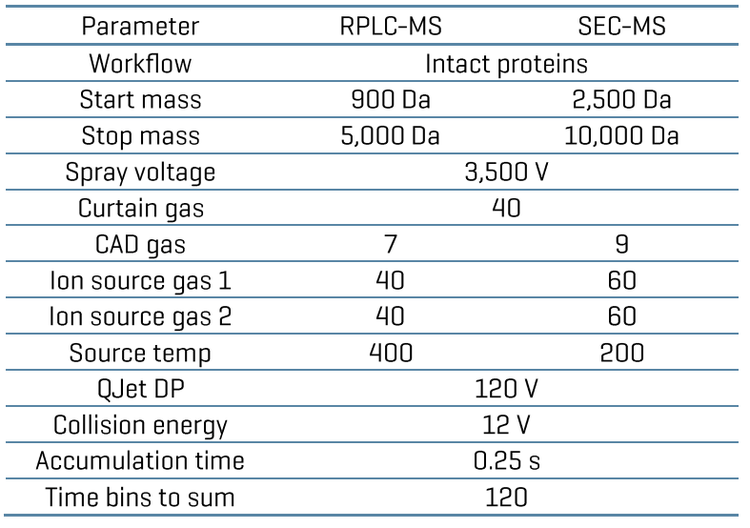
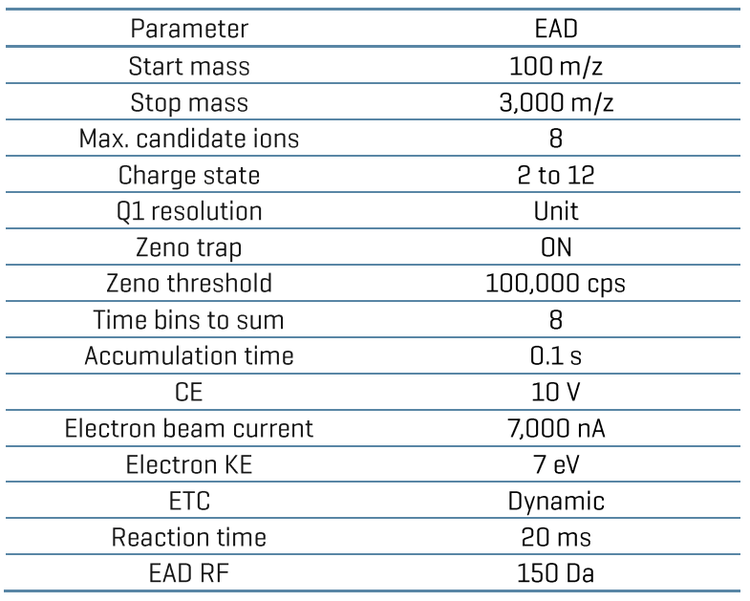
In this study, Brentuximab vedotin, a Cys-linked ADC, was characterized using native SEC–MS, reversed-phase LC–MS, and EAD-based peptide mapping on the ZenoTOF 8600 system. This multi-level analysis approach enabled accurate DAR determination, site-specific payload localization, and detailed PTM mapping. Together, these results demonstrate a robust framework for in-depth ADC characterization.
Characterization of brentuximab vedotin by native SEC-MS
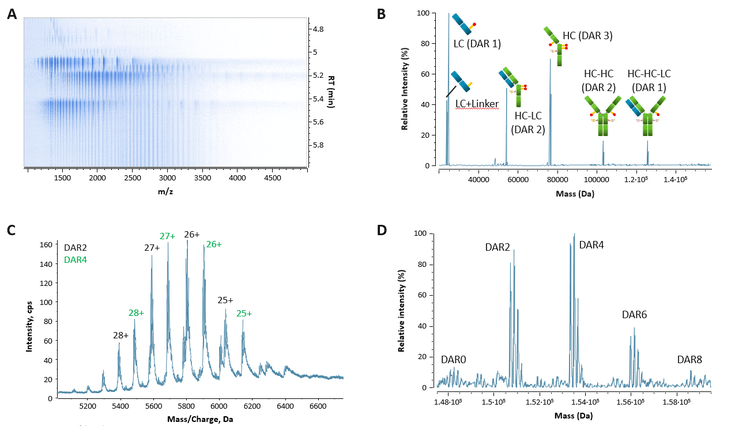
In Cys-linked ADCs, the cysteine residues that normally form inter-chain disulfide bonds are reduced and subsequently conjugated to cytotoxic payloads. As a result, the structures of these ADCs are maintained primarily through non-covalent interactions rather than covalent disulfide linkages. Under denaturing conditions used in RPLC, the non-covalent interactions are prone to and readily disrupted, leading to dissociation of the ADC into subunits.
Brentuximab vedotin is a heterogeneous ADC with a distribution of DARs. When analyzed by RPLC–MS, this heterogeneity, combined with subunit dissociation, produces highly complex spectra (Figure 2A). Spectral deconvolution revealed multiple species, including light chain (LC), heavy chain (HC), half antibodies, and other fragment combinations (Figure 2B). This complexity complicates the accurate determination of the average DAR. MMAE loss was also detected, with the intact analysis showing a mass decrease of 762 Da, consistent with loss of the payload.
In contrast, native MS preserves the intact ADC structure by maintaining non-covalent interactions. Under native conditions, the intact form of brentuximab vedotin was retained (Figure 2C), enabling direct measurement of the whole molecule. Deconvolution of the native MS spectrum reveals discrete species corresponding to DAR values of 0, 2, 4, 6, and 8 (Figure 2D). The average DAR, calculated from the relative signal intensities of these species, was determined to be 3.7.
EAD-based peptide mapping
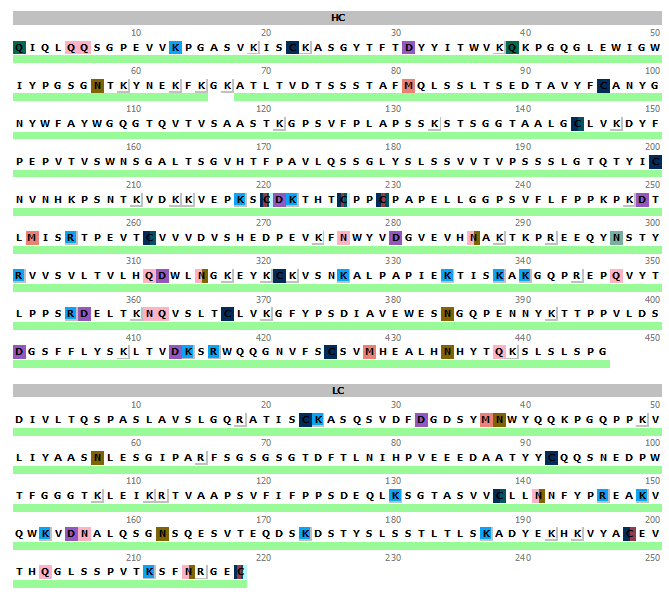
EAD-based peptide mapping workflow was employed for the comprehensive characterization of brentuximab vedotin. High sequence coverage was achieved for both HC (>99%) and LC (100%) from EAD-based peptide mapping analysis of reduced brentuximab vedotin (Figure 3). Beyond sequence confirmation, the EAD DDA approach enabled detection of peptides modified with the vedotin payload, as well as species reflecting payload-related modifications. Various PTMs, including glycosylation, glycation, oxidation, and deamidation, were also observed, supporting a detailed assessment of PQAs. The combination of speed and sensitivity provided by EAD DDA supports its use as a single-injection workflow for comprehensive biotherapeutic analysis. Figure 3: High sequence coverage of brentuximab vedotin using the EAD-based peptide mapping workflow. A nearly complete sequence coverage of HC (>99%) and LC (100%) was obtained for brentuximab vedotin using the EAD DDA method in a single injection.
Payload localization and payload-related modifications
As observed from the intact analysis, brentuximab vedotin presents a heterogeneous DAR distribution from 0 to 8. Each HC can carry up to 3 payloads, while the LC can carry a maximum of 1. This variability necessitates analytical approaches capable of resolving and localizing multiple conjugation states with high confidence.
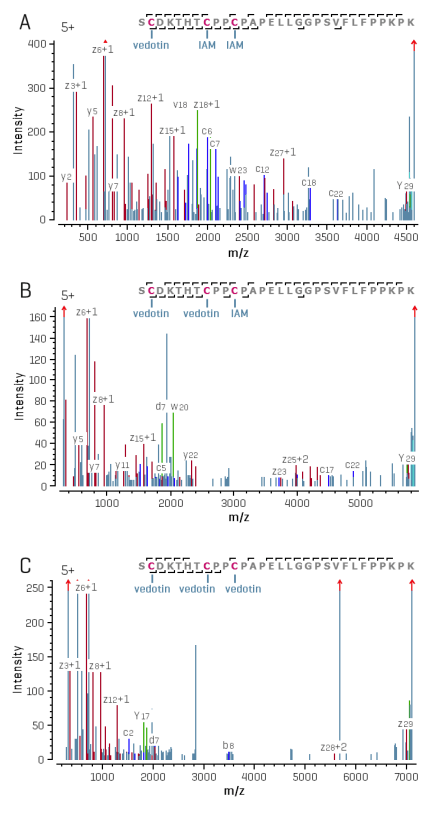
EAD enabled extensive fragmentation of peptide backbones while preserving labile modifications, including the vedotin payload. This fragmentation behavior is particularly advantageous for ADC analysis, as it supports both sequence confirmation and precise localization of conjugation sites. The EAD spectra of vedotin-containing peptide HC[219-248] revealed multiple conjugation states, with species carrying 1 (Figure 4A), 2 (Figure 4B), or 3 (Figure 4C) payloads detected.
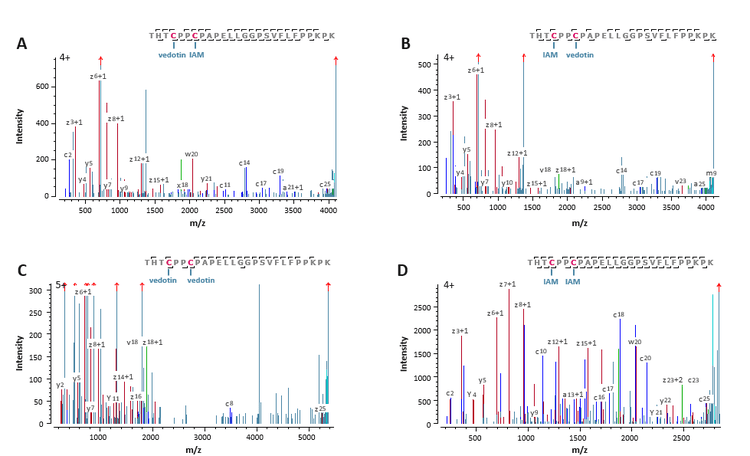
Further evidence for heterogeneous payload localization was obtained from a shorter peptide HC[223–248] from the same region, focusing on the 2 conjugation sites, Cys226 and Cys229. Multiple conjugation forms were observed, including 1 cysteine conjugated at either residue (Figures 5A and 5B), both conjugated (Figure 5C), and both unconjugated (Figure 5D). The high-quality EAD fragmentation data enabled precise mapping of payload attachment, allowing confident assignment to either Cys226 or Cys229 based on fragment ion evidence.
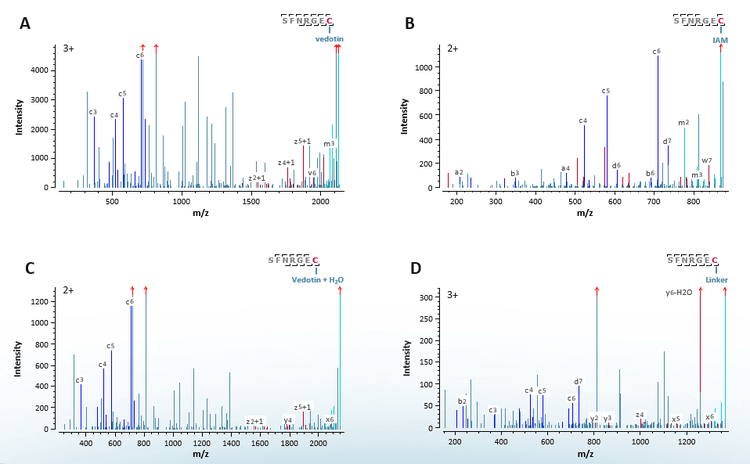
Similarly, the vedotin-containing peptide LC[212–218] was analyzed. Consistent with the expected payload stoichiometry, the peptide was observed as carrying 1 payload (Figure 6A) or unconjugated (Figure 6B). Overall, these results demonstrate that EAD-based peptide mapping provides a powerful and sensitive approach for characterizing site-specific conjugation and DAR heterogeneity in complex ADCs.
Additional payload-related modifications were also detected. Hydrolysis is a common reaction for Cys-linked ADCs, in which the maleimide linker undergoes ring-opening reactions. This modification was evident in the peptide mapping data. For example, the EAD spectra of LC[212–218] showed the presence of hydrolysis event (Figure 6C). As observed in the intact analysis, MMAE loss was further validated by EAD peptide mapping (Figure 6D).
PTM analysis and isomer differentiation
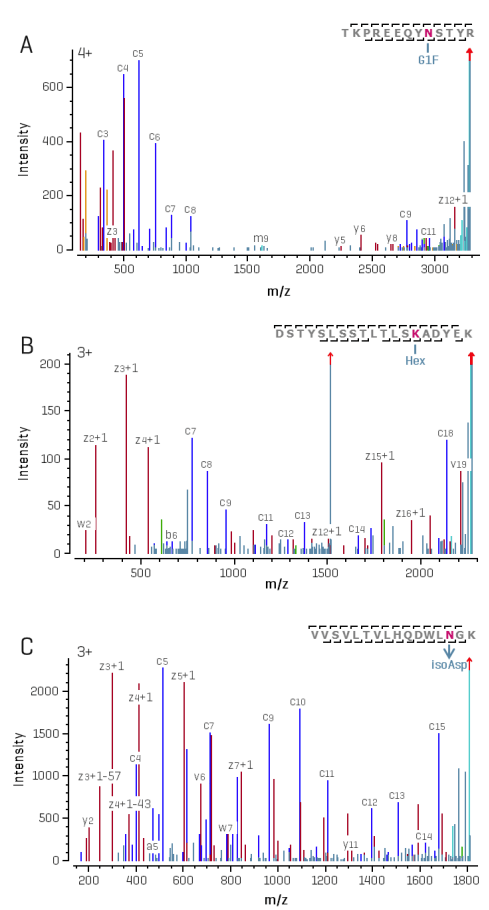
Beyond payload characterization, EAD enables detailed analysis of labile PTMs and differentiation of amino acid isomers. For example, analysis of the glycopeptide HC[289-301] allowed localization of the G1F glycan (Figure 7A). Similarly, a glycated peptide LC[174-192] demonstrated clear identification of the Hex modification (Figure 7B). The high sensitivity of the EAD DDA approach also produced extensive fragmentation of deamidated peptides. Detection of the diagnostic z3–57 fragment facilitated confident assignment of the modified Asn as an isoAsp residue rather than Asp (Figure 7C). Additionally, EAD also generated a characteristic z-43 fragment, confirming the presence of a Leu residue and enabling differentiation from Ile (Figure 7C).
Collectively, these examples highlight the power of EAD for precise PTM localization and amino acid isomer differentiation, making it a versatile tool for comprehensive biotherapeutic characterization.
Conclusions
- The ZenoTOF 8600 system provides a single-instrument solution to obtain high-quality intact and peptide mapping data for comprehensive characterization of ADCs, including intact mass measurement, DAR analysis, sequence confirmation, PTM, and payload localization
- Native MS offers accurate mass measurement of biotherapeutics and rapid DAR measurement of ADCs with minimal sample preparation
- EAD provides sensitive detection and confident identification of partial or complete payload conjugation for accurate DAR determination and impurity assessment
- EAD preserves the payloads and labile PTMs in the fragments for their accurate localization
- EAD generates diagnostic fragments for the clear differentiation of amino acid isomers
References
- Agarwal, P., & Bertozzi, C. R. (2015). Site-specific antibody-drug conjugates: the nexus of bioorthogonal chemistry, protein engineering, and drug development. Bioconjugate chemistry, 26(2), 176–192.
- A peptide mapping workflow with improved MS sensitivity for enhanced PQA characterization. SCIEX technical note, MKT32361-A.
- Enhanced sensitivity of intact LC-MS approaches to expand the capability of biotherapeutic analysis. SCIEX technical note, MKT-35364-A.
- Native mass spectrometry analysis of biotherapeutics and aggregates with enhanced sensitivity. SCIEX technical note, MKT-36146-A.