Abstract
This technical note highlights a streamlined oligonucleotide (oligo) sequencing workflow using ion-pair reverse-phase liquid chromatography-tandem mass spectrometry (IP-RP LC-MS/MS) and automatic data analysis . This workflow combines excellent chromatographic separation and high-quality MS/MS data of oligos with intuitive and automated software tools, leading to rapid oligo sequencing with improved user experience.
Oligo therapeutics are promising drugs targeting a variety of diseases through various mechanisms of action.1 Synthetic oligos often carry various modifications and product-related impurities. IP-RP LC-MS and MS/MS are commonly used to charac terize oligos and their impurities. A streamlined workflow−from chromatographic separation to data acquisition and analysis−is essential to enable rapid mass measurement, sequenc e confirmation, and impurity assessment , accelerating the development and decision -making process of therapeutic oligos.
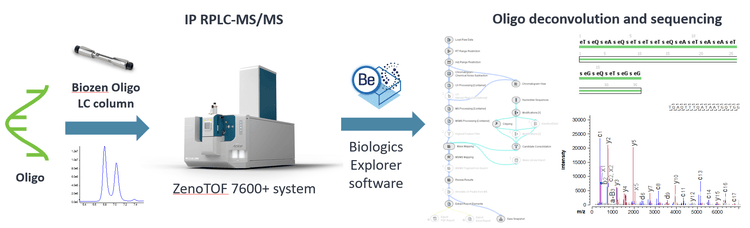
Key features of the streamlined IP- RP LC- MS/MS workflow for oligo analysis
- Streamlined: Oligo analysis is streamlined from chromatographic separation to MS/MS data acquisition and interpretation
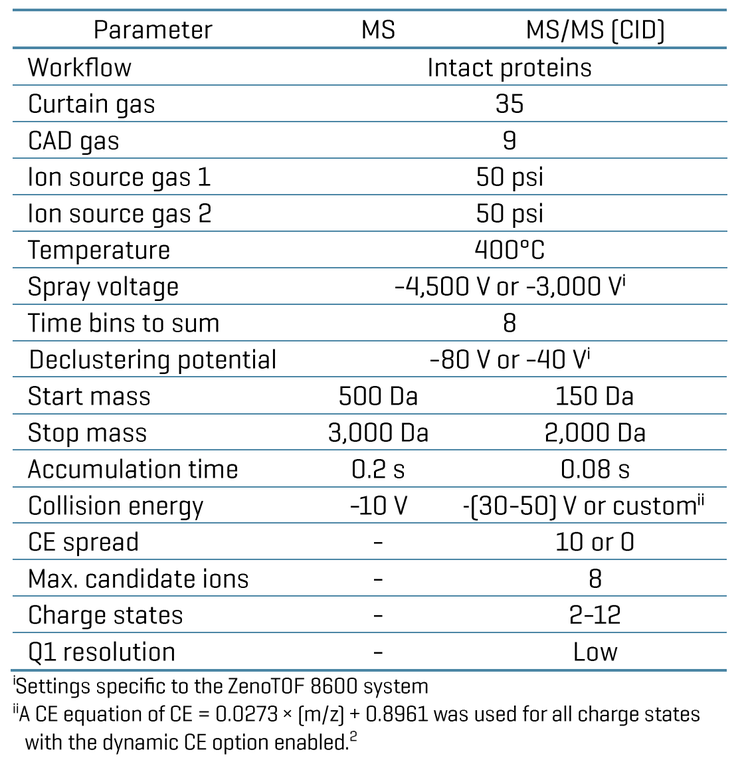
- Flexibility: SCIEX OS software allows the user to build data-dependent CID methods using a fixed collision energy (CE) with spread or custom dynamic CEs, providing flexibility to obtain optimal MS/MS fragmentation of oligos in different lengths or charge states
- Simplicity: Biologics Explorer software provides easy-to use data analysis workflow s for oligo sequence creation, intact deconvolution, mass mapping, and MS/MS sequencing
- Consistent recovery: Biozen Oligo LC column combines core-shell particle technology and bioinert hardware, significantly increasing the chromatographic efficiency
Methods
Sample preparation: A synthetic oligo 18mer with full phosphorothioate (PS) linkages was purchased from Integrated DNA Technologies (IDT). An antisense oligo (ASO) 20mer with a maleimide C2 linker (ASO-MC) on the 3’ endwas ordered from VectorBuilder.A stock solution of 1 mg/mL was prepared for 2 oligos. This solution was diluted to 10 ng/ µL, from which 5 µL (50 ng) was injected for LC -MS analysis.
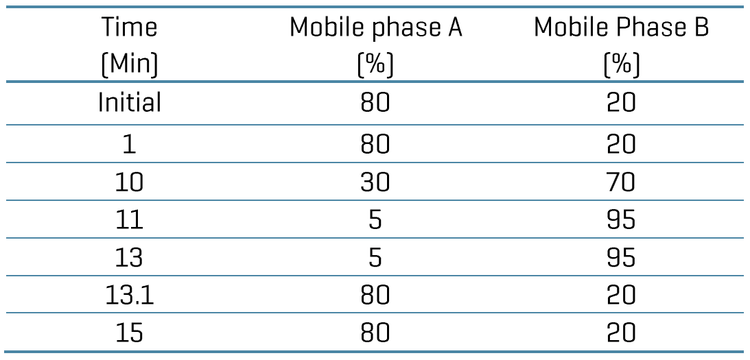
IP-RP LC separation: Oligos were separated based on IR -RP chromatography using a Phenomenex Biozen Oligo LC column (2.6 µm, 50 x 2.1 mm) installed on a Nexera XS inert HPLC system (Shimadzu). The separation was performed using the gradient shown in Table 1 with a column temperature of 60°C and a flow rate of 0.3 mL/min. Mobile phases A and B are water and methanol/water (1:1 v/v), respectively, with 50 mM 1,1,3,3,3-hexafluoroisopropanol (Sigma -Aldrich) and 15 mM diisopropylethylamine (Sigma -Aldrich).
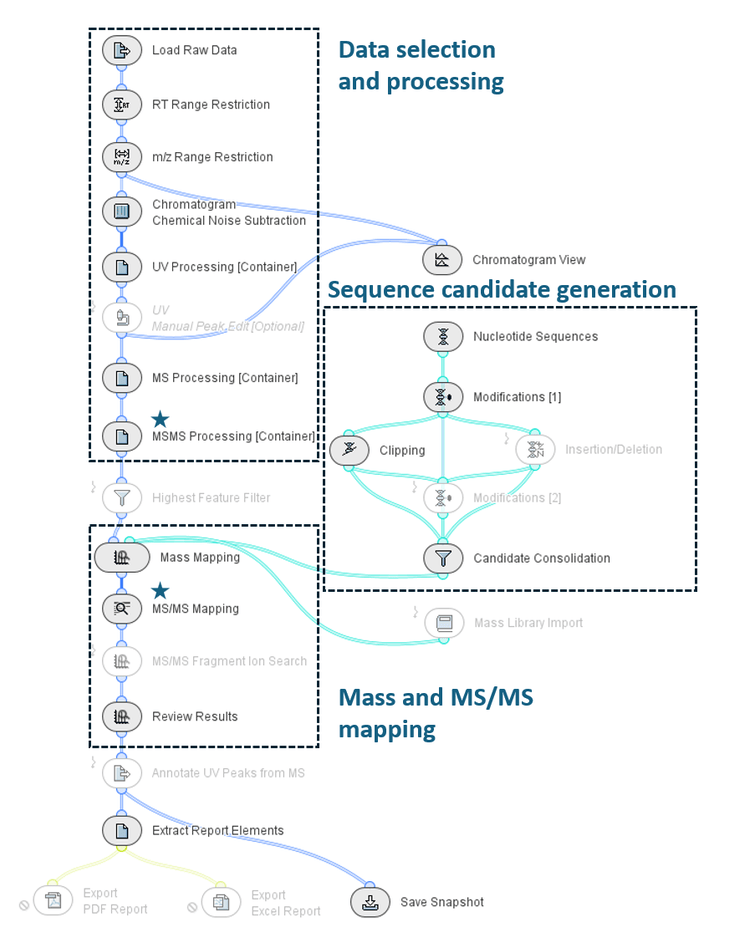
Data analysis: Oligo sequence creation and intact deconvolution of TOF MS data were described previously.3 CID DDA data were processed using an oligo sequencing workflow (Figure 2) within Biologics Explorer software, Version 8.0.3 (SCIEX).
Oligo sequence creation and deconvolution
Built upon powerful algorithms from Genedata Expressionist®, Biologics Explorer software offers intuitive data analysis workflows for comprehensive characterization of protein-or oligo-based therapeutics. These streamlined workflows require minimal user’s input and hence are quick to learn and easy to run. For advanced users, the workflows offer the flexibility to fine-tune various settings or algorithms.
Oligo sequences are created using 1-letter abbreviations for the building blocks, including sugars, linkers and bases.3 For example, an “s” and “o” represent PS and phosphate (PO) linkers, respectively. Custom building blocks can be added using a Nucleotide Editor within Biologics Explorer software. In this work, 5-methyl-cytosine and 2’-methoxyethylribose (2’- MOE) were defined as Q and e, respectively, within the Nucleotide Editor. With the building blocks defined, the sequence s of the 18mer and ASO-MCanalyzed in this study were defined as the following:
18mer
eT-s-eQ-s-eA-s-eQ-s-eT-s-eT-s-eT-s-eQ-s-eA-s-eT-s-eA-s-eA-s-eT-s-eG-s-eQ-s-eT-s-eG-s-eG
ASO-MC
eQ-s-eT-s-eA-s-eG-s-eA-s-dT-s dG-s-dC-s-dA-s-dA-s-dT-sdG-s-dT-s- dT-s-dG-s-eQ-s-eT-s-eQ-s-eA-s-eT
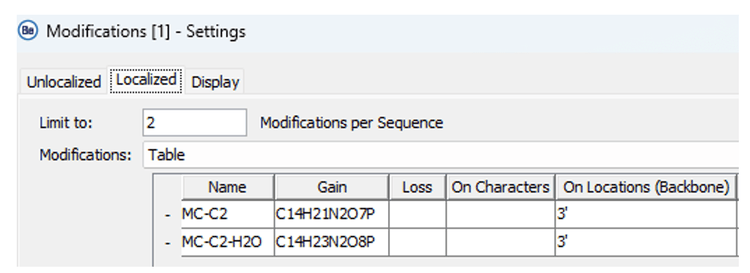
The PS to PO modification was defined for 2 oligos in the Unlocalized tab of the Modifications activity within the sequence candidate generation section of the data analysis workflow (Figure 2). The ASO-MCanalyzed in this work was modified with an MCC2 linker on its 3’ end. The gains of the formula of the linker (C14H21N2O7P) and its hydrated form (C14H23N2O8P) were specified in the Localized tab of the Modification activity (Figure 3).
Intact oligo deconvolution
Similar high-quality TOF MS and CID DDA data of oligos were obtained using the ZenoTOF 7600+ system and the ZenoTOF 8600 system. The data from the ZenoTOF 7600+ system were used here to demonstrate the streamlined intact deconvolution and oligo sequencing workflows of Biologics Explorer software.
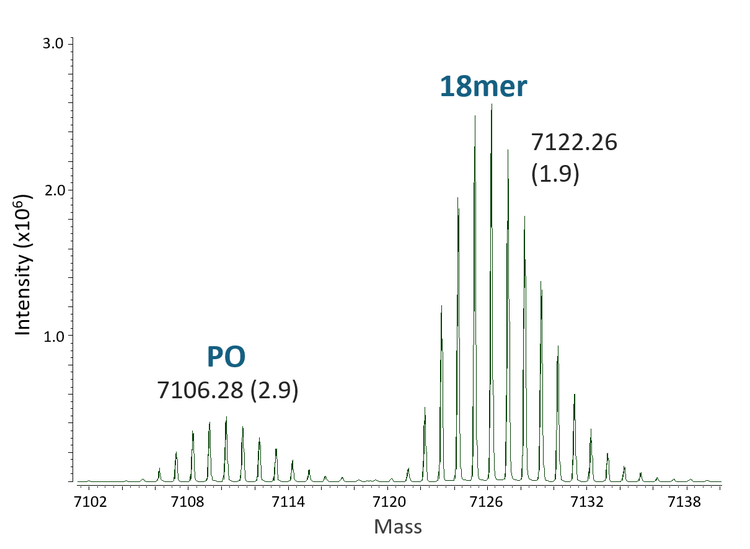
The intact deconvolution workflow for oligos was described in a previous technical note.3 The deconvolution can be performed using the monoisotopic or average masses. In this work, the monoisotopic masses of oligo candidate sequences were used to map the isotopically resolved spectra of the 18mer and ASO-MC.
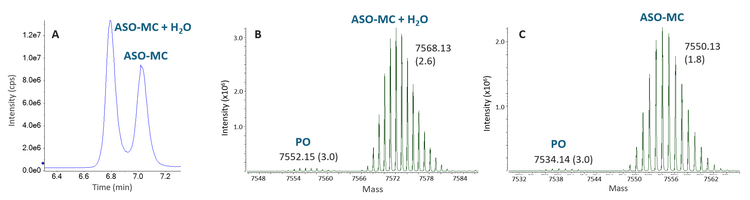
Figures 4 and 5 show the deconvolution spectra of the 18mer and ASO-MC, respectively. High mass accuracies (<5 ppm) were obtained for the intact forms of these 2 oligos and their PO species . The MC linker of the ASO-MC is prone to hydrolysis, leading to the formation of a hydrated (+H2O) species. The Phenomenex Biozen Oligo LC column provided good separation of the ASO-MC and its hydrated species (Figure 5A) for their accurate mass determinations (Figures 5B and 5C).
Oligo sequencing
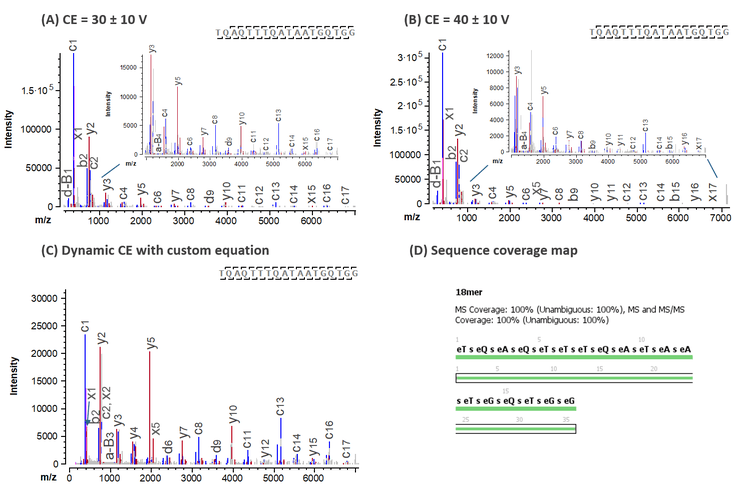
The CID DDA data of the oligos were acquired using a fixed CE with spread or dynamic CE s with a custom equation of CE = 0.0273 × (m/z) + 0.8961 described in a previous study2 .The oligo sequencing workflow within Biologics Explorer software allows a quick comparison of the data acquired using different settings , accelerating method optimization for oligo analysis.
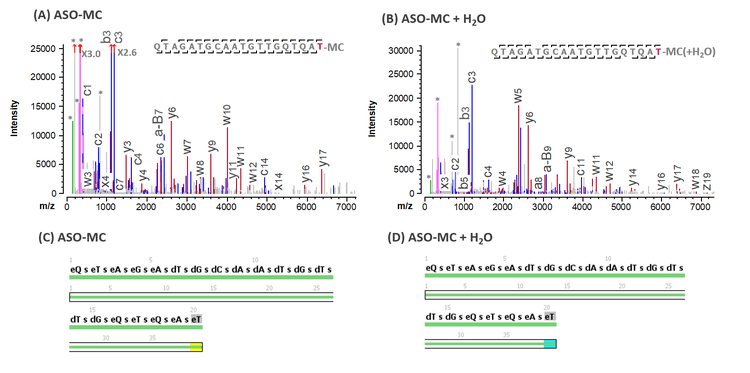
Figures 6 shows the CID DDA results of the 18mer obtained using 3 different CE settings. The MS/MS spectra of the charge states -3 to -10 were combined and deisotoped prior to MS/MS mapping against the oligo candidate sequences (Figures 6A - 6C). While all CE setting s provided a complete coverage of the 18mer, the dynamic CE s with a custom CE equation resulted in the most balanced fragmentation of the oligo (Figure 6C). The complete sequence coverage map of the 18mer obtained using the custom CE setting is shown in Figure 6D. The CID DDA method with the custom dynamic CE setting also provided high-quality MS/MS data and complete sequence coverage of the ASO-MC and its hydrated species, confidently confirming the oligo sequence and the location of the MC modification on the 3’ end (Figure 7).
In summary, this technical note highlights a streamlined IP-RP LC-MS/MS workflow for accurate mass measurement and sequence analysis of oligos. The oligo sequencing workflow offered by Biologics Explorer software allows rapid method optimization and sequence confirmation, accelerating the development of oligo therapeutics.
Conclusions
- A streamlined IP-RP LC-MS/MS workflow was developed for comprehensive oligo sequence analysis, leveraging the optimized DDA method with custom dynamic CEs using the ZenoTOF 7600+ system or the ZenoTOF 8600 system and the intuitive oligo sequencing workflow from Biologics Explorer software.
- Rapid data processing using t he oligo sequencing workflow allows quick comparison of DDA data acquired using different settings, accelerating method optimization.
- Compared to fixed CEs with spread, the custom dynamic CEs provided balanced fragmentation of oligos in different charge states, leading to high-quality MS/MS spectra and complete sequence coverage of the oligos.
- Biozen Oligo LC column provided good separation of the ASO-MC and its hydrated form for confident characterization of these 2 species.
References
- Pourshahian S. (2021) Therapeutic oligonucleotides, impurities, degradants, and their characterization by mass spectrometry. Mass Spectrom. Rev. 40:75-109.
- Karasawa K et al. Method development for metabolite and impurity profiling of oligonucleotide therapeutics. ASMS Conference on Mass Spectrometry and Allied Topics, June 2- 6, 2019, Atlanta, Georgia.
- A streamlined LC-MS workflow for intact oligonucleotide analysis with enhanced MS sensitivit. SCIEX Technical Note, MKT-36686-A.