Abstract
The poly(A) tail is a critical quality attribute (CQA) of mRNA therapeutics. Analytical scientists require high-resolution methods for characterization of poly(A) tail length and distribution across diverse mRNA candidates during development and lot release. In this technical note, we describe a capillary gel electrophoresis with UV detection (CGE-UV) workflow using the Oligo 200 nt Purity and Integrity kit for analysis of poly(A) tails released from mRNA. The workflow uses a ready-to-use gel and pre-assembled bare-fused silica (BFS) cartridges and can be performed on either the BioPhase 8800 system or PA 800 Plus system. Accurate size determination, assay repeatability (%RSD for CPA% below 5.0% across 8 injections of CD19 CAR mRNA, n=8), and applicability to the four mRNA samples tested in this study (GFP, CD19 CAR, FLuc, and DasherGFP) were demonstrated. The workflow also enables analysis of mRNA fingerprint profiles for research use, providing complementary information on mRNA identity and integrity.
Key features
- Platform workflow with CGE-UV: Enables analysis of poly(A) tails ranging from 92 to 180 nt across multiple mRNA samples without sample-specific optimization with ready-to use-gel and pre-assembled cartridges
- Enables accurate poly(A) tail length determination and reproducible peak quantitation
- Assay reproducibility (n=8, CD19 CAR mRNA, BioPhase 8800 system): The corrected peak area % for the different fragments of poly(A) tail had %RSD below 5.0%
- Wide Poly(A) size range: Longest distribution of poly(A) tail size ranged from 60 to 230 nt for Dasher GFP sample
- Analysis of mRNA fingerprints and poly(A) tails in a single workflow: Supports identity and integrity assessments
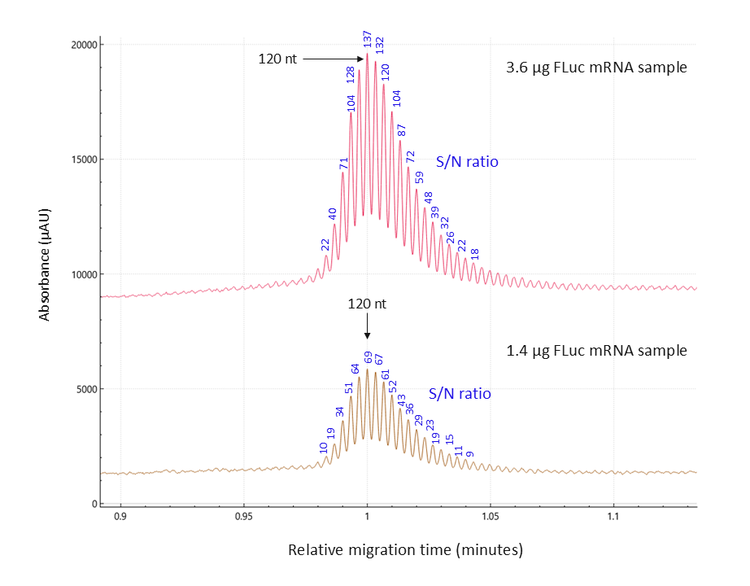
- Sensitivity (LOD below 0.6 µg mRNA, FLuc mRNA, single BioPhase 8800 system, n=1 dilution series): Demonstrated for poly(A) tail and RNA fingerprint analysis of purified FLuc mRNA; feasibility for in-process IVT mRNA samples was not evaluated in this study
Introduction
The mRNA-based therapeutics have emerged as an important modality for vaccines, protein replacement therapies, gene editing applications, and cancer immunotherapies.1 As the number and diversity of mRNA products continue to expand, reliable analytical methods are needed to characterize critical quality attributes (CQAs) that influence product quality and performance. One such CQA is the poly(A) tail, which plays an important role in mRNA stability, translation efficiency, and biological activity. Accurate characterization of poly(A) tail length and distribution is therefore an essential component of mRNA analytical development.2-4
Current approaches for poly(A) tail analysis often rely on liquid chromatography (LC)-based methods, which may require method optimization for different poly(A) tail lengths and can exhibit limited resolving power for longer poly(A) species. Therefore, analytical scientists need a platform workflow capable of delivering reliable, high-resolution poly(A) tail characterization across diverse mRNA candidates.3,4
In this technical note, we describe a CGE-UV workflow using the Oligo 200 nt Purity and Integrity kit. The workflow utilizes a ready-to-use gel and pre-assembled BFS cartridges and can be performed on either the BioPhase 8800 system or the PA 800 Plus system. In addition to high-resolution poly(A) tail analysis, the workflow enables assessment of mRNA fingerprint profiles, providing complementary information on mRNA identity and integrity within a single analytical workflow − for research use.
Methods
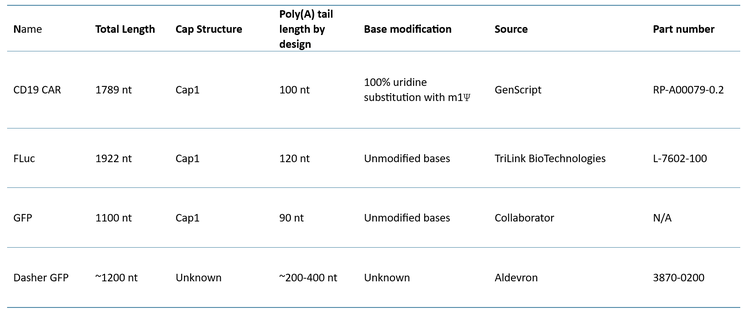
Materials: The Oligo 200 nt Purity and Integrity kit (P/N: 5321745) containing the Oligo 200 nt Purity and Integrity gel, Oligo 200 nt test mix (50 nt to 141 nt), Single-stranded Oligo standard (15 nt), Oligo 200 nt Purity and Integrity sample buffer (20x), CE Grade water, and Acid Wash/Regenerating Solution (0.1N HCl), was from SCIEX (Marlborough, MA). The BioPhase sample and reagent plates (4,4,8) (P/N: 5080311) and the BioPhase BFS capillary cartridge - 8 x 30 cm (P/N: 5080121) were from SCIEX. Rainin LTS filter tips were from Mettler Toledo (Oakland, CA). Nuclease-free water (NFW) (P/N: AM9932), and RNase T1 (1000 U/μL, P/N EN0541) were obtained from Thermo Fisher Scientific (Waltham, MA). The properties of the four mRNA samples analyzed in this technical note are listed in Table 1. The firefly luciferase (FLuc) mRNA (P/N: L-7602-100) was from TriLink BioTechnologies (San Diego, CA). The FLuc mRNA contains a 5’-cap and a 3’-poly(A) tail, mimicking an mRNA drug substance. The CD19 CAR mRNA (P/N: RP-A00079-0.2) was from GenScript. The CD19 CAR mRNA encodes a chimeric antigen receptor (CAR) that specifically recognizes the CD19 antigen on B cells. It contains a 5’-cap and a 3’-poly(A) tail, with 100% uridine substitution by N1-methylpseudouridine (m1ψ) to improve protein expression and reduce innate immune activation, thereby mimicking an mRNA drug substance. The GFP mRNA was from a collaborator. The DasherGFP was from Aldevron. The 120 nucleotides (nt) poly(A) size marker was custom synthesized by Integrated DNA Technologies (Coralville, IA).1
Storage of the Oligo 200 Purity and Integrity kit: The Acid Wash/Regenerating Solution and CE Grade water were stored at room temperature upon receipt. The Oligo 200 nt Purity and Integrity gel and the Oligo 200 nt Purity and Integrity sample buffer (20x) were refrigerated at 2-8°C. The Oligo 200 nt test mix and the Single-stranded Oligo standard (15 nt) were kept at -35°C to -15°C.6
Preparation of the Oligo 200 Purity and Integrity kit reagents before CE separation: The Oligo 200 nt Purity and Integrity sample buffer is a 20X solution and was diluted to 1X with the CE Grade water. The Oligo 200 nt Purity and Integrity gel was warmed up to room temperature in the dark before use.
Preparation of mRNA samples for poly(A) tail analysis: The mRNA samples were first digested with RNase T1. The released poly(A) tails were purified before CGE analysis on the BioPhase 8800 system using UV detection at 254 nm.
The CE instrument and software: The BioPhase 8800 system with UV/LIF (P/N: 5089278)—equipped with a laser-induced fluorescence (LIF) detector utilizing an excitation wavelength of 488 nm and an emission wavelength of 520 nm—was from SCIEX. Automated data acquisition and analysis were performed using BioPhase software version 1.5 from SCIEX.
CGE-UV separation conditions: The default separation method with electrokinetic injection and capillary temperature at 22°C, was used for sample analysis, following instructions in the Oligo 200 nt Purity and Integrity kit application guide.6 The BioPhase 8800 system with UV/LIF detection (P/N 5089278) was from SCIEX. The data was acquired with the BioPhase software V1.5 and the data analyzed with V1.6. All modifications made during reanalysis were recorded in the audit trail, and the final datasets were electronically signed with the Analyzed and Reviewed states.
Results
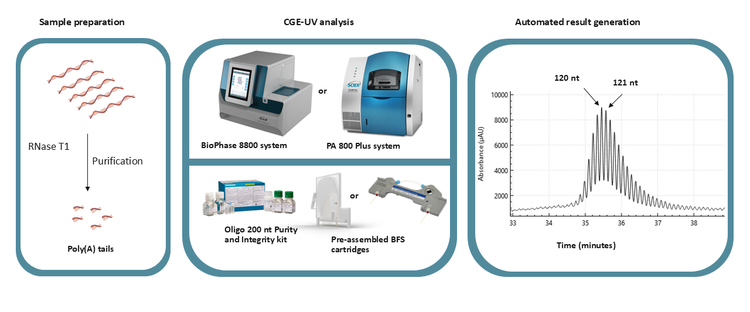
New workflow for mRNA poly(A) tail analysis by CGE-UV: Figure 1 shows the workflow for mRNA poly(A) tail analysis by CGE-UV using the Oligo 200 nt Purity and Integrity kit. First, the mRNA sample is digested with RNase T1. The poly(A) tails released are then purified and separated by CGE-UV. The electropherogram in the right panel demonstrates single-nucleotide resolution of the poly(A) tails with different lengths in a typical poly(A) tail distribution obtained with an mRNA sample. The poly(A) tail is a critical quality attribute (CQA) of mRNA therapeutics that influences mRNA stability, translation efficiency, and biological activity. Poly(A) tails may be plasmid-encoded, enzymatically added, or generated through a combination of both approaches, resulting in a distribution of tail lengths rather than a single discrete species. Tail length and heterogeneity can impact product performance and consistency, making optimization and characterization essential during process development. Assessment of poly(A) tail length and distribution is also required for lot release to ensure consistent product quality and manufacturing control. The size of the most abundant species is 120 nucleotides (nt). This new workflow for mRNA poly(A) tail analysis features the use of the Oligo 200 nt Purity and Integrity kit that comes with a ready-to-use gel and works with pre-assembled BFS cartridges for ease of use and time savings. The CE separation can be performed on either the multi-capillary BioPhase 8800 system or the single-capillary PA 800 Plus system using universal UV absorbance detection at 254 nm.
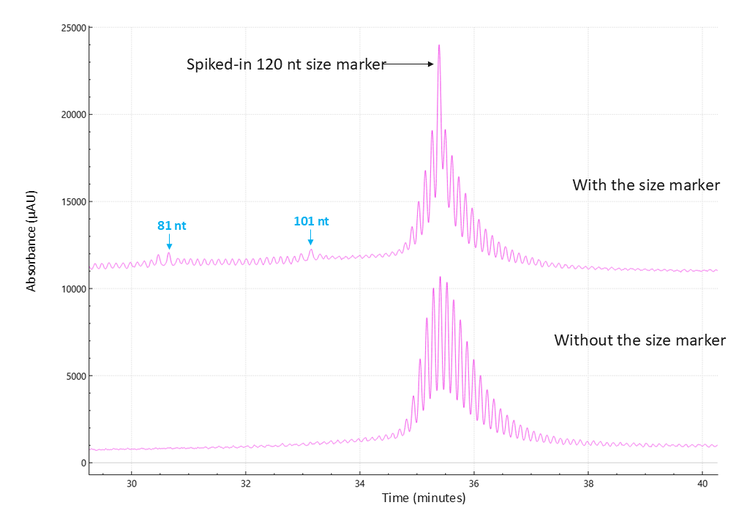
Determination of the poly(A) tail length: To determine the poly(A) tail length, the poly(A) tails released from the TriLink FLuc mRNA sample were mixed with a 120 nt poly(A) size marker before CE separation on the BioPhase 8800 system using the Oligo 200 nt Purity and Integrity kit. As a control, the poly(A) tail samples were also analyzed alone. Results obtained with the poly(A) tail sample and the spiked-in 120 nt size marker are shown in the upper panel of Figure 2, while the results obtained with the poly(A) tail sample alone are shown in the lower panel. Single-nucleotide resolution was achieved in both separation results and maintained throughout the entire poly(A) tail profile. The arrow in the upper panel indicates the 120 nt full-length size marker comigrating with one of the poly(A) tail peaks in the sample, indicating the length of this poly(A) tail peak is 120 nt. This 120 nt peak is the most abundant poly(A) tail species in this sample, consistent with the theoretical 120 nt poly(A) tail length design by TriLink. This sample's poly(A) tail profile included a length distribution from 95 nt to 158 nt. The signal levels for peaks on the left side of the poly(A) tail distribution in the upper trace were higher than those in the lower trace when the poly(A) tail sample was analyzed alone. In addition, the peak spacing was slightly shifted to the right as indicated by the blue arrows. This was caused by the n-1 variants from the spiked-in 120 nt size marker. The peak spacing change was due to the presence of a G at the 80th and 100th position on the size marker.
Analysis of poly(A) tails with different lengths from different mRNA samples:
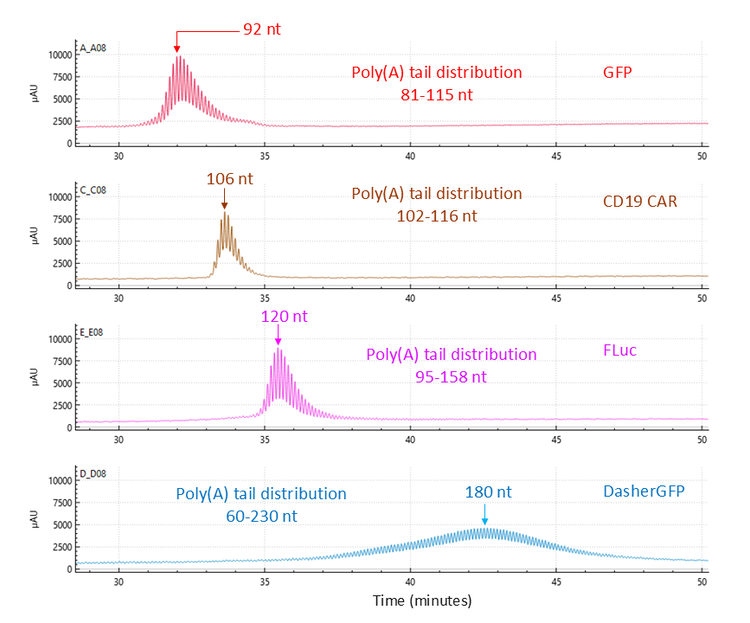
The workflow for mRNA poly(A) tail analysis by CGE-UV is a platform workflow that works well with poly(A) tails of a broad length range with minimal adjustments. In Figure 3, the top trace shows the poly(A) tail profile obtained with GFP mRNA. The most abundant species has an estimated size of 92 nt with a poly(A) tail distribution spanning 81 to 115 nt. The poly(A) tail size is 90 nt by design. The difference between the designed and measured sizes arises because RNase T1 cleaves after G residues. As a result, the released poly(A)-containing fragment includes the nucleotides located between the last G and the first A of the poly(A) tail, increasing the observed fragment size relative to the designed poly(A) length.
The second trace shows the poly(A) tail profile obtained from CD19 CAR mRNA, with the most abundant species at a size of 106 nt and a distribution of 102 to 116 nt. The third trace shows the results obtained with FLuc mRNA, with the most abundant species at a size of 120 nt and a distribution of 95 to 158 nt. The bottom trace shows the poly(A) tail profile from DasherGFP mRNA, with the most abundant species at a size of 180 nt and a distribution ranging from 60 to 230 nt. This heterogeneity in poly(A) length is likely related to transcription slippage of RNA polymerases during in vitro transcription (IVT) reactions. The difference in the range or extent of the poly(A) tail distribution among these mRNA samples is likely related to different RNA polymerases or to different IVT conditions. Additionally, differences in resolution were observed among the poly(A) tail profiles from different mRNA samples. Because RNase T1 cleaves after G residues, the analyzed fragment includes the poly(A) tail and any nucleotides between the last G and the start of the poly(A) region. Differences in the composition and modification of these nucleotides may affect electrophoretic migration. For example, FLuc mRNA contains unmodified U residues, whereas CD19 CAR mRNA contains m1Ψ-modified U residues, which may contribute to the observed differences in resolution.
The same CE method can be applied to mRNA samples regardless of modifications of the Us, reducing the need for sample-specific optimization in comparison to liquid chromatography methods. In addition, the modification of Us is desired for making mRNA therapeutics because it not only increases the stability of the mRNA but also reduces the amount of double-stranded RNA (dsRNA) impurities. Therefore, being able to analyze the poly(A) tails containing modified Us is important.
Assay repeatability:
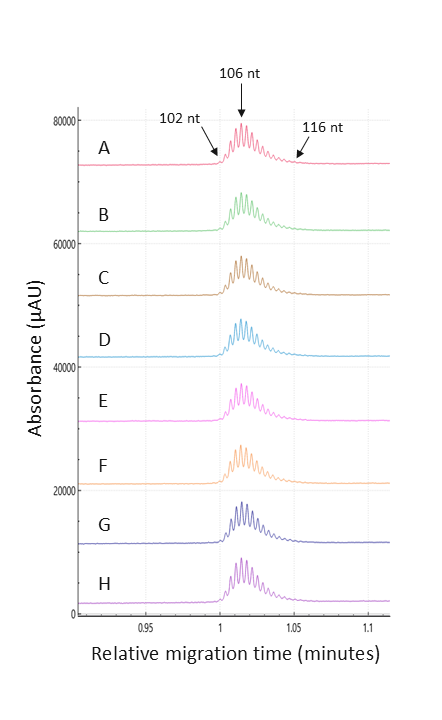
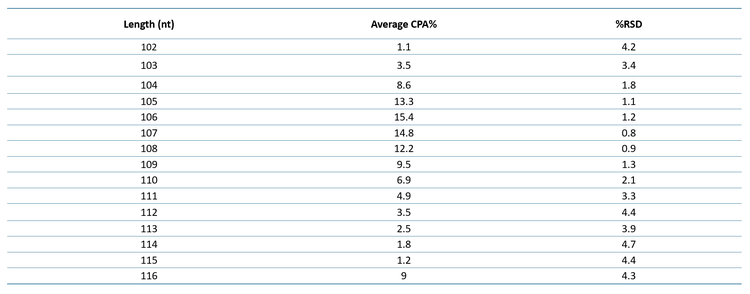
To assess assay repeatability, poly(A) tails from the CD19 CAR mRNA (n=8) were injected into 8 different capillaries independently on a single BioPhase 8800 system and separated using Oligo 200 nt Purity and Integrity gel. Consistent poly(A) tail profiles were obtained from each capillary. The most abundant poly(A) tail species has a length of 106 nt, the poly(A) tail distribution range spans 102 nt to 116 nt in length and 0.05-minutes in migration time, with single-nucleotide resolution maintained throughout the profile. The single-nucleotide resolution throughout the entire poly(A) tail profile facilitates peak integration using the BioPhase 8800 software, adding value to the characterization and quality monitoring of mRNA-based therapeutics for research use. The CPA% of each poly(A) tail species from the CD19 CAR mRNA sample (n=8) was determined and summarized in Table 2. The most abundant 7 species spanning 105 nt to 110 nt in fragment size, cover about 80% of the total CPA of all poly(A) tails. Repeatability was demonstrated by %RSD below 5.0% (n=8, CD19 CAR mRNA, single BioPhase 8800 system). These results demonstrate injection repeatability and inter-capillary consistency on a single system with a single mRNA sample.
Conclusions
- High-resolution platform workflow: Achieved single-nucleotide resolution for poly(A) tails ranging from 92 to 180 nt and characterized distributions spanning 81 to 230 nt across the four mRNA samples tested (GFP, CD19 CAR, FLuc, and DasherGFP; n=4 samples) using a single method on the BioPhase 8800 system.
- Accurate size determination: Confirmed the most abundant FLuc poly(A) tail species at 120 nt, consistent with the theoretical poly(A) tail design.
- Reproducibility: Demonstrated consistent poly(A) tail profiles across 8 independent capillaries (CD19 CAR mRNA, single BioPhase 8800 system, n=8), with %RSD values for CPA% below 5.0%.
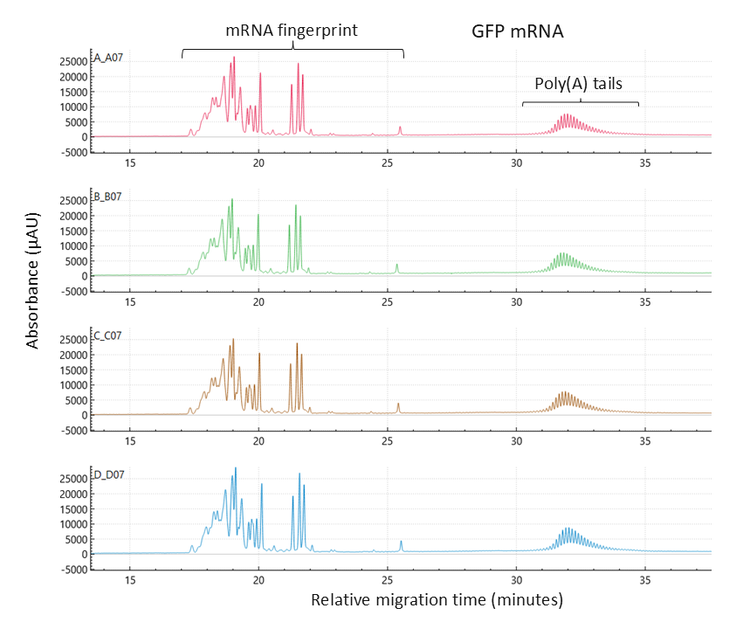
- Multi-attribute characterization: Enabled analysis of both mRNA fingerprint profiles and poly(A) tails in a single workflow (GFP mRNA injected into 4 capillaries on the BioPhase 8800 system, n=4), supporting research-use assessment of mRNA identity, integrity, and poly(A) tail attributes.
- Sensitivity: Demonstrated an LOD below 0.6 µg for the FLuc mRNA (single BioPhase 8800 system, n=1 dilution series), supporting poly(A) tail analysis of purified products. Feasibility for in-process IVT samples and mRNA-LNP vaccine samples was not evaluated in this study and would require separate verification.
References
- Peng L. et al. Multiplexed LNP-mRNA vaccination against pathogenic coronavirus species. Cell Reports 2022; 40:111160.
- Wu N. et al. A potential bivalent mRNA vaccine candidate protects against both RSV and SARS-CoV-2 infections. Molecular Therapy 2024, 32:1033-1047.
- Camperi J. et al. Current Analytical Strategies for mRNA-Based Therapeutics. Molecules 2025, 30(7):1629.
- Sobczak K and Krzyzosiak WJ RNA structure analysis assisted by capillary electrophoresis. Nucleic Acids Res. 2002, 30(22):e124.
- Drennan BW and Schug KA Challenges and advances in analytical separation techniques for RNA-lipid nanoparticle therapeutics. Anal. Bioanal. Chem. 2025 418:395–413.
- Application Guide Oligo 200 nt Purity and Integrity kit for the BioPhase 8800 System, TPUB-CUST-16092-A.