Abstract
This technical note describes an LC–MS/MS method for the simultaneous quantitation of three metanephrines and three catecholamines in plasma, achieving in-sample limits of quantitation (LOQs) of 0.025–2.5 ng/mL. Using the SCIEX QTRAP 4500 system, the method demonstrated robust quantitative performance across plasma matrix-spiked calibration standards (n=3) and QC standards (n=3). The intra- and inter-day performance were evaluated over three consecutive days using spiked plasma QC standards at 1, 10, and 50 ng/mL, achieving inter-day mean accuracy ranging from 87.1% to 108% and precision between 3.2% and 8.6% CV across all spiking levels. Additionally, the Phenomenex Luna C18(2) column provided good peak shape, separation between analytes, consistent retention times and reproducible chromatographic performance for both analyte classes using an 8.1-minute gradient.
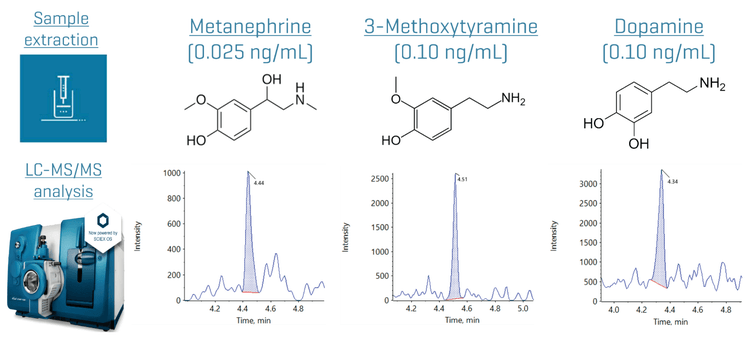
Key benefits of metanephrine and catecholamine analysis in plasma using the QTRAP 4500 system
- Good analytical sensitivity with robust quantitative performance. Using the SCIEX QTRAP 4500, the method achieved in-sample equivalent LOQs between 0.025 and 2.5 ng/mL, with accuracies of 88.5% to 108% and precision from 2.4% CV to 14% CV (n=3)
- Excellent assay reproducibility across analytical batches. Across three sample preparation and analytical batches, QC standards at 1, 10, and 50 ng/mL (n = 3) showed intra-day mean accuracy of 85.8%–113% and precision ranging from 0.8% to 12% CV for all spike levels
- Robust chromatographic performance with symmetrical peak shape and separation from the void volume. The Phenomenex Luna C18(2) column resulted in good peak shape and separation from the void volume, with retention factors (k’) ranging from 3.3 to 4.5
Introduction
Plasma metanephrines (metanephrine, normetanephrine and 3-methoxytyramine) and catecholamines (epinephrine, norepinephrine and dopamine) are commonly measured in clinical research labs to evaluate rare neuroendocrine tumours such as pheochromocytoma and paraganglioma (PPGL).1 Although plasma-free metanephrines are considered to be the most sensitive and specific biomarkers for PPGLs1, measurements of catecholamines can provide complementary regarding catecholaminergic activity, tumour phenotype and autonomic function.2 Therefore, the simultaneous quantitation of metanephrines and catecholamines can provide a more comprehensive biochemical assessment of PPGLs.
Liquid chromatography tandem mass spectrometry (LC-MS/MS) is the preferred analytical technique for the measurement of metanephrines and catecholamines in biological samples due to its high specificity, sensitivity, and multiplexing capability.3 In this technical note, a comprehensive method for the quantitation of three metanephrine compounds and three catecholamine compounds was developed using the SCIEX QTRAP 4500 system. The extraction procedure and chromatographic conditions were extensively optimized, resulting in a sensitive and robust analytical workflow for clinical research applications.
Methods
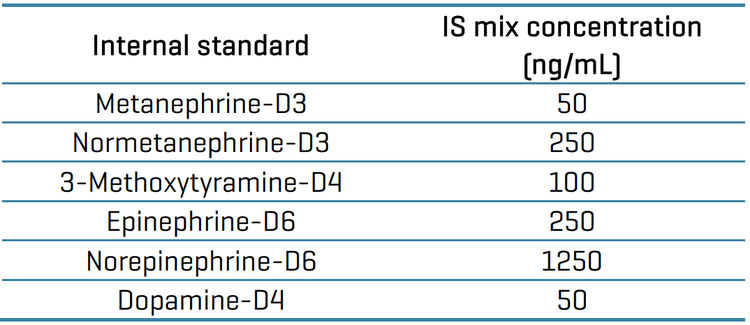
Reagent and standard preparation: The metanephrine (metanephrine, normetanephrine, 3-methoxytyramine) and catecholamine (epinephrine, norepinephrine, dopamine) analytes and deuterated internal standards (IS) were purchased from LGC Standards. Intermediate stock solutions were prepared in methanol and stored at -20 °C. The IS working solution was also prepared in methanol at the concentrations specified in Table 1.
Plasma-spiked calibration standards and QC sample preparation: Charcoal-stripped human plasma (BioCon II, Life Technologies (India) Pvt. Ltd.) was used for the preparation of matrix-spiked calibration standards (n = 1 per level) and quality control (QC) samples (n = 3 per level). Before use, the plasma was pretreated with L-ascorbic acid, as an anti-oxidant, by mixing 950 μL of plasma with 50 μL of 10 mg/mL L-ascorbic acid. Calibration standards were prepared in the pretreated plasma across in-sample concentrations of 0.025, 0.05, 0.1, 0.25, 0.5, 1, 2.5, 5, 25, 75, and 500 ng/mL. QC samples were prepared at in-sample concentrations of 1, 10, and 50 ng/mL.
Sample preparation: Double blank, blank, matrix-spiked calibration and QC standards were extracted and cleaned-up using Waters WCX solid-phase extraction (SPE) cartridges (1 cc, 30 mg, 30 μm). For each sample type, 500 μL of blank or pre-spiked plasma was transferred to a 2 mL centrifuge tube followed by 500 μL of 10mM ammonium acetate (pH 6.0). For the double blanks, 20 μL of methanol was added to the centrifuge tubes, while 20 μL of the IS mix was added to the blanks, calibration and QC standards only. The tubes were vortexed for 15 sec and then processed through the SPE cleanup procedure described below.
Briefly, the SPE cartridges were conditioned with 1 mL of methanol, followed by 1 mL of 10mM ammonium acetate (pH 6.0). The samples were loaded onto the cartridges and washed sequentially with 1 mL of 10mM ammonium acetate (pH 6.0) and 1 mL of 80:20 (v/v) methanol/water. The cartridges were briefly dried and then eluted with 0.1% (v/v) formic acid in methanol. The eluent was evaporated under a nitrogen gas stream, reconstituted in 100 μL of mobile phase A, and transferred to an autosampler vial for LC–MS/MS analysis.
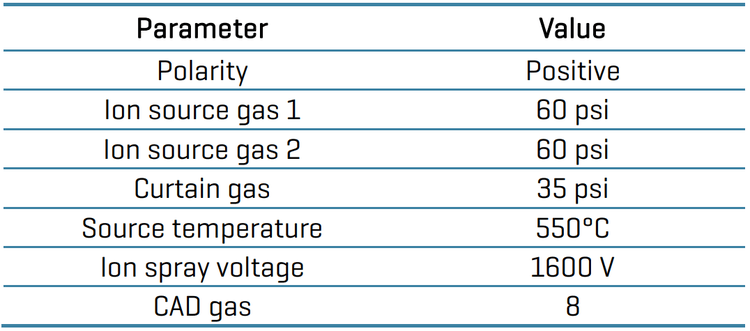
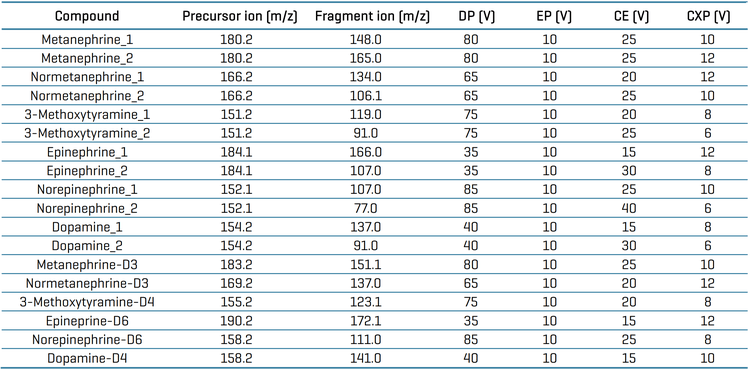
Mass spectrometry: Samples were analyzed using the SCIEX QTRAP 4500 system with electrospray ionization operating in positive polarity mode. Data acquisition was performed using multiple reaction monitoring (MRM), with the optimized source gas parameters listed in Table 3 and compound-specific parameters provided in Table 4. Two MRM transitions were monitored for each compound.
Data processing: Data acquisition and processing were performed using the SCIEX OS software (version 4.0.0.8559). The raw analyte area counts were normalized using the respective IS responses.
Chromatographic performance
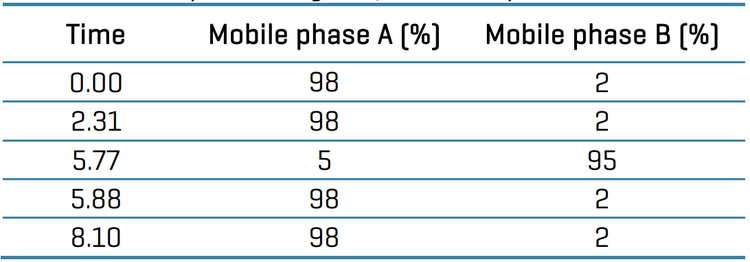
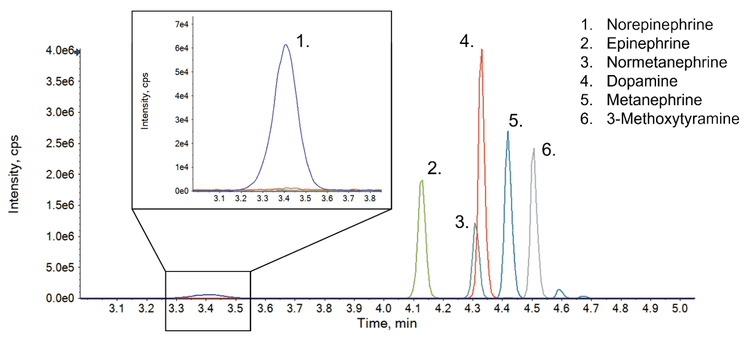
Good chromatography, including adequate void volume separation and symmetrical peak shape, is critical for satisfactory quantitative performance in complex biological matrices such as plasma. Metanephrines and catecholamines are difficult to retain with traditional reverse phase LC columns due to their highly polar and basic characteristics. In this technical note, HFBA was used as an ion-pairing agent to improve retention with the Phenomenex Luna C18 (2) column. Using these conditions, the method provided symmetrical peak shapes, baseline analyte separation, and adequate retention from the void volume within the 8.1-min runtime (Figure 2). Specifically, the analyte retention factors (k’) ranged from 3.3 to 4.5.
Sensitivity, accuracy, and precision in plasma‑spiked calibration standards
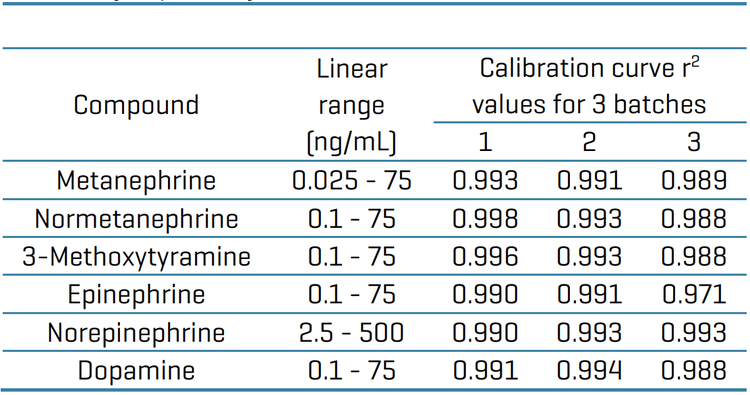
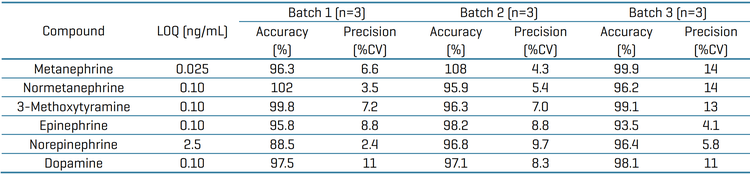
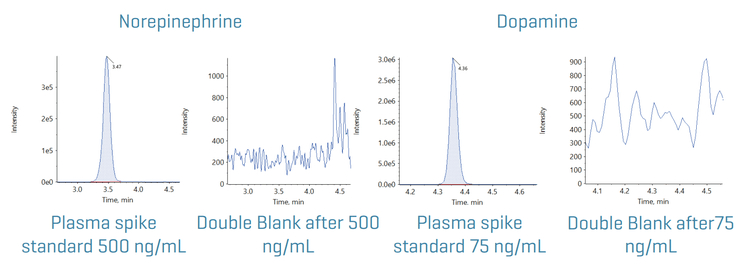
Sensitivity, accuracy, precision, and linearity were assessed through triplicate injections of plasma-spiked calibration standards that were prepared and analyzed over three consecutive days. Raw analyte area counts were normalized to their respective internal standards (Table 4). Calibration ranges for each analyte, based on the quantifier transition, are presented in Table 5. Calibration curves, generated from triplicate injections at each level, showed good linearity (0.971– 0.998) across the three batches using a 1/x2 weighting factor. The method achieved in-sample equivalent LOQs ranging from 0.025 to 2.5 ng/mL (Table 6). Across the three batches, the mean LOQ accuracy ranged from 88.5% to 108%, with mean precision between 2.4% and 14% CV (Table 6). These results demonstrate that the QTRAP 4500 system provides sensitive and reproducible quantitation of metanephrines and catecholamines in plasma.
Quantitative performance in plasma‑spiked QC
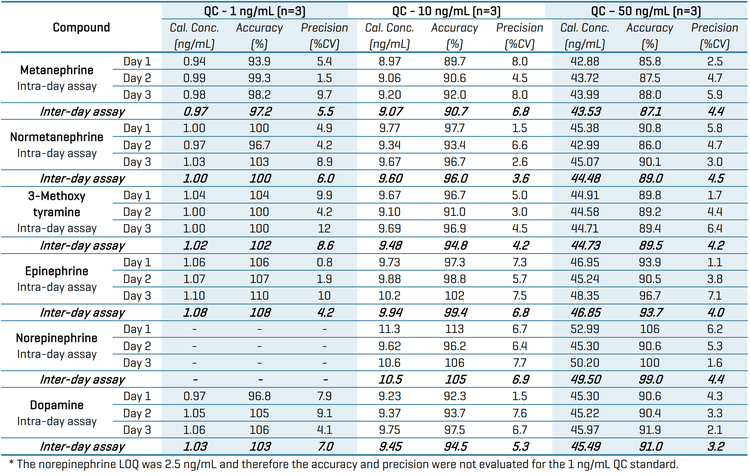
The method quantitative performance was further evaluated in QC standards (n = 3 per level) prepared at 1 ng/mL (low), 10 ng/mL (medium), and 50 ng/mL (high) and quantified against matrix-spiked calibration standards. The intra- and inter-day assay results are summarized in Table 7. Across the three analytical batches, intra-day accuracy ranged from 85.8% to 113%, with precision between 0.8% and 12%CV across all spike levels. Similarly, the inter-day accuracy ranged from 87.1% to 108%, with precision between 3.2% and 8.6%CV. Overall, these results demonstrate the strong reproducible performance of the SCIEX QTRAP 4500 system for the analysis of metanephrines and catecholamines in plasma.
Conclusions
This technical note demonstrated:
- A comprehensive LC-MS/MS method for the analysis of metanephrines and catecholamines in plasma, achieving LOQs ranging from 0.025 to 2.5 ng/mL
- Using a Phenomenex Luna C18 (2) column, the optimized mobile phase conditions and 8.1-minute gradient delivered excellent peak shape, efficient analyte separation, and adequate retention from the void volume with k’ factors ranging from 3.3 to 4.5
- Robust quantitative performance at LOQ concentration for plasma-spiked calibration standards; across three batches, the mean LOQ accuracy ranged from 88.5% to 108%, with mean precision between 2.4% and 14% CV
- Excellent inter-day reproducibility in plasma-spiked QC samples; inter-day mean accuracy ranging from 87.1% to 108% and precision between 3.2% and 8.6% CV
References
- Lenders, J.W.M.; Pacak, K.; Walther, M.M.; Linehan, W.M.; Mannelli, M. et al. Biochemical diagnosis of pheochromocytoma: Which test is best? JAMA 2002, 287 (11), 427-1434. DOI: 10.1001/jama.287.11.1427
- Eisenhofer, G.; Pamporaki, C.; Lenders, J.W.M. Biochemical assessment of pheochromocytoma and paraganglioma. Endocr, Rev. 2023, 44 (5), 862-909. DOI: 10.1210/endrev/bnad011
- Rufolo, S.; Balsamo, A.C.; Parisi, F.; Coglianese, A.; Charlier, B.; Izzo, V. Catecholamines and metanephrines: Quantification in the diagnosis of pheochromocytoma and paraganglioma, consideration and critical issues. Diagnostics 2026, 16 (9), 1263. DOI: 10.3390/diagnostics16091263