Abstract
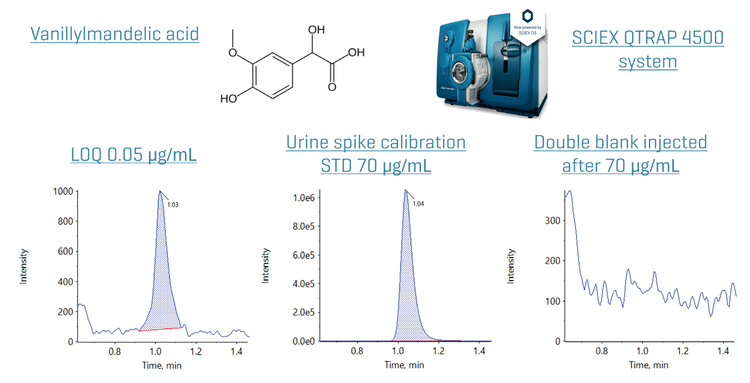
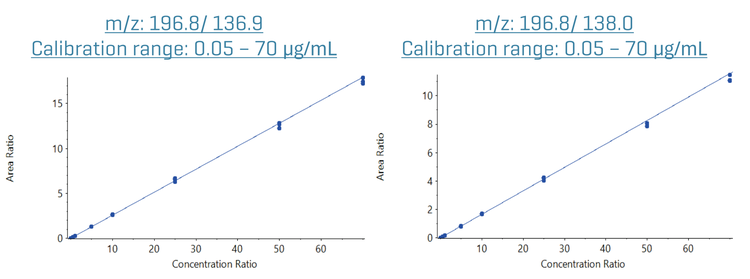
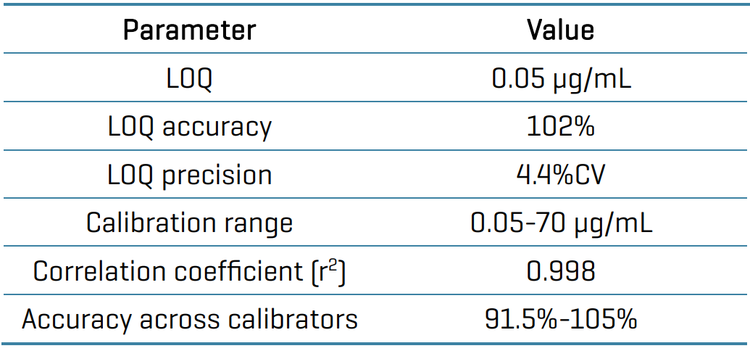
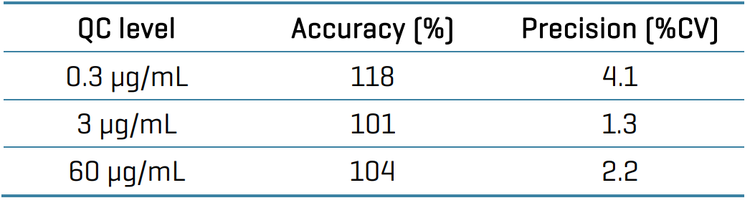
In this technical note, an LC/MS-MS method was developed for the quantitation of vanillylmandelic acid (VMA) in human urine. Using the SCIEX QTRAP 4500 system and 20 μL injection volume, the in-sample equivalent limit of quantification (LOQ) was 0.05 μg/mL (Figure 1) in the urine-spiked calibration standard. Triplicate samples (n=3) were prepared for calibration standards over the range of 0.05-70 μg/mL, and the r² value for the quantifier transition was 0.998. Good quantitative performance was observed in the urine matrix quality control (QC) standards spiked at 0.3, 30, and 60 μg/mL (n=5), with accuracies of 101%-118% and precision of 1.3%-4.1% CV. The developed gradient and the Phenomenex Synergi Polar-RP column showed good peak shape and retention in a 5 min runtime.
Key benefits for the analysis of vanillylmandelic acid in urine on the SCIEX QTRAP 4500 system
- Sensitive quantitation using the QTRAP 4500 system: The method yielded an in-sample LOQ of 0.05 μg/mL for vanillylmandelic acid in the urine spiked calibration standard with mean accuracy of 102% and precision of 4.4 %CV
- Rapid sample preparation: A simple 1000-fold dilution reduced sample preparation time, while maintaining sensitivity to analyze vanillylmandelic acid in human urine samples
- Good analyte peak shape and retention: The Phenomenex Synergi Polar-RP column and gradient showed good peak shape, retention and void volume separation of the analyte with a retention factor (k’) 1.34 (retention time ~ 1.0 min) within the 5 min runtime.
Introduction
Vanillylmandelic acid (VMA) is the major end-product of catecholamine metabolism (epinephrine, norepinephrine, dopamine) and is predominantly excreted in urine.1 Elevated urinary VMA concentrations are clinically relevant biomarkers for catecholamine-secreting tumors such as neuroblastoma, pheochromocytoma and paraganglioma in pediatric populations.2 Liquid chromatography–tandem mass spectrometry (LC-MS/MS) remains the preferred analytical approach for VMA quantitation due to its specificity, robustness and compatibility with high-throughput workflows. In this technical note, we describe a simple dilution-based sample preparation strategy and an LC-MS/MS method optimized on the SCIEX QTRAP 4500 system to enable reliable quantitation of VMA in human urine using a routine-sensitivity mass spectrometry platform.
Methods
Reagent and standard preparation: The analyte and internal standard (ISD) were purchased from LGC Standards. Intermediate stock solutions of the analyte and ISD were prepared in methanol and stored at -20°C. The ISD working solution was prepared in methanol at 50 ng/mL.
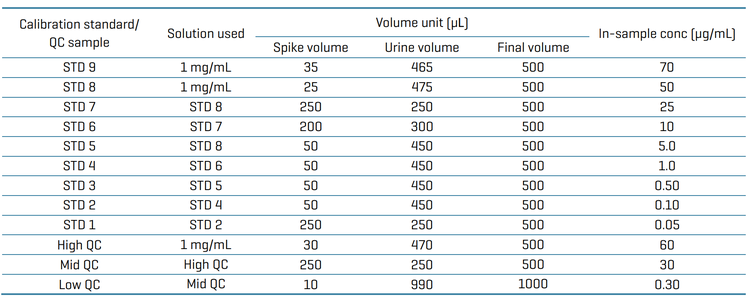
Urine-spiked calibration standards and QC sample preparation: The experiments used acidified Sigmatrix Urine Diluent (Millipore Sigma) as the synthetic matrix to prepare the blanks, calibration standards (n=3) and QC samples (n=5). The urine matrix was acidified by adding 0.125 mL of acetic acid to 50 mL of the Sigmatrix Urine Diluent. The urine-spiked calibration standards and QC samples were prepared using the scheme shown in Table 1.
Sample preparation: The double blanks, blanks, calibration standards and QC samples were prepared by 1000-fold dilution in two stages. First, 980 μL of HPLC-grade water was aliquoted into 2 mL microcentrifuge tubes. For the calibration standards and QC samples, 20 μL of the corresponding urine-spiked calibration standard or QC sample was added, and the tubes were vortexed for 10 s. For the double blank and blank samples, 20 μL of the acidified control urine was added, and the tubes were vortexed for 10 s. Second, the blank, calibration standard and quality control samples were further diluted by aliquoting 50 μL of the initial dilution sample into a clean tube containing 900 μL of HPLC-grade water and vortexed for 10 s. Then, 50 μL of the IS solution was added, and the tubes were vortexed again. The double blank samples were diluted by aliquoting 50 μL of the initial dilution into a clean tube containing 950 μL of HPLC-grade water and vortexed. Finally, the samples were transferred to autosampler vials for LC-MS/MS analysis.
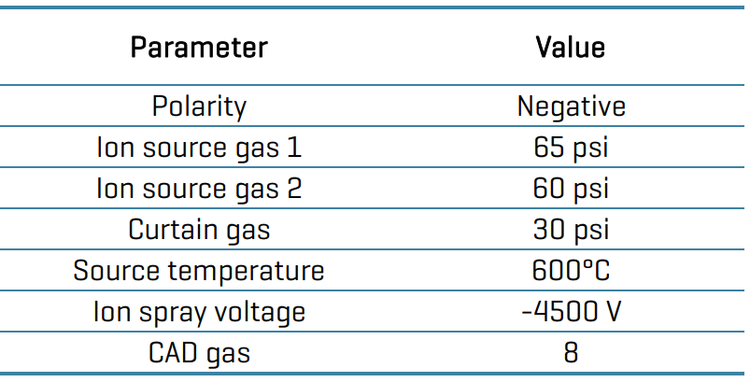
Mass spectrometry: Samples were analyzed using the SCIEX QTRAP 4500 system with electrospray ionization operating in negative polarity mode. Data was acquired using multiple reaction monitoring (MRM) with the optimized source and gas parameters shown in Table 3 and the compound-specific parameters in Table 4. Two MRMs per compound were monitored.
Data processing: Data acquisition and processing were performed using the SCIEX OS software (version 4.0). The raw peak area count was normalized to the IS response.

Sensitivity, accuracy and precision in urine-spiked calibration standards
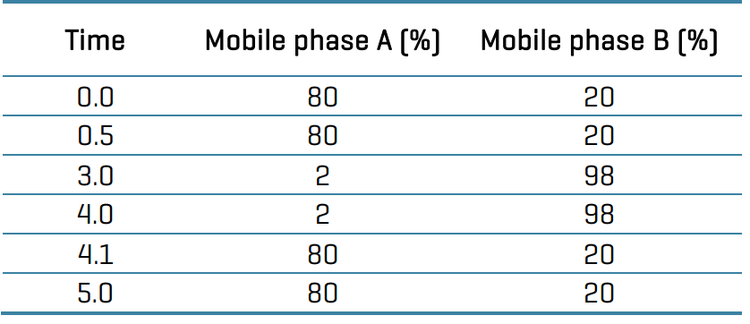
The chromatographic conditions for compound analysis were optimized to provide a fast run time of 5 minutes. The gradient conditions and Phenomenex Synergy Polar-RP column provided good peak shape, retention and separation of the analyte from the void volume, thereby reducing potential matrix interferences. Further, the analyte retention time was ~1.0 min, as shown by a retention factor (k’) of 1.34 with a 5 min runtime (Figure 1).
Urine-spiked matrix calibration standards were used to evaluate the method sensitivity, accuracy, precision and linearity. The calibration curve was plotted using triplicate samples (n=3) for each standard level. The SCIEX QTRAP 4500 system showed good sensitivity for vanillylmandelic acid, with an in-sample equivalent LOQ of 0.05 μg/mL, and linearity over 0.05-70 μg/mL in urine-spiked calibrators (see Figure 1 for the LOQ XIC and Figure 2 for the IS-normalized calibration curves). The LOQ selection was based on the following criteria for both quantifier and qualifier transitions: signal-to-noise (S/N) ratio ≥ 10 for both MRMs, accuracy (± 30%), precision %CV (< 15%), and ion ratio tolerance (±30%). The LOQ mean accuracy was 102%, and the mean precision was 4.4% CV. Excellent linear dynamic range (3 orders of magnitude) was observed in the urine-spiked matrix calibration standards with an r2 value of 0.998 using the 1/x2 weighing factor. The internal standard normalized mean accuracy of the full calibration standard set ranged from 91.5% to 106%. The quantitative data for the quantifier transition of the calibration standards are shown in Table 5.
Carry-over was evaluated by analyzing a double blank immediately after the highest calibration standard (70 μg/mL). Across the batch, no vanillylmandelic acid peak was detected in the double blank (Figure 1), demonstrating negligible carryover in the LC-MS/MS system.
Quantitative performance in urine-spiked QC standards
The method performance was further evaluated using QC standards (n=5) prepared at 0.3 μg/mL (low), 30 μg/mL (mid) and 60 μg/mL (high) levels and quantified against the matrix-spiked calibration standards. The mean QC accuracy ranged from 101% to 118%, and the mean QC precision ranged from 1.3% to 4.1% CV. The IS-normalized urine-spiked QC standards result for the quantifier MRM transition are shown in Table 6. Overall, these results demonstrate the method’s capability for analyzing vanillylmandelic acid in human urine samples using the SCIEX QTRAP 4500 system.
Conclusions
This technical note demonstrated:
- A simple extraction method with a 1000-fold dilution to analyze vanillylmandelic acid in human urine samples
- Optimal chromatographic peak shape and retention from the void volume using the Phenomenex Synergi Polar-RP column with a 5 min gradient
- Using the SCIEX QTRAP 4500 system, the in-sample equivalent LOQ of 0.05 μg/mL was obtained in the urine spike matrix calibration standards
- Good linearity in the urine spike matrix calibration standards with an r² value of 0.998 using the weighting factor of 1/x²
- Excellent quantitative performance in the urine spiked matrix QC standards (n=5); mean accuracy was 101-118%, precision <5%CV
References
- Eisenhofer, G.; Kopin, I.J.; Goldstein, D.S. Catecholamine metabolism: a contemporary view with implications for physiology and medicine. Pharmacol. Rev. 2004, 56(3), 331-349. DOI: 10.1124/pr.56.3.1
- Eisenhofer, G.; Peitzsch, M.; Bechmann, N.; Huebner, A. Biochemical diagnosis of catecholamine-producing tumors of childhood: neuroblastoma, pheochromocytoma and paraganglioma. Front. Endocrinol. 2022, 13, 901760. DOI: 10.3389/fendo.2022.901760