Quantitative analysis of homocysteine in human urine samples
Abstract
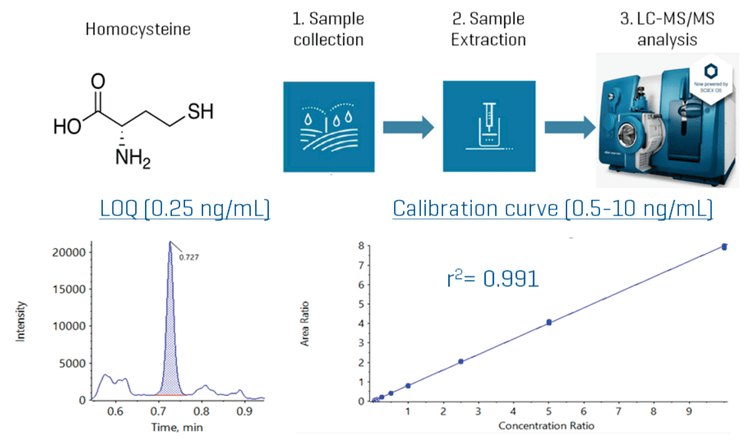
In this technical note, an LC-MS/MS method was developed for the analysis of homocysteine in human urine, achieving an in-sample limit of detection (LOQ) of 0.25 ng/mL (Figure 1). Using the SCIEX QTRAP 6500+ system and a simple protein precipitation sample preparation, good quantitative performance was shown in urine matrix calibration and quality control (QC) standards. Specifically, across 3 separate batches, the LOQ accuracy ranged from 101% to 107% and the precision ranged from 2.3%CV to 6.7%CV. Further, good linear dynamic range was shown with r2 values ranging from 0.991 to 0.998. In addition, the Phenomenex Luna Omega PS C18 column exhibited good peak shape and retention for the 3 min gradient. Intra-and inter-day performance was evaluated over 3 consecutive days. Overall, the inter-day accuracy and precision, calculated as the mean of the 3 batches, was 94.1% and 4.3%CV for the 0.50 ng/mL QC, and 100% and 2.2%CV for the 2.5 ng/mL QC.
Key benefits of the analysis of homocysteine in urine using the SCIEX QTRAP 6500+ system
- Rapid 3 min runtime for high sample throughput. The combination of the Phenomenex Luna Omega PS C18 column and gradient conditions achieved good peak shape and chromatographic separation from the void volume in 3 min
- Sub-ng/mL sensitivity in urine: The homocysteine LOQ was 0.25 ng/mL using only 20 μL of urine and the QTRAP 6500+ system. Further, over 3 separate analytical batches, the mean LOQ accuracy ranged from 101% to 107% and the LOQ precision ranged from 2.3%CV to 6.7%CV
- Good intra- and inter-day variability: During 3 consecutive days, QC standards at 0.5 ng/mL and 2.5 ng/mL showed inter-day mean accuracy of 94.1% and 100%, respectively, with a mean precision of 4.3%CV and 2.2%CV.
Introduction
Homocysteine is a non-essential amino acid that serves as an intermediate during the metabolism of methionine1. After formation, homocysteine may be remethylated back to methionine or further degraded via transulfuration to cysteine and other metabolites. Various B vitamins – primarily B6, B9 and B12 - are critical in the homocysteine biological pathway and deficiencies have been linked to high circulating levels of homocysteine (hyperhomocysteinemia).2 Other potential causes include genetic defects impacting methionine metabolism and environmental factors such as the consumption of certain pharmaceuticals. In addition to identifying potential genetic and B vitamin concerns, high levels of homocysteine are a known risk factor for cardiovascular disease.2 Although homocysteine is typically analyzed in plasma, urinary levels can also be monitored.
In this technical note, a simple and rapid sample preparation LC-MS/MS method was developed for the low-level (ng/mL) quantitation of homocysteine in human urine samples using the SCIEX QTRAP 6500+ system.
Methods
Reagent and standard preparation: The analyte and mass labelled internal standard (ISD, homocysteine-13C415N) were purchased from LGC Standards. Analyte intermediate stock solutions were prepared in water. An internal standard stock solution of 0.5 mg/mL was prepared in phosphate buffer, and intermediate stock solutions were prepared in water.
Reagent preparation: The dithiothreitol (DTT) reduction solution (77 mg/mL) was freshly prepared in HPLC water prior to sample preparation each day. The trifluoroacetic acid (TFA) precipitation solution (0.5 μL/mL TFA with 0.5 μL/mL formic acid) was prepared in acetonitrile using a volumetric flask.
Urine calibration standards and QC samples: Calibration standards were prepared, using the intermediate stocks, in blank urine matrix (Sigmatrix Urine Diluent, Sigma-Aldrich) at the following concentrations: 0.25, 0.5, 1.0, 2.5, 5.0 and 10 ng/mL (n=3). and QC standards were prepared at 0.50 and 2.5 ng/mL (n=5). Although not certified as homocysteine-free, pre-screening showed no detectable homocysteine peaks. The urine-spiked calibration and QC standards were prepared and analyzed on three consecutive days.
Sample preparation: 20 μL of urine (calibrator, control, or sample) and 20 μL of internal standard were added to an Eppendorf tube. 20 μL of the DTT reduction reagent was added, the tube vortexed for 10 s and then incubated for 15 min at ambient temperature. Then, 100 μL of the TFA precipitation reagent was added, tube vortexed for 10 s and incubated for 10 min at 4ºC. Following incubation, the tube was vortexed for 10 s and centrifuged for 5 min at 15,000 rpm. Prior to analysis, 100 μL of the supernatant was transferred to a low-volume autosampler vial for injection onto the LC-MS/MS system.
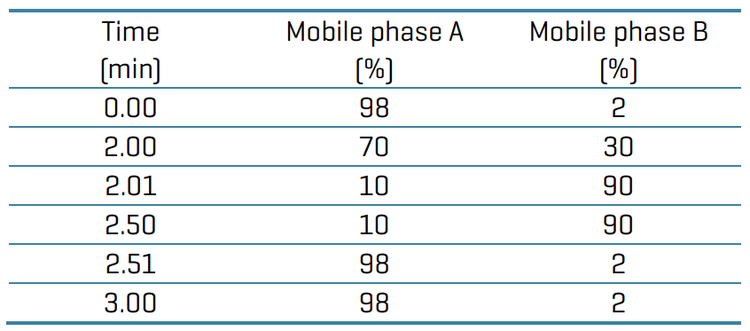
Chromatography: Chromatographic separation was performed using an ExionAD LC system and a Phenomenex Luna Omega PS C18 column (1.6 µm, 100 x 2.1 mm, P/N: 00D-4752-AN). Mobile phase A was water with 0.05% (v/v) formic acid, and mobile phase B was acetonitrile with 0.05% (v/v) formic acid. The runtime was 3 min using the gradient conditions presented in Table 1. The flow rate was 400 µL/min, the injection volume was 5 μL, and the column oven temperature was 40°C.
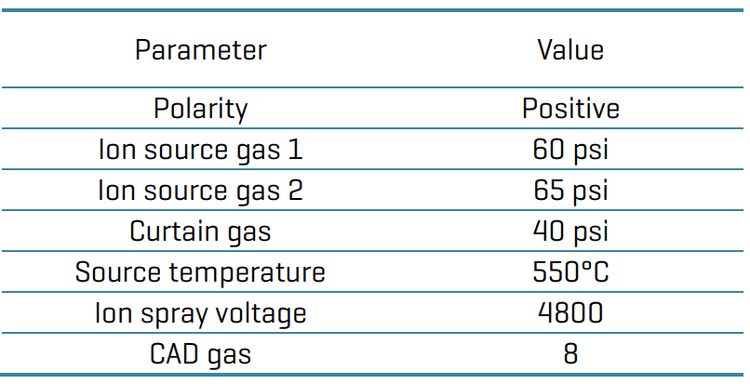
Mass spectrometry: Samples were analyzed using the QTRAP 6500+ system with electrospray ionization in positive polarity mode. Data was acquired using multiple reaction monitoring (MRM) with the compound-specific parameters (Table 2) and optimized source gas parameters (Table 3) described. Two MRMs per compound were monitored.
Data processing: Data acquisition and processing were performed using SCIEX OS software (version 3.4.5.828). Raw area counts were ISD-normalized.

Chromatographic retention of homocysteine using the Phenomenex Luna Omega PS C18 column
The combination of the Phenomenex Luna Omega PS C18 column and optimized gradient conditions enabled the good retention and peak shape for homocysteine during the short 3 min runtime. The homocysteine retention time was 0.75 min as compared to the estimated void peak retention time of 0.60 min. Adequate separation from the void volume reduced the potential impact from the unretained urine interferences. Further, the 3 min runtime is critical for high sample throughput.
Sensitivity, accuracy, precision and linear dynamic range in urine-spiked calibration standards
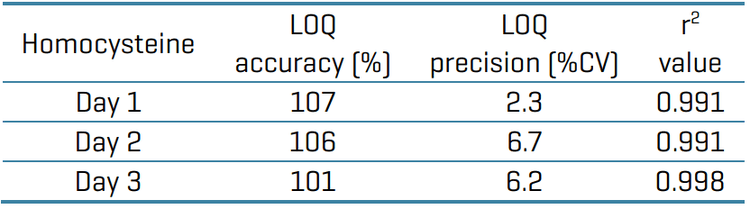
A series of urine matrix calibration standards were prepared at in-sample concentrations ranging from 0.25 to 10 ng/mL. Samples were spiked prior to extraction (n=3) and prepared and analyzed on 3 consecutive days. Raw area counts were normalized to the ISD response. Good sensitivity was achieved on the SCIEX QTRAP 6500+ system and the in-sample LOQ was 0.25 ng/mL. The LOQ was determined by using the two selective MRM transitions, achieving a signal-to-noise (S/N) ratio of≥10 for both MRMs, accuracy of <30%, precision of <15%, and ion ratio tolerance of ±30%. The LOQ accuracy ranged from 101% to 107% across the 3 batches and the precision ranged from 2.3%CV to 6.7%CV (Table 4). Considering the entire calibration range, the mean accuracy was between 85.9 and 107% and precision was <10%CV. In addition, good linear dynamic range was shown with r2 values ranging from 0.991 to 0.998 across the 3 batches.
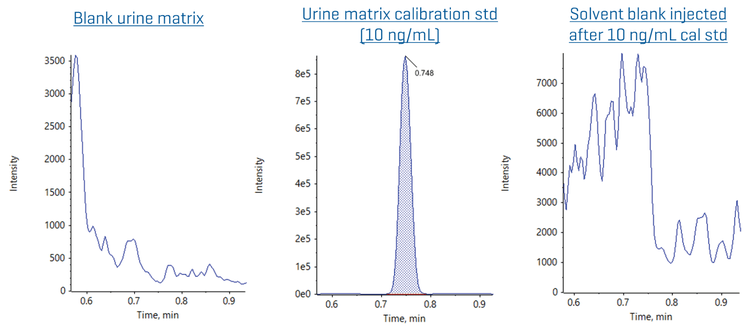
Carry-over was evaluated by running a solvent blank after the highest calibration standard. Throughout the batches, no homocysteine peak was detected in the solvent blank (example shown in Figure 2), demonstrating negligible carry-over in the LC-MS/MS system. As noted above, the Sigmatrix Urine Diluent was pre-screened and it showed no detectable homocysteine peak.
Overall, these results demonstrate the ability of the sample preparation method and QTRAP 6500+ system to generate good accuracy and precision data for homocysteine in urine at sub- to low-ng/mL levels.
Intra- and inter-day variability in urine matrix-QC samples
QC samples (n=5 per level) at 0.50 ng/mL and 2.5 ng/mL were prepared and analyzed on three consecutive days to evaluate the method intra- and inter-day variability. Quantitation was performed using the urine matrix calibration curve that was generated on that day. Intra-day accuracy and precision ranged between 89.2-102% and 3.0- 5.1%CV for the 0.50 ng/mL QC standards, and between 100- 101% and 1.7-2.9% for the 2.5 ng/mL QC standards (Table 5).
The overall inter-day accuracy and precision, calculated as the mean of the 3 batches, was 94.1% and 4.3%CV for the 0.50 ng/mL QC, and 100% and 2.2%CV for the 2.5 ng/mL QC. Overall, these results demonstrate excellent method intraand inter-day quantitative performance for the analysis of homocysteine in urine using the QTAP 6500+ system.

Conclusion
This technical note demonstrated:
- A simple, rapid sample preparation procedure using protein precipitation and only 20 μL of urine
- 3 min runtime using the Phenomenex Luna Omega PS C18 column; good peak shape and void volume separation were shown
- LOQ of 0.25 ng/mL in urine extracted matrix calibration standards using the SCIEX QTRAP 6500+ system
- Good quantitative performance for the LOQ calibration standard across 3 separate analytical batches; the mean LOQ accuracy ranged from 101% to 107% and the LOQ precision ranged from 2.3%CV to 6.7%CV
- Reproducible data quality across 3 consecutive days in 0.5 ng/mL and 2.5 ng/mL QC standards; inter-day mean accuracy of 94.1% and 100%, respectively, with a mean precision of 4.3%CV and 2.2%CV
- A simple sample preparation method with a 5 µL injection volume for the analysis of homocysteine compound in a urine sample using the SCIEX QTRAP 6500+ system
References
- McCaddon, A.; Miller, J.W. Homocysteine – a retrospective and prospective appraisal. Front. Nutr. 2023, 10, 1179807. DOI: 10.3389/fnut.2023.1179807
- Kumar, A.; Palfrey, H.A.; Pathak, R.; Kadowitz, P.J.; Gettys, T.W.; Murthy, S.N. The metabolism and significance of homocysteine in nutrition and health. Nutr. Metab. 2017, 14, 78. DOI: 10.1186/s12986-017-0233-z