Sensitive, high-throughput LC-MS/MS analysis of homovanillic acid in human urine
Abstract
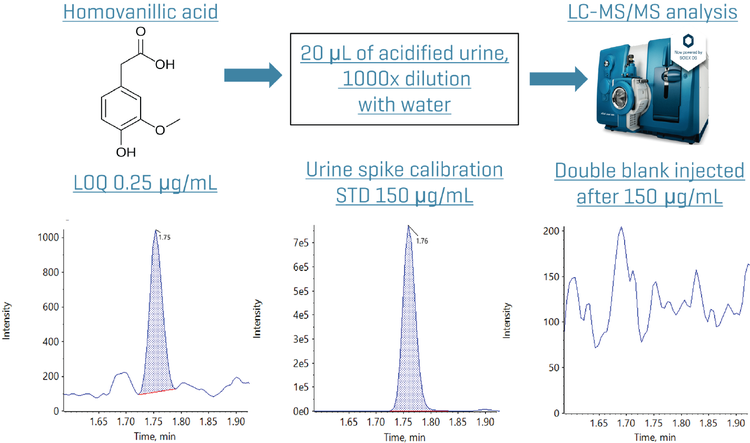
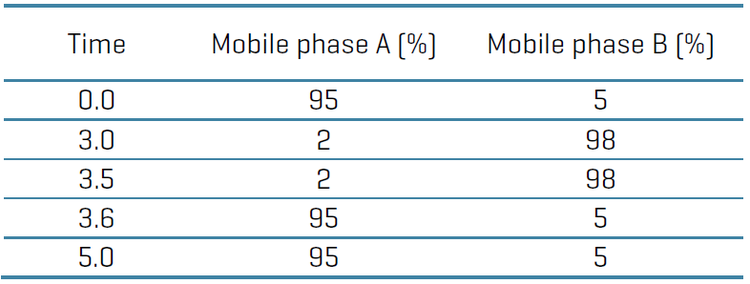
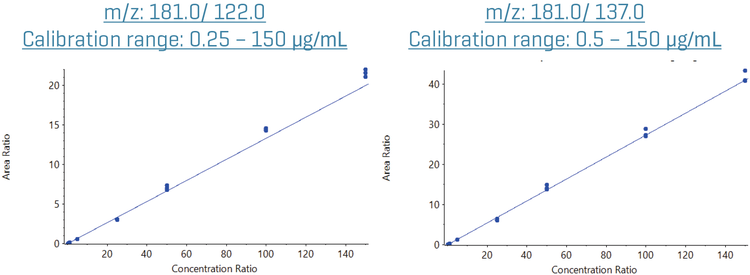
This technical note demonstrated a simple 1000-fold dilution sample preparation and LC-MS/MS method for the analysis of homovanillic acid in urine samples. Using the SCIEX QTRAP 6500+ system, the in-sample equivalent limit of quantification (LOQ) was 0.25 μg/mL for the quantifier transition and 0.50 μg/mL for qualifier transition (Figure 1). Further, the method showed good linearity across the calibration range of 0.25-150 μg/mL, with an r² value of 0.989. Matrix quality control (QC) standards evaluated at 1.5, 20, and 120 μg/mL (n=5 per level) showed mean accuracy from 77.7% to 100% and mean precision <9.8%CV. The Phenomenex Synergi Polar-RP column showed good peak shape and retention from the void volume using the rapid 5 min gradient.
Key benefits of the analysis of homovanillic acid in urine samples using the QTRAP 6500+ system
- Good sensitivity in urine matrix-spiked calibration standards: Using the SCIEX QTRAP 6500+ system, the LOQ was 0.25 μg/mL for the quantifier transition with a mean LOQ accuracy of 106% and precision of 11%CV (n=3)
- Accurate and precise quantitation in urine matrix-spiked QC standards: QC standards spiked at 1.5, 20 and 120 μg/mL (n=5 per level) showed mean accuracy from 77.7 to 100% with mean precision <9.8%CV
- Good analyte peak shape and void volume separation: The Phenomenex Synergi Polar-RP column and method gradient conditions achieved good peak shape and excellent retention from the void volume within the 5 min runtime, allowing for high sample throughput
Introduction
Homovanillic acid (HVA) is the primary metabolite of dopamine in the human body and acts as an indirect marker of dopamine turnover in the brain.1,2 HVA is formed from dopamine through consecutive reaction with monoamine oxidase and catechol-O-methyltransferase.2 HVA is highly water-soluble and readily excreted by the kidneys, and therefore, conveniently monitored in urine. HVA urinary levels have been used as a non-invasive biomarker, alongside other metabolites such as vanillylmandelic acid (VMA), for certain catecholamine-secreting tumours, such as neuroblastoma and pheochromocytoma.3 LC-MS/MS is the ideal technique for the HVA analysis in biological samples due to the sensitivity, selectivity and robustness. In this technical note, a simple dilution sample preparation procedure was used to accurately and precisely quantify HVA in urine using the SCIEX QTRAP 6500+ system.
Methods
Reagent and standard preparation: The analyte and internal standard (ISD) were purchased from LGC Standards. Intermediate stock solutions were initially prepared in methanol and stored at -20°C. The ISD working solution was prepared at 50 ng/mL in methanol.
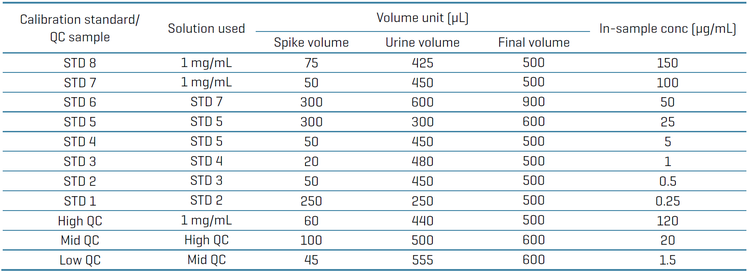
Urine-spiked calibration standards and QC sample preparation: Sigmatrix Urine Diluent (Millipore Sigma) was used as the matrix to prepare the calibration standards (n=3) and QC samples (n=5). Prior to use, a stock of acidified urine was prepared by adding 0.125 mL of acetic acid to 50 mL of the Sigmatrix Urine Diluent. Urine-spiked calibration standard and QC samples were prepared using the scheme shown in Table 1.
Sample preparation: The sample preparation procedure consisted of a 2-stage dilution with HPLC water, ultimately resulting in a 1000-fold dilution of the original urine sample. To prepare the calibration standards and QC samples, 20 μL of the corresponding urine-spiked calibration standard or QC sample was added to 980 μL of HPLC-grade water in 2 mL microcentrifuge tubes. The tubes were vortexed for 10 s and further diluted by aliquoting 50 μL of the initial dilution sample into a clean tube containing 900 μL of HPLC grade water and vortexed for 10 s. Finally, 50 μL of the ISD solution was added and the tubes vortexed. To prepare the double blank and blank samples, 20 μL of the acidified control urine was added to 980 μL of HPLC-grade water in 2 mL microcentrifuge tubes and the tubes vortexed for 10 s. The blank was further diluted by aliquoting 50 μL of the initial diluent into a clean tube containing 900 μL of HPLC grade water, vortexed for 10 s, 50 μL of the ISD solution added and the tubes vortexed again. The double blank was further diluted by aliquoting 50 μL of the initial diluent into a clean tube containing 950 μL of HPLC grade water and then vortexed.
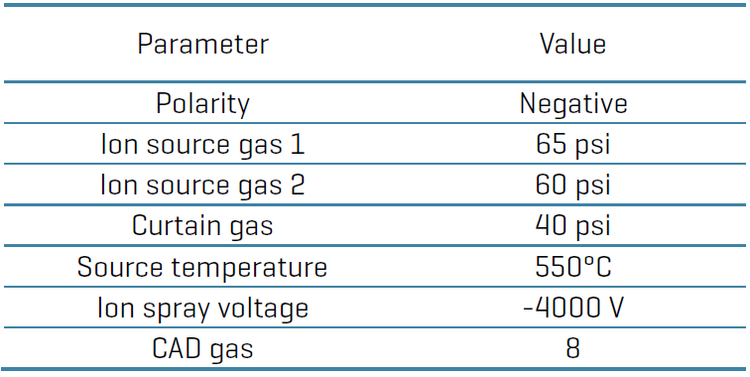
Mass spectrometry: Samples were analyzed using the SCIEX QTRAP 6500+ system with electrospray ionization operating in negative polarity mode. Data was acquired using multiple reaction monitoring (MRM) with the optimized source and gas parameters shown in Table 3 and the compound-specific parameters in Table 4. Two MRMs per compound were monitored.
Data processing: Data acquisition and processing were performed using the SCIEX OS software (version 4.0.0.8559). The raw homovanillic acid area count was normalized to the ISD response.

Method performance in urine-spiked calibration standards: Sensitivity, accuracy and precision
Matrix interferences in biological samples, such as urine and blood, can result in poor quantitative performance, including false positives or negatives. The sensitivity of the QTRAP 6500+ system allowed for a simple 1000-fold dilution sample preparation procedure which minimized potential matrix interferences while maintaining sensitivity to achieve the sub-μg/mL LOQ. Further, the Phenomenex Synergi Polar-RP column provided good retention from the void volume and unretained polar interferences. Specifically, the retention time was ~1.75 min with a retention factor (k’) of 2.98.
The quantitative performance of the method, using the QTRAP 6500+ system, was evaluated in a series of urine-matrix spiked calibration standards, prepared in triplicate. Good sensitivity was achieved, as demonstrated by the in-sample LOQ of 0.25 μg/mL for the quantifier transition (m/z 181.0/ 122.0) and 0.50 μg/mL for the qualifier transition (m/z 181.0/137.0). The representative LOQ chromatogram for the quantifier transition is shown in Figure 1. Considering the quantifier transition, the mean LOQ accuracy was 106% and the mean LOQ precision was 11%CV. The calibration curves showed good linearity across the range of 0.25-150 μg/mL for the quantifier and qualifier transitions (Figure 2). Specifically, r² values were 0.989 and 0.992 for the quantifier and qualifier MRMs, respectively, using the weighting factor of 1/x². The urine-matrix calibration standard LOQ accuracy and precision, and r² values are shown in Table 5. The method carry-over was evaluated by running a double blank sample immediately after the highest calibration standard. As shown in Figure 1, no homovanillic acid peak was detected in the double-blank, demonstrating negligible carryover in the LC-MS/MS system.
Accuracy and precision in urine-spiked QC standards
The method reproducibility was evaluated using urine-spiked QC samples at 1.5, 20, and 120 μg/mL (n=5 per level). The QC area counts were normalized to the ISD response and were quantified against the urine matrix-spiked calibration curve. Overall, the QCs showed good accuracy and precision across 3 spiking levels, demonstrating the ability of the QTRAP 6500+ system to produce good quantitative data for the analysis of homovanillic acid in urine (data presented in Table 6). The mean QC accuracy range was 77.7–100% and the mean precision was <9.8%CV.


Conclusion
This technical note demonstrated:
- An LC-MS/MS method for the analysis of homovanillic acid in urine using the QTRAP 6500+ system with a simple sample preparation procedure using a 1000-fold dilution with water
- Good peak shape and retention from the void volume using the Phenomenex Synergi Polar-RP column with a 5 min linear gradient
- An LOQ of 0.25 μg/mL in the urine-spike calibrators (n=3) with a mean accuracy of 106% and mean precision of 11%CV for the quantifier transition
- Linearity across the 0.25-150 μg/mL calibration range with an r² value for the quantifier transition
- Good quantitative performance in the urine matrix QC standards (n=5); mean accuracy was 77.7–100% and precision <9.8%CV
References
- Amin, F.; Davidson, M.; Davis, K.L. Homovanillic acid measurement in clinical research: A review of methodology. Schizophr. Bull. 1992, 18(1), 123-148. DOI: 10.1093/schbul/18.1.123
- Marin-Valencia, I.; Serrano, M.; Ormazabal, A.; Perez-Duenas, B.; Garcia-Cazorla, A.; Campistol, J.; Artuch, R. Biochemical diagnosis of dopaminergic disturbances in paediatric patients: Analysis of cerebrospinal fluid homovanillic acid and other biogenic amines. Clin. Biochem. 2008, 41(16-17), 1306-1315. DOI: 10.1016/j.clinbiochem.2008.08.077
- Verly, I.R.N.; van Kuilenburg, A.B.P.; Abeling, N.G.G.M.; Goorden, S.M.I.; Fiacco, M. et al. Catecholamines profiles at diagnosis: Increased diagnostic sensitivity and correlation with biological and clinical features in neuroblastoma patients. Eur. J. Cancer 2017, 72, 235-243. DOI: 10.1016/j.ejca.2016.12.002