Abstract
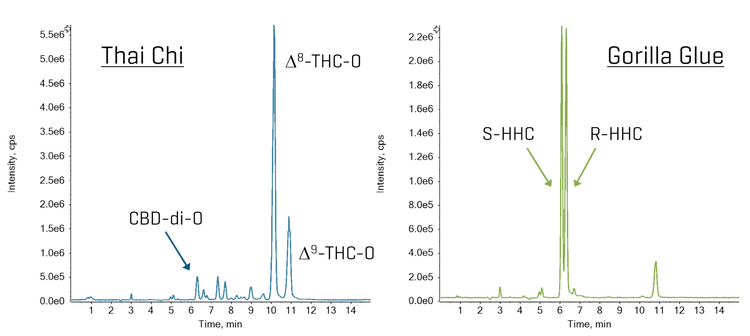
This technical note demonstrates a robust LC-MS/MS method for the separation and quantitation of 12 cannabinoids in commercial vape e-liquids. Using the SCIEX QTRAP 6500+ system coupled with a Phenomenex Kinetex C18 column, chromatographic resolution was achieved for several challenging cannabinoid isomers including 𝚫8-THC, 𝚫9-THC, exo-THC, cannabichromene, cannabidiol, acetylated THC derivatives, and hexahydrocannabinol isomers (Figure 1). A five-day validation study demonstrated good linearity with all calibration curves showing r2≥0.996. The method was applied to 25 commercially available e-liquids, revealing substantial diversity in the cannabinoid composition and highlighting the value of selective, reliable analytical methods to accurately characterize these highly complex vape products.
Key benefits of cannabinoid analysis using the SCIEX QTRAP 6500+ system
- Differentiate legacy and emerging cannabinoids with confidence Chromatographic resolution of key cannabinoid isomers and analogs was achieved using the Phenomenex Kinetex C18 column
- Reliable quantitative results. Good analytical performance demonstrated across a 5-day validation study including carry-over, calibration curve linearity and quality control (QC) accuracy and bias
- Comprehensive characterization of commercial vape products. The method was applied to 25 e-liquids demonstrating a diverse cannabinoid profile
Introduction
The use of electronic cigarettes and vaping devices to deliver cannabinoids has expanded rapidly over the past decade, transforming both the legal cannabis and illicit drug markets. Although vaping was initially promoted as an alternative to combustible nicotine products, these devices have increasingly been adapted for the delivery of 𝚫9-tetrahydrocannabinol (𝚫9-THC), cannabidiol (CBD), and the growing array of semi-synthetic and synthetic cannabinoids. Regulatory changes, including the 2018 U.S. Agricultural Improvement Act (the “Farm Bill”), facilitated the emergence of a largely unregulated market of hemp-derived cannabinoid vaping products, including 𝚫8-THC, 𝚫6a,10a-THC, hexahydrocannabinol (HHC), tetrahydrocannabiphorol (THCP), THC-O-acetates, and other analogs synthesized from CBD.1,2 Although some of these compounds occur naturally in cannabis or hemp, they are typically present at trace concentrations and are marketed as legal alternatives despite limited pharmacological and toxicological evaluation. Reported adverse effects include hallucinations, sedation, vomiting, and/or seizures.3,4
Cannabinoid vaping products often contain high concentrations (>40%) of active compounds together with solvents, terpenes, flavoring agents, and carrier liquids such as propylene glycol, vegetable glycerin, and medium-chain triglycerides. Characterizing the cannabinoid profile of vaping products is important because a survey of U.S. users indicated that cannabinoids are the most frequently vaped drugs other than nicotine.5 Products may also contain complex mixtures of positional isomers, acetylated derivatives, hydrogenated cannabinoids, and unintended reaction byproducts arising from poorly controlled synthetic processes.1 This increasing chemical diversity presents significant analytical challenges and to monitor these emerging cannabinoid analogs, a robust chromatographic method for the separation and quantitation of cannabinoids is presented. The method is readily adaptable to incorporate newly emerging cannabinoids as they enter the marketplace.
Methods
Target analytes. The method targeted 𝚫9-THC isomers and related cannabinoid analogues, including cannabichromene (CBC), 𝚫9-THC, 𝚫8-THC, cannabidiol (CBD), 𝚫6a,10a-THC, exo-THC, 𝚫9-THC-P, 𝚫8-THC-P, hexahydrocannabinol (HHC), 𝚫8-THC-O-acetate, 𝚫9-THC-O-acetate, and cannabidiol diacetate (CBD-di-O). Deuterated internal standards included CBD-d3, THC-d3, 𝚫9-THC-O-d3, exo-THC-d3, and CBD-di-O-d3. Certified reference materials were obtained from commercial suppliers when available. Reference materials for cannabinoid acetate analogues were synthesized in-house from certified parent compounds by acetylation using pyridine and acetic anhydride at 75°C overnight. Conversion of parent cannabinoids to their corresponding acetate derivatives was confirmed by gas chromatography–mass spectrometry.
Calibrator preparation. Calibration curves were prepared over a concentration range of 10 to 1000 ng/mL or 1 to 100% in the products. Quality control samples were prepared at low, mid, and high concentrations of 30, 300, and 750 ng/mL or 3%, 30%, and 75% in the products, respectively, along with blank controls with internal standard (ISTD) and double blanks without ISTD. All calibrators and controls were prepared in methanol and analyzed alongside samples. Analyte concentrations were calculated by 1/x weighted linear regression based on ISTD normalized peak areas using the SCIEX Analyst software.
Sample preparation, A total of 25 commercially available e-liquids, labeled as containing THC isomers and semi-synthetic cannabinoids, were purchased for analysis. For each sample, approximately 40 mg of vaping formulation was accurately weighed and diluted to a final volume of 1 mL with methanol. Samples were homogenized by agitation using a Bead Ruptor 24 (Biotage, Uppsala, Sweden). Prior to analysis, each sample was further diluted to a ratio of 1:4000 (v/v) vaping formulation to methanol.
Liquid chromatography. Chromatographic separation was performed using a SCIEX ExionLC 2.0 system equipped with a Phenomenex Kinetex C18 column (2.6 μm, 100 Å, 150 × 3.0 mm, P/N 00F-4462-Y0). The LC was operated under isocratic conditions consisting of 25:75 (v/v) mobile phase A (water with 1 g/L ammonium formate and 0.1% (v/v) formic acid): mobile phase B (acetonitrile). The flow rate was 0.650 mL/min, column oven set to 40oC and injection volume was 5 μL. The total runtime was 15 min.
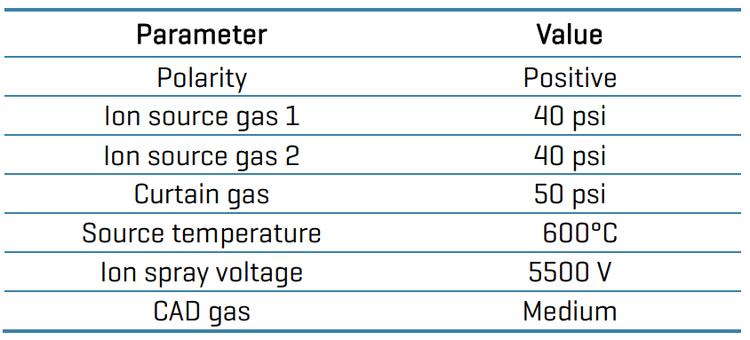
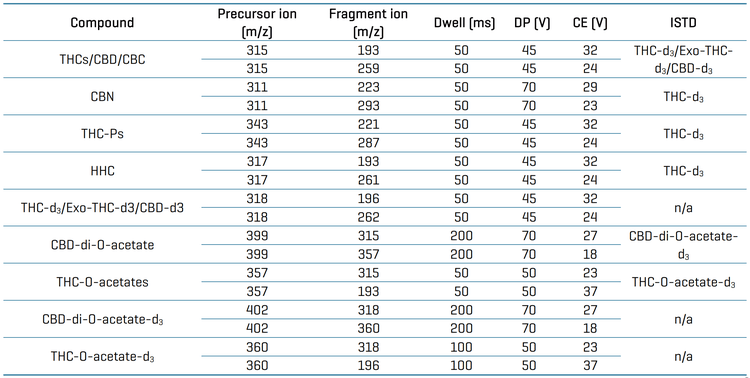
Mass spectrometry. Samples were analyzed using a SCIEX QTRAP 6500+ system equipped with an IonDrive Turbo V ion source and an electrospray ionization (ESI) probe operated in positive ion mode. Compound-specific and ion source and gas parameters were manually optimized and are presented in Tables 1 and 2. Data was acquired using multiple reaction monitoring (MRM) mode with the compound-specific parameters listed in Table 2. Raw area counts were normalized to the deuterated analogs listed in Table 2.
Chromatographic separation and method validation
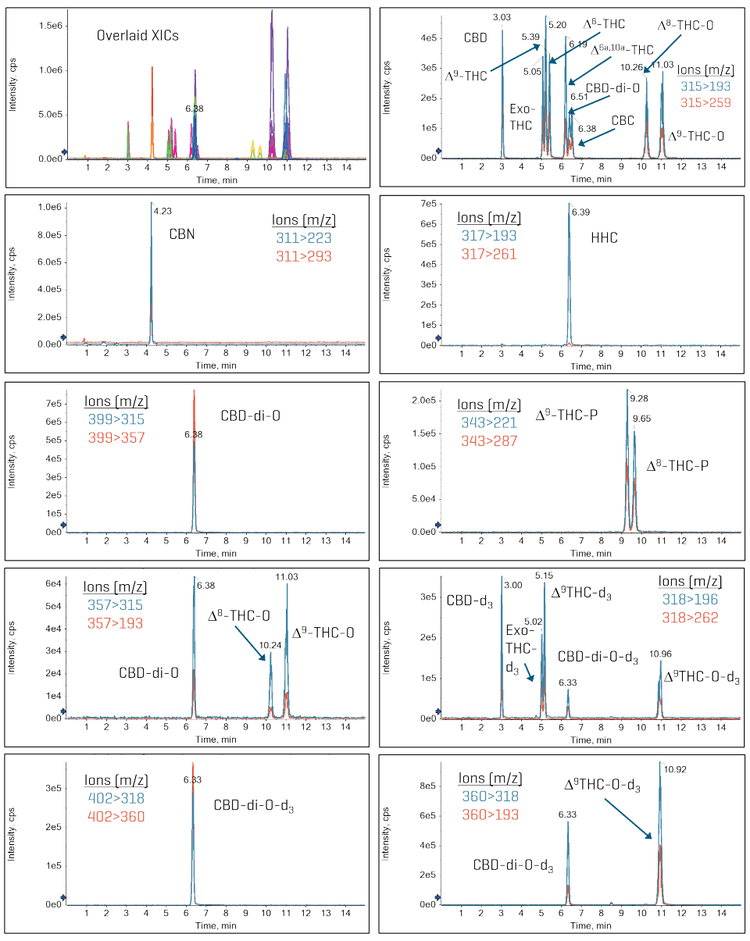
Using the Phenomenex Kinetex C18 column and mobile phase conditions, chromatographic resolution of the isobaric compounds was achieved, including: 𝚫8-THC, 𝚫9-THC, exo-THC, CBC, and CBD; 𝚫8-THC-acetate and 𝚫9-THC-acetate; and R-hexahydrocannabinol (R-HHC) and S-hexahydrocannabinol (S-HHC), enabling reliable identification and quantitation of these closely related analytes (Figure 2). No carryover was observed in blank samples following injection of the highest calibrator (100% concentation), and no internal standard carryover was detected in double-blank samples across all five validation days.
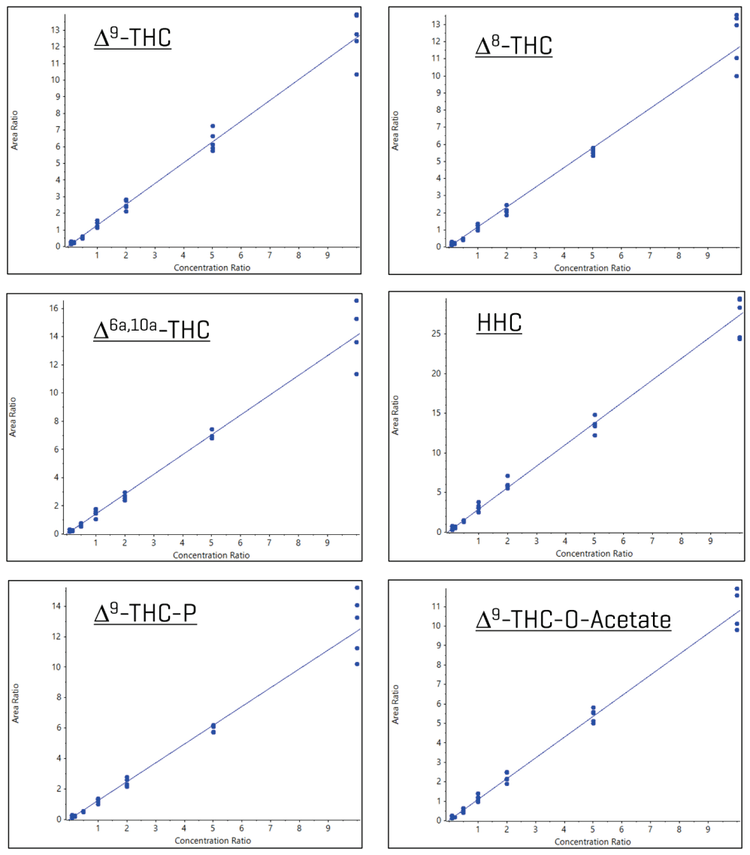
A five-day validation was successfully completed for the method. Linearity was evaluated over five analytical days (n = 5), with all calibration curves demonstrating coefficients of determination (r2) ≥ 0.9958 (Figure 3). Accuracy and bias were assessed using quality control samples analyzed in triplicate (n = 3) across each of the five validation days and were found to be within acceptable limits. Specifically, for the low QC, all analytes demonstrated accuracy within ±20% and precison <20%. For the mid QC, accuracy was within ±9% and precision <11% for all analytes. Finally, for the high QC, all analytes showed accuracy within ±6% and precision <11%.
Product analysis
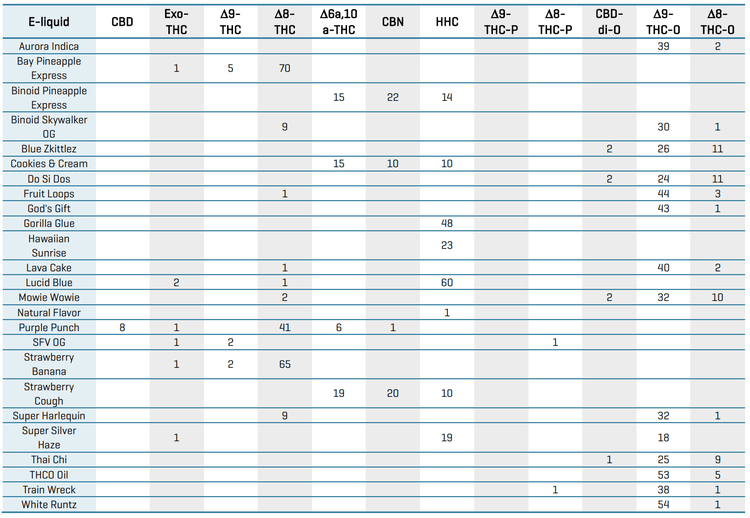
Analysis of the 25 commercially available e-liquids labeled as containing THC isomers and analogues revealed a wide range of cannabinoid compositions (Table 3). Several products contained predominantly 𝚫8-THC, including Bay Pineapple Express (70%), Strawberry Banana (65%), and Purple Punch (41%). 𝚫6a,10a-THC and exo-THC were detected in multiple samples, often alongside 𝚫8-THC and 𝚫9-THC. Cannabinol (CBN), a known oxidation product of THC, was present in several formulations, indicating potential product aging or thermal and oxidative degradation. Both HHC isomers were identified in eight samples and, in some cases, at appreciable total HHC concentrations (e.g., Gorilla Glue at 48% and Lucid Blue at 60%). The THC propyl analogue, 𝚫8-THC-P, was detected at low concentrations in only two products. Reports have suggested that this compound may exhibit increased potency relative to 𝚫8-THC. Acetylated cannabinoids were identified in 14 products, with 𝚫9-THC-O-acetate present at higher concentrations than 𝚫8- THC-O-acetate. Cannabidiol diacetate (CBD-di-O) was detected in only three of the acetylated cannabinoid formulations. Figure 1 shows total ion chromatograms (TICs) highlighting the cannabinoid profiles in the Thai Chi and Gorilla Glue e-liquids.
The successful characterization of these complex and highly isomeric cannabinoid mixtures was enabled by the high sensitivity and selectivity of the QTRAP 6500+ system combined with the resolving power of the Phenomenex Kinetex C18 analytical column. This instrumental configuration provided sufficient chromatographic separation and mass spectrometric discrimination to resolve closely related and isobaric cannabinoid species, allowing for reliable identification and quantitation across a wide range of cannabinoid classes.
Conclusions
This technical note demonstrated:
- An LC-MS/MS method for the separation and quantitation of 12 phyto-, semi-synthetic, and synthetic cannabinoids in vape e-liquids
- Chromatographic separation of challenging cannabinoid isomers including 𝚫8-THC, 𝚫9-THC, exo-THC, cannabichromene, cannabidiol, acetylated THC derivatives, and hexahydrocannabinol isomers using the Phenomenex Kinetex C18 column
- Reliable quantitative performance in a 5-day validation study demonstrating negligible carry-over, good calibration curve linearity and quality control (QC) accuracy and bias
- Application of the method for the characterization of cannabinoids in 25 commercial e-liquid products
Funding
This project was funded in part by National Institute of Health (P30DA033934 and T32DA007027) and National Institute of Justice 2019-MU-MU-0007. The content is solely the responsibility of the authors and does not necessarily represent the official views of the National Institutes of Health or the National Institute of Justice.
References
- Love, C.A.; Porter, N.A.; Kim, H.H.; Jaspers, I. Cannabinoid vaping products: Regulation, composition, toxicological effects, and emerging research. Chem. Res. Toxicol. 2025, 38 (12), 2028-2040. DOI: 10.1021/acs.chemrestox.5c00240
- Zhang, S.; Alam, M.M.; Chandler, B.D.; Lanorio, J.P.; Deskins C.; Song, L. Potency analysis of semi-synthetic cannabinoids in vaping oils using liquid chromatography diode array detector with electrospray ionization time-of-flight mass spectrometry for confirmation of analyte identity. Molecules 2025, 30 (12), 2597. DOI: 10.3390/molecules30122597
- Holt, A.K.; Poklis, J.L.; Peace, M.R. 𝚫8-THC, THC-O acetates and CBD-di-O acetate: Emerging synthetic cannabinoids found in commercially sold plant material and gummy edibles. J. Anal. Toxicol. 2022, 46 (8), 940-948. DOI: 10.1093/jat/bkac036
- Holt, A.K.; Karin, K.N.; Butler, S.N.; Ferreira, A.R.; Krotulski, A.J.; Poklis, J.L.; Peace, M.R. Cannabinoid-based vaping products and supplement formulations reported by consumers to precipitate adverse effects. Drug Test. Anal. 2023 15 (10), 1067-1076. DOI: 10.1002/dta.3253
- Holt, A.K.; Rudy, A.K.; Sawyer, A.N.; Poklis, J.L.; Breland, A.B.; Peace, M.R. Survey of U.S. residents and their usage of electronic cigarettes with drugs other than nicotine. J. Psychoactive Drugs 2024, 56 (4), 568-577. DOI: 10.1080/02791072.2023.2250353