Optimizing instrument sensitivity for robust and accurate quantitation of fluorotelomer alcohols (FTOH) in textiles
Abstract
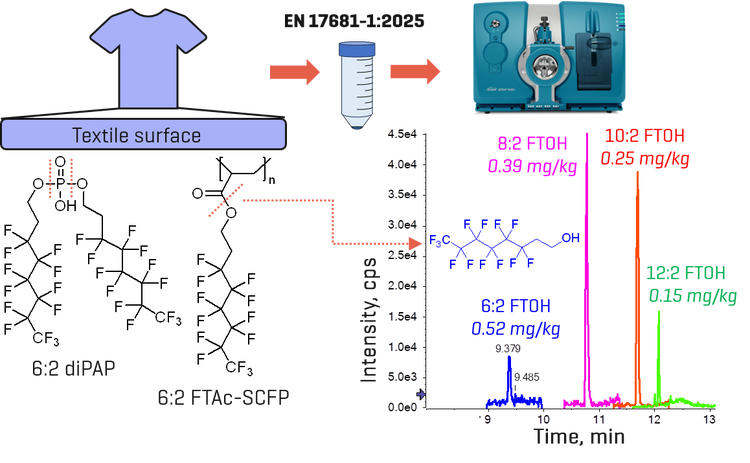
This technical note describes an LC-MS/MS method optimized for the sensitive quantitation of 6 fluorotelomer alcohols (FTOHs) in textiles using the SCIEX Triple Quad 6500+ system. Optimization of source parameters, such as temperature, enabled in-vial limits of quantitation (LOQ) of 1-5 ng/mL, representing on-column masses of 5-10 pg for all analytes. Apparent and absolute recoveries were in the range of 70–130% for most analytes. Excellent inter-day precision was demonstrated for a quality control (QC) spike over a 2-month period, with %CV values of 7–11%. The detection of FTOHs in a textile sample at sub-mg/kg levels demonstrated the method’s applicability for trace-level screening in real-world textile products (Figure 1)
Key benefits of the SCIEX Triple Quad 6500+ system for the analysis of FTOHs in textiles:
- Calibration and sensitivity: Optimized source conditions increased sensitivity, particularly for 4:2 and 6:2 FTOHs, resulting in in-vial LOQs of 1-5 ng/mL, equivalent to 5-10 pg on-column, with r2 ≥0.9945 and LOQ accuracies of 92–114%.
- Textile recovery performance: A spiked cloth sample, extracted using the EN 17681-1:2025 approach, produced recoveries of 71–111% for most analytes.
- Repeatability and applicability: Excellent inter-day repeatability (%CVs of 7–11%) was demonstrated for 22 QC replicates over a 2-month period, while the method detected 6:2, 8:2, 10:2 and 12:2 FTOHs in a real textile sample.
Introduction
Per- and polyfluoroalkyl substances (PFAS) are widely used in textile manufacturing to impart durable water-, oil- and stain-repellency to consumer and industrial fabrics.1 However, growing concerns regarding their environmental persistence, bioaccumulation potential and adverse health effects have led to increased regulatory scrutiny worldwide, including restrictions under the European Union’s REACH regulation EU 2024/24622 and the OEKO-TEX certification limits.3 Several member states in the EU, such as Denmark and France, and US states, such as California, New York and Washington, have already regulated the use of PFAS in textiles and further stringent regulations on textiles have been proposed. As regulatory requirements expand beyond freely extractable PFAS to include polymeric and precursor compounds, comprehensive analytical methods are needed to understand the overall PFAS burden in textile products.
Fluorotelomer-based precursors, such as side-chain acrylate and methacrylate polymers and polyfluoroalkyl phosphate diesters (diPAPs), are commonly used in textile finishes to achieve durable surface treatments. These precursors can undergo degradation to form fluorotelomer alcohols (FTOHs) and other PFAS products, which they themselves may also be present as impurities and residuals, resulting in their widespread detection in textiles.4-6 EN 17681-1:2025 method7 was developed to address limitations of the earlier EN 17681-1:2022 method, which relied primarily on methanolic extraction, restricting the analysis to free or loosely bound PFAS. The revised standard introduces an alkaline hydrolysis extraction step that degrades side-chain fluorinated polymers, releasing and improving the detection of PFAS monomers like FTOHs that were not effectively measured by the previous method.
Analysis of FTOHs by LC-MS/MS can be challenging due to their poor ionization efficiency, high volatility and susceptibility to matrix effects from co-extractables in complex textile extracts. This technical note features optimized conditions on the SCIEX Triple Quad 6500+ system to maximize sensitivity for FTOH quantitation, in response to the expanding regulatory scope of PFAS compliance monitoring in consumer textiles.
Methods
Samples and standards: Standards and sample extracts were provided by TÜV Rheinland.
Sample preparation: A 1 g portion of a navy-blue textile sample (~0.3–0.5 cm2) was extracted with 14 mL of methanol and 1.4 mL of 40% (w/v) sodium hydroxide in water. After sonicating at 60°C for 60 min, the sample was cooled down and adjusted to a pH of 6–7 with glacial acetic acid, with additional adjustment if needed upon 5 minutes of equilibration. The entire sample was then brought to a final volume of 20 mL with water. After centrifuging and filtering, an aliquot of the supernatant was diluted five-fold with methanol and transferred to an autosampler vial for LC-MS/MS analysis. A method blank and a method spike were prepared in solvent by repeating the above sample preparation without the matrix.
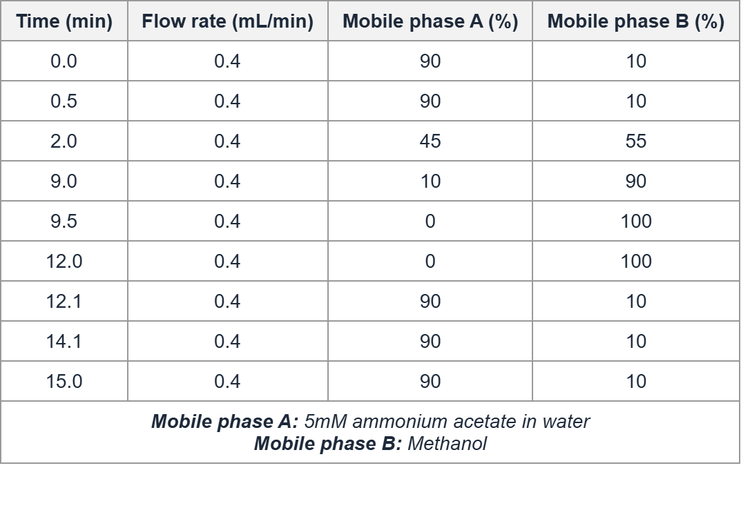
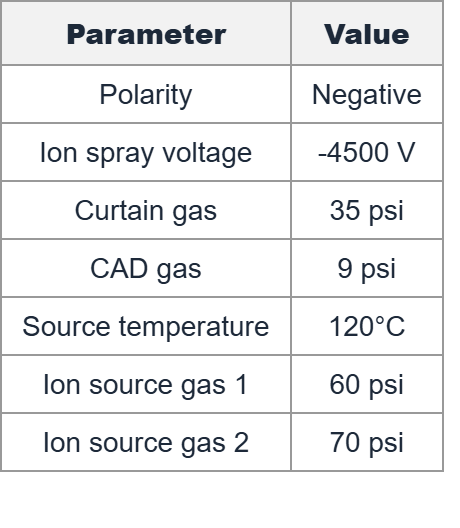
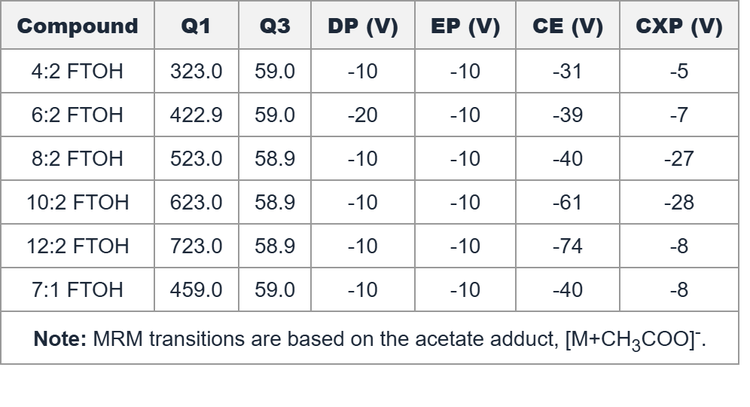
Chromatography: Chromatographic separation was performed on a Waters Acquity LC system using an Agilent Poroshell 120 EC-C18 column (100 x 3.0 mm, 2.7 µm) as the analytical column and the Phenomenex Luna Omega PS C18 (50 x 3.0 mm, 3 µm, P/N: 00B-4758-Y0) as the delay column. A column oven temperature of 40°C, an autosampler temperature of 10°C and an injection volume of 5 µL were used. Table 1 shows the chromatographic gradient.
Enhancing instrument sensitivity for FTOH analysis by source temperature optimization
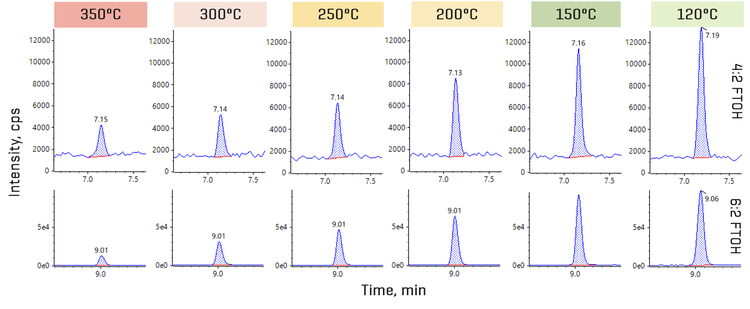
The impact of source temperature on instrument sensitivity of the FTOHs was evaluated by injecting a 50 ng/mL solvent standard at different temperatures of 120°C, 150°C, 200°C, 300°C and 350°C. Figure 2 demonstrates an approximate 3x increase in sensitivity for 2 example FTOHs, the 4:2 FTOH and 6:2 FTOH, between 350°C and 120°C. Based on this optimization experiment, the source temperature in the final method was selected to be 120°C for subsequent analysis. The high sensitivity of the SCIEX Triple Quad 6500+ system also enabled a small injection volume of 5 µL and the use of solvent-based calibration to minimize the matrix load on the instrument.
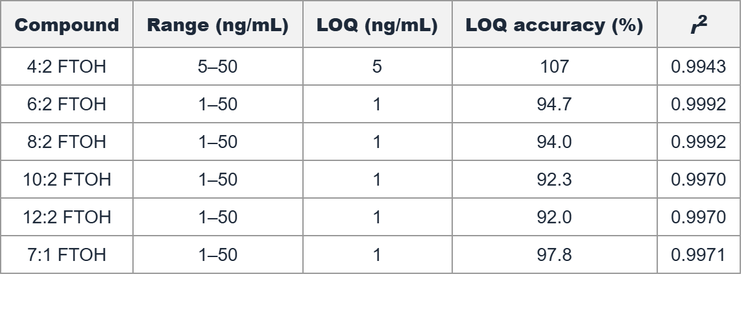
A solvent calibration curve, comprised of in-vial concentrations of 1, 5, 10, 25 and 50 ng/mL, was injected to evaluate the linear performance of the SCIEX Triple Quad 6500+ system (Table 4). The instrumental limits of quantitation (LOQs) were selected based on the lowest concentration achieving a calibration accuracy of ±30% and signal-to-noise ratio (S/N) ≥10. The in-vial LOQ was set to 1 ng/mL for most analytes, except for 4:2 FTOH which required a higher LOQ of 5 ng/mL. Accuracies at the LOQ ranged from 92% to 107%, while accuracies of 85–115% were achieved for the rest of the calibration curve.
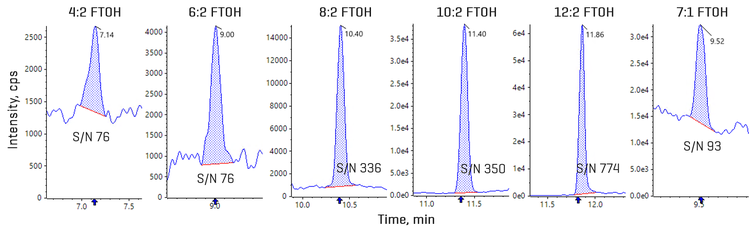
All analytes exhibited linear regression coefficients of r2 ≥0.994 with a weighting factor of 1/x. Figure 3 demonstrates representative XICs of the target FTOHs at their corresponding LOQs in the solvent standard, showing well-resolved chromatographic peaks with good S/N.
Back-calculation of the solvent LOQs through the sample preparation steps resulted in an approximation of the in-sample LOQs at 0.1–0.5 mg/kg. Current textile regulations generally do not impose standalone concentration limits for individual FTOHs, although 6:2 FTOH and other fluorotelomer-based precursors are regulated as PFHxA-related substances under the recent EU REACH regulation 2024/2462.2 For these substances, the regulation has established a summed concentration limit of 1 mg/kg in consumer textile products. While further experiments are necessary to validate the in-sample LOQs in matrix, they highlight the sensitivity of the SCIEX Triple Quad 6500+ system to support sensitive detection of FTOHs for compliance assessment.
Robust and accurate quantitation using EN 17681-1:2025
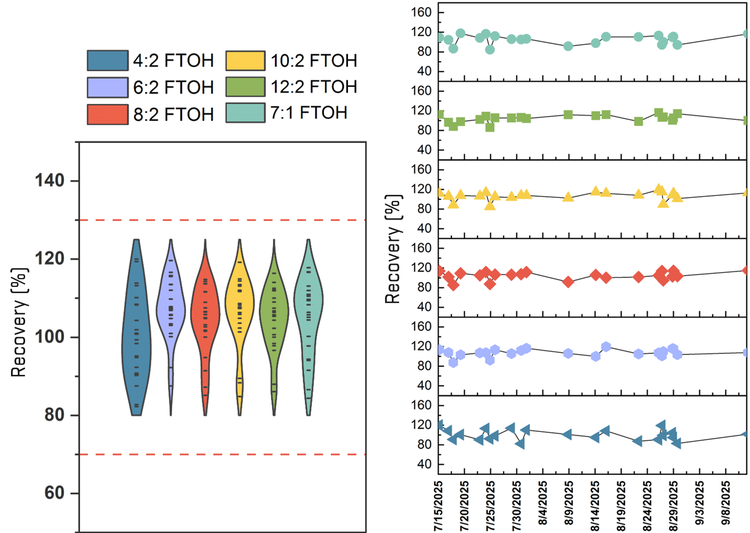
To evaluate the performance of the EN 17681-1:2025 method, procedural blanks, solvent and matrix spikes were subjected to the complete alkaline hydrolysis extraction workflow. The solvent-based method blank was used to monitor laboratory contamination, while solvent QC spikes provided an assessment of analyte stability during extraction in the absence of matrix effects. Figure 4 demonstrates excellent inter-day repeatability of 22 replicates (%CV 7–11%) of the QC solvent spikes evaluated over a 2-month period. The mean recoveries ranged from 100.2 to 107.1% for all analytes.
The matrix spike, prepared by fortifying the textile sample prior to extraction, was used to determine method recovery and potential matrix effects. The textile sample was pre-screened to determine the background levels for recovery corrections.
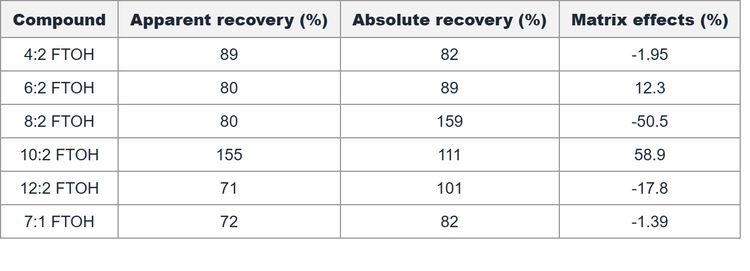
All analytes exhibited apparent recoveries of 71–89%, except for 10:2 FTOH (155%), while absolute recoveries were largely in the range of 82–111%, except for 8:2 FTOH (159%). Matrix effects were also assessed, with most FTOHs exhibiting matrix effects of ±20%. Matrix suppression was observed for 8:2 FTOH, while enhancement was observed for 10:2 FTOH, both of which may be improved with the use of internal standards to compensate for matrix effects.
Analysis of a real-world textile sample
The method applicability was tested in a real-world textile sample. No detection was observed for 4:2 FTOH and 7:1 FTOH, while 6:2 FTOH, 8:2 FTOH, 10:2 FTOH and 12:2 FTOH were detected at concentrations of 0.15–0.52 mg/kg (Figure 1).
Conclusions
The optimized LC-MS/MS method demonstrated sensitive, robust and reliable quantitation of 6 FTOHs in textiles:
- Lower source temperatures improved sensitivity, enabling LOQs of 1 ng/mL for five FTOHs and 5 ng/mL for 4:2 FTOH.
- Solvent calibration provided good linearity (r2 ≥ 0.9943) and LOQ accuracies of 92.0–107%.
- The EN 17681-1:2025 extraction workflow produced absolute recoveries of 82–111% for most analytes and consistent QC performance over 2 months.
- Application to a real textile sample detected 6:2, 8:2, 10:2 and 12:2 FTOHs at 0.15–0.52 mg/kg, demonstrating suitability for trace-level screening.
References
- Pervez, M.N. et al. PFAS in the textile industry: Sources, fate, detection, and pathways toward sustainable remediation and regulation. Chem. Eng. J. 2025, 522, 168183.
- Commission Regulation (EU) 2024/2462 of 19 September 2024 amending Annex XVII to Regulation (EC) No 1907/2006 of the European Parliament and of the Council as regards undecafluorohexanoic acid (PFHxA), its sales and PFHxA-related substances. Official Journal of the European Union. Document 32024R2462.
- OEKO-TEX Service GmbH. OEKO-TEX Limit values: New regulations 2025.
- Xia, C. et al. Per- and Polyfluoroalkyl Substances in North American School Uniforms. Environ. Sci. Technol. 2022, 56, 13845-13857.
- Gremmel, C. et al. Systematic determination of perfluoroalkyl and polyfluoroalkyl substances (PFASs) in outdoor jackets. Chemosphere. 2016, 160, 173-180.
- Nikiforov, V.A. Hydrolysis of FTOH precursors, a simple method to account for some of the unknown PFAS. Chemosphere. 2021, 276, 130044.
- European Standards. Textiles and textile products. Per- and polyfluoroalkyl substances (PFAS) Analysis of an alkaline extract using liquid chromatography and tandem mass spectrometry. BS EN 17681-1:2025.