A fast and ultra-sensitive method for analysis of TFA in multiple water sources
Abstract
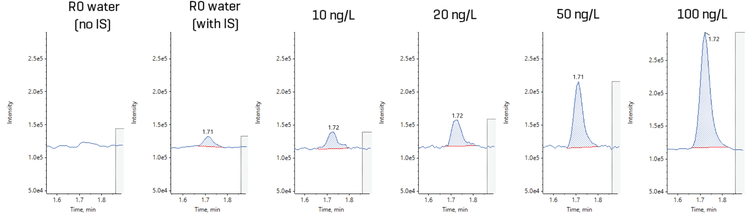
This technical note describes a robust, ultra-fast method for the quantitation of trifluoroacetic acid (TFA) in multiple water matrices, achieving a lower limit of quantitation (LLOQ) of 20 ng/L. Using the SCIEX 7500+ system with a simple sample preparation workflow and a 4.5 min isocratic runtime, the method enabled high-throughput analysis of up to 40 samples in less than 4 hrs. Quantitation was performed using the m/z 113.0/69.0 transition, with the fluoride fragment ion (m/z 113.0/19.0) monitored as the qualifier transition to enhance detection confidence. Significant effort was performed to minimize the background TFA contamination originating from the dilution and mobile phase solvents and lab consumables.1,2 The use of low-background mobile phases achieved the 20 ng/L LLOQ with an injection of volume of just 5 μL (Figure 1). Good linearity was demonstrated from 10-1000 ng/L, with an %RSD of 9.3% for the 20 ng/L standard (n=6). Method robustness was demonstrated through the batch analysis of >90 injections showing no signal degradation, significant change in baseline noise or retention time shift.
Key benefits of the analysis of TFA in multiple water sources using the SCIEX 7500+ system
- Use of mobile phases with low TFA contamination ensured ultra-sensitive analysis with a true calibration range of 10- 1000 ng/L and recommended LLOQ of 20 ng/L for the analysis of TFA
- Ultra-fast method with 4.5 min between sample injections, and simplified sample preparation
- Clean blank without TFA when no internal standard added, and with internal standard, blank level with TFA is approximately 55% of 10 ng/L standard TFA.
- Robust method with batch of >90 injections including multiple water sources with no increase in baseline noise or decrease in signal observed
Introduction
Trifluoroacetic acid (TFA, CF₃COOH) is a low molecular weight perfluorinated carboxylic acid formed as a breakdown product of various industrial chemicals, including fluorinated gases (Fgases), pharmaceuticals and pesticides.3,4 Found increasingly in surface water, groundwater, and drinking water,5 it has raised environmental and health concerns due to its resistance to degradation and removal.
Toxicological concerns have prompted the European Food Safety Authority (EFSA) to propose an acceptable daily intake (ADI) of 0.03 mg/kg body weight per day, expressed as sodium trifluoroacetate.6 This value is undergoing consultation6 due to emerging data suggesting potential classification of TFA as a Reproductive Toxicant Category 1B and a very persistent, very mobile (vPvM) substance under REACH.7
In response to these concerns, regulatory frameworks across Europe are evolving. The EU Drinking Water Directive EU 2020/2184 introduced a parametric value of 0.1 μg/L for 20 specific PFAS compounds, and 0.5 µg/L for “PFAS Total”, a measure of all C3-C14 PFAS. 8 Member states are expected to comply with these limits by January 2026. Although TFA is not included in this “PFAS Total” limit, the European Commission recommends measuring TFA separately if this value is applied.9 Current national approaches vary across Europe: the Netherlands has issued a health-based guideline of 2.2 μg/L10; Belgium shows regional variation, with Wallonia adopting the Dutch value, 11 and Flanders proposing a limit of 15.6 μg/L12 ; Denmark enforces a legal limit of 9 μg/L13 ; and Germany has proposed a target value of ≤10 μg/L and a precautionary health guideline of 60 μg/L. 14 A standardized method for TFA analysis in water does not exist, but the German standardization body DIN has recently developed a draft standard procedure (DIN 38407-53) which was tested in an interlaboratory trial, resulting in the suggested LLOQ of 300 ng/L. 14 The differences across regions and lack of standardized procedure reflect the growing concern and need for harmonized regulation across the EU.
Due to its low molecular weight and high polarity, TFA is analytically challenging and typically requires high-performance liquid chromatography coupled with tandem mass spectrometry (LC-MS/MS) for reliable detection. Conventional water treatment technologies, including activated carbon and reverse osmosis, are largely ineffective at removing TFA,15 underscoring the importance of upstream mitigation strategies and robust analytical methods. As scientific consensus builds around the environmental and health risks posed by TFA, harmonized EU-wide regulation is anticipated, potentially including prioritization under the Water Framework Directive and further restriction under REACH.7
Methods
Samples and reagents: Standards, both the native and mass-labelled internal standard (IS), were purchased from Cambridge Isotope Laboratories Inc.
Sample preparation: Polypropylene vials were washed with methanol prior to use. 20 μL of a 25 μg/L solution of 13C2-TFA internal standard was added to 980 µL of water for a final concentration of 500 ng/L in vial.
Chromatography: Chromatographic separation was performed using an Shimadzu LC-40 system with PFAS kit installed, at a flow rate of 0.6 mL/min on a Phenomenex Luna Omega 1.6 μm PS-C18 100x2.1 mm column. A four-minute isocratic method utilized a mobile phase consisting of 1mM ammonium acetate in water. An injection volume of 5 μL was used for analysis. 95:5 (v/v) LCMS grade water/methanol was used as a needle wash solvent.
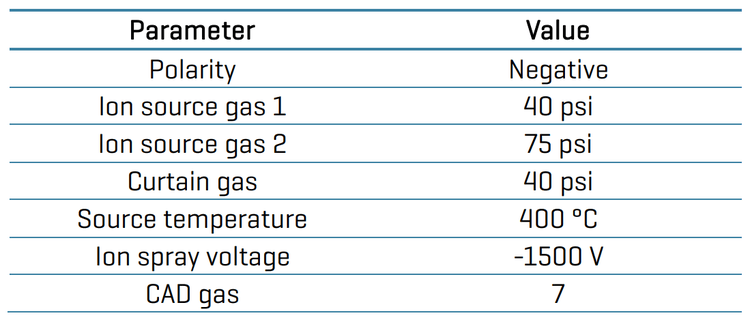
Mass spectrometry: Samples were analyzed using the SCIEX 7500+ system equipped with an OptiFlow Pro ion source with E lens and electrospray ionization (ESI) analytical probe. Source conditions are outlined in Table 1.
Data processing: Processing was performed using SCIEX OS 4.0 software. Peaks were automatically integrated using the MQ4 algorithm, noise determined with the peak-to-peak algorithm and a weighting of 1/x was used for quantitation.
Quantitative Performance
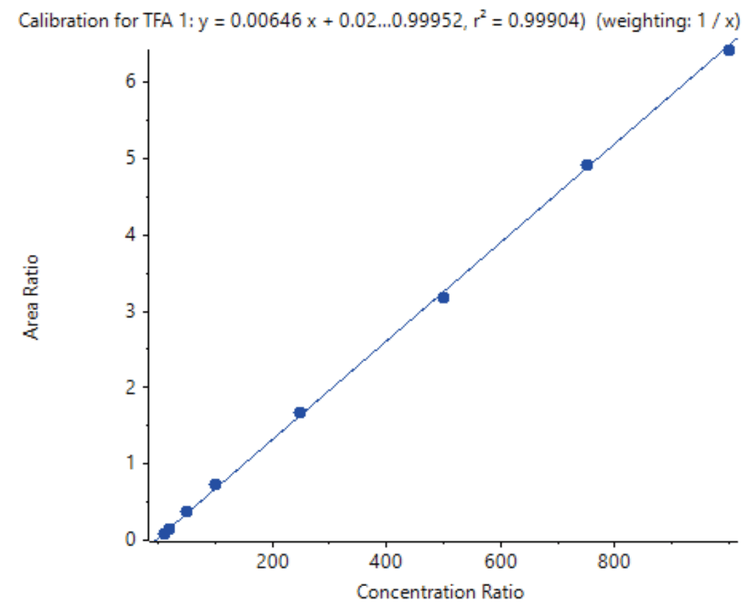
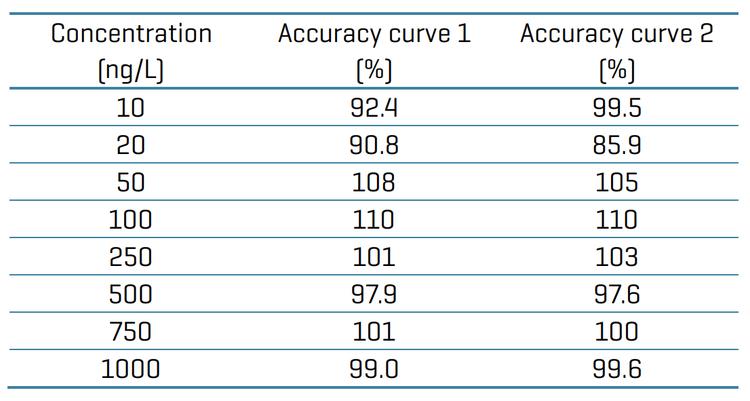
Linearity was determined using the calibration curve (Figure 1) prepared in reverse osmosis (RO) water and TFA showed linearity between 10 and 1000 ng/L. Calibration standards were analysed at the beginning and end of the batch (n=91 injections), 5 hours apart, with accuracy of 85-115% (Table 2) and an r2 value of 0.999 (Figure 2) for both sets of calibration standard injections (n=1 per set).
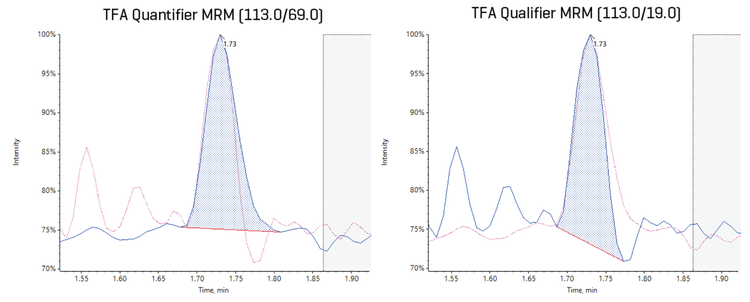
Precision was measured by six replicate injections of a 20 ng/L standard where the %RSD of the calculated concentration was 9.3% across all injections. This value was selected as the recommended LLOQ of the method and Figure 3 shows the qualifier and quantifier extracted ion chromatogram (XIC) of the 20 ng/L calibration standard. This value is >10x lower than the LLOQ recommended by current proposed draft procedure DIN 38407-5314 and provides resilience if lower limits are requested in the future.
Previous methods have required use of a parent-to-parent pseudo-MRM as the qualifier ion of TFA,2 however in this method it was possible to use formation of the fluoride ion (m/z=19), maintaining a signal-to-noise (S/N) >3 for the qualifier ion for all calibration standards (Figure 3). All standards, QC replicates and unknowns showed an ion ratio ±20% of the mean (calculated from calibration standards).
Sample analysis: Method accuracy in various water samples
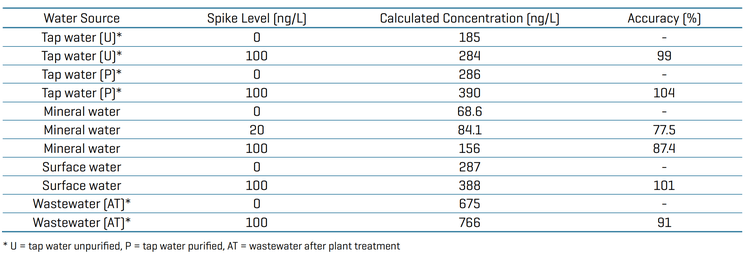
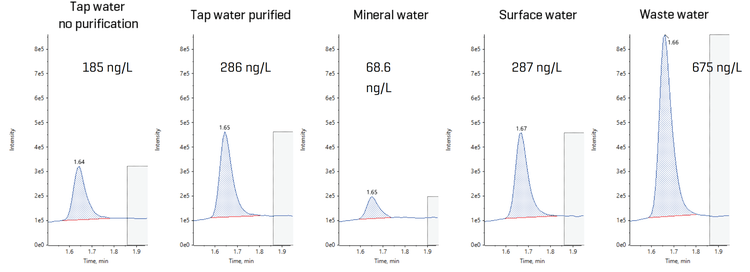
The method accuracy was evaluated in several different water sources, including mineral water, drinking water (tap water, with and without purification), surface water and wastewater. To determine overall accuracy of the method, mineral water and tap water were spiked at 20 ng/L and 100 ng/L, and surface and wastewater were spiked at 100 ng/L. Peak areas and calculated concentrations, with and without spikes are shown Table 3. Unspiked sample injections for all five water sources are shown in Figure 4. Accuracy is calculated for spiked samples after subtracting blank levels, and showed excellent accuracy (77.5- 101 %) for all sample types. All sample types (treated and untreated tap water, mineral water, surface water and wastewater post-treatment) showed a high concentration of TFA (>50 ng/L).
Additionally replicate injections (n=6) of the mineral water (with and without 20 ng/L spike) and unpurified tap water were performed and %RSD values were <10% in each case.
Method robustness
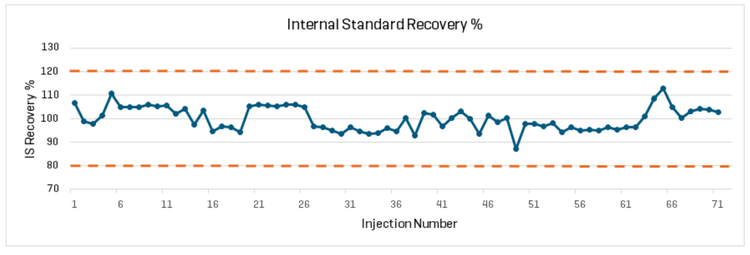
Method robustness was evaluated across a sequence of >90 injections through monitoring the retention time stability and internal standard recovery. Of the >90 injections, 72 contained the internal standard and were used for the calculations.
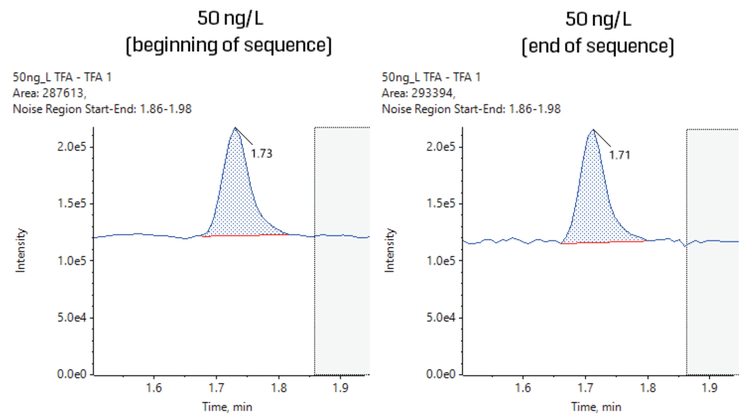
Retention time stability across the sequence was excellent with a %RSD of 2.3% across the 72 injections. In addition, the internal standard recoveries were tracked across the entire sequence and were between 80 and 120% of the mean (Figure 5). Method robustness was also evaluated by comparing the peak area and baseline noise for the 50 ng/L calibration standard at the beginning and end of the batch sequence (separated by more than 5.5 hours of injections). The results showed no significant reduction in peak area or increased in baseline noise (Figure 6). These results demonstrate excellent method robustness and show that a column wash sequence is not necessary when analysing a batch of at least 90 samples.
Minimizing TFA contamination
Obtaining accurate results for trace-analysis of samples requires background contamination to be reduced as much as possible, and several aspects were investigated to accurately obtain the very low LLOQ value obtained here. Trace-level TFA contamination is often found in plastic consumables used in sample preparation, solvents used as the sample diluent for PFAS multi-methods1,2 and in polypropylene vials.
To reduce TFA contamination, polypropylene vials were used and washed with methanol prior to use. In addition, the sample preparation was simplified and the TFA internal standard was added to the vial immediately prior to analysis.
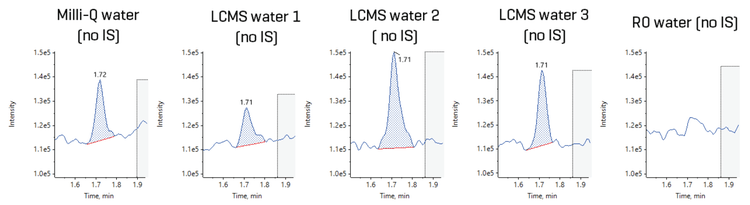
Of the five water sources evaluated (reverse-osmosis water, Milli-Q water and three commercially available LCMS grade waters) only reverse-osmosis (RO) water did not contain TFA at detectable concentrations (Figure 7). Therefore, RO water was used for preparing the blanks and calibration standards.
The only contamination identified came from addition of the internal standard (Figure 1), however this was negligible and the method still maintained good linearity (Figure 2). The method described in this tech note demonstrated an improved LLOQ (20 ng/L) over previous methods1,2 and is ideal for labs requiring quantitation of TFA only.
Conclusion
- TFA contamination was reduced by use of RO water and a simplified sample preparation with linearity from 10-1000 ng/L, and excellent precision with a %RSD of 9.3% for six replicate injections of the 20 ng/L standard.
- An isocratic LC method was utilized with <5 min between injections, with baseline noise remaining consistent over a batch of >90 injections.
- TFA was quantifiable with two MRMs, with an ion ratio maintained at 80-120% of the mean value, across all sample types including surface water and wastewater.
- Water samples across five different sources (mineral water, drinking water, tap water with and without purification, surface water and wastewater) were successfully analysed for TFA with good accuracies (92.5-104%) for all spiked samples.
- Analysis of multiple commercially available LC-MS grade water sources showed that TFA contamination is common and may interfere with trace analysis of TFA <20 ng/L. Addition of deuterated internal standard may also contribute to TFA concentration at levels <10 ng/L.
References
- Quantitation of ultrashort- and short-chain PFAS in beverages by a direct injection LC-MS/MS method. SCIEX Technical Note. MKT-35579-A.
- Simultaneous quantitation of ultrashort-, short- and longchain PFAS in water by a single direct injection LC-MS/MS method. SCIEX Technical Note. MKT-34163-A.
- Joudan, Shira; De Silva, Amila O.; Young, Cora J. 2021. “Insufficient Evidence for the Existence of Natural Trifluoroacetic Acid.” Environmental Science: Processes & Impacts 23: 1641–1649, https://doi.org/10.1039/D1EM00306B
- Joerss, Hanna; Freeling, Finnian; van Leeuwen, Stefan; Hollender, Juliane; Liu, Xingang; Nödler, Karsten; Wang, Zhanyun; Yu, Bochi; Zahn, Daniel; Sigmund, Gabriel. 2024. “Pesticides Can Be a Substantial Source of Trifluoroacetate (TFA) to Water Resources.” Environment International 193: Article 109061, https://doi.org/10.1016/j.envint.2024.109061
- PAN Europe. 2024. “TFA: The Forever Chemical in the Water We Drink.” Pesticide Action Network Europe. July 2024
- European Food Safety Authority (EFSA). Draft statement on consumer health-based guidance values on trifluoroacetic acid PC-1508. July 2025
- European Chemicals Agency (ECHA). Substance Information: Trifluoroacetic acid (EC No. 200-929-3, CAS No. 76-05-1). Accessed November 2025.
- European Union. Directive (EU) 2020/2184 of the European Parliament and of the Council of 16 December 2020 on the quality of water intended for human consumption (recast). December 2020.
- European Union. Technical guidelines regarding methods of analysis for monitoring of per- and polyfluoroalkyl substances (PFAS) in water intended for human consumption (C/2024/4910). August 2024.
- Dutch National Institute for Public Health and the Environment (RIVM). Drinking Water Guideline Value for Trifluoroacetic Acid. November 2024.
- Walloon Public Service (SPW). TFA in Walloon drinking water. October 2024.
- Flemish Environment Agency (VMM). Provisional HealthBased Guideline Value for TFA in Drinking Water Determined. November 2024.
- Danish Ministry of the Environment. Substance Flow Analysis of PFAS. February 2024.
- German Federal Environmental Agency. Classification and Derivation of a Guideline Value for Trifluoroacetate (TFA) in Drinking Water. October 2020.
- Dorgerloh, Ute, et. al. 2025. “Standardising the Quantification of Trifluoroacetic Acid in Water: Interlaboratory Validation Trial Using Liquid Chromatography–Mass Spectrometric Detection (LC– MS/MS).” Accreditation and Quality Assurance 30: 473– 476