Abstract
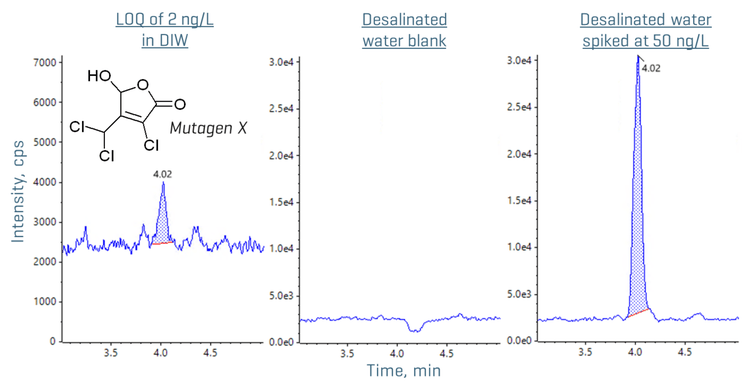
This technical note describes a collaboration with the Public Utilities Board (PUB), Singapore’s National Water Agency, for the LC-MS/MS quantitation of Mutagen X (MX), a chlorinated disinfection byproduct, in water. Excellent sensitivity of the QTRAP 6500+ system was demonstrated by a limit of quantitation (LOQ) of 2 ng/L and method detection limit (MDL) of 0.85 ng/L in deionized water (DIW) (Figure 1). Recovery was evaluated at 50 ng/L using desalinated water and seawater to evaluate and compare potential matrix effects. The desalinated water spike exhibited a mean recovery of 99% with a %CV of 0.3% (n = 3). While initially impacted by matrix effects, the seawater recovery improved to 91% (n = 3) when injecting at a lower volume on the SCIEX 7500 system.
Key benefits of the QTRAP 6500 + system for the analysis of Mutagen X in water
- Direct injection approach: The QTRAP 6500+ system enabled a direct LC-MS/MS injection method with an LOQ of 2 ng/L, yielding a mean accuracy of 100% (%CV 8.8%, n = 3) and a calculated MDL of 0.85 ng/L .
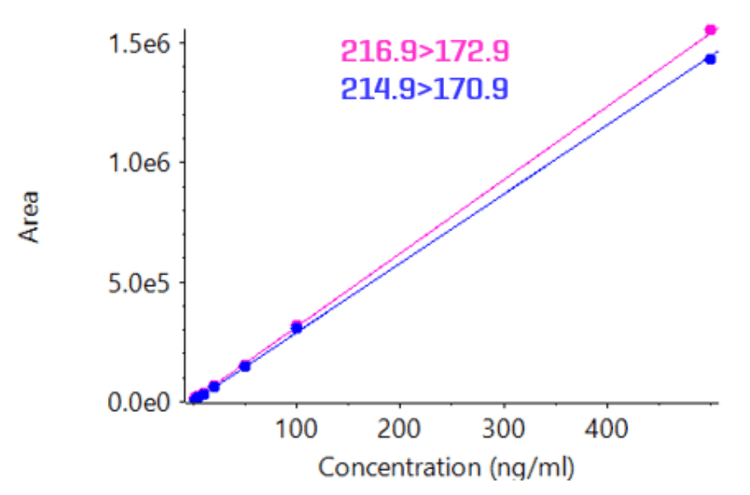
- Good linear performance: The aqueous-based calibration exhibited an r2 ≥0.999 and a linear dynamic range (LDR) of over 2 orders of magnitude.
- Good quantitative performance in matrix: Matrix spikes in desalinated water exhibited an apparent recovery of 99.4% (%CV 0.3%, n = 3).
- Leveraging sensitivity to mitigate matrix effects: Matrix effects in the s eawater spike were mitigated by lower injection volumes on the QTRAP 6500+ system (72–79%) and substantially improved on the SCIEX 7500 system (91%).
Introduction
Disinfection of treated water is essential for preventing health problems caused by pathogens or other microorganisms. However, the use of disinfectants such as chlorine can also lead to the formation of disinfection byproducts (DBPs) through reactions with the natural organic matter (NOM) in water. Some DBPs are known to be hazardous to human health through exposure or consumption.1 For example, the US EPA regulates total trihalomethanes (THM, 80 µg/L) and five trihaloacetic acids (HAAs, 60 µg/L) as contaminants in drinking water, by the Disinfectants and Disinfection Byproducts Rules (Stage 1 and Stage 2).2
Mutagen X (3-Chloro- 4-(dichloromethyl)-5-hydroxy- 2(5H)- furanone) is a halogenated furanone (Figure 1) and a hazardous byproduct produced by chlorine disinfection. Although Mutagen X is typically present at much lower concentrations than other common DBPs in treated water (2–67 ng/L in surface waters and up to 9 ng/L in some treated water samples)3, it is highly mutagenic and has been shown to account for 20- 60% of the total genotoxicity in chlorinated treated water4. Toxicological studies indicate that MX can induce tumors in rats and is classified by IARC as Group 2B, possibly carcinogenic to humans. A health-based value of 1.8 µg/L has been proposed based on animal studies, but the concentrations in drinking water are well below this threshold.3
This technical note describes a direct LC-MS/MS injection method for the quantitation of Mutagen X at ng/L levels in water using the QTRAP 6500+ system, enabling reliable detection in environmental water samples.
Methods
Standards and samples: A stock standard solution of Mutagen X, the desalinated water and seawater were provided by PUB.
Sample preparation: All water samples were analyzed by direct LC-MS/MS injection. Briefly, the sample was filtered through a 0.2 µm PVDF filter and acidified with 0.1% acetic acid before LC-MS/MS analysis.
Method performance in matrix spikes: The desalinated water and seawater samples were spiked at 50 ng/L. The apparent recovery was calculated against the aqueous-based calibration curve prepared in acidified deionized water (DIW).
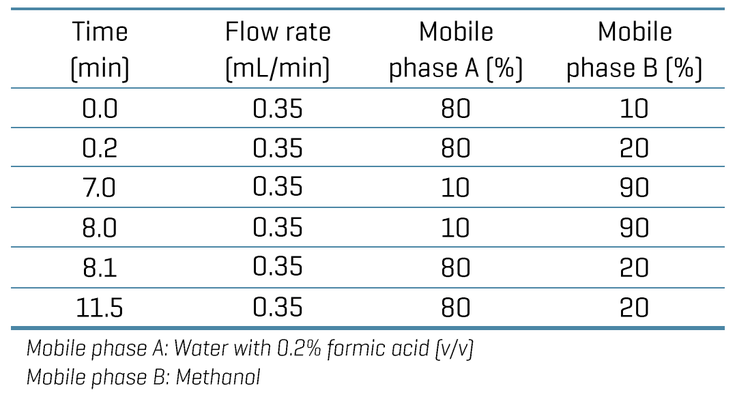
Chromatography: Chromatographic separation was performed on an Agilent Infinity 2 LC system using a Phenomenex Synergi Polar-RP column (100 x 2 mm, 2.5 µm, P/N: 00D- 4371-B0). A flow rate of 0.35 mL/min, a column oven temperature of 40°C and an injection volume of 50 µL were used. Table 1 shows the chromatographic gradient.
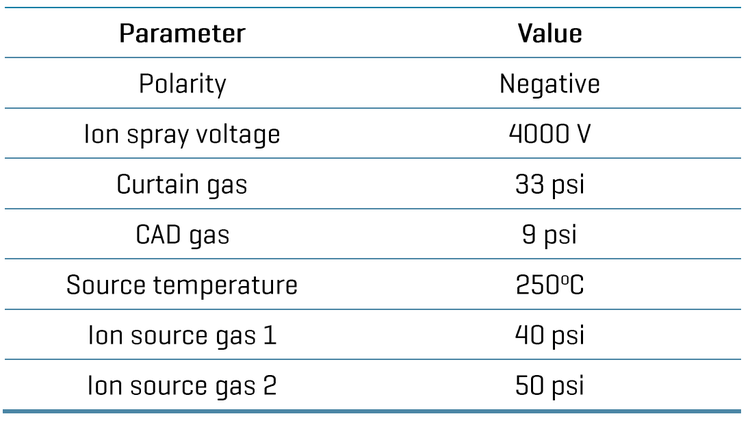
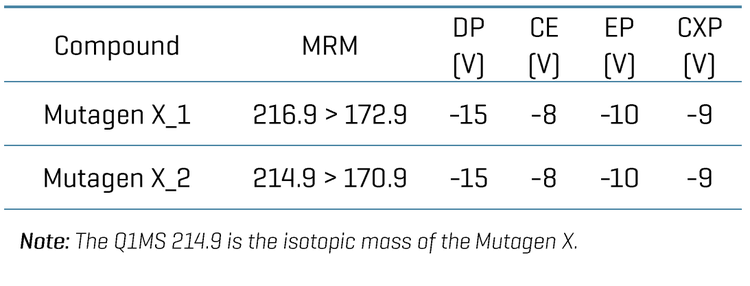
Data processing: Data acquisition and processing were performed using SCIEX OS software (version 3.4).
Performance of the solvent- based calibration curve in deionized water
The calibration curve spanning from 2 ng/L to 500 ng/L exhibited an r2 value of ≥ 0.999, with a weighting of 1/x, and an LOQ of 2 ng/L (Figure 2). The solvent-based calibration curve consisted of 2 ng/L, 5 ng/L, 10 ng/L, 20 ng/L, 50 ng/L, 100 ng/L and 500 ng/L concentrations levels (Figure 2). The mean accuracy at the LOQ was 100% with a %CV of 8.8% based on triplicate injections. The LOQ was selected based on accuracy of ±20%, precision %CV <20% for triplicate injections and ion ratios within ±30% .
Determination of the method detection limit (MDL)
The method detection limit (MDL) is defined as the minimum measured concentration of a substance that can be reported with 99% confidence as distinguishable from the method blank.5 Here, 7 replicates of DIW spiked at 5 ng/L, that is 2.5x the solvent LOQ, were used to calculate the MDL. The MDL was calculated by multiplying the standard deviation (S) of the replicates by the Student’s t-value (t) at the 99% confidence level based on the following equation:
MDL = S*t
Here, the calculated MDL in DIW was 0.85 ng/L with a mean accuracy of 100% and %CV of 5.4%.
Quantitative performance in real-world aqueous matrices
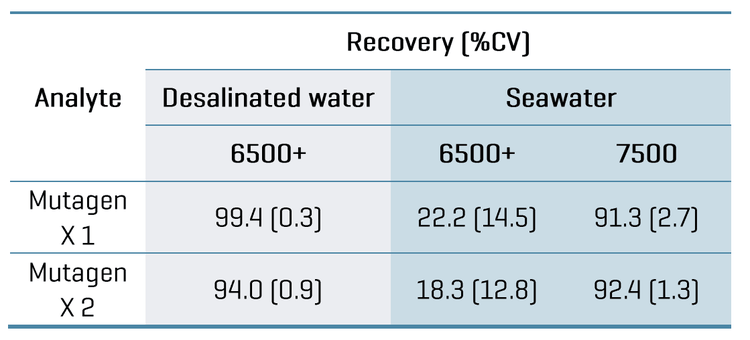
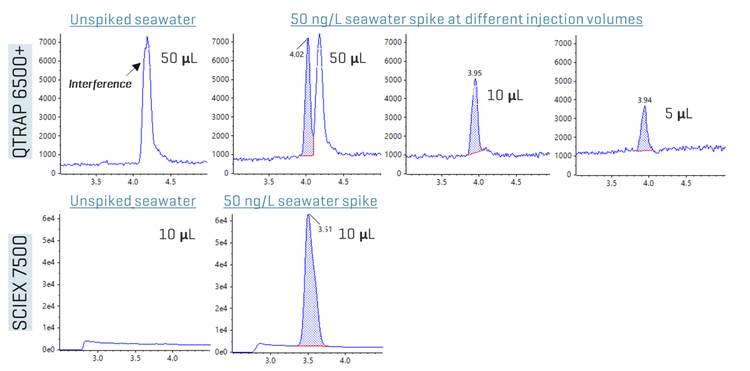
The quantitative performance of the direct LC-MS/MS injection method was evaluated in desalinated water and seawater samples spiked at 50 ng/L, in triplicate. Excellent mean recovery (99%, %CV 0.3%, n = 3) was achieved in desalinated water at an injection volume of 50 µL on the QTRAP 6500+ system (Table 4), while the recovery (22.2%) in seawater was initially impacted by coeluting interferences at the same injection volume. Upon lowering the injection volumes to 10 µL and 5 µL, seawater recoveries improved to 72% and 79% , respectively, on the QTRAP 6500+ system. Recovery further improved to 91.3% (%CV 2.7%, n = 2) when the seawater s pike was injected at 10 µL on the SCIEX 7500 system.
Here, the sensitivity of the QTRAP 6500+ enabled a direct LC-MS/MS large-volume injection approach for low-level ng/L quantitation of MX in treated water. For more complex aqueous matrices such as seawater, the SCIEX 7500 system can help minimize the impact of matrix effects with lower injection volumes or higher dilution factors (Figure 3).
Conclusions
A simple direct LC-MS/MS injection method was developed for the quantitation of Mutagen X in desalinated water and seawater using the QTRAP 6500 + system, featuring:
- Good linearity with an LDR of 2.5 orders and r2 ≥ 0.999.
- High sensitivity with a solvent-based LOQ of 2 ng/L (mean accuracy of 100% and %CV of 8.8%) and a calculated MDL of 0.85 ng/L (mean accuracy of 100% and %CV of 5.4%).
- Excellent quantitative performance in desalinated water matrix with mean recovery of 99.4% and %CV of 0.3%.
- Leveraging sensitivity of the QTRAP 6500+ and SCIEX 7500 systems for lower injection volumes to overcome matrix effects in seawater and potentially other complex aqueous matrices.
References
- Bagheban, M.; Mohammadi, A.; Baghdadi, M.; Janmohammadi, M.; Salimi, M. Removal of mutagen X “MX” from drinking water using reduced graphene oxide coated sand particles.J. Environ. Health Sci. Eng. 2019, 17, 827- 837.
- US EPA Office of Water. Comprehensive Disinfectants and Disinfection Byproducts Rules (Stage 1 and Stage 2): Quick Reference Guide, 2020. Drinking Water Rule Quick Reference Guides | US EPA
- Guidelines for drinking-water quality, fourth edition incorporating the first and second addenda, p 435 - 436, 2022
- Zheng, D.; Andrews, R.C.; Andrews, S.A.; Taylor- Edmonds, L. Effects of coagulation on the removal of natural organic matter, genotoxicity, and precursors to halogenated furanones, Wat. Res. 2015. 70, 118-129.
- US Geological Survey. New Reporting Procedures Based on Long-Term Method Detection Levels and Some Considerations for Interpretations of Water-Quality Data Provided by the U.S. Geological Survey National Water Quality Laboratory. Open- File Report 99 -193, 1999.
Abstract
This technical note describes a collaboration with the Public Utilities Board (PUB), Singapore’s National Water Agency, for the LC-MS/MS quantitation of Mutagen X (MX), a chlorinated disinfection byproduct, in water. Excellent sensitivity of the QTRAP 6500+ system was demonstrated by a limit of quantitation (LOQ) of 2 ng/L and method detection limit (MDL) of 0.85 ng/L in deionized water (DIW) (Figure 1). Recovery was evaluated at 50 ng/L using desalinated water and seawater to evaluate and compare potential matrix effects. The desalinated water spike exhibited a mean recovery of 99% with a %CV of 0.3% (n = 3). While initially impacted by matrix effects, the seawater recovery improved to 91% (n = 3) when injecting at a lower volume on the SCIEX 7500 system.
Key benefits of the QTRAP 6500 + system for the analysis of Mutagen X in water
- Direct injection approach: The QTRAP 6500+ system enabled a direct LC-MS/MS injection method with an LOQ of 2 ng/L, yielding a mean accuracy of 100% (%CV 8.8%, n = 3) and a calculated MDL of 0.85 ng/L .
- Good linear performance: The aqueous-based calibration exhibited an r2 ≥0.999 and a linear dynamic range (LDR) of over 2 orders of magnitude.
- Good quantitative performance in matrix: Matrix spikes in desalinated water exhibited an apparent recovery of 99.4% (%CV 0.3%, n = 3).
- Leveraging sensitivity to mitigate matrix effects: Matrix effects in the s eawater spike were mitigated by lower injection volumes on the QTRAP 6500+ system (72–79%) and substantially improved on the SCIEX 7500 system (91%).
Introduction
Disinfection of treated water is essential for preventing health problems caused by pathogens or other microorganisms. However, the use of disinfectants such as chlorine can also lead to the formation of disinfection byproducts (DBPs) through reactions with the natural organic matter (NOM) in water. Some DBPs are known to be hazardous to human health through exposure or consumption.1 For example, the US EPA regulates total trihalomethanes (THM, 80 µg/L) and five trihaloacetic acids (HAAs, 60 µg/L) as contaminants in drinking water, by the Disinfectants and Disinfection Byproducts Rules (Stage 1 and Stage 2).2
Mutagen X (3-Chloro- 4-(dichloromethyl)-5-hydroxy- 2(5H)- furanone) is a halogenated furanone (Figure 1) and a hazardous byproduct produced by chlorine disinfection. Although Mutagen X is typically present at much lower concentrations than other common DBPs in treated water (2–67 ng/L in surface waters and up to 9 ng/L in some treated water samples)3, it is highly mutagenic and has been shown to account for 20- 60% of the total genotoxicity in chlorinated treated water4. Toxicological studies indicate that MX can induce tumors in rats and is classified by IARC as Group 2B, possibly carcinogenic to humans. A health-based value of 1.8 µg/L has been proposed based on animal studies, but the concentrations in drinking water are well below this threshold.3
This technical note describes a direct LC-MS/MS injection method for the quantitation of Mutagen X at ng/L levels in water using the QTRAP 6500+ system, enabling reliable detection in environmental water samples.
Methods
Standards and samples: A stock standard solution of Mutagen X, the desalinated water and seawater were provided by PUB.
Sample preparation: All water samples were analyzed by direct LC-MS/MS injection. Briefly, the sample was filtered through a 0.2 µm PVDF filter and acidified with 0.1% acetic acid before LC-MS/MS analysis.
Method performance in matrix spikes: The desalinated water and seawater samples were spiked at 50 ng/L. The apparent recovery was calculated against the aqueous-based calibration curve prepared in acidified deionized water (DIW).
Chromatography: Chromatographic separation was performed on an Agilent Infinity 2 LC system using a Phenomenex Synergi Polar-RP column (100 x 2 mm, 2.5 µm, P/N: 00D- 4371-B0). A flow rate of 0.35 mL/min, a column oven temperature of 40°C and an injection volume of 50 µL were used. Table 1 shows the chromatographic gradient.
Performance of the solvent- based calibration curve in deionized water
The calibration curve spanning from 2 ng/L to 500 ng/L exhibited an r2 value of ≥ 0.999, with a weighting of 1/x, and an LOQ of 2 ng/L (Figure 2). The solvent-based calibration curve consisted of 2 ng/L, 5 ng/L, 10 ng/L, 20 ng/L, 50 ng/L, 100 ng/L and 500 ng/L concentrations levels (Figure 2). The mean accuracy at the LOQ was 100% with a %CV of 8.8% based on triplicate injections. The LOQ was selected based on accuracy of ±20%, precision %CV <20% for triplicate injections and ion ratios within ±30% .
Determination of the method detection limit (MDL)
The method detection limit (MDL) is defined as the minimum measured concentration of a substance that can be reported with 99% confidence as distinguishable from the method blank.5 Here, 7 replicates of DIW spiked at 5 ng/L, that is 2.5x the solvent LOQ, were used to calculate the MDL. The MDL was calculated by multiplying the standard deviation (S) of the replicates by the Student’s t-value (t) at the 99% confidence level based on the following equation:
MDL = S*t
Here, the calculated MDL in DIW was 0.85 ng/L with a mean accuracy of 100% and %CV of 5.4%.
Quantitative performance in real-world aqueous matrices
The quantitative performance of the direct LC-MS/MS injection method was evaluated in desalinated water and seawater samples spiked at 50 ng/L, in triplicate. Excellent mean recovery (99%, %CV 0.3%, n = 3) was achieved in desalinated water at an injection volume of 50 µL on the QTRAP 6500+ system (Table 4), while the recovery (22.2%) in seawater was initially impacted by coeluting interferences at the same injection volume. Upon lowering the injection volumes to 10 µL and 5 µL, seawater recoveries improved to 72% and 79% , respectively, on the QTRAP 6500+ system. Recovery further improved to 91.3% (%CV 2.7%, n = 2) when the seawater s pike was injected at 10 µL on the SCIEX 7500 system.
Here, the sensitivity of the QTRAP 6500+ enabled a direct LC-MS/MS large-volume injection approach for low-level ng/L quantitation of MX in treated water. For more complex aqueous matrices such as seawater, the SCIEX 7500 system can help minimize the impact of matrix effects with lower injection volumes or higher dilution factors (Figure 3).
Conclusions
A simple direct LC-MS/MS injection method was developed for the quantitation of Mutagen X in desalinated water and seawater using the QTRAP 6500 + system, featuring:
- Good linearity with an LDR of 2.5 orders and r2 ≥ 0.999.
- High sensitivity with a solvent-based LOQ of 2 ng/L (mean accuracy of 100% and %CV of 8.8%) and a calculated MDL of 0.85 ng/L (mean accuracy of 100% and %CV of 5.4%).
- Excellent quantitative performance in desalinated water matrix with mean recovery of 99.4% and %CV of 0.3%.
- Leveraging sensitivity of the QTRAP 6500+ and SCIEX 7500 systems for lower injection volumes to overcome matrix effects in seawater and potentially other complex aqueous matrices.
References
- Bagheban, M.; Mohammadi, A.; Baghdadi, M.; Janmohammadi, M.; Salimi, M. Removal of mutagen X “MX” from drinking water using reduced graphene oxide coated sand particles.J. Environ. Health Sci. Eng. 2019, 17, 827- 837.
- US EPA Office of Water. Comprehensive Disinfectants and Disinfection Byproducts Rules (Stage 1 and Stage 2): Quick Reference Guide, 2020. Drinking Water Rule Quick Reference Guides | US EPA
- Guidelines for drinking-water quality, fourth edition incorporating the first and second addenda, p 435 - 436, 2022
- Zheng, D.; Andrews, R.C.; Andrews, S.A.; Taylor- Edmonds, L. Effects of coagulation on the removal of natural organic matter, genotoxicity, and precursors to halogenated furanones, Wat. Res. 2015. 70, 118-129.
- US Geological Survey. New Reporting Procedures Based on Long-Term Method Detection Levels and Some Considerations for Interpretations of Water-Quality Data Provided by the U.S. Geological Survey National Water Quality Laboratory. Open- File Report 99 -193, 1999.