Delivering exceptional robustness for long-term food testing on the novus V55 system
Abstract
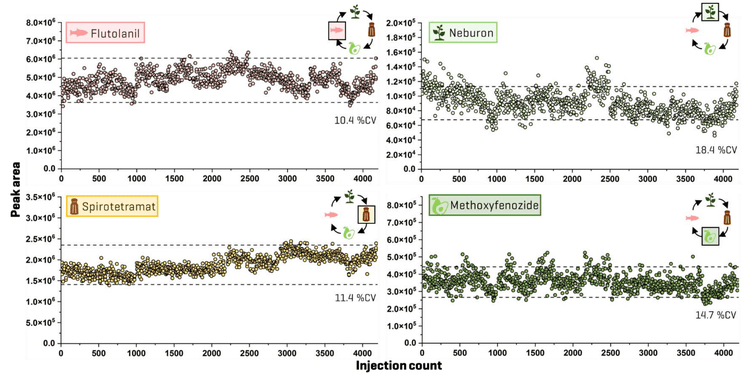
This technical note demonstrates the robustness of the novus V55 system for the analysis of pesticides in food extracts. Equipped with proven source durability of the OptiFlow ion source, the novus V55 system achieved 4,185 consecutive injections of solvent and matrix quality control (QC) samples, over 5 weeks of continuous operation. Most of the target analytes exhibited <20 %CV in raw peak areas and single-digit %CV in ion ratios throughout the experiment, preserving optimal sensitivity to support high-throughput food testing (Figure 1). Together with Phenomenex sample preparation and chromatography solutions and SCIEX OS software, the novus V55 system delivers an end-to-end ecosystem built for high-throughput food analysis.
Key benefits of the novus V55 system for food testing
- Consistent instrument uptime from trusted technology: Equipped with the OptiFlow ion source, curtain gas interface and QJet ion guide, the novus V55 system delivered exceptional stability with >4100 injections of solvent and matrix QCs over 5 weeks of continuous operation.
- Intelligent software to optimize lab efficiency: SCIEX OS software offered real-time queue management and automated processing to minimize sample and time loss from QC failures and to expedite results generation for review.
Introduction
Multiresidue testing in food samples is often challenged by matrix complexity, which can degrade the quantitative performance of a mass spectrometer (MS) over time. Sample preparation and chromatography can help reduce the matrix load entering the instrument, but MS robustness is also crucial for maintaining optimal assay performance over extended analysis. This is especially critical for high-throughput food testing laboratories, where consistent instrument uptime directly supports data integrity, ongoing profitability and predictable operational confidence. As a fifth-generation triple quadrupole MS, the novus V55 system features the OptiFlow ion source, curtain gas interface and QJet ion guide, known for their proven durability in challenging matrices.1
In this technical note, the integration of Phenomenex QuEChERS-based sample preparation and the Kinetex Biphenyl LC column with the intelligent software features in SCIEX OS software and the novus V55 system delivered a robust, end-to-end workflow designed for long-term, routine pesticides analysis in food. The results demonstrated consistent performance, reliable data quality and operational stability required for high-throughput, day-to-day laboratory use.
Methods
Standards and samples: Mixed pesticide standards were used to prepare stock solutions in acetonitrile. Mass-labeled internal standards were purchased from Millipore Sigma. Both native and mass-labeled internal standards were used to spike quality control (QC) samples in solvent and food matrices. Salmon, avocado, kale and five-spice powder were locally purchased.
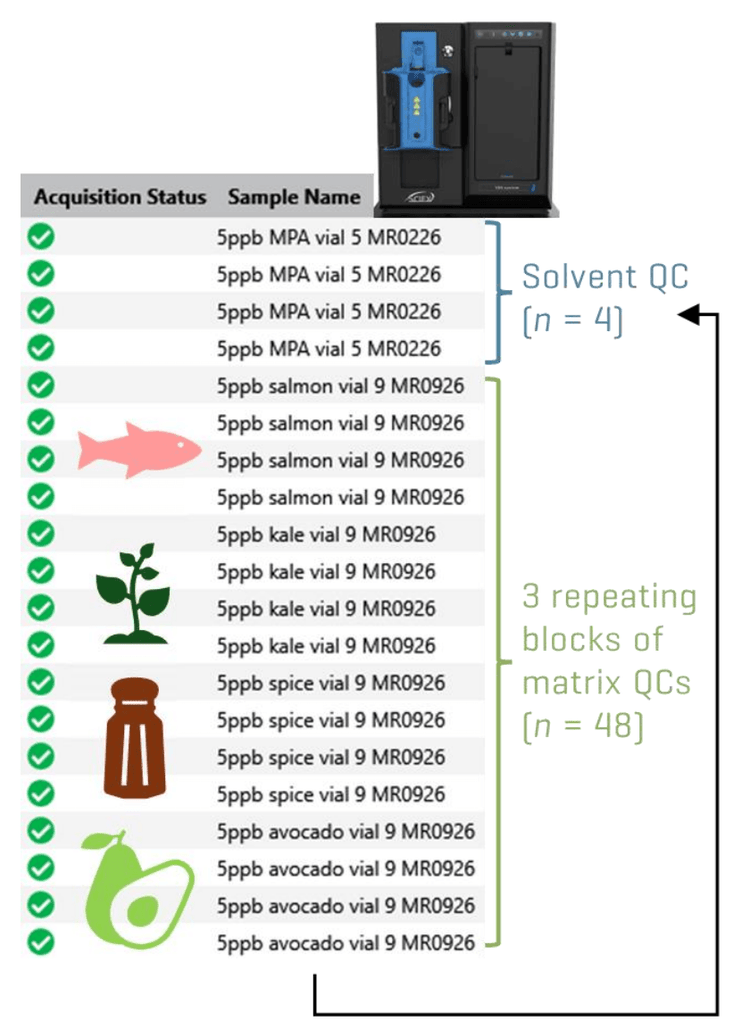
Sample preparation: Prior to extraction, salmon, avocado and kale (~50 g each) were homogenized using a food processor. The food samples were extracted using QuEChERS with dispersive (dSPE) clean-up. Briefly, 5 g of homogenized salmon/avocado/kale or 2 g of spice powder was combined with 10 mL of water, then extracted with 12 mL of acetonitrile. Upon adding a QuEChERS packet (4 g MgSO4, 1 g NaCl, 1 g SCTD, 0.5 g SCD; Phenomenex P/N KS0-8909), the sample was vortexed and shaken for 15 minutes. After centrifuging at 4,000 rpm for 10 minutes, the supernatant was transferred to a 15 mL dSPE tube (900 mg MgSO4, 150 mg PSA, 150 mg C18E; Phenomenex P/N KS0-9508 for fatty and waxy samples like salmon and avocado; 900 mg MgSO4, 150 mg PSA, 15 mg GCB; Phenomenex P/N KS0-9509 for pigmented samples like kale and spice). After shaking and centrifuging at 4,000 rpm for 10 minutes, the supernatant was evaporated to dryness and reconstituted in 90:10 (v/v) water/methanol with 5mM ammonium formate. After filtering through a 0.45 µm filter, the final extract was aliquoted into autosampler vials for post-spiking with native and mass-labelled internal standards. Solvent QC samples were also prepared by spiking at the same solvent composition as the food matrix extracts. Instrument robustness was evaluated by repeating blocks of consecutive matrix injections sandwiched between solvent QC replicate injections at an 12:1 matrix:solvent frequency ratio (Figure 2).
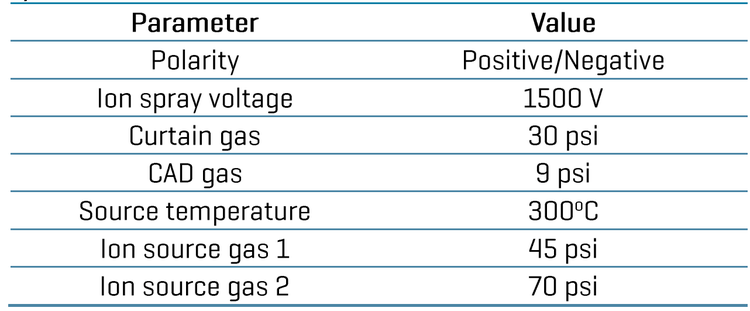
Data acquisition and processing: Data acquisition and processing were performed using SCIEX OS software (version 5.0).
Uncompromised robustness proven by raw instrument response
Salmon, avocado, kale and spice powder were selected as representative matrices of foods with varying fat, protein, carbohydrate and water content.2 High-throughput analysis of these complex matrices can be challenging due to the presence of co-extractables and their contribution to instrument contamination. Built with the OptiFlow ion source, curtain gas interface and QJet ion guide, the novus V55 system maintained exceptional stable sensitivity performance (Figures 1, 3 and 4) across 4,185 injections of matrix and solvent QCs.
Figure 1 depicts the robustness performance of the novus V55 system based on uncorrected raw peak areas monitored for flutolanil in salmon, neburon in kale, spirotetramat in spice powder and methoxyfenozide in avocado. Based on the <20 %CV in raw peak areas for these 4 representative pesticides, the novus V55 system exhibited strong stability and sensitivity performance over 5 weeks of continuous operation without any cleaning or interim maintenance. Upon examination, no significant visual contamination of ion optics components was observed at the conclusion of the experiment. Similar robustness trends were observed for other pesticides in matrix based on both uncorrected raw response and ion ratios (Figure 3) and internal standard (IS)-corrected area ratios (Figure 4).
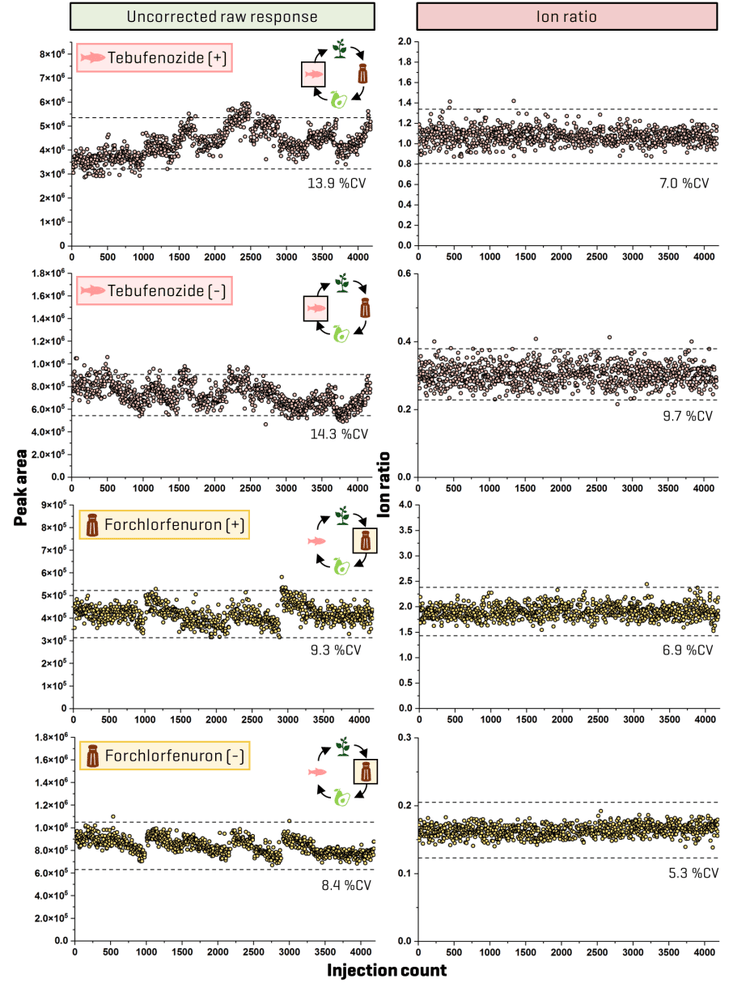
Consistent MRM ion ratios during routine pesticide analysis support ongoing assessment of instrument performance and method robustness, as deviations from EU SANTE acceptance limits may indicate changes in fragmentation, ion transmission or overall system stability.3 Single-digit %CV, with ion ratios largely within ±25% of the mean, demonstrated strong instrument robustness for tebufenozide in salmon and forchlorfenuron in spice, independent of which polarity was monitored (Figure 3). Similarly, the uncorrected raw peak area response exhibited <15 %CV variation throughout the experiment (Figure 3).
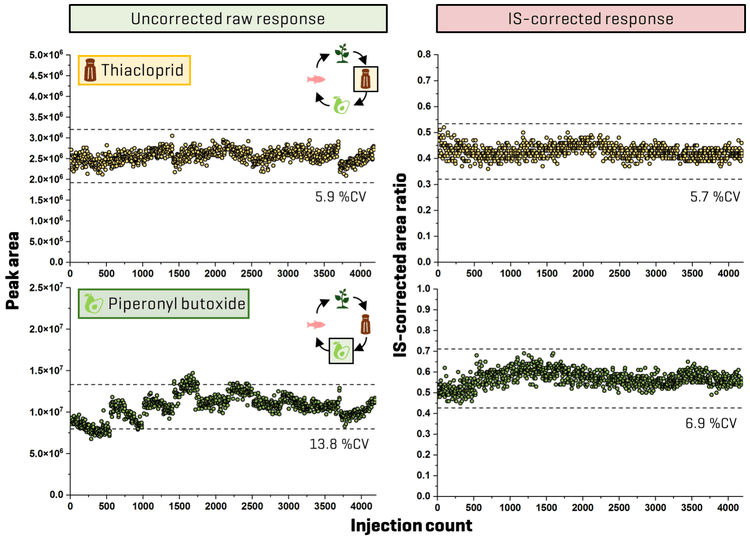
Internal standards are often used in quantitative assays to correct for variations that occur during sample preparation and instrumental analysis. Figure 4 demonstrates single-digit %CV in the IS-corrected area ratios for thiacloprid in spice powder and piperonyl butoxide in avocado. However, because both the native and mass-labeled IS are expected to respond identically in the assay environment, IS-corrected results may not fully reflect instrument performance. As such, evaluating uncorrected raw peak areas provides a more accurate measure of instrument performance over time and can better inform maintenance planning. Here, the raw peak areas exhibited slightly larger variability (<15 %CV) with no observable decline in sensitivity. As such, the robustness study was concluded after 5 weeks of continuous operation as the novus V55 system showed no evidence of performance degradation.
End-to-end integration for high-throughput food testing
In addition to system suitability tests (SSTs) with QC samples, intermittent infusion-based checks can also provide real-time insights regarding the instrument's performance between acquisition batches. SCIEX OS software provides a built-in metrics tracker that enables the user to chart instrument and assay performance data (Figure 5). Any suboptimal performance, as indicated by deviations in the metrics tracker plots, would trigger the need for user interventions such as instrument maintenance or data review. Figure 5 shows how a user-defined rule for monitoring out-of-bound retention times (RTs) can trigger warning notifications to alert the user of the issue.
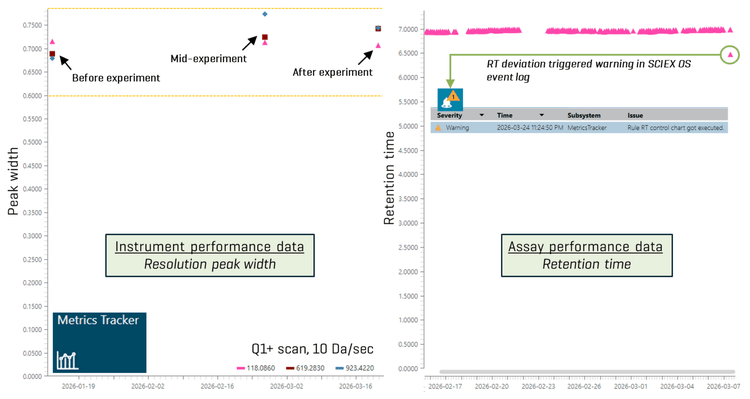
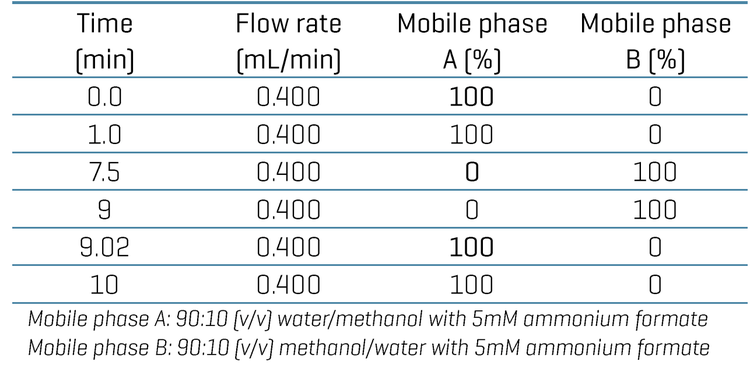
Aside from the simulated RT deviation shown in Figure 5, the Phenomenex Kinetex Biphenyl column exhibited robust chromatographic performance (single-digit %CV in RT) throughout the experiment, during which only the guard cartridge was changed once.
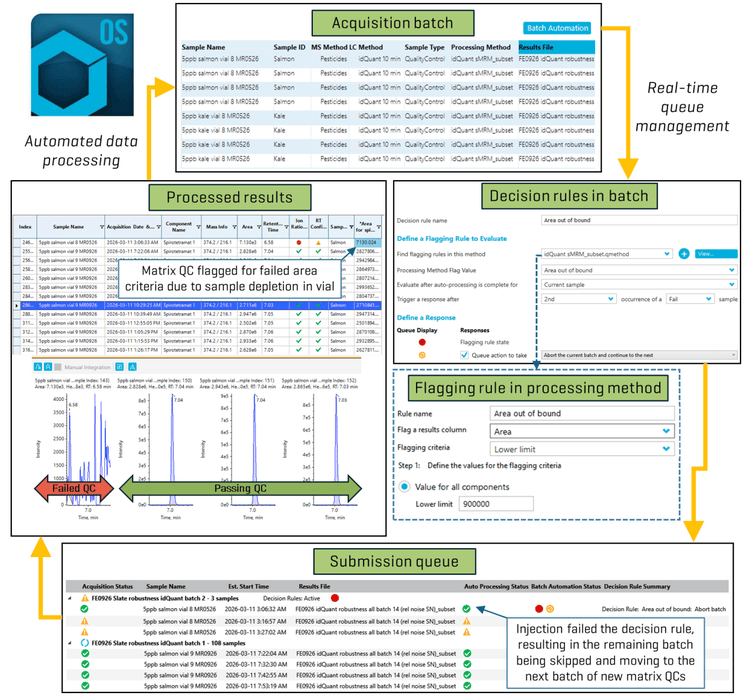
Software-driven automation was used to coordinate data acquisition, data processing and QC performance tracking into an end-to-end analytical workflow (Figure 6). SCIEX OS software initiates automated data processing for each sample upon completion of acquisition based on the processing method predefined in the batch. Real-time decision-making can be embedded in queue management by leveraging flagging rules set in the processing method to monitor for performance deviations. Figure 6 demonstrates how a batch decision rule works with a processing method flagging rule to monitor peak areas that fall below a prespecified value, such as in the case of a failed QC sample. Here, an injection from a depleted sample vial triggered the decision rule to abort the current batch and move onto the next batch of freshly prepared matrix QC samples. This prevents further time spent on reinjections, enabling earlier intervention to salvage the remaining batch using alternative QC samples. QC deviations are also flagged in the processed results table, which is automatically generated and saved to the destination file initially specified in the acquisition batch.
The exceptional robustness demonstrated on the novus V55 system enabled reliable, long-term residue testing in complex food matrices, supporting consistent data quality over extended routine operation. In parallel, SCIEX OS software features such as automated processing, batch decision rules and metrics tracker performance tracking minimize manual intervention and streamline daily workflow. Together, this hardware-software ecosystem delivers high-throughput performance and increased efficiency and lowers the operational burden for routine food testing laboratories.
Conclusion
- The novus V55 system maintained sensitivity performance after 4,185 injections of complex food matrix and solvent QC samples, with target pesticides exhibiting peak area %CV predominantly within ±25% of the mean.
- Intelligent software features, such as automated processing, batch decision rules and metrics tracker, in SCIEX OS were implemented to automate data acquisition, data processing and performance tracking in a streamlined end-to-end workflow.
- The combination of the robust novus V55 system with Phenomenex sample preparation and chromatography products and intelligent software automation created an integrated analytical ecosystem for high-throughput food testing.
- As the most compact triple quadrupole MS of its class with improved energy savings compared to the SCIEX 5500+ system, the novus V55 system is designed for food testing laboratories seeking to expand analytical capacity with long-term, reliable performance for sustainability-focused operations.
References
- The SCIEX novus V55 system. SCIEX brochure. MKT-38393-A.
- Wolf, W.R.; Andrews, K.W. A system for defining reference materials applicable to all food matrices. Fresenius J. Anal. Chem. 1995, 352, 73-76.
- EU Reference Laboratories for Residues of Pesticides. Analytical quality control and method validation procedures for pesticide residues analysis in food and feed. SANTE 11312/2021 v2026.