Maximizing throughput with accelerated MRM (aeMRM) on the novus V55 system
Abstract
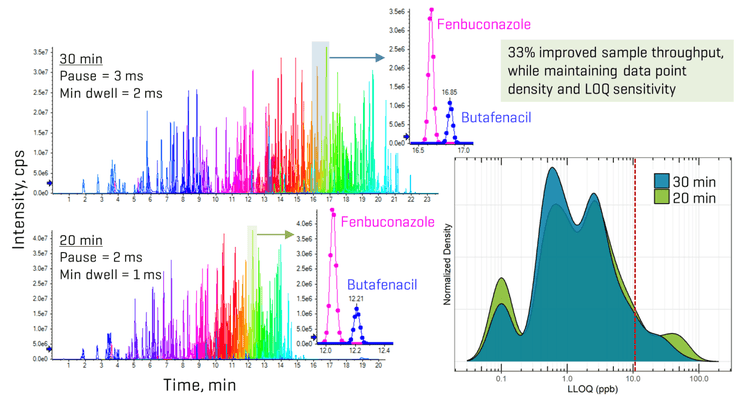
This technical note describes the quantitation of >500 pesticides in orange juice with a single-injection, polarity switching method using accelerated MRM (aeMRM) on the novus V55 system. Rapid cycle times enabled the acquisition of >1,400 positive and negative transitions, significantly increasing analyte coverage for large-panel multiresidue assays. Faster cycling allowed more flexible retention time (RT) window scheduling and shorter gradients, thereby increasing method robustness and sample throughput while maintaining sensitivity and sufficient data collection per LC peak for accurate and reproducible quantitation (Figure 1).
Key benefits of the novus V55 system for food testing
- Maximize multiresidue coverage in a single injection: Fast MRM cycle times, coupled with fast polarity switching, enabled large-panel monitoring in a single injection, without sacrificing data quality.
- Accelerate sample turnaround: Faster acquisition supported narrower peaks, shorter gradients and more flexible retention time (RT) windows, reducing total runtime and the need for reinjections from RT shifts.
- Improved compound identification: Inclusion of multiple transitions strengthened identification in food matrices.
Introduction
Multiresidue testing in food is challenged by analyte diversity and matrix complexity. These large-panel methods often contain hundreds to thousands of analytes, which can affect data quality, especially in regions of high MRM concurrency, where the number of data points across chromatographic peaks is critical for accurate quantitation. Lengthening the chromatographic gradient to improve baseline separation can reduce concurrency, but it also lowers sample throughput.
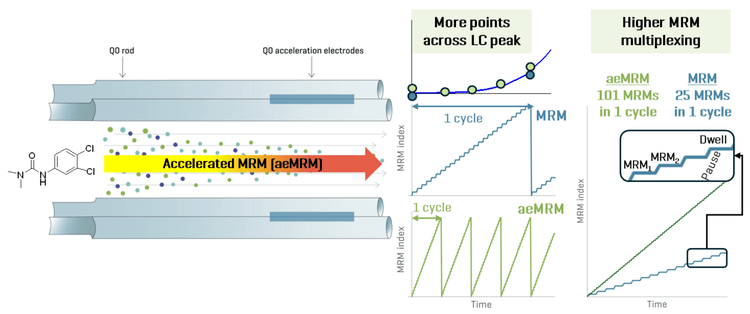
The novus V55 system features a Q0 ion guide with acceleration electrodes designed for faster ion transmissions (Figure 2).1 Together with the Q0 acceleration electrodes and updated software algorithms, a new MRM regime called accelerated MRM (aeMRM) delivers speeds of up to 1000 MRMs per second. Figure 2 represents cycle time as a staircase sequence of flat dwell time segments, separated by vertical pause time segments, with each step corresponding to an MRM transition. The total cycle time equals the number of MRM transitions multiplied by the sum of the dwell and pause times assigned to each transition. Figure 2 depicts how faster cycle times enable simultaneous increases in analyte and sample throughput, while preserving quantitative performance with higher data point density across chromatographic peaks. Here, an aeMRM method was developed for the quantitation of >500 pesticides in orange juice. Efficiency gains from analyte multiplexing, shorter gradients and wider RT windows were demonstrated in both solvent and matrix -matched standards.
Methods
Standards and samples: The Smart SolutionsTM v700 PestiMix Kit 3 from LGC Standards was used to prepare solvent calibration standards in 50:50 (v/v)methanol/water and matrixmatched standards in orange juice extract. No internal standards ( IS) were used. Orange juice was locall y purchased.
Sample preparation: A 1 mL aliquot of orange juice was diluted with 9 mL of 50:50 (v/v) methanol/water, then filtered through a 0.45 µm syringe filter prior to post-spiking. The final spiking concentrations ranged from 0.01 ng/mL to 50 ng/mL in-vial, equivalent to 0.1–500 ng/mL in-sample after a 10-fold dilution during sample preparation.
Chromatography: Chromatographic separation was performed on a Shimadzu Nexera Prominence system using a Phenomenex Luna Omega C18 column (100 x 2.1 mm, 1.6 µm, P/N: 00D-4742-AN). A flow rate of 0.3 mL/min, an injection volume of 2 µL and a column temperature of 50°C were used.
Data acquisition and processing: Data was acquired and processed using SCIEX OS software (version 5.0).
Large panel RT discovery in a single injection
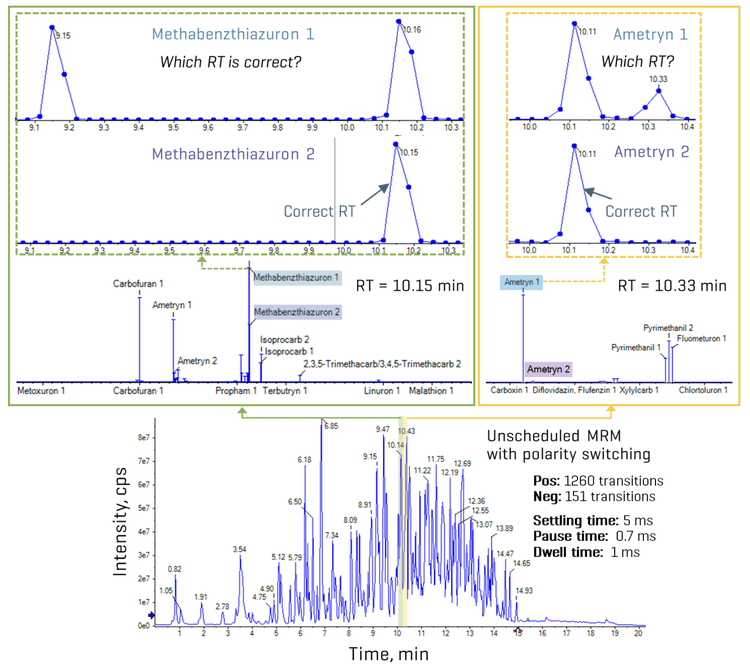
Large multiresidue workflows benefit from comprehensive multi- component standard mixtures , such as the LGC PestiMix Kit used here, to reduce preparation complexity and support consistent evaluation across the panel. Method development typically starts with unscheduled MRM acquisition to identify retention times (RTs) of the target analytes, but this can be time- and sample-consuming for large panels, often requiring multiple injections to maintain reasonable MRM concurrency. Pause and dwell times are typically in the low single-digit ms range, but this depends on chromatographic peak width, number of MRMs and instrument speed. For example, pause and dwell times of 3–5 ms and 3 ms, respectively, have previously been used for 1860 transitions on the SCIEX 5500+ system.2 Figure 3 demonstrates how aeMRM enabled a 0.7 ms pause time and a 1 ms dwell time, yielding an aggregate cycle time of 1.7 ms. Coupled with the fast polarity switching time of 5 ms, an unscheduled MRM method was developed to identify the RTs of the entire panel of 1411 transitions, with both quantifier and qualifier transitions included for each of the >700 pesticides in the mixed standard. While the higher cycling rate used here is not recommended for quantitation, it enabled sufficient data point density for RT confirmation. Monitoring multiple transitions also helped with confirming the RTs of compounds exhibiting multiple LC peaks, such as methabenzthiazuron and ametryn (Figure 3), reducing the need for reinjections. Overall, aeMRM enabled RT discovery of all analytes in both polarities in a single injection, significantly expediting method development and conserving analytical standards. This approach was used to develop the 30- and 20-min gradients for the quantitation of pesticides in orange juice.
Greater flexibility in RT window scheduling
As the demand for larger analyte panels increases in food testing, so has the reliance on faster scanning triple quadrupole mass spectrometers to maintain data quality. Scheduled MRM (sMRM)is considered the gold standard approach for targeted quantitation, especially for large panels, where concurrency can be strategically controlled through RT windows.
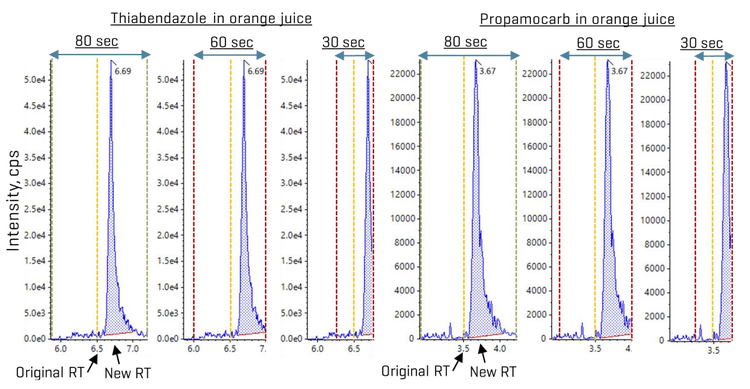
Narrower RT windows (≤30 seconds) are often used to compensate for poor data point density in methods with high MRM concurrency, but this increases the risks of peak truncation or even data loss if RTs shift due to column aging, matrix effects and instrument fluctuations. Faster cycling provides extra data point density for oversampling, enabling chromatographic peaks to be fully captured and RT windows to be safely widened without sacrificing peak quality. Figure 4 demonstrates how aeMRM enabled the use of an RT window of 80 seconds to fully capture the peaks of thiabendazole and propamocarb despite minor shifts from their original RTs. Any further shifts, often encountered in complex food matrices over time, may result in peak truncation or even complete peak loss if narrower windows were used (Figure 4). Overall, aeMRM enabled wider RT windows to be used in the final method, rendering it more tolerant of real-world variations in column age, sample matrix, batch-to-batch and instrument variability.
Additionally, the higher data point density provided by aeMRM yields better-defined chromatographic peaks, improving integration reproducibility and simplifying peak review.
Accelerate sample throughput with shorter chromatography while preserving data quality
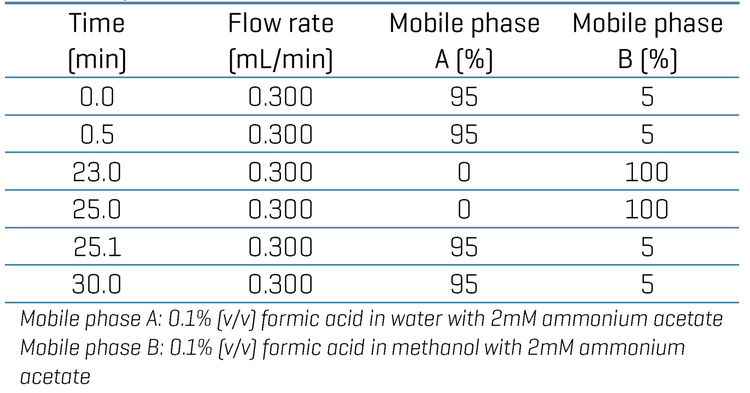
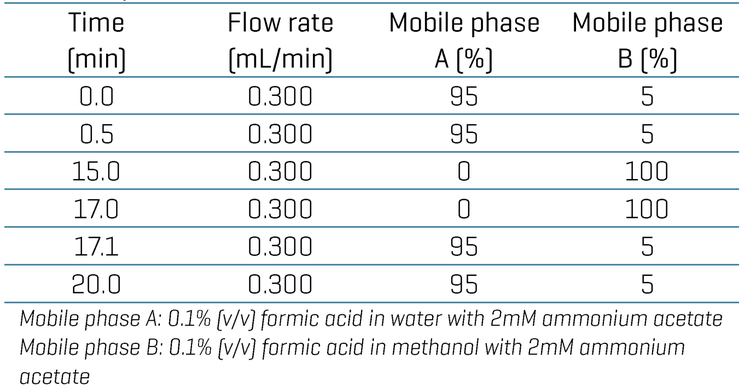
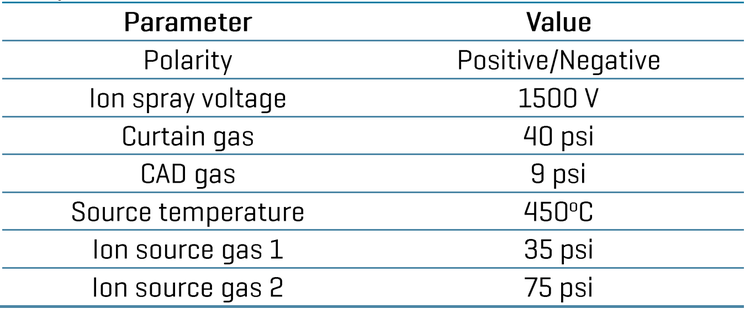
Due to the diversity of the physicochemical properties in the large pesticides mix, source conditions were optimized to ensure good sensitivity performance for the majority of the analytes. The final method monitored 1411 transitions (1260 positive, 151 negative) for 533 pesticides. The Phenomenex Luna Omega C18 column exhibited good chromatographic separation of the target analytes and data point density (≥10), even during the regions of highest MRM concurrency, in both the 30- and 20-min gradients (Figure 1). A subset of 100 pesticides was selected for more detailed interrogation of quantitative performance characteristics, which included sensitivity, matrix effects, ion ratios, LOQs, accuracy and precision (%CV), compared against the acceptance criteria outlined in SANTE 11312/2021 v2.2 The selection was designed to be representative of the entire analyte panel based on varying signal-to-noise (S/N) performance and m/z range, RTs distributed across the entire chromatogram and both polarities.
Shorter gradients and polarity switching are being increasingly adopted in food testing, largely driven by the demand for higher analyte and sample throughput. Both strategies increase the MRM concurrency, especially in multiresidue panels containing hundreds to thousands of analytes, exacerbating the trade-off between data quality and throughput.
Fast MRM acquisition, however, supports narrower chromatographic peaks and faster gradients, enabling shorter run times and ultimately, increasing sample throughput. Leveraging aeMRM, the combination of a shorter pause (2 ms) and minimum dwell time (1 ms) allowed for greater MRM concurrency and thereby, a faster 20-min method, without sacrificing data quality, as compared to a 30-min method using a pause time of 3 ms and a minimum dwell time of 2 ms. Despite the compressed chromatography in the 20-min gradient, aeMRM helped maintain signal intensity and data point density across each LC peak (≥10), even during the region of highest MRM concurrency (369 transitions) (Figure 1). Figure 5 also demonstrates similar sensitivity performance between the 2 gradients, where 88% of the processed subset in the 20-min method retained ≥85% of the peak area response relative to the 30-min method.
LOQs were also comparable between the 2 gradients, ranging between 0.1 and 50 µg/kg, with most below the global maximum residue level (MRL) of 10 µg/kg in orange juice (Figure 1). LOQ selection was based on accuracy (±20%), precision (%CV <20%) , S/N ≥10 and ion ratios (±30%). Ion ratio, expressed as the peak area quotient of the qualifier transition to the quantifier transition, is used for identification by comparing the values calculated in the sample extracts and solvent standards acquired under the same conditions. Ion ratios from the matrix-matched standards were compared against those calculated from the solvent standards. Both the 30-min and 20-min methods exhibited ion ratio differences within the ±30% tolerance for identification, outlined in SANTE 11312/2021 v2 (Figure 6).2
Repeatability was assessed based on peak area precision (%CV) measured from triplicate injections of the matrix-matched standards at different concentrations. For both the 30-min and 20-min methods, the majority of the processed subset exhibited %CV less than the 20% precision threshold outlined in SANTE 11312/2021 v2,2 with reproducibility improving with higher concentrations (Figure 7).
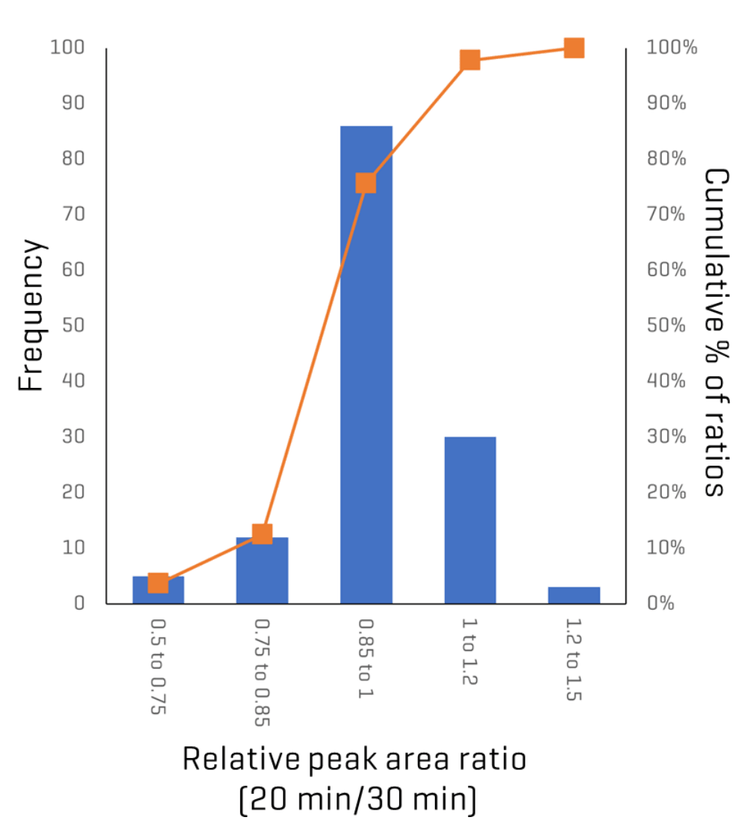
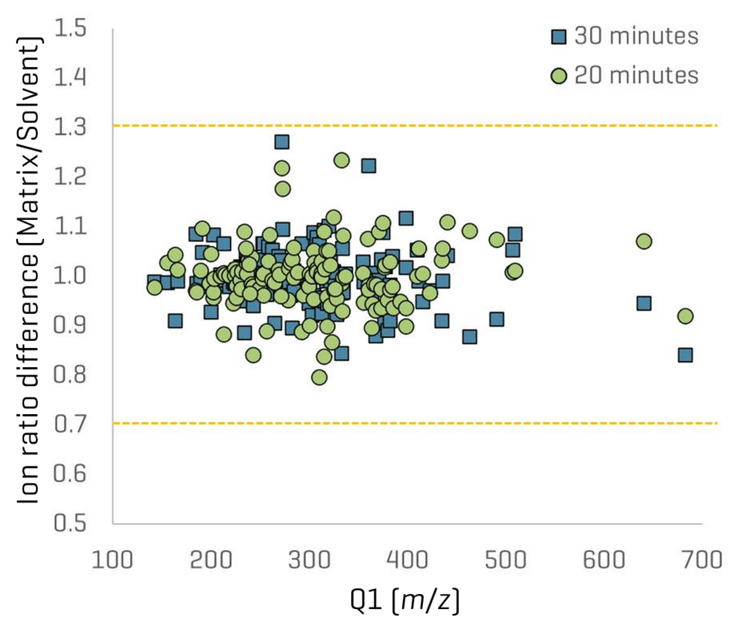
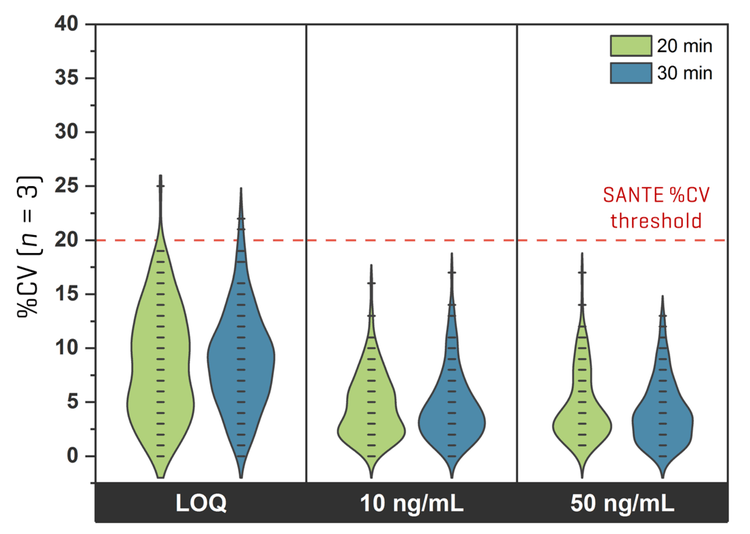
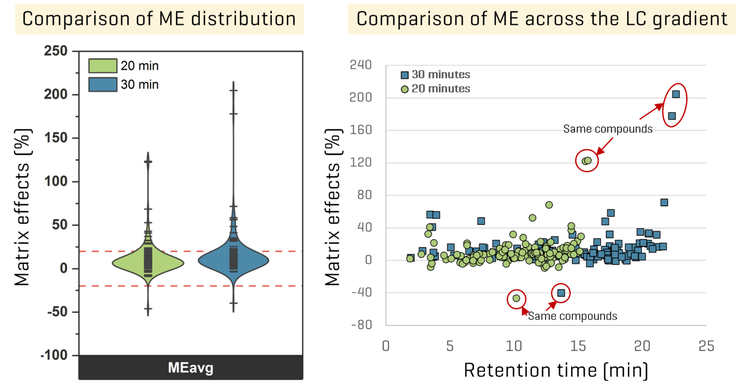
Figure 8 compares the average matrix effects across 3 concentrations for the processed subset between the 2 gradients. The violin plot shows similar ME spread between the 2 methods, with most falling within the ±20% criteria outlined in SANTE 11312/2021 v2.2 Both gradients exhibited similar trends in which significant matrix enhancement was observed for bifenthrin and pyridalyl and matrix suppression for thiodicarb. The graph on the right also shows these deviations, as well as limited impact of the condensed chromatography on the early eluters that are typically more prone to matrix effects.
Overall, sensitivity, data point density, LOQ, ion ratios, precision and ME were largely preserved between the 20-min and 30-min methods, resulting in ~30% time savings per sample. This alleviates trade-off concerns between sensitivity and acquisition speed that had been previously demonstrated in a large-panel assay comprised of 931 mycotoxins and other secondary metabolites.3 In that study, method development from a dual-injection HPLC -MS/MS assay to a single -injection polarity switching UPLC -MS/MS reduced the runtime by half, but at the cost of elevated LOQs due to repeatability issues.3 Here, fast aeMRM acquisition on the novus V55 system offers a scalable approach to address growing analyte panels and higher throughput demands, while maintaining quantitative performance.

Conclusion
- Leveraging aeMRM acquisition on the novus V55 system, rapid MRM cycling increased transition capacity while maintaining robust quantitative performance, enabling analyte panel expansion, additional confirmation transitions for improved identification confidence, more reproducible peak integrations and faster peak review, greater tolerance to RT shifts and shorter runs for increased sample throughput.
- Low ms cycle times on aeMRM helped transition previous multi-injection workflows into a single-injection method, offsetting trade-offs between sensitivity and acquisition speeds encountered in conventional MRM mode.
- The novus V55 system enables food laboratories to expand capacity efficiently, maximizing limited lab space while supporting energy- and resource-conscious operations and increased throughput of revenue-generating samples.
References
- The SCIEX novus V55 system. SCIEX brochure. MKT-38393- A.
- Kenjeric, L.; Sulyok, M.; Bueschl, C.; Malachova, A.; Krska, R. Exploring the limits of UPLC -MS/MS with polarity switching towards the quantification of 931 mycotoxins and other secondary metabolites in cereal-based food. J. Food Comp Anal. 2026, 151, 108908.
- EU Reference Laboratories for Residues of Pesticides. Analytical quality control and method validation procedures for pesticide residues analysis in food and feed. SANTE 11312/2021 v2026.