Targeted analysis of artificial dyes in spices and jaggery sugar using LC-MS/MS
Abstract
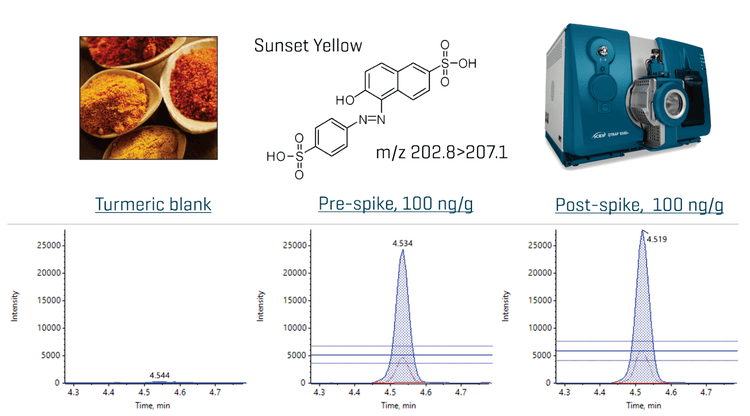
This technical note describes a method for the trace analysis of 7 artificial dyes in turmeric and jaggery sugar. Using the QTRAP 6500+ system and a simple extraction procedure, good quantitative performance was shown for matrix spikes at 100 ng/g, 500 ng/g and 5000 ng/g. Absolute recoveries ranged from 80.2% to 104% in the turmeric spikes, and from 89.4% to 107% in the jaggery spikes, demonstrating good extraction yield. Matrix effects were within ±30%, except for Indigotine in turmeric which showed a matrix enhancement of 56%. Low matrix effects were due to the optimized chromatography and sample extract dilution (333x), which was possible due to the sensitivity of the QTRAP 6500+ system. Figure 1 highlights the recovery efficiency of Sunset Yellow in a 100 ng/g spike level. The method was applied to 6 turmeric and jaggery samples and Sunset Yellow was detected above the LOQ in only one sample.
Key features of artificial dyes analysis in turmeric and jaggery sugar using the QTRAP 6500+ system
- Rapid sample preparation method. A simple sample extraction procedure involving dilution to help minimize matrix effects to within ±30%
- Method sensitivity using the QTRAP 6500+ system. In-vial limits of quantitation (LOQs) ranged from 0.02 to 0.2 ng/mL for all the targeted artificial dye compounds in the neat solvent standard
- Accurate and precise quantitation in turmeric and jaggery matrices. Matrix spikes at 100 ng/g, 500 ng/g, and 5000 ng/g in turmeric and jaggery demonstrated absolute recoveries between 80-107%, the apparent recoveries between 48-95% with precision <5%CV
Introduction
Artificial dyes and colors are widely used in many foods, such as spices, beverages, candies and processed foods to enhance their appeal and attractiveness.1 Artificial dyes are desirable since they are typically cheaper, more visually intense and chemically stable as compared to natural food colors.2 However, the consumption of synthetic dyes and their metabolites has been linked to cancer3 and neurobehavioral conditions in children.4 As a result of these potential human health effects there has been increasing public health concerns and regulatory actions. For example, in 2025 the US FDA banned the use of Red No. 3 5 and announced the intention to phase-out all petroleum-based synthetic dyes by the end of 2026.6 In the European Union, authorized food dyes are listed in Regulation (EC) No. 1333/2008 on food additives. In addition to government regulations, several major food manufacturers have announced their intent to voluntarily remove all artificial colors.2
To ensure compliance with regulatory and voluntary food dyes restrictions, a sensitive and accurate analytical method is needed. This technical note describes a LC-MS/MS method for the analysis of 7 artificial dyes in turmeric and jaggery sugar, an unrefined sugar product that is common is South and Southeast Asia.
Methods
Reagents and standard preparation: Standards were purchased from LGC Standards, and individual 1 mg/mL stock solutions were prepared in water. Calibration standards were prepared in the diluent (70:30 (v/v) water/methanol with 20mM ammonium formate) at concentrations ranging from 0.02 to 100 ng/mL, except for indigotine (0.2 to 200 ng/mL).
Sample preparation procedure for pre- and post-extraction spike experiments: A 0.2 g sample of turmeric or jaggery sugar was weighed and spiked with the artificial dye stock solutions (pre-spike experiments only). After adding 20 mL of methanol with 20mM ammonium formate, the samples were vortexed for 15 min, followed by centrifugation at 4500 rpm for 20 min. After centrifugation, 1 mL of the sample was aliquoted into a clean tube and diluted with 20mM ammonium formate in water to yield a final composition ratio of 30:70 (v/v) processed sample extract/20mM ammonium formate in water. The extract was centrifuged at 13,000 rpm for 20 min and then the supernatant solution was transferred to an auto-sampler vial for instrumental analysis.
Intermediate stock solutions were used for the matrix recovery experiments at in-sample concentrations of 100 ng/g (low), 500 ng/g (mid) and 5000 ng/g (high). For the post-extraction experiments, spiking was performed in the processed extract. All experiments were performed in triplicate.
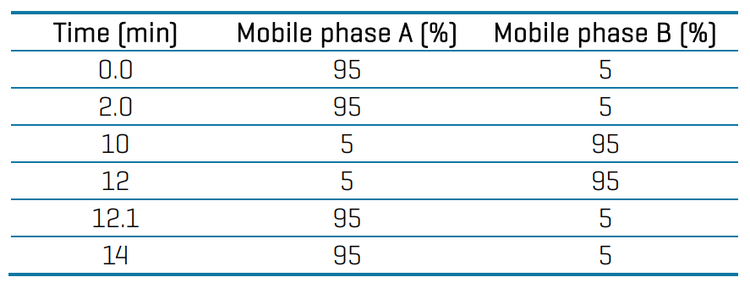
LC chromatography: Chromatographic separation was performed using an ExionAD LC system and a Phenomenex Luna Omega Polar C18 column (3.0 µm, 100 x 2.1 mm, P/N: 00D-4760-AN). Mobile phase A was water with 20mM ammonium formate, and mobile phase B was methanol. The runtime was 14 min using the gradient conditions presented in Table 1. The flow rate was 500 µL/min, the injection volume was 5 µL, and the column oven temperature was set to 40°C.
Analysis of real-world turmeric and jaggery sugar samples: Commercial turmeric and jaggery sugar products were purchased from a local store in Bangalore, India and analyzed using the sample preparation methods described above.
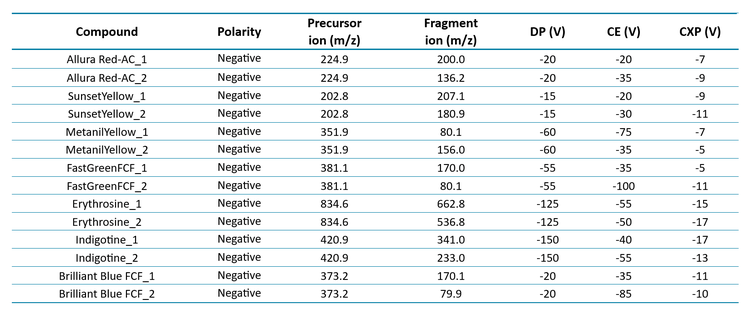
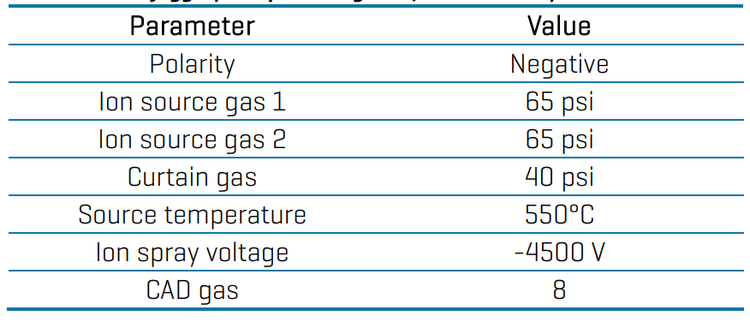
Mass spectrometry: Samples were analyzed using the QTRAP 6500+ system with electrospray ionization in negative polarity mode. Data was acquired with multiple reaction monitoring (MRM) using optimized compound-specific parameters (Table 2) and source & gas conditions (Table 3). Two MRMs per compound were monitored.
Data processing: Data acquisition and processing were performed using SCIEX OS software (version 3.4.5.828).
Good chromatographic separation using the Phenomenex Luna Omega Polar C18 column
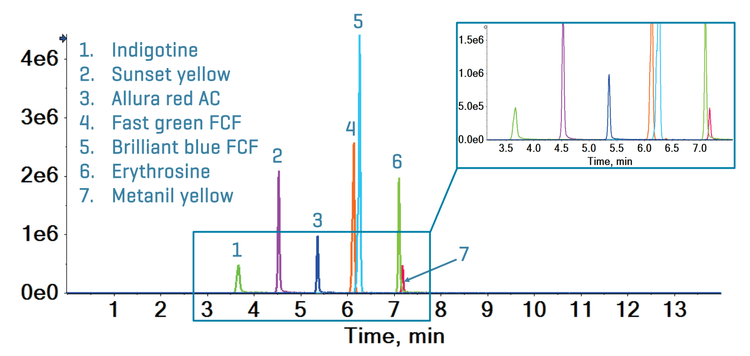
The chromatographic conditions were optimized to ensure retention from the void volume and good analyte separation. Various mobile phases and LC columns were tested during the method development. Ultimately, good peak shape and void volume separation were achieved using the Phenomenex Luna Omega Polar C18 column with the mobile phases of water modified with 20mM ammonium formate and methanol (Figure 2). In addition, the 14 min gradient was optimized to avoid co-elution with the matrix interferences. The most polar analyte, indigotine, eluted after the void volume at 3.7 min with a retention factor (k’) of 6.7. Separation from the void volume is critical to reduce potential matrix suppression or peak shape interferences, which can impact quantitative performance.
Linear dynamic range, sensitivity, accuracy, and precision of the solvent-based calibration standards
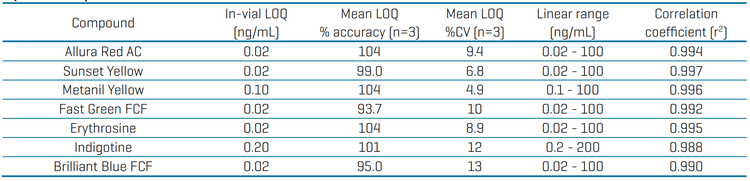
The method sensitivity and linear dynamic range of the QTRAP 6500+ system were evaluated in the solvent-based calibration standards (n=3 injections). Linearity covered 3 orders of linear dynamic range for all 7 artificial color analytes as demonstrated by r2 values ≥0.990 using the weighing factor 1/x2. The in-vial LOQs were at sub-ng/mL levels, ranging from 0.02 to 0.2 ng/mL (Table 4). The mean LOQ accuracy was between 93.7% and 104%, and the mean precision ranged from 1.9%CV to 23%CV. The specific LOQ criteria evaluated included 2 selective MRM transitions achieving a signal-to-noise (S/N) ratio of ≥10, accuracy ±30%, precision <15% and ion ratio tolerance of ±30%.
Quantitative performance in turmeric and jaggery sugar matrix spikes
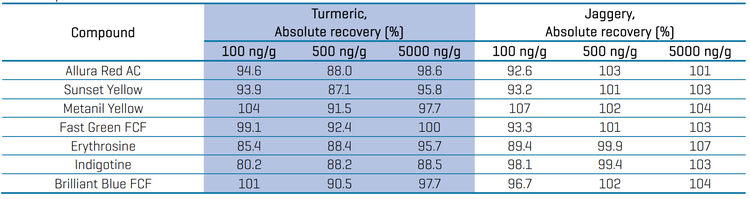
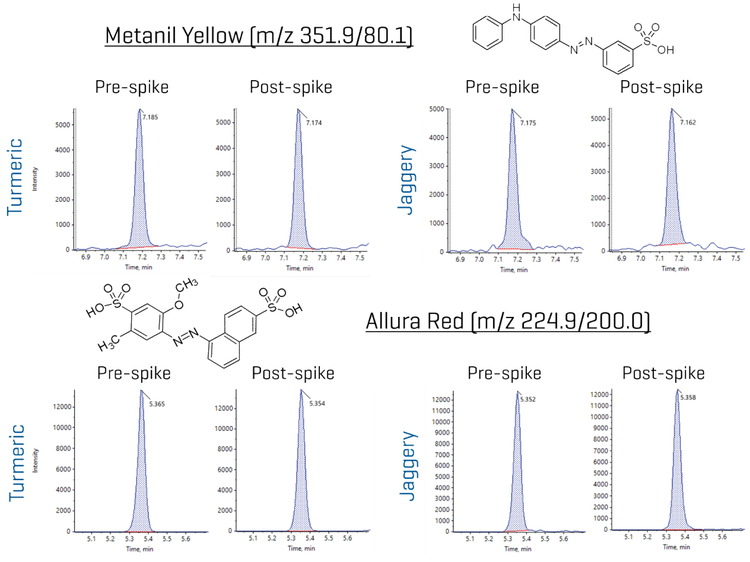
The method performance was evaluated through matrix spikes in turmeric and jaggery sugar at 100 ng/g, 500 ng/g and 5000 ng/g (n=3 per spiking level). The absolute recovery was calculated as the ratio of the mean pre- to post-extraction area count. The pre-to-post spiked recovery data set is presented in Table 4 and Figure 3 shows representative extracted ion chromatograms (XICs) for Allura Red AC and Sunset Yellow at the 100 ng/g spike level. The absolute recoveries ranged from 80.2% to 104% in the turmeric spikes, and from 89.4% to 107% in the jaggery sugar spikes, calculated from the quantifier transition at 3 spiking levels. These results demonstrate good method extraction recovery in the two matrices evaluated.
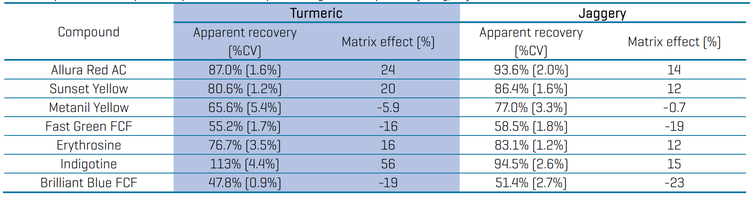
The apparent recovery was determined by quantifying the pre-extraction spikes using the solvent calibration standards (n=3). Therefore, the apparent recovery is a function of the extraction recovery and matrix effects. Apparent recoveries ranged from 47.8% to 87.0% in the turmeric, and from 51.4% to 94.5% in the jaggery sugar. Presumably, the lower apparent recovery observed for some analytes was due to matrix suppression as discussed below. However, the apparent recovery precision (%CV) was mainly <5% demonstrating excellent reproducibility.
The matrix effects were evaluated by comparing the response of the 500 ng/g post-extraction matrix spike to the equivalent solvent standard (1.5 ng/mL) using the equation:

Detection in commercial turmeric and jaggery samples
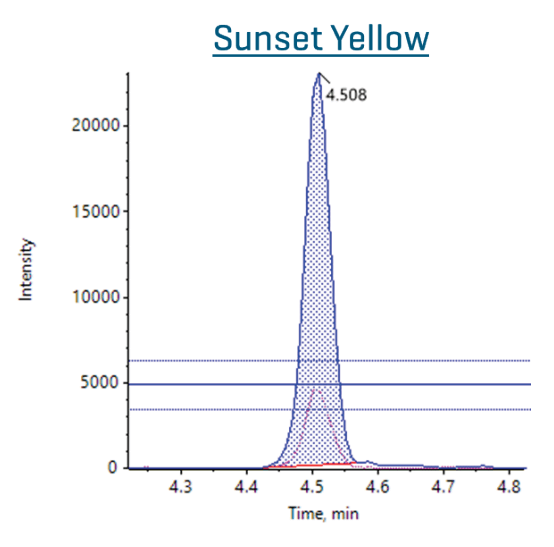
Six different turmeric and jaggery sugar samples were purchased from a local store, processed through the extraction protocol and quantified against a solvent calibration curve for the presence of the 7 artificial dye compounds. Most analytes were not detected in the commercial samples. The only exception was the detection of Sunset Yellow in one jaggery sugar sample at a concentration of 392 ng/g (Figure 4). Analyte detection was confirmed using the ion ratio relative to the analytical standard.
Conclusion
This technical note demonstrated:
- A simple sample extraction procedure and LC-MS/MS method for the analysis of 7 artificial dyes using the QTRAP 6500+ system
- Good chromatographic separation and retention from the void volume of the 7 targeted artificial dye chemicals using the Phenomenex Luna Omega Polar C18 column
- Method sensitivity with the LOQs ranging from 0.02 to 0.2 ng/mL in the solvent standard
- Good quantitative performance in matrix spikes at 100 ng/g, 500 ng/g and 5000 ng/g in turmeric and jaggery sugar samples, with absolute recoveries between 80-107% and apparent recoveries between 48-95%
- Method applicability was demonstrated in 6 purchased turmeric and jaggery samples, with Sunset Yellow detected in one jaggery sample
References
- Pereira, H.; Deuchande, T.; Fundo, J.F.; Leal, T.; Pintado, M.E.; Amaro, A.L. Painting the picture of food colouring agents: Near-ubiquitous molecules of everyday life – A review. Trends Food Sci. Technol. 2024, 143, 104249. DOI: 10.1016/j.tifs.2023.104249
- Blois, M. Is now the time for natural food colors? Chemical & Engineering News 2025, 103(13). https://cen.acs.org/food/food-ingredients/time-naturalfood-colors/103/web/2025/05
- Jacobson, M.F.; Kobylewski, S. Toxicology of food dyes. Int. J. Occup. Environ. Health 2012, 18 (3), 220-246. DOI: 10.1179/1077352512Z.00000000034
- Miller, M.D.; Steinmaus, C.; Golub, M.S.; Castorina, R.; Thilakartne, R.; Bradman, A.; Marty, M.A. Potential impacts of synthetic food dyes on activity and attention in children: A review of the human and animal evidence. Environ. Health 2022, 21 (45). DOI: 10.1186/s12940-022-00849-9
- FDA to revoke authorization for the use of Red No. 3 in food and ingested drugs. U.S. Food & Drug Administration, January 15, 2025. https://www.fda.gov/food/hfp-constituentupdates/fda-revoke-authorization-use-red-no-3-food-andingested-drugs (accessed 2025-09-08)
- HHS, FDA to phase out petroleum-based synthetic dyes in nation’s food supply. U.S. Food & Drug Administration, April 22, 2025. https://www.fda.gov/news-events/pressannouncements/hhs-fda-phase-out-petroleum-basedsynthetic-dyes-nations-food-supply (accessed 2025-09-08)