Targeted quantitation of 28 antibiotics in honey
Abstract
This technical note describes the analysis of 28 antibiotics in honey, achieving in-sample limits of quantitation (LOQ) ranging from 0.5 to 10 ng/g. Using the SCIEX QTRAP 4500 system , good quantitative performance was demonstrated in matrix-matched calibration standards with mean LOQ accuracies of 70-130% and mean LOQ precision mainly <10%. Matrix spikes at 1, 10 and 100 ng/g showed apparent recoveries between 76.2 % to 117% when quantified against the solvent standards. Absolute recoveries at 10 and 100 ng/g predominantly ranged from 80% to 120%, demonstrating good recovery efficiency using the simple dilution sample preparation method. Matrix effects were within ±20% for most target analytes, demonstrating effective dilution of potential quantitative impacts from the honey matrix. The analysis of commercial honey showed a single detection of trimethoprim in one sample at < LOQ concentration.
Key benefits of antibiotics in honey analysis using the SCIEX QTRAP 4500 system
- Sensitive quantitation of a diverse panel of antibiotics. Target list included 28 antibiotics, covering 7 classes, with in-sample LOQs ranging from 0.5 ng/g to 10 ng/g in honey .
- Simple, fast sample preparation. Target analytes were extracted from the honey using simple dilution in water and methanol to ensure broad analyte applicability .
- Good apparent and absolute recoveries. Apparent recoveries at 1 ng/g, 10 ng/g, and 100 ng/g in honey ranged from 76.2% to 117% when quantified against the solvent standards. The absolute recovery predominantly ranged from 80% to 120% for most analytes.
- Minimal quantitative impacts due to matrix effects. Matrix effects were mainly ±20% .
Introduction
Honey is widely consumed around the world, with global production reaching nearly 1900 thousand tonnes in 2023.1 It is a complex natural product containing bioactive compounds such as sugars, enzymes and proteins, organic acids and polyphenols.2,.3 Many of these compounds are associated with honey’s broad health benefits, including antioxidant, anti-inflammatory, antimicrobial and antiviral properties. 2,.3
However, the use of antibiotics in apiculture can lead to residue contamination in honey, posing potential health risks to consumers .4 Consequently, antibiotic use in beekeeping has been prohibited in several regions, including the European Union, under Commission Regulation (EU) No. 37/2010.
Given these regulatory demands, selective and sensitive analytical method s for monitoring antibiotics in honey are needed. The European Union Reference Laboratories (EURL) updated the Minimum Method Performance Requirements (MMPRs) in 2020 for several antibiotic classes in food; however, api-products such as honey are excluded due to a zero - tolerance policy for antibiotic residues.
This technical note describes the analysis of 28 antibiotics in honey across seven classes using a simple dilution -based sample preparation procedure. Apparent recovery, absolute recovery and matrix effect were evaluated without the use of any internal standard s, demonstrating the method’s suitability for routine residue analysis .
Methods
Standard preparation: The standards were purchased from Vivan Life Sciences and Evolution Life Sciences. The individual stock solutions were prepared in either water, methanol or acetonitrile. An intermediate 1 μg/mL mixed standard, in 1:1 (v/v) methanol/water, was used to prepare the solvent-based and matrix-matched calibration standards at concentrations ranging from 0.025 ng/mL to 100 ng/mL. The diluent used to prepare the solvent-based calibration curve was 50:50 (v/v) methanol/water. Internal standards were not used.
Matrix spikes for apparent and absolute recoveries in honey: To determine the apparent recovery, honey matrix spikes were prepared in triplicate (n = 3) at three concentrations: 1 ng/g, 10 ng/g, and 100 ng/g. The absolute recovery was evaluated in the 10 ng/g and 100 ng/g matrix pre- extraction spike s and compared to the post- extraction equivalent concentration s of 1 ng/mL and 10 ng/mL .
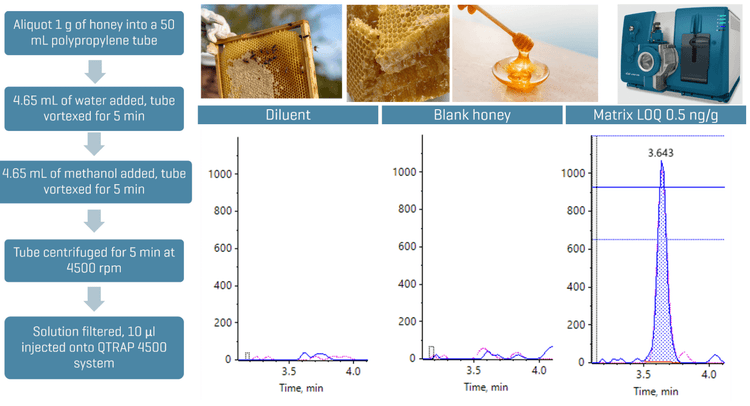
Sample preparation: Honey samples were purchased from local stores and pre -screened to ensure negligible background levels of antibiotics. 1 g of honey was sub -sampled and aliquoted into a 50 mL polypropylene tube. To the tube, 4.65 mL of water was added, vortexed for 5 min, 4.65 mL of methanol added and then vortexed for an additional 5 min (total volume = 10 mL). The solution was centrifuged at 4500 rpm for 5 min and then filtered using a 0.2 μM PVDF hydrophobic filter before injection onto the mass spectrometer.
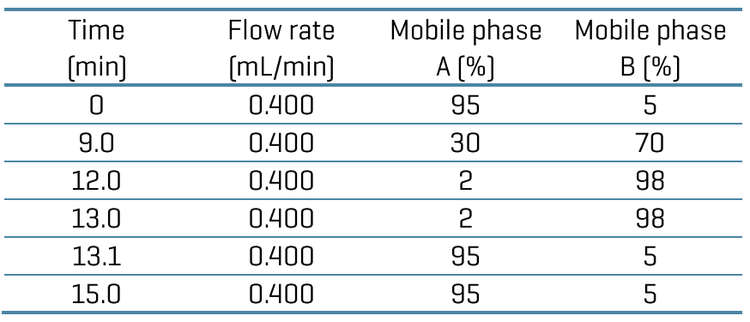
Chromatography: Chromatographic separation was achieved using the Exion AD system with the Phenomenex Kinetex Phenyl Hexyl column (100Å, 100 x 3 mm, 2.6 µm, P/N:00D4495-Y0). Mobile phase A was water with 5mM ammonium formate and 0.1% (v/v) formic acid, and mobile phase B was acetonitrile with 0.2% (v/v) formic acid. The injection volume was 10 µL, the flow rate was 0.4 mL/min and the column oven was set to 40 oC. The rinsing solution was 80:20 (v/v) acetonitrile/water. The gradient is presented in Table 1.
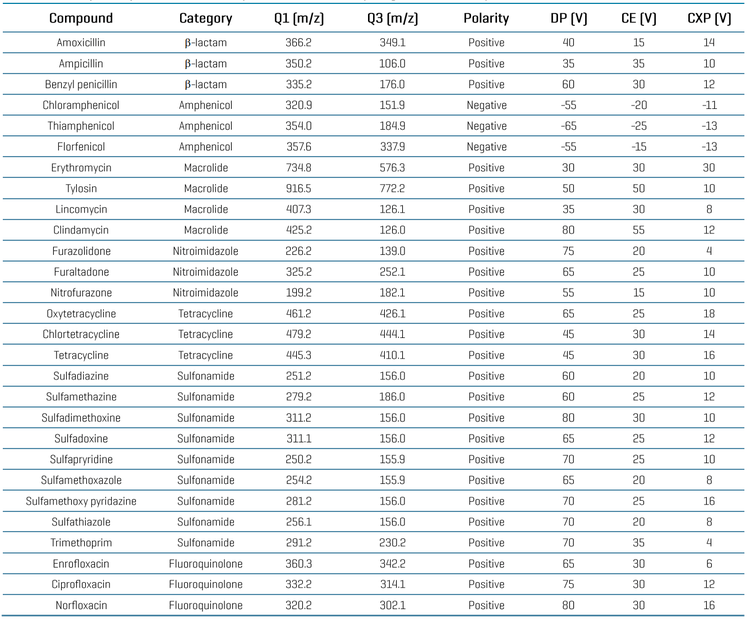
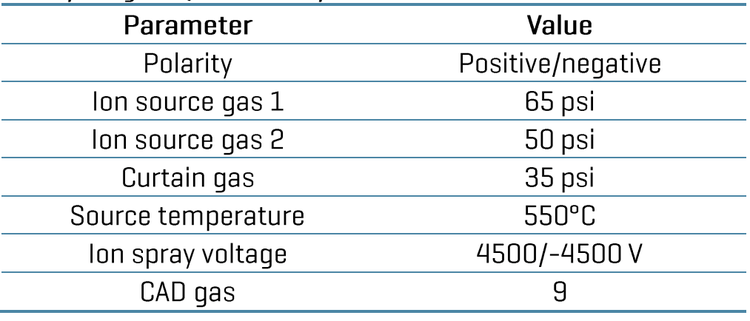
Mass spectrometry: Samples were analyzed with the SCIEX QTRAP 4500 system using scheduled multiple reaction monitoring (sMRM) acquisition in polarity switching mode and electrospray ionization. The optimized source and gas conditions and compound parameters are listed in Tables 2 and 3.
Data processing: All data were acquired and processed using the SCIEX OS software (version 3.3.1). Compound optimization was performed directly within the SCIEX OS software.
Performance of aqueous and matrix - matched calibration curves
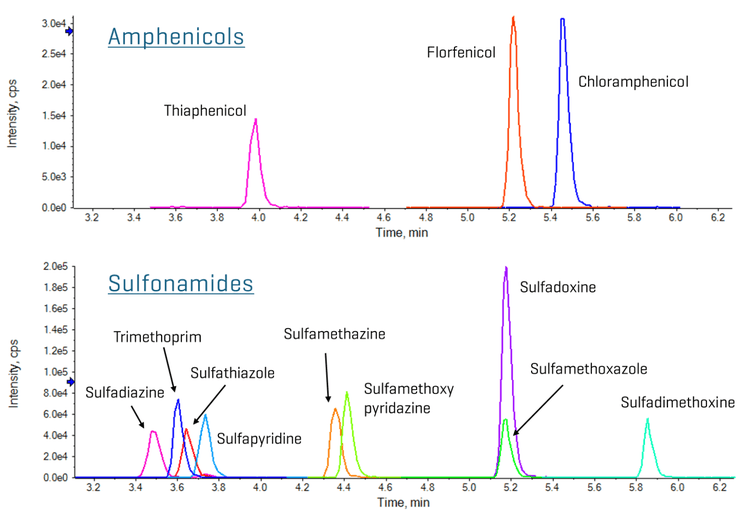
The combination of the Phenomenex Kinetex Phenyl Hexyl column, mobile phase composition and gradient conditions ensured good retention from the void volume and unretained, polar matrix interferences, as well as good chromatographic separation of the target analytes. The aromatic and moderate hydrophobic selectivity of the Kinetex Phenyl Hexyl stationary phase was critical for the retention and separation of aromatic antibiotics. Figure 1 shows example overlaid extracted ion chromatograms (XICs) for the targeted amphenicols and sulfonamides.
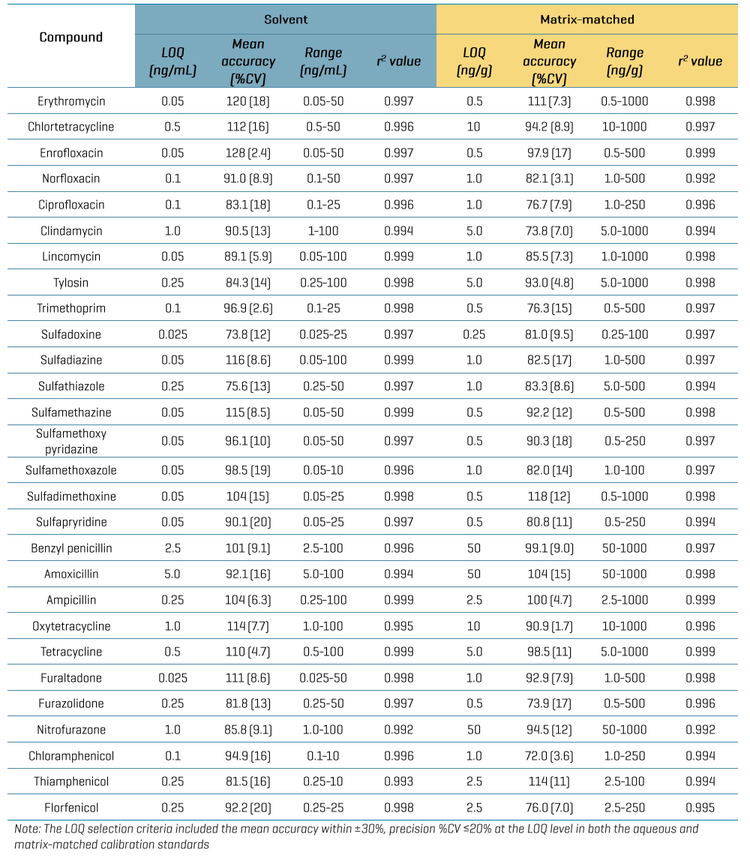
The solvent and matrix -matched calibration standards were injected in triplicate to evaluate the sensitivity, accuracy, precision and linear dynamic range (full data set presented in Table 4). The in- vial concentrations ranged from 0.025 ng/mL to 100 ng/mL, equivalent to in -sample concentrations of 0.25 ng/g to 1000 ng/g. The compounds showed r2 values ≥0.991 for all the transitions except the qualifier transition of thiamphenicol in the solvent standard ( r2 = 0.988). The solvent standard LOQs ranged from 0.025 ng/mL to 5 ng/mL , but were <0.5 ng/mL for most analytes. Similarly, the LOQs in the matrix-matched standards ranged from 0.025 ng/mL to 5 ng/mL , but again predominantly <0.5 ng/mL for most analytes . The corresponding back- calculated in -sample LOQs ranged from 0.25 ng/g to 50 ng/g, demonstrating sub - to low ng/g (ppb) LOQs for antibiotics in honey using the SCIEX QTRAP 4500 system. The LOQ of each compound was verified by evaluating the mean accuracy (70–130%) and precision (<10%), S/N ≥10 and ion ratios within tolerance of ±20%.
Quantitative performance in matrix spikes
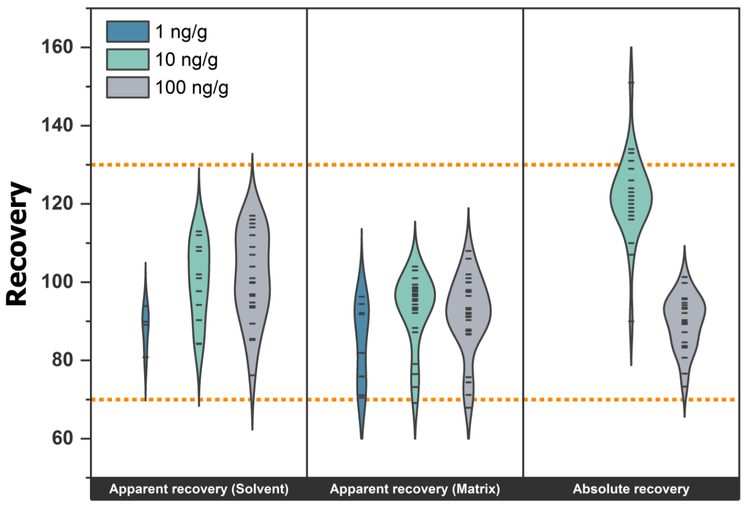
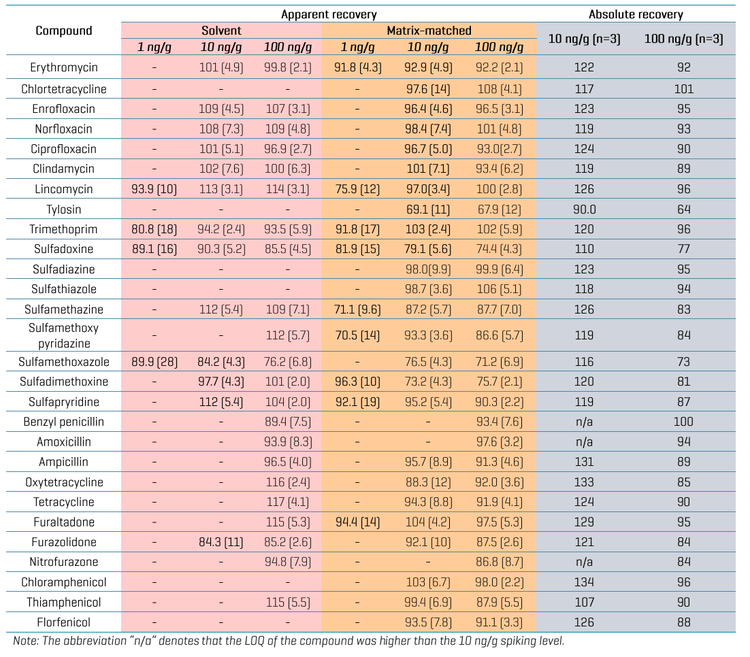
Method performance was evaluated in the honey matrix spikes at three concentrations: 1 ng/g, 10 ng/g, and 100 ng/g (n=3 replicate samples per spiking level). The apparent recovery was determined using the pre - extraction spike samples and quantified against the solvent-based calibration standards. Therefore, the apparent recovery represents a combination of the extraction efficiency and matrix effects. Apparent recoveries are not reported for some antibiotics at the lower spiking levels since the accuracy cr iteria was not achieved. Overall, the mean apparent recovery, against the solvent standards, ranged from 76.2% to 117% (Figure 4 , Table 5). The mean apparent recovery precision was predomina ntly <10%CV in the 10 ng/g and 100 ng/g spikes , and <30% in the 1 ng/g spikes. In addition, to isolate the potential quantitation effects of the honey matrix, the apparent recovery was also quantified against the matrix -matched calibration standards. Overall, the solvent-based and matrix-matched apparent recoveries were similar for most analytes, but improved quantitative performance (accuracy & precision) was noted for some antibiotics when matrix-matched calibration was used for quantitation.
The absolute recovery was evaluated in the 10 ng/g and 100 ng/g matrix spikes and was calculated as the ratio of the pre - to post- extraction spike area count. This parameter represents losses or gains from the sample preparation method , which may include analyte loss, degradation or contamination. The mean absolute recoveries ranged from 80% to 120% for most analytes, demonstrating good method extraction efficiency (Figure 4 , Table 5). Absolute recoveries for nitrofurazone, benzyl penicillin and amoxicillin were not available at the 10 ng/g spiking level d ue to the lack of detection, but these compounds exhibited good recoveries in the range of 80 –100% in the higher 100 ng/g spike.

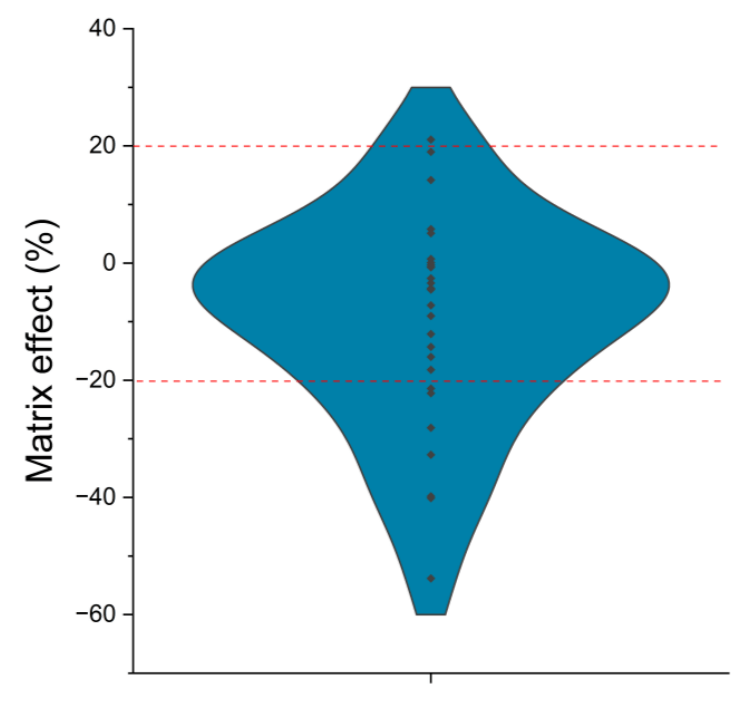
The matrix effects were mostly ±20% , with some outliers showing matrix suppression up to 54%. Figure 5 shows the violin plot of the mean matrix effects for the 28 antibiotics monitored. Analytes outside of the ±20% range predominantly showed matrix suppression. Overall, these trends were consistent with the apparent recovery results , which showed minimal quantitati ve impacts due to the honey matrix.
Method applicability to commercial honey samples
Three commercial honey samples were purchased from a local market and processed through the sample preparation and instrumental analysis procedures. None of the target antibiotics were detected in any of the samples, except for trimethoprim in one sample (Figure 1). However, the trimethoprim concentration was below the LOQ and was not reported.
Conclusion
This technical note demonstrated:
- A simple extraction procedure using dilution in methanol and water for the analysis of 28 antibiotics encompassing 7 different classes in a single injection
- Good analyte retention and separation using the Phenomenex Kinetex Phenyl Hexyl column
- Sub-to low-ng/g sensitivity in honey with LOQs ranging from 0.25 µg/kg to 10 µg/kg
- Good extraction efficiency with absolute recoveries ranging from 80% to 120% in the 10 ng/g and 100 ng/g spikes for most analytes
- Good apparent recoveries at 1 ng/g, 10 ng/g, and 100 ng/g ranging from 76.2% to 117% when quantified against the solvent standards and without the use of internal standards
- Sensitivity of the SCIEX QTRAP 4500 system enabled a simple dilution sample preparation procedure , resulting in minimal matrix effects; matrix effects were mostly ±20% , indicating minimal quantitation impacts due to matrix suppression or enhancement
References
- Food and Agriculture Organization of the United Nations. World Bee Day 2025: Africa honey production has highest global growth rate.
https://www.fao.org/newsroom/detail/world- bee- day2025 -- africa-honey- production-has-highest- globalgrowth-rate/en (accessed: 2025 - 10- 3) - Palma -Morales, M.; Huertas, J.R.; Rodríguez-Pérez, C. A comprehensive review of the effect of honey on human health. Nutrients 2023 , 15, 3056. DOI: 10.3390/nu15133056
- Ranneh, Y. et al. Honey and its nutritional and anti - inflammatory value. BMC Complement. Med. Ther. 2021, 21, 30. DOI: 10.1186/s12906-020-03170-5
- Rodrigues, H.; Leite, M.; Oliveira, B.; Freitas, A. Antibiotics in honey: a comprehensive review on occurrence and analytical methodologies. Open Res. Eur. 2024, 4, 125. DOI: 10.12688/openreseurope.17664.2