Abstract
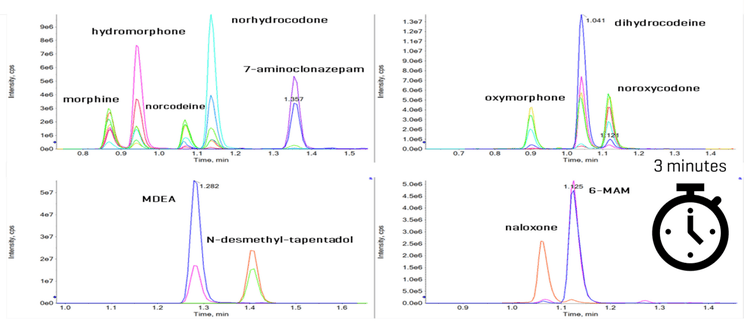
This technical note describes the analysis of 79 drugs of abuse and metabolites in a 3-min single-injection, polarity switching method using the accelerated MRM (aeMRM) feature on the novus V55 system. The fast cycle times supported acquisition of 181 MRM transitions, enabling shorter gradients and increased sample throughput with sufficient data density (≥10 points per peak). Despite the compressed runtime, baseline separation of challenging isomeric and isobaric compounds was achieved, improving analytical specificity and reducing the risk of misidentification (Figure 1). This combination of chromatographic resolution and aeMRM supports accurate and reproducible quantitation across the drug panel over a concentration range of 25 to 1000 ng/mL.
Key benefits of forensics testing using the novus V55 system:
- Faster turnaround times: Monitor large, polarity switching MRM panels in 3-minutes using aeMRM
- Consistent quantitative performance: Preserve accuracy and precision across narrow LC peaks and challenging isomeric separations
- Comprehensive drug screening made practical: Expand drug panels without sacrificing data quality
- Streamlined workflows: Reduce sample preparation complexity for routine analysis
Introduction
The increasing prevalence of illicit and prescription drug use continues to place growing pressure on forensic laboratories to deliver rapid, reliable, and comprehensive quantitative results while maintaining stringent data quality standards. Laboratories are challenged not only by increasing sample volumes, but also by continually expanding drug panels that demand broader analytical coverage without compromising turnaround time.
As forensic drug panels continue to expand, the acquisition speed and duty cycle performance of the mass spectrometer is increasingly critical to maintaining quantitative accuracy and reproducible peak integration. Multiple reaction monitoring (MRM) methods containing hundreds of transitions require rapid dwell times and fast polarity switching to preserve chromatographic peak fidelity while maintaining sufficient data points across narrow peaks for reliable quantitation. The novus V55 system features a Q0 ion guide with acceleration electrodes designed for faster ion transmissions.1 Together with the Q0 acceleration electrodes and updated software algorithms, a new MRM regime called accelerated MRM (aeMRM) delivers speeds of up to 1,000 MRMs per second. The ability to use faster cycle times enables simultaneous increases in analyte and sample throughput, while preserving quantitative performance with sufficient data point density across chromatographic peaks.
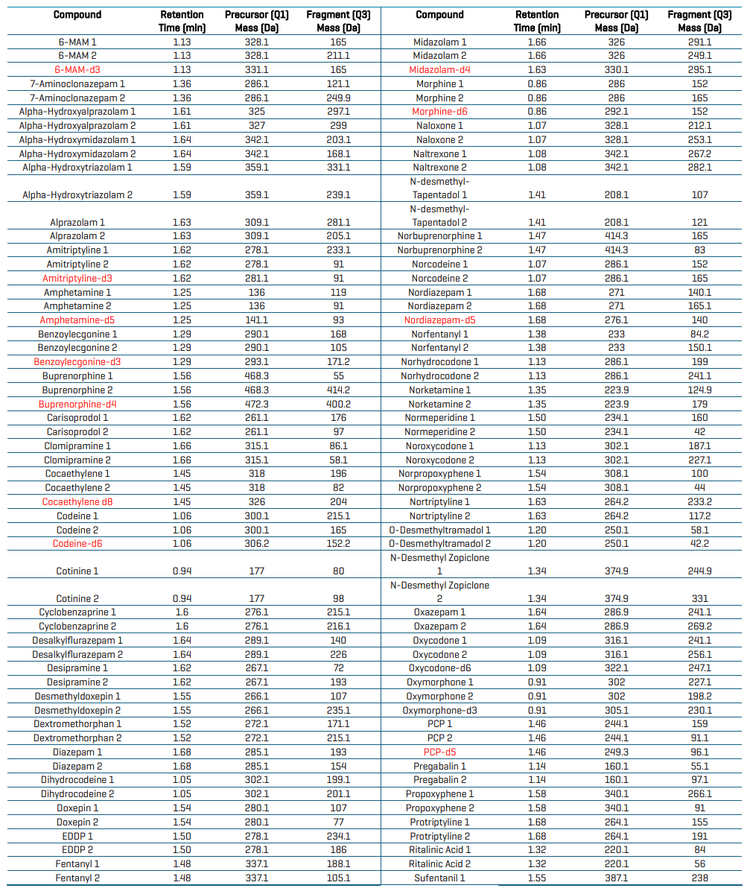
In this technical note, we demonstrate a high-throughput LC-MS/MS method for the quantitative analysis of 79 drugs of abuse and metabolites utilizing a fifth-generation triple quadrupole MS equipped with aeMRM allowing for faster dwell times. A total of 181 MRM transitions were monitored within a streamlined 3-min analytical run while maintaining sensitivity, reproducibility, and peak quality across diverse drug classes. This workflow highlights the ability of modern high-speed triple quadrupole technology to support comprehensive forensic toxicology testing while maximizing laboratory efficiency and sample throughput.
Methods
Standards and samples: Analytical standards for native compounds and isotopically labeled internal standards were purchased from Cerilliant (Rockwell, TX). Intermediary drug mixes were diluted in methanol and fortified into previously screened human urine with undetectable levels of the target analytes.
Sample preparation: A 100 μL aliquot of an individual human urine sample was mixed with 25 μL IMCS Rapid Hydrolysis Buffer, 20 μL IMCSzyme and 10 μL IS (internal standard). Both IMCS Rapid Hydrolysis Buffer and IMCSzyme were acquired from IMCS (Columbia, SC). The hydrolysis time was 60 min at 55°C. Following hydrolysis, 0.220 mL of methanol and 0.625 mL of water were added to the mixture. The mixture was then centrifuged at 21,000 g for 10 min. The supernatant was transferred to a glass vial for analysis by LC-MS/MS. This dilution followed by direct injection simplifies the workflow and minimizes consumable requirements.
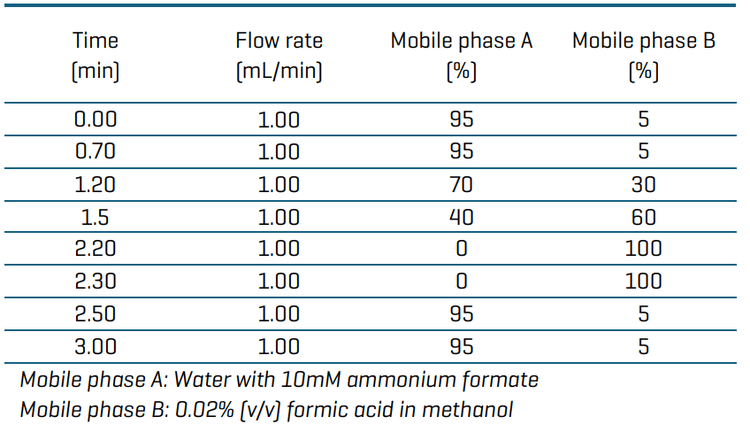
Chromatography: Chromatographic separation was performed on an ExionLC AE system using a Waters BEH C18 3x50 mm 1.7 μm analytical column. A flow rate of 1 mL/min, injection volume of 5 μL and a column oven temperature of 30°C were used. The LC gradient is presented in Table 1.
Source optimization
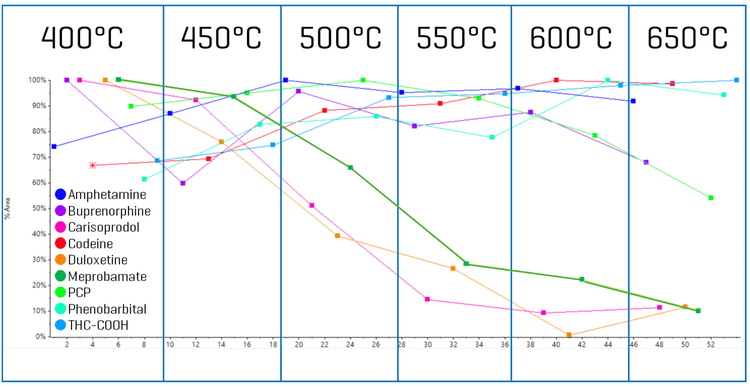
Source conditions were optimized to maximize the response of a subset of temperature-sensitive compounds. However, the lower source temperature used resulted in slightly reduced sensitivity for many of the remaining analytes in the panel. A representative figure illustrates the thermal preferences of selected analytes (Figure 2). Some compounds in the panel including amphetamine, buprenorphine, and codeine maintained relatively consistent signal intensity across the evaluated temperature range of 400°C to 650°C, generally remaining above ~80–90% of total maximum peak area observed. This behavior suggests an analyte specific preference, as there is minimal degradation to signal and these compounds show stable ionization efficiency under varying thermal conditions. Other analytes such as duloxetine, carisoprodol, meprobamate, and PCP show considerable decrease in signal with increasing source temperatures, suggesting susceptibility to thermal degradation or reduced ion transmission efficiency at elevated temperatures.
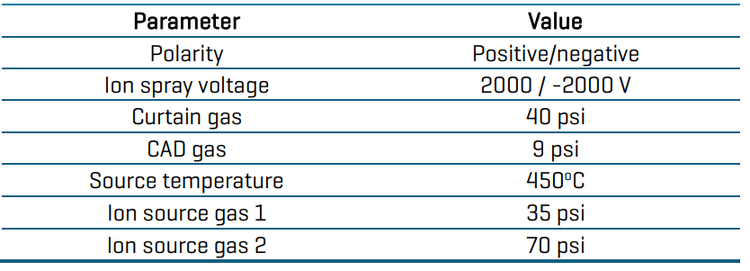
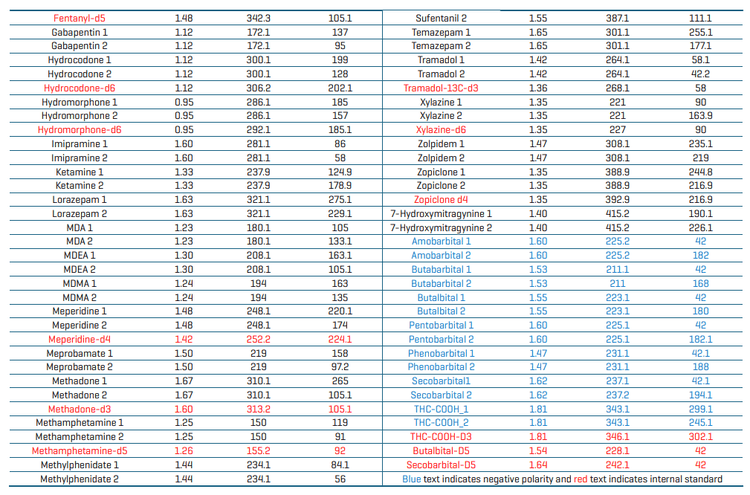
In total, 165 MRMs were acquired in positive polarity and 17 in negative polarity. In addition to source temperature, all parameters (Table 2) were optimized, and values were selected to enhance ionization for analytes requiring lower limits of quantitation or exhibiting poorer ionization efficiency.
Gradient optimization
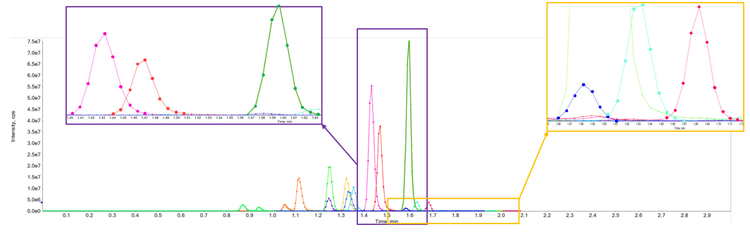
The aeMRM capabilities of the novus V55 system enabled low millisecond dwell times, providing sufficient data density across even very narrow chromatographic peaks within a compressed gradient. Figure 1 displays the ability for isomeric separation using this 3-min gradient. Baseline separation is maintained between isomer pairs such as morphine and hydromorphone, codeine and hydrocodone, and norcodeine and norhydrocodone (Figure 1). As shown in Figure 3, the fast acquisition of aeMRM still allowed sufficient datapoints across each LC peak, supporting accurate peak definition and reproducible integration, even during periods of high MRM concurrency. The purple and yellow boxes represent zoomed in regions of the chromatogram where MRM concurrency is high. Each extracted ion chromatogram (XIC) shows ≥ 10 data points across the eluting peaks. The ability to maintain consistent data density across peaks enabled reliable quantitation without compromising chromatographic performance, despite the shortened runtime.
Analytical performance
A urine blank, followed by six fortified matrix calibrators, were analyzed sequentially. Two quality control (QC) samples at 25 ng/mL and 100 ng/mL bracketed three urine samples spiked with blinded drug mixtures. Both QC and blinded urine samples were analyzed in triplicate. Spike concentrations were calculated using a single calibration curve to assess precision and accuracy of the urine QCs.
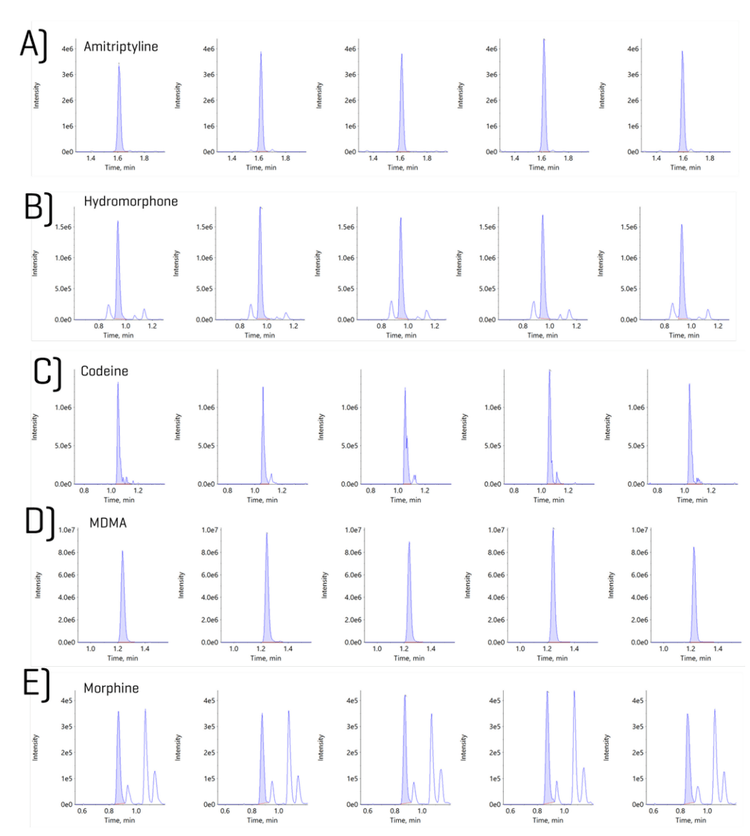
Figure 4 illustrates the lower limit of quantitation (LLOQ) for selected analytes, with sufficient signal-to-noise ratios that suggest the potential for further reduction of method detection limits. LLOQs were determined at the lowest calibration level that met a coefficient of variation (%CV) for the replicates ≤30%. The five replicates of LLOQ are shown at the same scale for each injection for a variety of drugs including A) amitriptyline, B) hydromorphone, C) codeine, D) MDMA, and E) morphine, which indicate the precision of the novus V55 system at LLOQ levels.
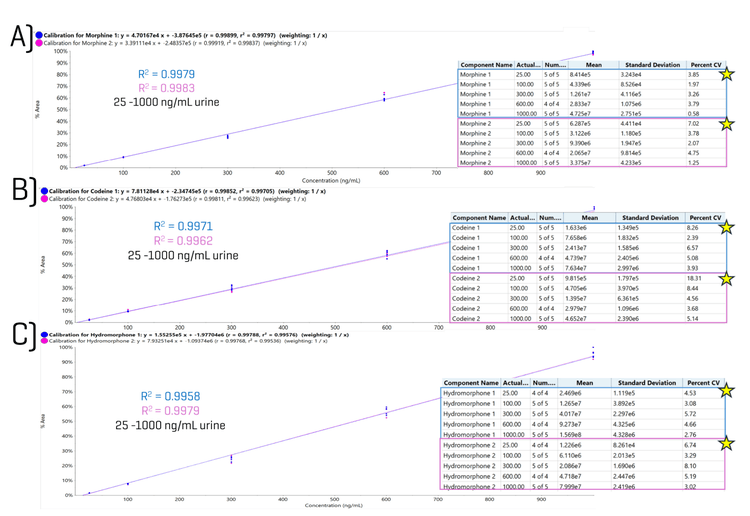
All calibration curves for the 79 drugs and metabolites were evaluated against acceptance criteria of %CV≤30% at the LLOQ and %CV≤20% at all higher calibrator levels and r2 values ≥0.995 for both quantifier and qualifier ions (Figure 5). The precision observed at the LLOQ demonstrates that aeMRM provides reproducible results while maintaining sufficient sensitivity for quantitation, even with dwell times as short as 0.5 msec. All analytes demonstrated acceptable linearity, with r² values ≥0.996 for both quantifier and qualifier transitions, supporting reliable ion ratio confirmation and reducing the risk of false-positive identifications in unknown samples.
Figure 5 displays the overlaid urine calibration curves for five replicate injections and demonstrates acceptable linearity across five replicates for four of the calibration levels and four replicates at the higher 600 ng/mL calibrator. Morphine, codeine, and hydromorphone are shown as representative opioid analgesic calibration curves over a concentration range of 25–1000 ng/mL. Tables to the right of the calibration curves represent statistical parameters built into the software without the need for additional calculations. Gold stars on the tables represent low %CV (<10% for quantifier and <20% for qualifier ions) at the lowest calibrator levels.
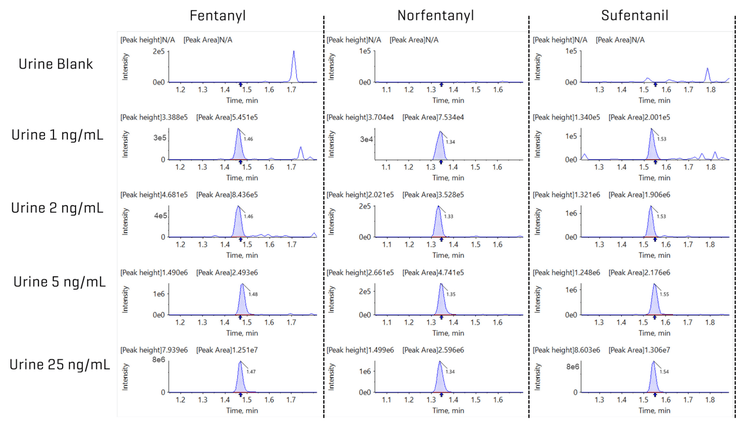
Notably, several analytes, including fentanyl, norfentanyl, and sufentanil, achieved detection levels more than ten-fold lower than 25 ng/mL (Figure 6). This demonstrates the sensitivity that can be achieved by the novus V55 system below the tested quantitation range of 25 to 1000 ng/mL.
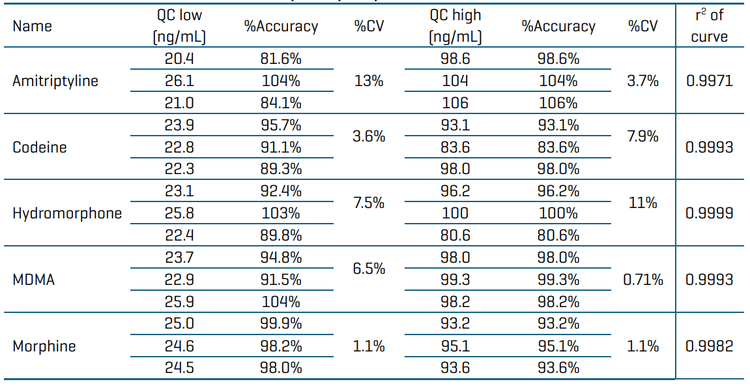
Quality control (QC) samples were evaluated for method accuracy at 25 ng/mL (low QC) and 100 ng/mL (high QC). The QC samples were quantified against a calibration curve with one replicate per level. Table 4 summarizes selected analytes, showing R² values ≥ 0.997 accuracies within ±20% and %CV ≤ 15% at both QC levels (n = 3).
Conclusions
This technical note demonstrated:
- High analyte coverage and throughput with 181 MRMs analyzed in 3 minutes
- Accurate and reproducible quantitation with sufficient data points across narrow peaks
- Robust quantitative performance for linearity, precision, and accuracy
- No compromise to chromatographic integrity or data quality
- Efficient polarity switching enabling broader compound coverage
- Simplified sample preparation, reducing workflow complexity and consumables
References
- . The SCIEX novus V55 system. SCIEX brochure. MKT-38393-A.