Quantitation of 11-nor-9-carboxy-THC (THC-COOH) in hair samples using MRM3 acquisition
Abstract
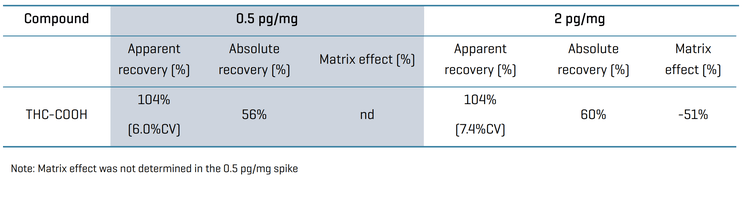
This technical note demonstrates the quantitation of THC-COOH in hair using MRM3 acquisition to achieve a 10-fold lower limit of quantitation (LOQ) relative to MRM. Using the QTRAP 6500+ system and MRM3 acquisition, the LOQ was 0.5 pg/mg as compared to 5 pg/mg using MRM acquisition (Figures 1 & 4). In addition, the gradient conditions, in combination with the Phenomenex Kinetex Biphenyl column, was optimized to chromatographically separate hair matrix interferences. Using MRM3 acquisition, matrix quality control (QC) spikes at 0.5 and 2 pg/mg (n=3) showed moderate absolute recovery (56% and 60%, respectively). However, the analysis of matrix extracted calibration standards, ranging from 0.5 to 10 pg/mg, showed good accuracy (89-105%) and precision (<6.7%CV) when normalized against THC-COOH-D3 internal standard.
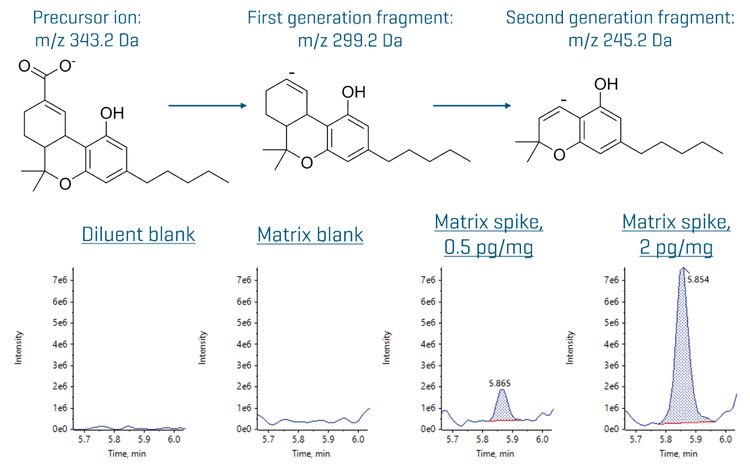
Key benefits of THC-COOH analysis in hair using the SCIEX QTRAP 6500+ system and MRM3
- Sensitive quantitation of THC-COOH in hair using QTRAP technology. MRM3 acquisition reduced matrix background allowing for an LOQ of 0.5 pg/mg in hair as compared to 5 pg/mg using MRM
- Good quantitative performance in matrix spikes. ISD-normalized accuracies of 89-105% with precision <6.7%CV in the matrix extracted calibration standards
- Chromatographic separation from hair matrix interferences. Phenomenex Kinetex Biphenyl column and optimized chromatography conditions achieved separation of THC-COOH from hair matrix interferences
Introduction
Cannabis remains one of the most abused psychoactive drugs in the world despite the fact that the possession and usage is illegal in most countries.1 Tetrahydrocannabinol (THC) is the main psychoactive chemical in cannabis and the predominant metabolite, 11-nor-9-carboxy-ᐃTHC (THC-COOH) is typically used to monitor cannabis consumption in biological matrices such as urine, blood, oral fluid and hair.2,3
Many drugs of abuse are well-preserved in hair, making it an effective matrix for monitoring chronic usage.3 However, quantitative analysis is challenging due to the low analyte concentrations in hair and complex matrix interferences, requiring the analytical method to be both sensitive and specific. In this technical note, the LC gradient methods were extensively optimized to improve the THC-COOH recovery and chromatographically separate out matrix interferences. In addition, MRM3 acquisition was used to reduce the matrix background baseline, achieving a lower LOQ as compared to traditional multiple reaction monitoring (MRM) acquisition. MRM3 is a unique scan type which uses the QTRAP technology to improve analyte specificity through the combined monitoring of first- and second-generation fragments. MRM3 acquisition may be effective to reduce matrix background when analyzing complex matrices such as hair.
Methods
Reagents and standard preparation: The native THC-COOH and and THC-COOH-D3 internal standard (ISD) were purchased from LGC Standards. Intermediate stock solutions were prepared in the diluent, 1:1 (v/v) water/methanol with 10mM ammonium bicarbonate.
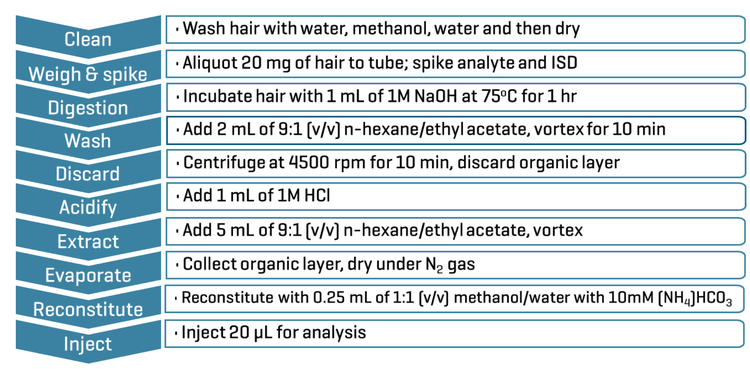
Pre-and-post spiked hair sample preparation: The sample preparation scheme is summarized in Figure 2. Briefly, hair samples were washed with water, methanol and again with water before being dried and cut into small pieces for extraction. A 20 mg sample of hair was weighed, placed into a tube, and 20 µL of the analyte and internal standard intermediate stock solutions added. The internal standard concentration was 2.5 pg/mg for the MRM experiments and 5 pg/mg for the MRM3 experiments. The hair sample was digested by incubating with 1 mL of 1M sodium hydroxide at 75°C for 1 hour. After digestion, 2 mL of 9:1 (v/v) n-hexane/ethyl acetate was added to the sample, and the solution was vortexed for 10 min, followed by centrifugation at 4500 rpm for 10 min. The deprotonated analyte, THC-COO- , remained in the aqueous layer while the hair matrix impurities partitioned into the organic layer. The organic layer was removed, and the extract was acidified by adding 1 mL of 1M hydrochloric acid. Then, 5 mL of 9:1 (v/v) n-hexane/ethyl acetate was added, and the sample was vortexed for 20 min, followed by centrifugation at 4500 rpm for 10 min. This time, the protonated THC-COOH analyte partitioned into the organic layer. The organic layer was collected, dried under a gentle stream of nitrogen gas and then reconstituted with 0.25 mL of 1:1 (v/v) methanol/water with 10mM ammonium bicarbonate before being transferred into an autosampler vial for analysis.
Matrix-spiked calibration standards were analyzed, in the MRM3 experiments only, at levels ranging from 0.5 to 10 pg/mg (n=3). Pre-and-post-extraction QC samples (n=3) were prepared by spiking at final THC-COOH concentrations of 0.5 and 2 pg/mg for the MRM3 experiments, and 5 and 10 pg/mg for the MRM experiments. In the post-spike experiment both the analyte and internal standard were added after sample preparation.
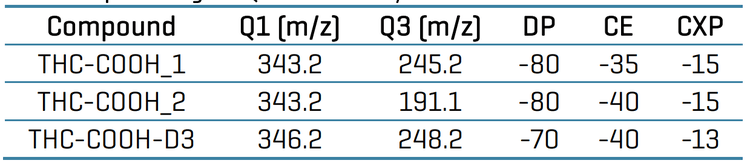
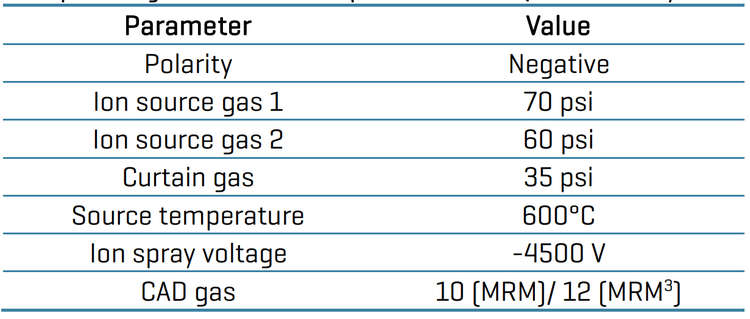
Data processing: Data acquisition and processing were performed using SCIEX OS software (version 3.4.5). Unless noted, the THC-COOH area counts were normalized to the THC-COOH-D3 ISD.
Good chromatographic separation from hair matrix interferences using the Phenomenex Kinetex Biphenyl column
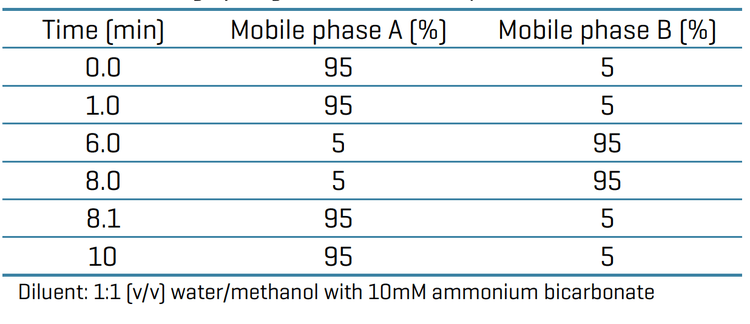
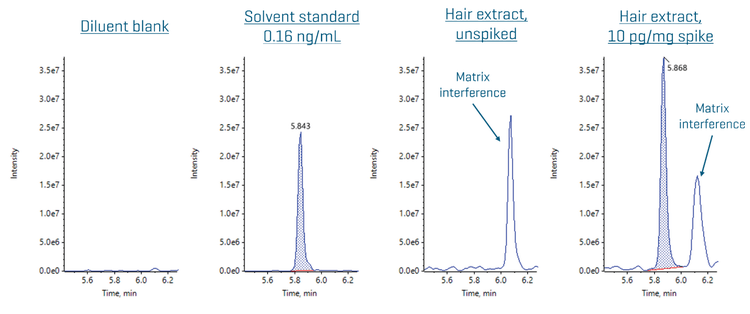
The chromatographic conditions were extensively optimized to achieve good retention, void volume separation, and interference separation from the analyte peak. Despite the increased specificity of MRM3 acquisition, a matrix interference was present in the XIC, necessitating chromatographic resolution. Initial method development showed that shorter gradients were ineffective at separating the hair matrix interferences from the THC-COOH peak, resulting in poor quantitative performance. However, the extended 10 min gradient, in combination with the Phenomenex Kinetex Biphenyl column and mobile phase composition, achieved good chromatographic separation of THC-COOH from the hair matrix interferences. Figure 3 shows extracted ion chromatograms (XICs) of the diluent blank, neat solvent standard, blank hair matrix and 10 pg/mg matrix spike. The far-right panel demonstrates the baseline separation between THC-COOH (5.9 min) and the hair matrix interference (6.2 min) in the matrix spike.
Elevated matrix background using MRM acquisition
The solvent-based standards showed linearity from 50 to 50,000 pg/mL with r2 = 0.993 for the quantifier transition using MRM acquisition. Good accuracy (96.1%) and precision (3.5%CV) were also shown in the 50 pg/mL standard (n=3).
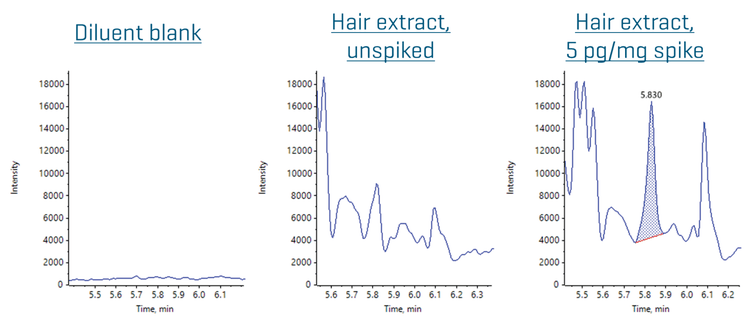
In the matrix spikes, high background noise was observed for both THC-COOH transitions using MRM acquisition despite the thorough sample preparation and chromatography methods. Figure 4 shows XICs for the THC-COOH quantifier transition in the diluent blank, unspiked hair matrix and 5 pg/mg post-extraction matrix spike. The elevated baseline of the hair sample (Figure 4, middle panel) resulted in comparatively higher LOQ values relative to the solvent-based standard. Using the lowest spike level, the LOQ was set as 5 pg/mg using MRM acquisition (Figure 4, right panel) which was equivalent to 400 pg/mL in-vial concentration. This LOQ concentration should be considered tentative since a full calibration curve was not run. In contrast, the LOQ in the solvent-based standards was 50 pg/mL.
In the matrix QC spikes, the absolute recovery was calculated as the ratio of the mean pre- to post-extraction area counts (n=3). The absolute recoveries were 74% for the 5 pg/mg spike and 62% for the 10 pg/mg spike. The relatively THC-COOH low recovery values were also reported in another hair study.5
Enhanced sensitivity using MRM3 acquisition
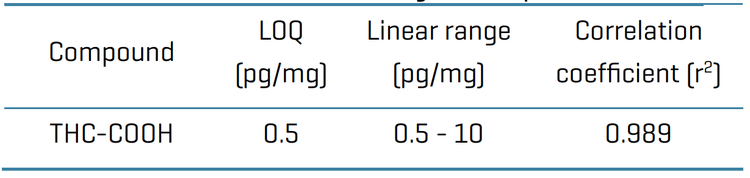
The matrix background was significantly reduced using MRM3 acquisition, resulting in a 10-fold sensitivity gain as compared to traditional MRM acquisition (Figure 1). Specifically, the THC-COOH LOQ using MRM3 acquisition was 0.5 pg/mg as compared to 5 pg/mg when using MRM acquisition. These results demonstrate the benefits of MRM3 acquisition when analyzing complex matrices such as hair.
The extracted hair matrix calibration standards showed linearity from 0.5 pg/mg to 10 pg/mg with an r2 value of 0.989 using the 1/x2 weighing factor (Table 4). The QTRAP fill trap time represents the time that the linear ion trap accumulates ions before further analysis (e.g., being scanned out to the detector or undergoing secondary fragmentation). In this experiment, the short linear dynamic range (LDR) was due to the high fill time used (250 ms), resulting in detector saturation at relatively low concentrations. Considering the entire calibration range, the mean accuracy ranged from 89% to 105% and mean precision was <6.7%CV.

Conclusion
This technical note demonstrated:
- Improved sensitivity using MRM3 scans with the QTRAP technology due to reduced matrix background
- THC-COOH LOQ in hair of 0.5 pg/mg using MRM3 acquisition as compared to 5 pg/mg using MRM acquisition
- Chromatographic separation of THC-COOH from hair matrix interferences using the Phenomenex Kinetex Biphenyl column, optimized chromatography and mobile phase conditions
- Accuracies of 89-105% and precision <6.7%CV in matrix extracted calibration standards when normalized to the ISD
- Absolute recovery of 56% in the 0.5 pg/mg spikes and 60% in the 2 pg/mg spikes, but ISD-normalized apparent recoveries were 104%. These trends highlight the importance of using mass-labelled internal standards for hair analysis
References
- World Drug Report 2025; United Nations Office on Drugs and Crime, 2025. https://www.unodc.org/unodc/en/data-andanalysis/world-drug-report-2025.html
- Musshoff, F.; Madea, B. Review of biologic matrices (urine, blood, hair) as indicators of recent or ongoing cannabis use. Ther. Drug Monit. 2006, 28 (2), 155-163. DOI: 10.1097/01.ftd.0000197091.07807.22
- Pragst, F.; Balikova, M.A. State of the art in hair analysis for detection of drug and alcohol use. Clin. Chim. Acta. 2006, 370 (1-2), 17-49. DOI: 10.1016/j.cca.2006.02.019
- MRM3 quantitation for highest selectivity in complex matrices. 2017. SCIEX Technical Note, RUO-MKT-02-2739-A.
- Hehet, P.; Franz, T.; Kunert, N.; Musshoff, F. Fast and highly sensitive determination of tetrahydrocannabinol (THC) metabolites in hair using liquid chromatography-multistage mass spectrometry (LC-MS3). Drug Test Anal. 2022, 14, 1614-1622. DOI: 10.1002/dta.3330