Abstract
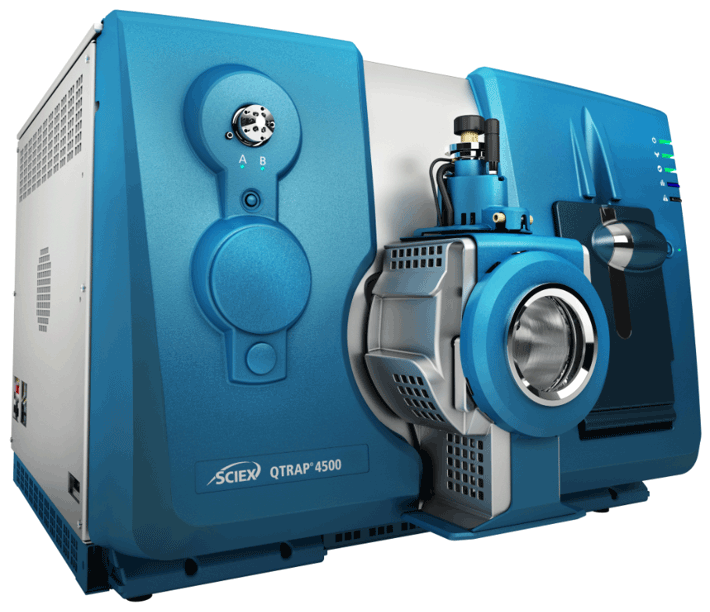
A method for the analysis of the R and S enantiomers of Amlodipine using a SCIEX QTRAP® 4500 system, an ExionLC™ System and a Phenomenex Lux HPLC column, in human plasma with an LLOQ of 0.050 ng/ml is described.
Introduction
Amlodipine is a calcium channel blocker used to treat high blood pressure, chest pain and other conditions caused by coronary artery disease. It acts by improving blood flow by dilating blood vessels. (S)-Amlodipine is the pharmacologically active enantiomer of Amlodipine but a racemic mixture of Amlodipine is used for therapeutic purposes. The use of racemic mixture of the Amlodipine has shown adverse effects like peripheral edema and other side effects like headache, dizziness, flushing and abdominal pain.15 Studies have reported these adverse effects are rarely associated with (S)-Amlodipine.14 (S)-Amlodipine and (R)-Amlodipine enantiomers exhibit different pharmacokinetics and pharmacodynamics. According to regulatory guidelines12,13 individual enantiomers should be measured in case the enantiomers exhibit different pharmacokinetic or pharmacodynamic properties or the exposure ratio of enantiomers is modified by a difference in the rate of absorption. If one enantiomer is pharmacologically active and other is inactive or has low contribution to activity, it is sufficient to demonstrate bioequivalence for the active enantiomer.
The purpose of the study was to develop an improved selective and robust LC-MS/MS method for the quantitation of Amlodipine enantiomers in human plasma samples. This method was used to monitor concentrations of (S)-Amlodipine and (R)-Amlodipine enantiomers in human plasma to evaluate the pharmaceutical equivalence for both racemic and (S)-Amlodipine formulations of Amlodipine.
Key features of enantiomer separation method
- QTRAP 4500 System provides sensitivity to detect Amlodipine enantiomers at therapeutic levels in human plasma
- Phenomenex Lux Cellulose-4 column allows for baseline chromatographic separation of the (R) and (S) enantiomers of Amlodipine
Methods
Chemicals and reagents: Analytical Standards of (S)-Amlodipine, (R)-Amlodipine, (S)-Amlodipine-d4 and (R)-Amlodipine-d4 were purchased from Toronto Research Chemicals, Canada with the purity of 99%. Acetonitrile, Water, Methanol, Ethanol Amine, Formic acid and Isopropyl alcohol were purchased for Sigma Aldrich.
Stock and working standard solutions: Stock solution of (S)-Amlodipine and (R)-Amlodipine were prepared in methanol at the concentration of 1 mg/mL. Working standard solutions of various concentrations for spiking into plasma were prepared with methanol: water (50:50 v/v). Working stock of internal standard was prepared at the concentration of 100 ng/mL.
Calibration and quality control samples: Calibration curve and quality control samples were prepared by spiking 2% by volume of the appropriate working standard solutions into human plasma to reach the final calibration concentrations (0.050, 0.10, 0.20, 1.250, 5.0, 20.0, 40.0 and 50.0 ng/ml) and quality control concentrations of 0.050 ng/ml (LLOQ QC), 0.150 ng/ml (LQC), 20.0 ng/ml (MQC) and 40.0 ng/ml (HQC)
Sample preparation: The extraction of Amlodipine enantiomers from human plasma was carried out using a solid phase extraction technique. The Strata™-X 33 µm Polymeric Reversed Phase SPE cartridge (Phenomenex) was first conditioned with 1 mL of methanol and equilibrated with 1 mL of water. 5 µL of internal standard working solution was added to 100 µL spiked human plasma and mixed. 500 µL of 0.2%v/v ethanolamine in water was added to sample and vortexed. Sample was loaded on conditioned cartridge and allowed to pass through the cartridge at moderate speed. Cartridge was washed with 1 mL of water followed by 1 mL of 20% methanol in water to remove polar and non-polar interferences. The elution of the analytes was performed by 1 mL of 0.1% formic acid in methanol. The eluent was evaporated at 50ºC under nitrogen stream and reconstituted with 100 µL of mobile phase.
LC-MS/MS analysis: SCIEX ExionLC™ AD HPLC System was coupled with QTRAP® 4500 System (SCIEX). Separation of Isomers was achieved on a Lux® 3 µm Cellulose-4 LC Column (150 x 2 mm, Phenomenex) with a flow rate of 0.3 mL/min. The mobile phase consisted of 0.05% ethanolamine in acetonitrile and isopropyl alcohol (96:4v/v) and the elution was performed with an isocratic elution.
Electrospray ionization (ESI) was performed in positive mode using multiple reaction monitoring (MRM) scan type with the transitions 409.3/237.9 for (R)-Amlodipine and (S)-Amlodipine enantiomers and 413.3/237.9 for (R)-Amlodipine-d4 and (S)-Amlodipine-d4 Internal standard enantiomers. The source temperature was 300ºC and spray voltage was set at 5500 V.
Method development
A thorough literature review revealed that several LC-MS/MS methods have been published for separation of (S)-Amlodipine and (R)-Amlodipine enantiomers in various biological matrices.1-11 However, these methods using various chiral columns and chromatographic conditions had peak tailing and longer methods. Published methods have used various basic mobile phase additives e.g. ammonium hydroxide, trimethylamine and diethylamine for chiral separations. Various additives were tried for method development, ethanolamine at the concentration of 0.05%v/v showed best peak shapes and signal for amlodipine isomers.
It is important to setup a rapid, selective and sensitive LC-MS/MS method for bioanalysis approach to ensure wide concentration range (50 pg/mL to 50 ng/mL) to cover PK and bioequivalence studies for all dosage forms ranging from 2.5 mg to 10 mg per day.
Method validation
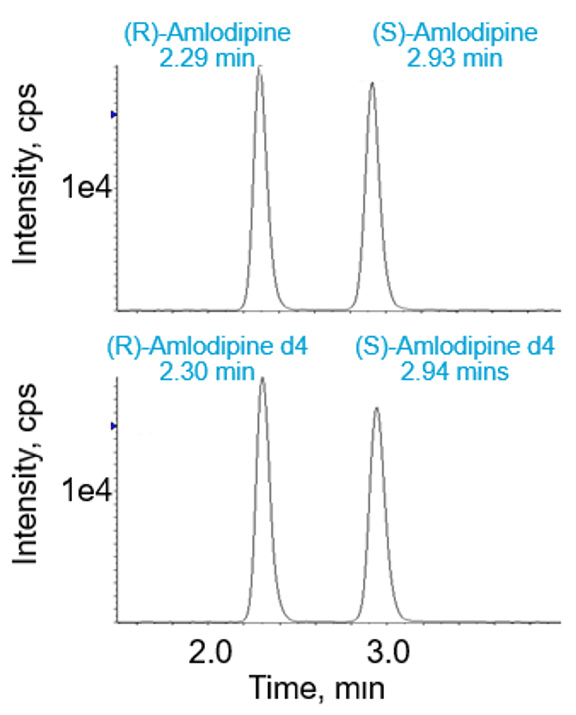
System suitability: Six replicates of analyte and internal standard mixture 1ng/mL were injected every day at the start of the experiment to ensure instrument performance at the start of the day. %CV criteria for the area ratio for the analyte to the internal standard peak area was established to be ≤5% for both analytes and, IS and retention time deviation was less than 2% for both the analytes and IS for the system suitability study. Chromatograms of (R)-Amlodipine and (S)-Amlodipine enantiomers and deuterated internal standards is presented in Figure 1.
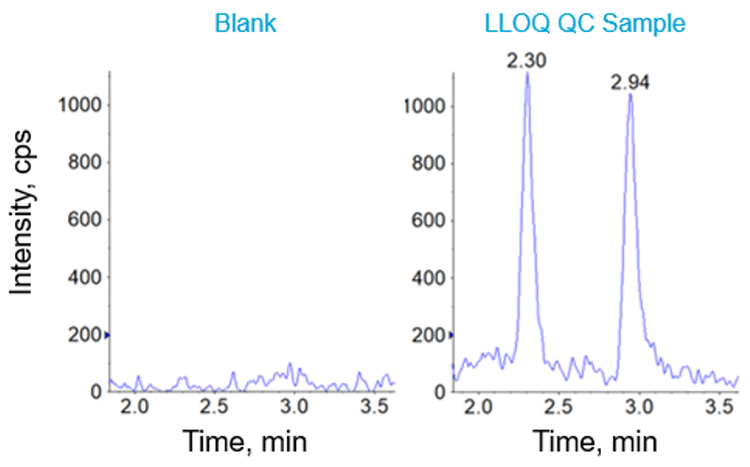
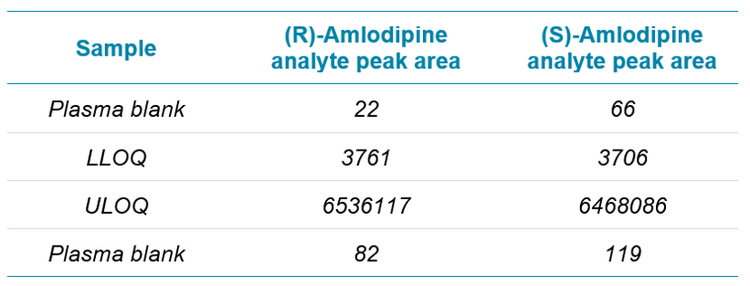
Selectivity, specificity and carryover: Eight different lots of blank plasma were extracted and analyzed using the developed LC-MS/MS method along with the corresponding lots of plasma spiked at the lower limit of quantitation (LLOQ) and working internal standard concentration. Carry over was evaluated by injecting the following sample set: extracted blank, LLOQ, ULOQ and extracted blank. Percentage interference at the retention time of the analyte was monitored and calculated against the LLOQ area response and internal standard area response. Analytes and Internal standard showed high degree of selectivity and specificity in the proposed method. Blank samples injected after ULOQ samples did not show quantifiable response, demonstrating that the proposed method has no carry over. Chromatograms of extracted plasma blank, plasma spiked LLOQ are displayed in Figure 2. A summary of carry over data is presented in Table 1.
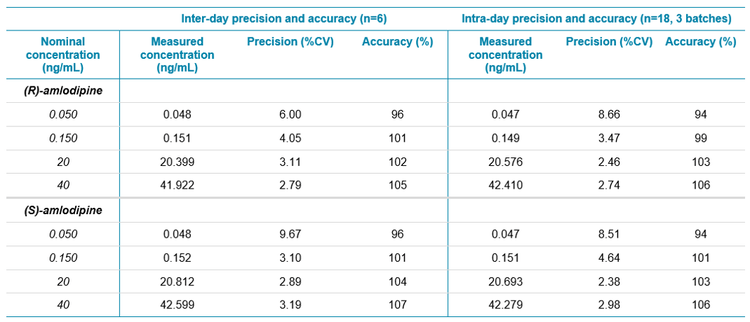
Accuracy and precision: Intraday and interday precision and accuracy was evaluated using 6 replicates of extracted LLOQ QC (0.050 ng/mL), LQC (0.150 ng/mL), MQC (20.000 ng/mL) and HQC (40.000 ng/mL) samples in human plasma. According to the USFDA Regulatory guidelines, mean % nominal concentration at each QC level, other than LLOQ QC, must be within 85% to 115% and precision (% CV) should be ≤15%. Mean % of nominal concentration at LLOQ QC level must be within 80% to 120% and the precision (% CV) should be ≤20%. Intraday and interday precision and accuracy was studied and met both the precision and accuracy requirements. The study data is presented in Table 2.
Recovery: The extraction recoveries for both (R)-Amlodipine and (S)-Amlodipine at three concentration levels were determined by measuring the mean peak area response of 6 replicates of extracted quality control samples and comparing to the mean peak area response of extracted blank matrix that was spiked after preparation with the nominal amount of both analytes at the low, medium and high QC levels. The extraction recoveries of analytes were uniform and reproducible. Extraction recovery for (R)-Amlodipine was 94.14% and 92.23% for (S)-Amlodipine.
Matrix effect: Matrix effect was determined by measuring the corresponding analyte peak area response in reconstituted matrix samples from 6 different plasma lots against the analyte mean peak area response in reference solution at 2 different concentration levels (Low and High QC Concentrations). Matrix effect was also studied for all 6 replicates and the developed method showed no matrix effect.
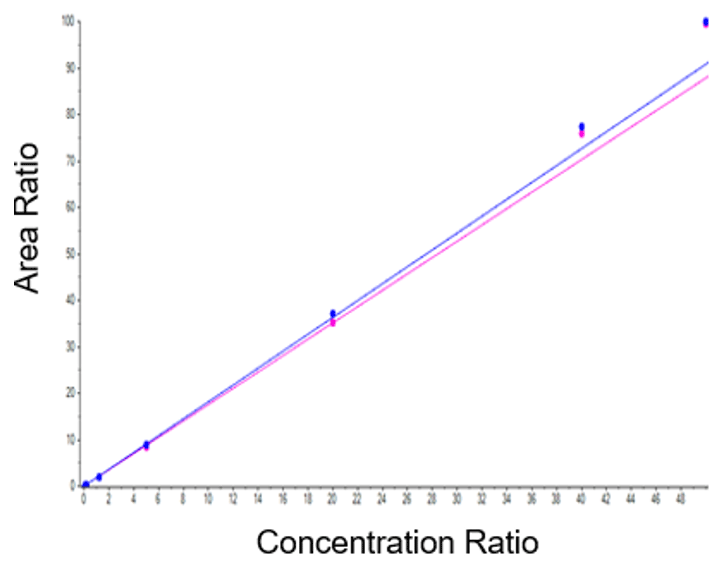
Dilution integrity: The upper level of quantitation for (R)-Amlodipine and (S)-Amlodipine is 50 ng/mL. A dilution integrity test was performed by spiking 1.6x concentrations of ULOQ in plasma samples and diluted 4-fold and 2-fold with blank plasma. The average percentage recoveries for 4-fold and 2-fold dilutions for 6 replicate injections each were 94.90% for (R)-Amlodipine and 96.40% for (S)-Amlodipine.
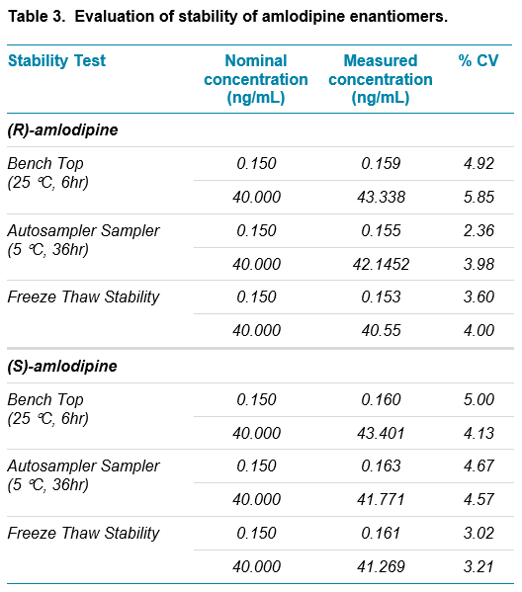
Stability: Stability studies in human plasma were evaluated to cover a wide range of expected experimental and storage conditions. Analytes and Internal standard were found to be stable at benchtop for 6 hours, in autosampler for 48 hours and for 3 freeze thaw cycles of stability studies. Sample stock solutions were also found stable in refrigerator conditions (2°C to 8°C) for 4 days. A summary of stability data is listed in Table 3.
Conclusions
A selective and sensitive LC-MS/MS method was developed for the separation and quantitation of (R)-Amlodipine and (S)-Amlodipine in human plasma. A solid phase extraction sample preparation technique was developed for extraction of the analytes from human plasma. The developed LC-MS/MS method was 7 min long, with LLOQ of 0.050 ng/mL from (R)-Amlodipine and (S)-Amlodipine enantiomers. This method is unique in that it can quantify both the pharmacologically active and inactive enantiomers of Amlodipine in human plasma. This method for quantitation of (R)-Amlodipine and (S)-Amlodipine in human plasma could be used in bioavailability / bioequivalence studies, and also in preclinical studies, because it is simple, sensitive and reproducible.
References
- Shah JV et al. (2017) Application of an LC–MS/MS method for the analysis of amlodipine, valsartan and hydrochlorothiazide in polypill for a bioequivalence study, Journal of Pharmaceutical Analysis. 7(5), 309-316 .
- Yoo HH, Kim TK, Lee BY, Kim DH. (2011) Determination of S- and R-Amlodipine in Rat Plasma using LC-MS/MS After Oral Administration of S-Amlodipine and Racemic Amlodipine. Mass Spectrometry Letters. 2(4), 88-91.
- Dossou KSS et al. (2011) Determination of enantiomeric purity of S-amlodipine by chiral LC with emphasis on reversal of enantiomer elution order. J. Sep. Sci. 34(15), 1772–1780.
- Massaroti P, et al. (2005) Development and validation of a selective and robust LC-MS/MS method for quantifying amlodipine in human plasma. Anal. Bioanal. Chem. 382(4), 1049-1054.
- Zou Q, Zhan Y, Ge Z, Wei P, Ouyang P. (2009) Liquid chromatography-mass spectrometry method for the determination of amlodipine in human plasma and its application in a bioequivalence study. Arzneimittelforschung. 59 (8), 383–391.
- Alsarra IA. (2009) High-Performance Liquid Chromatographic Method for Quantitative Determination of Amlodipine in Human Plasma and Pharmaceutical Dosage Form and Its Application to Pharmacokinetic Studies. J Chromatogr Sci. 47(10), 863-867.
- Hotha KK, Roychowdhury S, Mullangi R, Ravindranath LK. (2013) Rapid quantification of amlodipine enantiomers in human plasma by LC-MS/MS: application to a clinical pharmacokinetic study. Biomed Chromatogr. 27(9), 1192-1199.
- Taguchi R, Naito T, Sato H, Kawakami J. (2017) Validated LC-MS/MS Method for the Simultaneous Determination of Amlodipine and Its Major Metabolites in Human Plasma of Hypertensive Patients. Ther Drug Monit. 39(6), 625-631.
- Chan-Mei Lv CM et al. (2013) Determination of Amlodipine in Human Plasma by LC-MS/MS and Its Bioequivalence Study in Healthy Chinese Subjects. Pharmacology & Pharmacy. 4 (2), 191-200.
- Somagoni J, Reddy S, Koorelli S, Manda S, Yamsani MR. (2011) Enantiomeric Separation and Determination of Stereospecific Drug Release from Marketed Racemic Amlodipine Besylate Tablets by HPLC. Pharm Anal Acta, 2(5).
- Xie J et al. (2014) A simple and rapid method for chiral separation of amlodipine using dual chiral mobile phase additives. Analytical Methods, 6 (12), 4408-4413.
- Guidance for Industry Bioanalytical Method Validation. US Department of Health and Human Services, US FDA, Rockville, MD, USA.
- Guideline on bioanalytical method validation. European Medicines Agency, London, UK.
- Vikrant S. (2015) S-amlodipine induced gingival enlargement. Indian J Nephrol., 25(1), 62-63.
- www.drugs.com
- www.webmd.com