Abstract
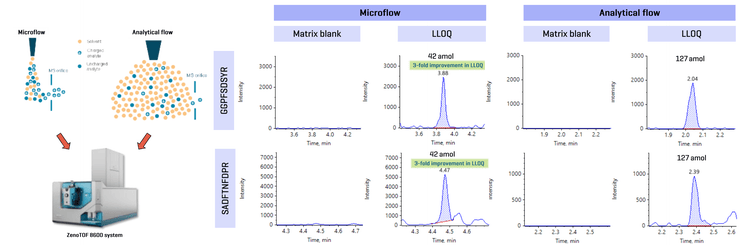
This technical note describes the enhancement of lower limits of quantitation (LLOQs) for peptides in extracted rat plasma by using a microflow trap-and-elute method. Low-attomole level quantitation was achieved for peptides with highly reproducible and accurate quantitative performance using the ZenoTOF 8600 system (Figure 1).
As the pharmaceutical landscape shifts toward more potent peptide therapeutics, laboratories are faced with bioanalytical challenges in detecting low abundance peptides within highly complex biological matrices. Therefore, robust and reliable quantitative sensitivity has become a critical priority in bioanalytical labs. Low flow chromatographic approaches , such as microflow LC (flow rates of 1 to 50 µL/min), have been increasingly adopted by bioanalytical labs to improve sensitivity limits, owing to enhanced ionization efficiency. When such techniques are coupled with a high resolution mass spectrometry (HRMS) platform, inherent advantages, such as higher selectivity for differentiating target peptides from matrix components and simplified MS/MS method development, can be leveraged. In this study, the quantitative analysis of peptides in extracted rat plasma was performed on the ZenoTOF 8600 system using both microflow and analytical flow LC conditions .
Key benefits or microflow-based peptide quantitation using the ZenoTOF 8600 system
- Enhanced sensitivity using microflow: Demonstration of improved LLOQs across 6 peptides (at low- attomole level) in extracted rat plasma using microflow on the ZenoTOF 8600 system.
- Simplified MRMHR method development: Automatically sum high-intensity product ions from TOF MS/MS spectra, resulting in improved sensitivity using SCIEX OS software on the ZenoTOF 8600 system.
- Meet critical quantitative performance criteria: Achieve accurate quantitative performance with %CV < 12% at all concentration levels across a n LDR of up to 4.3 orders of magnitude.
- Sustainability: Minimizing LC-MS grade solvent consumption reduces operating costs while improving system reliability.
- Simplified data management: Employ a single platform for streamlined data acquisition, processing, and management with SCIEX OS software .
Introduction
As sample complexity increases, the quantitative capability of HRMS in complex matrices has gained significant attention. Owing to its high mass resolution and mass accuracy, HRMS enables effective separation of target analytes from matrix interferences, allowing more reliable quantitation in challenging samples. In addition, HRMS enables simplified method development, as MS/MS- based quantitation requires minimal MRM optimization, thereby significantly reducing method development time.
As quantitative analysis of biological matrices increasingly focuses on low-abundance analytes, achieving higher sensitivity has become essential. Improving ionization efficiency is therefore a key consideration, and LC flow rate plays an important role in the electrospray process. In this study, peptide quantitative performance was compared between analytical flow and microflow conditions. The results demonstrate a significant enhancement in ionization efficiency with microflow, resulting in lower detection limits. These findings demonstrate that microflow strategies can effectively improve quantitative sensitivity for low-level peptide analysis in complex biological samples.
Methods
Sample preparation: Rat plasma samples were subjected to protein precipitation by adding methanol at a 3 -fold excess relative to plasma volume. Following vortex mixing, samples were centrifuged at ambient temperature to remove precipitated proteins. The resulting clear supernatant was collected and diluted 4-fold with 2:2:0.1 (v/v/v) acetonitrile/acetic acid /formic acid in water. A set of 6 peptides was subsequently spiked into the diluted rat plasma extracts and serially diluted to establish calibration curves for quantitative evaluation.1
Analytical flow LC conditions: The UHPLC separation was performed using an ExionLC AE system (SCIEX) . The chromatography column used was a Phenomenex bioZen Peptide XB-C18 (50 x 2.1 mm, 2.6 μm), and the column oven temperature was 40°C. The gradient conditions are in Table 1. The injected sample volume was 2 μL. The mobile phase A consisted of 0.1% (v/v) formic acid in water, and the mobile phase B was composed of 0.1% (v/v) formic acid in acetonitrile. The flow rate was set to 0.3 mL/min.
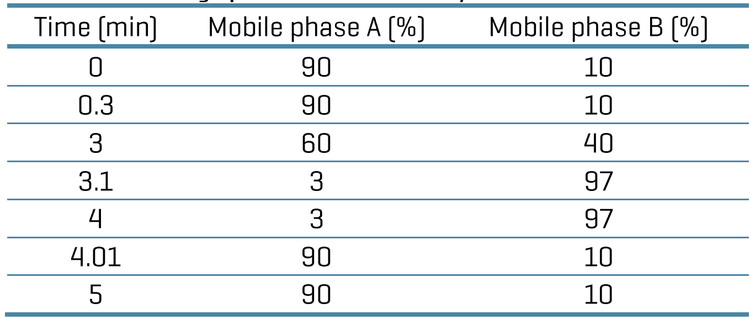

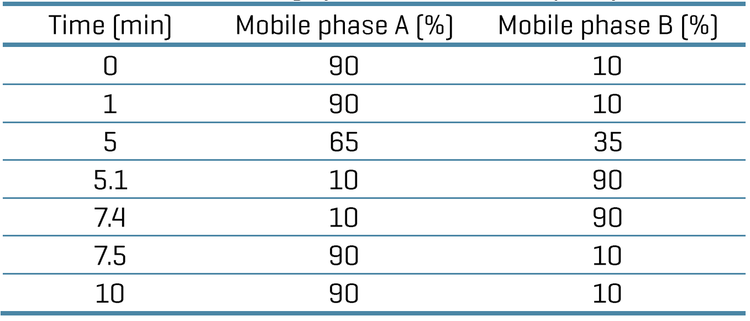
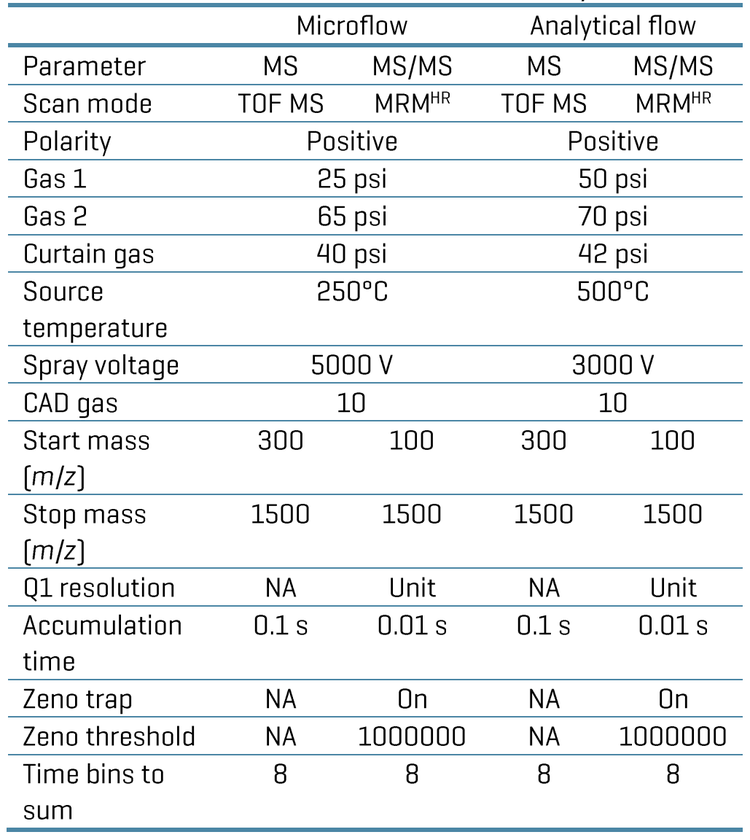
Quantitative performance or peptide analysis using microflow and analytical flow
The quantitative performance of microflow LC and analytical flow LC was evaluated by analyzing 6 peptides in extracted rat plasma. The peptide mixture was spiked into processed rat plasma at different concentrations. Each concentration level was evaluated in triplicate for both LC approaches. Zeno MRMHR mode was employed for sample analysis in both LC approaches, enabling data collection across a range of fragment ions, with select ed fragment ions automatically evaluated and summed for best assay sensitivity using SCIEX OS software.2 For this study, all peptides were quantified using the sum of 3 fragment ions.
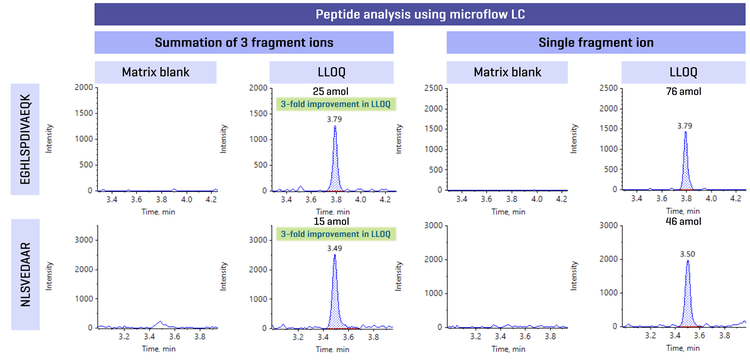
Figure 2 shows a microflow-based result for the summation of highly abundant fragment ions, thereby improving the signal-to-noise ratio (S/N) and increasing assay sensitivity. Peptides EGHLSPDIVAEQK and NLSVEDAAR show a 3-fold improvement in LLOQ with summation of 3 fragment ions when compared to quantitation using a single fragment ion.
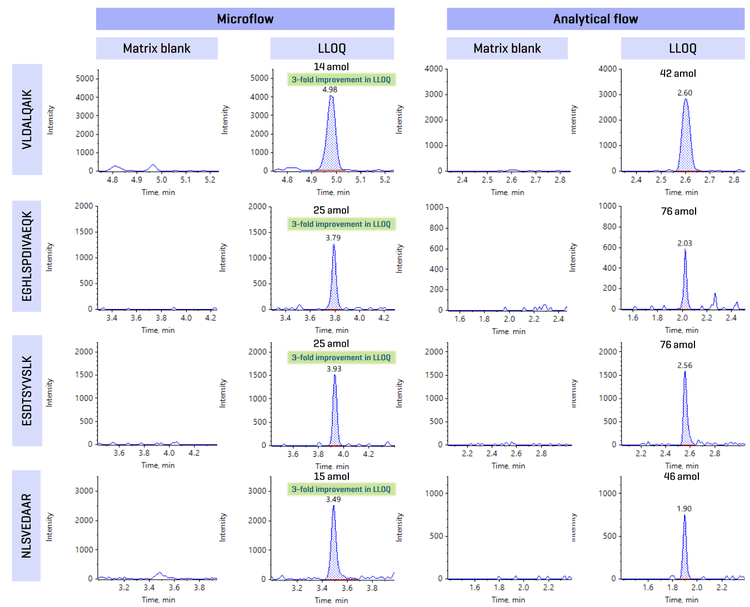
Representative peptide XICs were displayed to highlight the improvement in LLOQ achieved with microflow LC compared with analytical flow LC (Figure 3). Peptides SADFTNFDPR , EGHLSPDIVAEQK, ESDTSYVSLK , and NLSVEDAAR showed a 3-fold improvement in LLOQ compared with analytical flow LC. The observed gain in sensitivity was primarily attributed to improved ionization efficiency at a microflow rate.
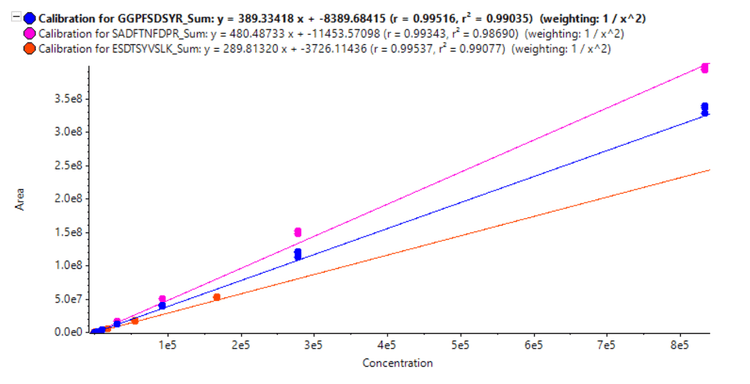
Calibration curves from analysis of 3 representative peptides are shown in Figure 4. Overall, an LDR of up to 4.3 orders of magnitude was achieved for peptide analysis using microflow LC, demonstrating measurement of a wide range of concentrations.
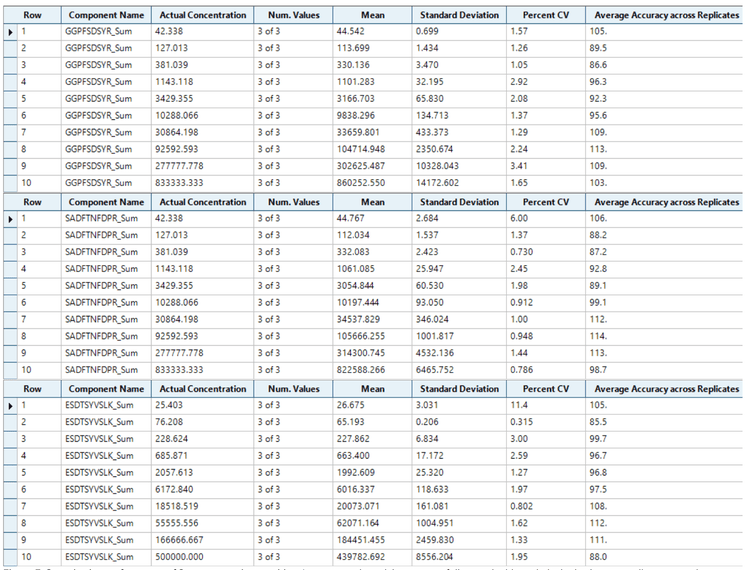
For the bioanalytical performance assessment, the LLOQ was determined based on the requirement that the %CV be below 20% and that accuracy be between 80% and 120%. For concentrations above the LLOQ, the %CV was required to be below 15%, with accuracy between 85% and 115%.3 Figure 5 shows the accuracy and precision values for 3 example peptides across the measured linear range. Calculated concentrations for all calibration points were within ±15% of the nominal value, where %CV was <12%, demonstrating high reproducibility (Figure 5). Overall, a highly sensitive method for the quantitation of peptides was demonstrated. For all 6 peptides evaluated in this study, low‑attomole sensitivity was achieved using microflow LC.
Compliance-ready SCIEX OS software
Equivalent SCIEX OS software capabilities for regulated bioanalysis can be executed on the ZenoTOF 8600 system, ensuring high fidelity when performing method transfers while retaining critical compliance features.
SCIEX OS software is a closed system and requires records and signatures to be stored electronically, in compliance with 21 CFR Part 11. SCIEX OS software can open raw data files from any visible storage location within a closed network by using designated processing workstations.
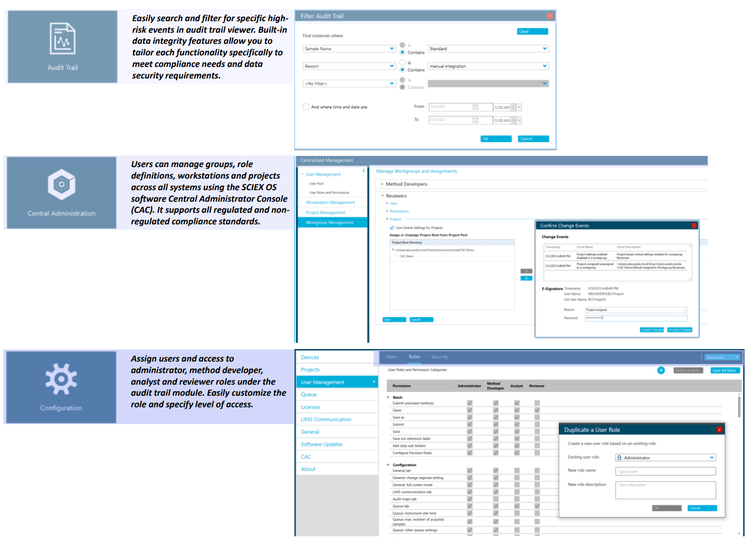
Figure 6 illustrates the features of SCIEX OS software used to monitor the audit trail, acquire and process data, and configure user access. The audit trail feature enables users to audit critical user actions and locks in data integrity. The Central Administrator Console (CAC) feature allows users to centralize acquisition and processing on a single platform, maximizing efficiency for multi-instrument laboratories, regardless of compliance standards. The configuration module allows users to assign roles an d access as the administrator, method developer, analyst, and reviewer.
Conclusions
- Improved LLOQs were achieved across 6 peptides in extracted rat plasma using microflow compared to analytical flow on the ZenoTOF 8600 system.
- The improvement in sensitivity is attributed to higher ionization efficiency at microflow rates during the ionization process in the ion source, which facilitates the achievement of higher sensitivity compared with analytical flow rates.
- A simplified Zeno MRMHR approach was demonstrated with the collection of several high intensity product ions from TOF MS/MS spectra, which were automatically evaluated and summed using SCIEX OS software on the ZenoTOF 8600 system for optimal sensitivity.
- Accurate quantitative performance was achieved with %CV <12% at all concentration levels across an LDR of up to 4.3 orders of magnitude.
- With microflow LC, reducing the use of LC-MS grade solvents aids in lowering expenses while also boosting overall system reliability.
- Retain data management and compliance-readiness (21 CFR Part 11) features using SCIEX OS software to support quantitative analysis on the ZenoTOF 8600 system.
References
- Enhanced sensitivity and quantitative performance featuring a novel quadrupole time of flight mass spectrometer. SCIEX technical note. MKT-33800-A.
- Automated peptide fragment ion selection and summation for streamlined HRMS quantitative workflows. SCIEX technical note. MKT-36303-A.
- Bioanalytical Method Validation, May 2018.