Abstract
This technical note demonstrates the confident characterization and identification of GLP-1 and its impurities using the ZenoTOF 7600+ system, leveraging electron-activated dissociation (EAD) capabilities for the generation of unique fragment ions, aiding in the accurate confirmation of modifications and isomer differentiation (Figure 1). Therapeutic peptide moieties, such as GLP-1, have redefined the drug market, offering unique advantages such as high receptor specificity, lower immunogenicity, and limited cross reactivity compared to small molecule counterparts, while also avoiding the complexities associated with large proteins. Further, these synthetic peptides also overcome the shortcomings of naturally occurring GLP-1 molecules, such as very short half-life, enzymatic degradation, and patient lifestyle dependencies, owing to the use of modified amino acids and lipid linkers. However, this also poses a unique analytical challenge for isomer detection and impurity identification. Conventional collision-based high-resolution mass spectrometry (HRMS) often cannot definitively resolve questions related to isomeric species or labile modifications, highlighting the need for advances in fragmentation technologies.
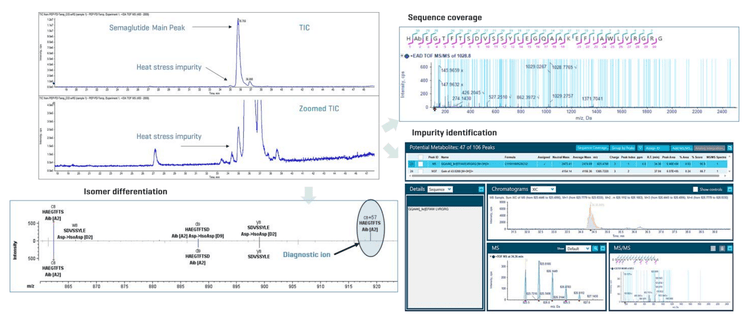
Key benefits of impurity analysis using ZenoTOF 7600+ system
- Comprehensive GLP-1 characterization: EAD-based MS/MS workflows with the ZenoTOF 7600+ system enables comprehensive characterization of GLP-1 and its impurities using diagnostic fragment ions compared to CID
- Unambiguous isomer differentiation: EAD generates signature fragments that enable differentiation of common amino acid isomers.
- Accurate localization of modifications: EAD provides more complete sequence coverage and preserves labile moieties for accurate localization of critical modifications.
- Streamlined software: Easily perform data reduction for structural characterization and impurity identification using Molecule Profiler software and Biologics Explorer software.
Introduction
The peptide drug market has seen significant growth in recent years. Bioactive peptides such as GLP-1 receptor agonist (RA) have become the next blockbuster therapeutics in modern medicine, with nearly 100 peptide drugs receiving marketing approval in major markets around the globe. Having achieved phenomenal success in weight management and diabetes treatment regimen, therapeutic peptides are now being explored as viable treatment options for infectious and lifestyle diseases as well.1,2
The development and commercialization of synthetic peptides rely heavily on mass spectrometry-based analytical characterization to ensure sequence correctness, modification localization, impurity detection, and identification. Modern GLP-1 RAs use modified amino acid and lipid linkers to prolong half-life and protect against enzyme degradation.3,4 Collision-induced dissociation (CID)-based workflows have limited ability to distinguish isomeric species such as Asp/isoAsp and Leu/Ile. Furthermore, conventional quadrupole time-of-flight (QTOF) based HRMS platforms suffer from poor MS/MS sensitivity due to low duty cycles (5-25%), thus losing ions generated in the source. The ZenoTOF 7600+ system overcomes these limitations by incorporating 2 major advancements. Firstly, the on-demand Zeno trap boosts sensitivity by 5-20x without compromising on speed, resolution, mass accuracy, and dynamic range.5 The Zeno trap collects ions exiting the collision cell and releases them into the accelerator in a mass-dependent manner—allowing higher m/z ions to exit first. This allows all ions to reach the accelerator simultaneously, enhancing MS/MS sensitivity across the full mass range. Secondly, EAD provides complementary fragmentation information using a radical dissociation mechanism that preserves labile modifications. EAD produces diagnostic fragments that allow the distinction between isobaric amino acid isomers.6
In this technical note, semaglutide was thermally stressed and analyzed using the Zeno EAD DDA method. Heat-stress conditions generate a diverse set of impurities that were easily characterized and identified with the ZenoTOF 7600+ system.
Methods
Sample preparation: Semaglutide standard and stressed semaglutide samples (in water at 80°C for 24 hours) at a concentration of 1 mg/mL were used for this study. Prior to injection, both samples were mildly vortexed for 1 min, then centrifuged for 5 min at 10,000 rpm. The samples were diluted to a final concentration of 0.5 mg/mL with 0.1% TFA/FA (30:70, v/v) in water for analysis.
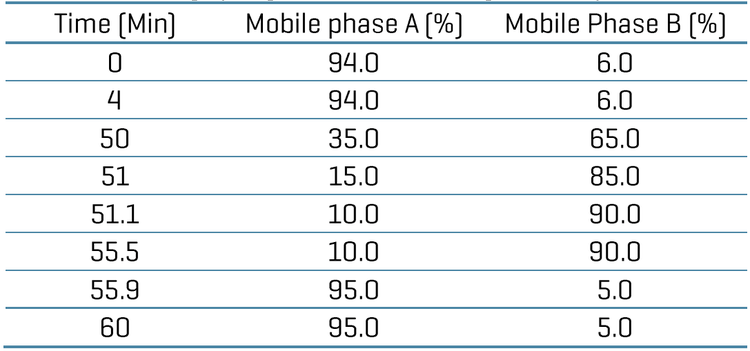
Chromatography: Chromatography was performed on a n ExionLC AD system (SCIEX) using 0.1% TFA/FA (30:70, v/v) in water and 0.1% TFA/FA (30:70, v/v) in acetonitrile at a flow rate of 0.2 mL/min. Separation was carried out at 45°C using a Phenomenex Aeris Peptide XB -C18 column (2.6 µm, 2.1 x 100 mm) with an on- column load of 0.5 µg for CID and 2 µg for EAD under a 60 min gradient as mentioned in Table 1.
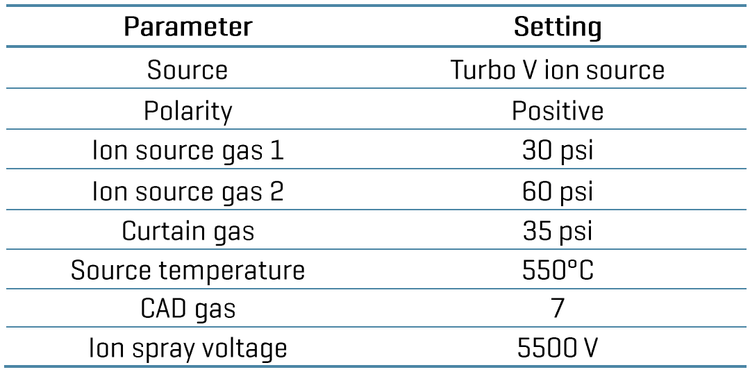
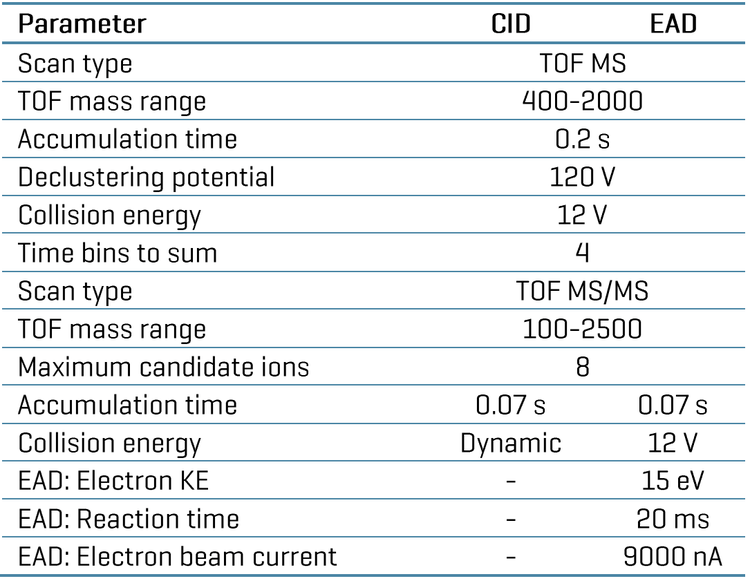
Characterization of semaglutide standard and its impurities using ZenoTOF 7600+ system
Comprehensive peptide characterization is a critical requirement for confirming the correct amino acid sequence and ensuring the purity of peptide-based therapeutics. In addition to primary sequence verification, robust impurity profiling and unknown analysis are essential for identifying and controlling product-and process-related variants, including chemical modifications, truncations, sequence isomers, and insertion or deletion impurities. Conventional CID-based workflows are widely used for routine peptide sequencing and impurity characterization. However, CID fragmentation often fails to distinguish amino acid isomers and may provide limited confidence when characterizing labile or fragile modifications.
To address these challenges, EAD offers an effective, complementary approach to fragmentation. EAD enables extensive backbone fragmentation for confident peptide identification, generates diagnostic fragments for confident differentiation of isomeric sequences and preserves labile modifications for their accurate localization. By combining CID and EAD fragmentation strategies, analysts can achieve higher confidence in peptide identity, impurity characterization, and overall product understanding throughout peptide drug development.
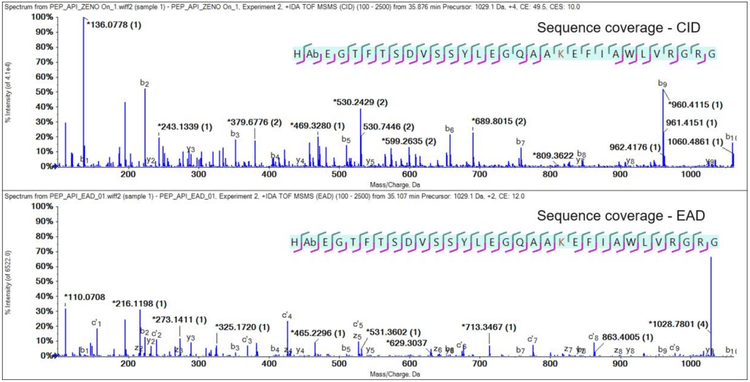
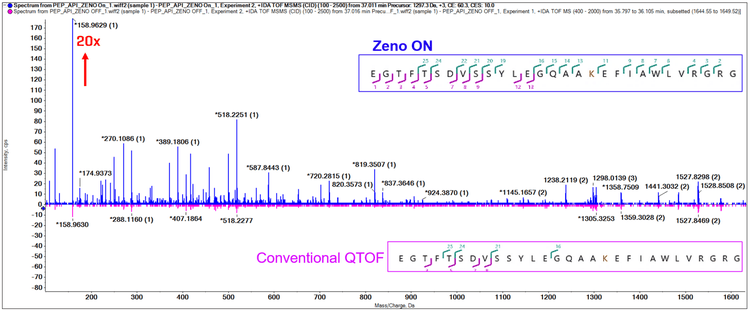
Peptide analysis using the Zeno trap revealed substantial increments in MS/MS sensitivity for standard and heat-stressed semaglutide. Complete sequence coverage was achieved for semaglutide standard with an on-column load of only 0.5 µg, with >90% fragment coverage (Figure 2A). This is due to duty cycle improvements, which enable the detection of ions that would otherwise be lost to the pulsing action of the TOF accelerator. The capture and release of ions by the Zeno trap enables the detection of low-abundance fragments, significantly reducing sample requirements. Further, higher sequence coverage can be observed in data acquired using EAD-based workflow (Figure 2B). EAD is a reagent-free, electron-based fragmentation technology in which free electrons are captured by ions, forming a radical state that then fragments. It generates additional fragments, which increase the overall fragment readout for sequence coverage from both N- and C-terminal. Such improvements in sensitivity, coupled with high-speed detection, underline the capabilities of the ZenoTOF 7600+ system. These advancements can substantially reduce sample requirements for impurity analysis of peptide products. Another example of the Zeno trap aiding sensitivity enhancement is seen in the detection and characterization of low-level impurities, such as a truncation impurity with a loss of 2 amino acids at the N-terminus. The ZenoTOF 7600+ system provided better sensitivity in MS/MS data and higher fragment coverage for truncation impurity when acquiring the data with Zeno trap ON compared to data acquired with Zeno trap OFF (Figure 3). The Zeno trap enables about a 20x increase in MS/MS intensity for analysis of low-level GLP-1 impurities (as low as 0.02%).
Impurity profiling and unknown analysis
Semaglutide was subjected to forced degradation by means of thermal stress (80°C for 24 hours) to generate a repertoire of catabolites. These samples were analyzed using an EAD-based workflow and processed using Molecule Profiler software.
The stressed sample exhibited several impurities, ranging from N- or C-terminal truncated species to forced degradation products such as oxidation and dehydration products (Figure 4). As shown in Figure 5, sequence coverage of >80% was achieved for low-level truncated semaglutide moieties. EAD further improves the fragment coverage, thereby increasing confidence in low-level detection of impurities.
Several known and unknown impurities were identified in the thermally degraded samples using Molecule Profiler software. Data shows that 100% coverage was observed for an impurity with only 0.03% abundance, at an on-column load of 0.5 µg. Additionally, semaglutide also exhibited the presence of cyclization at the N-terminal, generating his-cyclic semaglutide impurity with a gain of 12 Da. The XIC and TOF MS spectra l data clearly showed a retention time shift of 0.6 min and a mass gain of 12 Da for the impurity relative to the semaglutide standard (Figure 6A). Mirror plot comparison of MS/MS data revealed the presence of theoretical b1 (138.06 Da) and b2 (223.11 Da) ions found in the impurity, along with fragments having a gain of 12 Da (Figure 6B). Such ambiguity fails to definitively confirm the presence of an impurity, necessitating alternative fragmentation techniques.
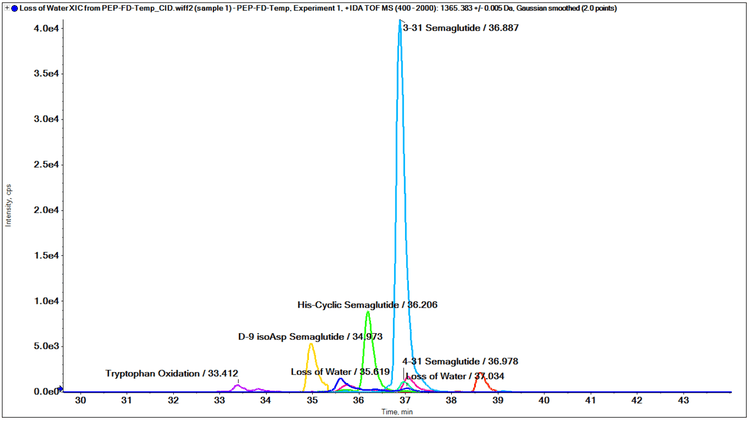
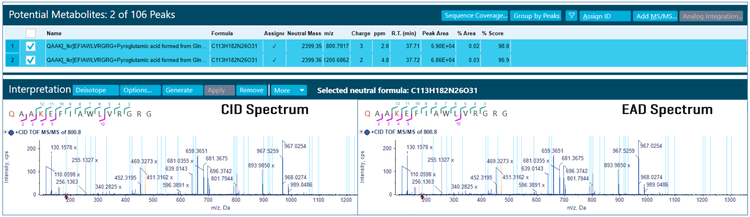
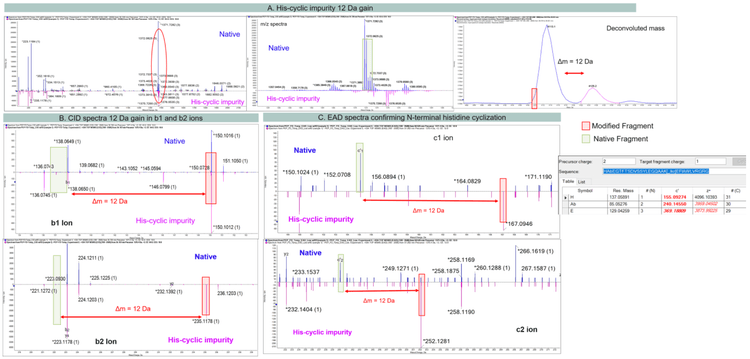
Figure 6C shows MS/MS data acquired using EAD, where c1 and c2 ions exhibit a gain of 12 Da compared to the theoretical masses of c1 and c2 ions, respectively. This eliminates all uncertainty, thus confirming histidine cyclization at the N-terminal.
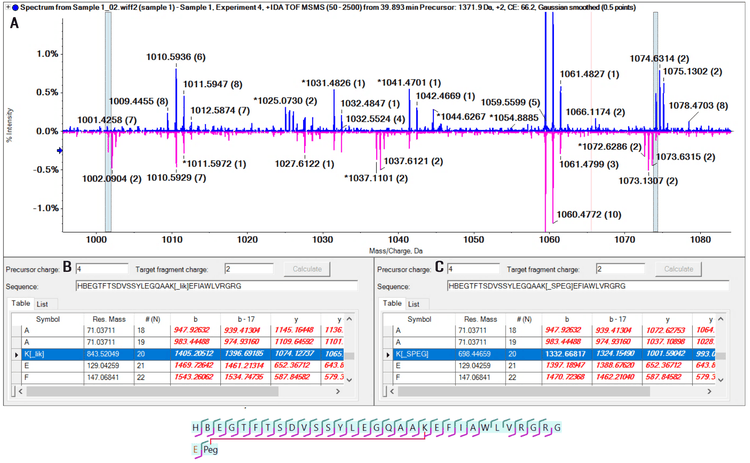
Another powerful demonstration of this peptide characterization workflow is its ability to characterize atypical impurities, such as the loss of a PEG molecule from the lipid linker, generating a monoPEG species with a mass loss of 145 Da (Figure 7). Both CID- and EAD-based workflows comfortably detected this without causing a complete loss of the truncated linker, suggesting the suitability of the ZenoTOF 7600+ system.
Isomer differentiation with EAD
Alternative electron-based fragmentation methods have been employed to address inherent limitations of CID, notably the preferential dissociation of labile modifications and the lack of diagnostic fragment ions required for unambiguous differentiation of peptide isomers. However, most electron-based fragmentation techniques have their own limitations, such as low sensitivity, low speed, reagent dependencies , and inability to adjust electron kinetic energy.
Here, EADon the ZenoTOF 7600+ system employs a radical dissociation mechanism which can be tuned to act even on singly charged species. In the case of synthetic peptide production, it is important to ascertain the presence of isomeric products to avoid immunogenic events upon injection in patients.
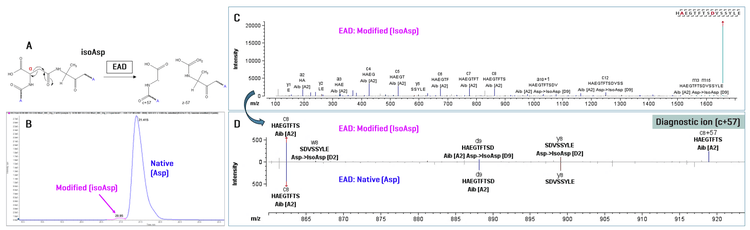
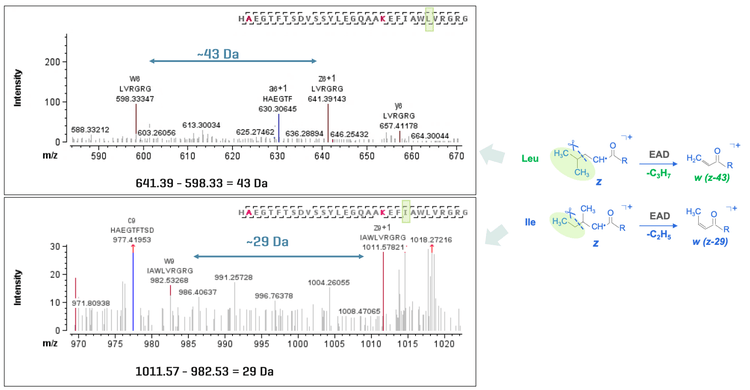
In the present case, the presence of an isomeric impurity was confirmed by digesting the peptide sample , allowing a clear separation of native and isomer peptides. The isomer generated unique diagnostic ions that can differentiate Asp from isoAsp. As shown in Figure 8A, isoAsp generates 2 unique diagnostic ions, c+57 Da and z-57 Da. These are automatically picked up by the Biologics Explorer software and are otherwise absent from the native product containing the amino acid Asp (Figure 8A-D). Leu can also b e distinguished from Ile because they generate distinct internal fragments in EAD compared to CID. For Leu, the z-ion backbone fragments generate a w-ion with a loss of 43 Da, while for Ile the w-ion shows a 29 Da loss. This can serve as a confirmatory sequence and site-specificity test whenever a peptide contains these identical amino acids (Figure 9).
Conclusions
- Characterization of synthetic therapeutic peptides relies a great deal on detecting low-abundant impurities with high resolution and accuracy.
- Zeno trap allows the detection of low abundant fragments without increasing sample load, leading to significant sensitivity enhancements.
- EAD-based fragments enabled the confident detection of isomeric amino acids such as Leu and Ile and Asp and isoAsp.
- EAD-based fragmentation generates additional fragments that can also boost coverage, increasing overall confidence in data quality.
- Data processing workflows are automated to pick up diagnostic ions generated by EAD that can help distinguish isomeric amino acids.
References
- Walsh G, Walsh E. Biopharmaceutical benchmarks 2022. Nature biotechnology. 2022 Dec;40(12):1722-60
- Lamers C. Overcoming the shortcomings of peptide-based therapeutics. Future Drug Discovery. 2022 Jun 1;4(2):FDD75.
- Luisa Di Gioia M, Leggio A, Malagrinò F, Romio E, Siciliano C, Liguori A. N-methylated α-amino acids and peptides: synthesis and biological activity. Mini reviews in medicinal chemistry. 2016 Jun 1;16(9):683-90.
- Stawikowski M, Fields GB. Introduction to peptide synthesis. Current protocols in protein science. 2012 Aug;69(1):18
- Improving peptide quantification using the on-demand operation of the Zeno trap. SCIEX technical note, RUO-MKT02-14371-A
- Facilitating the identification of peptide catabolites using electron - activated dissociation (EAD) through advanced software analysis. SCIEX technical note, MKT-32427-A