Maximizing speed and sensitivity in drug discovery using acoustic ejection coupled to next generation QTOF technology
Abstract
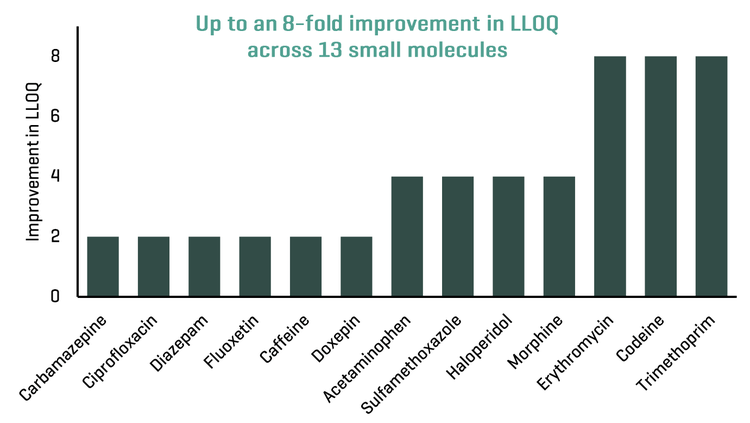
This technical note demonstrates sensitive quantitation of small molecules in an extracted microsomal stability matrix using the Echo® MS+ system with ZenoTOF 8600 system . Up to an 8-fold improvement in the lower limit of quantitation (LLOQ) was observed across 13 small molecules using Echo® MS+ system with ZenoTOF 8600 system compared to the Echo® MS+ system with ZenoTOF 7600 system (Figure 1).
In vitro metabolic stability is a cornerstone of early drug discovery, providing a controlled environment to assess how quickly a compound is metabolized before advancing to animal or human studies. Sensitive assays are needed to detect even minor differences in metabolic breakdown, enabling chemists to optimize molecular structures for improved stability. High-resolution mass spectrometry (HRMS) plays a critical role in analyzing complex matrices , offering enhanced selectivity and LLOQs. In this study, the Echo® MS+ system with ZenoTOF 8600 system was used to quantify small molecules in matrix, delivering improved sensitivity, excellent quantitative performance, and a wide dynamic range .
Key benefits for small molecule quantitation using the Echo® MS+ system with ZenoTOF 8600 system
- Improved LLOQ in matrix: Demonstration of up to an 8-fold improvement in LLOQ across 13 small molecules using Zeno MRMHR compared to Echo® MS+ system with ZenoTOF 7600 system .
- Rapid sample acquisition: Accelerate sample analysis in complex matrices at the speed of 2.5 seconds/sample without compromising data quality.
- Meet critical quantitative performance criteria: Achieve accurate and highly reproducible quantitative performance with %CV <25 at all concentration levels across a linear dynamic range (LDR) of up to 4.2 orders of magnitude .
- Streamlined data management: Streamline data acquisition, management and processing with SCIEX OS software .
Introduction
High-throughput workflows are critical for small molecule drug discovery, enabling rapid screening of large compound libraries to accelerate hit identification and lead optimization. Traditional LC-based methods can be slow and resource -intensive, but the Echo® MS+ system with ZenoTOF 8600 system overcomes these limitations. Using acoustic ejection sampling and an open- port interface, the Echo® MS+ system delivers ultra-fast analysis, up to one sample per second, without the need for LC separation. This sig nificantly reduces turnaround time and sample consumption, making it ideal for early -stage screening.
The ZenoTOF 8600 system delivers next - generation sensitivity compared to the ZenoTOF 7600 system, offering up to 10 -fold greater sensitivity for low- abundance compounds.1 This ensures accurate quantitation at trace levels, minimizes false negatives, and improves confidence in early decision -making. Combining high resolution and high mass accuracy with high throughput workflows, the Echo® MS+ system with ZenoTOF 8600 system supports comprehensive profiling of complex mixtures, enabling researchers to move fr om hit identification to lead optimization faster and more cost - effectively.
Methods
Sample preparation: Protein precipitation was performed using a 1:3 (v/v) plasma/acetonitrile ratio. Samples were vortexed and centrifuged at room temperature. The supernatant was further diluted to 1:4 (v/v) with water. A mixture of 13 small molecules was spiked into a diluted extracted microsomal stability matrix and serially diluted to create a standard curve.
Acoustic ejection: The samples were transferred to an Echo® MS qualified 384-well plate and centrifuged at 2000 rpm for 2 min. A 10 nL sample volume was ejected in the standard mode at a 2.5-second interval. A 70:30 (v/v) acetonitrile/1 mM ammonium fluoride in water was used as the carrier solvent at 550 µL/min for analysis on the Echo ® MS+ system with ZenoTOF 8600 system and at 400 µL/min for analysis on the Echo® MS+ system with ZenoTOF 7600 system.
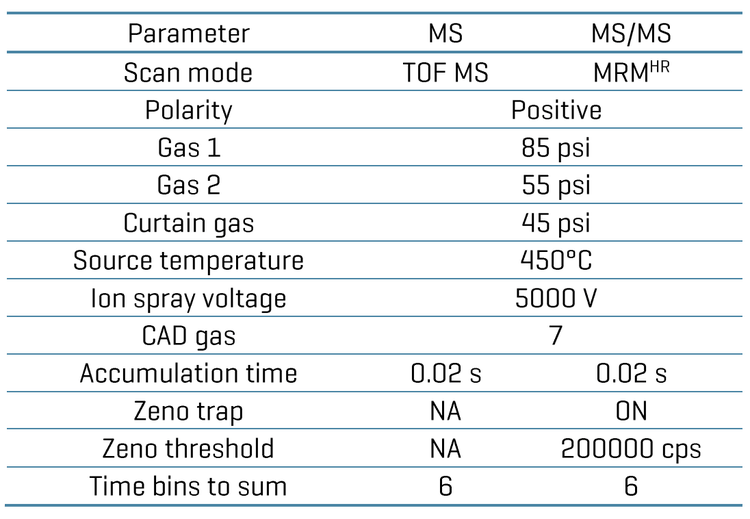
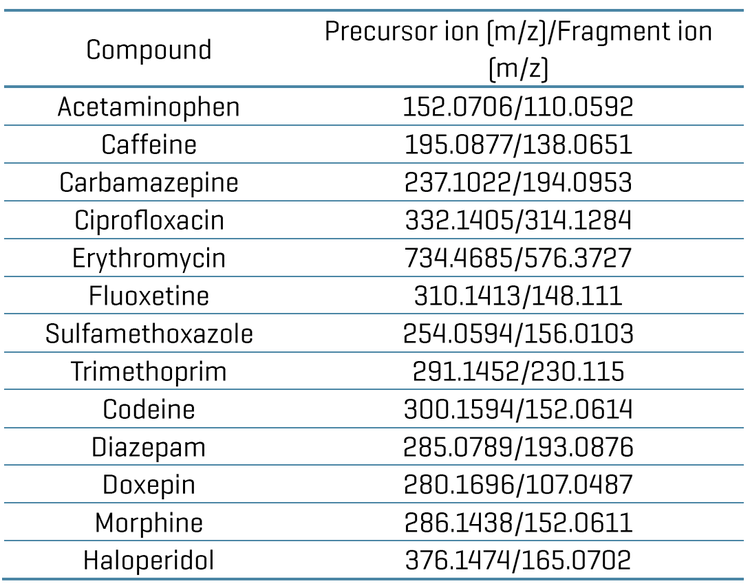
Mass spectrometry: Samples were analyzed using the Echo® MS+ system with ZenoTOF 8600 system operating in positive ion mode. The data were acquired using a Zeno MRMHR experiment. The optimized MS parameters are listed in Table 1. Transitions used for analysis are summarized in Table 2.
Data processing: Analysis was performed using SCIEX OS software, version 4.0. Peaks were integrated using the MQ4 algorithm, and a 1/x2 weighting was used to quantify all small molecules. A peak width of 0.02 Da was applied for quantitation.
Quantitative performance of the Echo® MS+ system with ZenoTOF 8600 system
Typically, instrument performance is evaluated by comparing the signal -to-noise (S/N) ratio of the peak. For some of the evaluated small molecules, Zeno MRMHR indicated very low background, making direct S/N comparisons challenging. Therefore, this study focused on comparing the LLOQ as a more robust metric to assess performance between the Echo® MS+ system with ZenoTOF 8600 system and the Echo® MS+ system with ZenoTOF 7600 system.
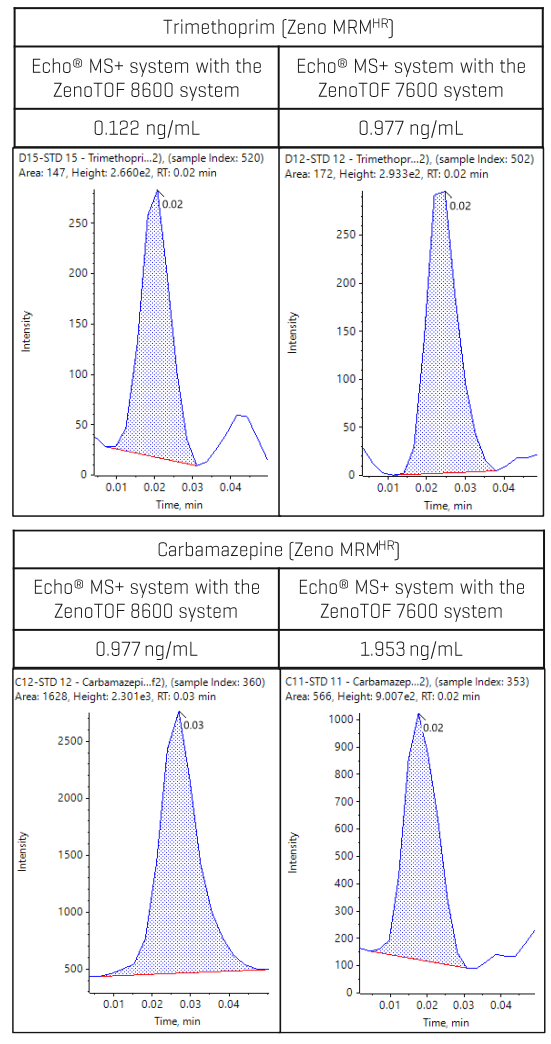
The quantitative performance of the Echo® MS+ system with ZenoTOF 8600 system was evaluated by analyzing 13 small molecules in an extracted microsomal stability matrix sample. Up to an 8-fold improvement in LLOQ was observed across 13 small molecules using the Echo® MS+ system with ZenoTOF 8600 system compared to the Echo® MS+ system with ZenoTOF 7600 system (Figure 1). Representative examples of small molecule s were displayed to highlight the improvement in LLOQ on the Echo® MS+ system with ZenoTOF 8600 sy stem versus the Echo® MS+ system with ZenoTOF 7600 system (Figure 2). Trimethoprim and carbamazepine showed 8- and 2- fold improvements in LLOQ respectively, representing the maximum and minimum improvements in the analyzed panel of small molecules.
This enhanced sensitivity is attributed to optimized source design, improved ion guide architecture, and refined TOF optics, which collectively enable low-level quantitation of small molecules in complex matrices. Additionally, the combination of acoustic ejection with HRMS minimizes sample carryover and maximizes throughput, making the platform highly suitable for demanding drug discovery workflows. These improvements demonstrate the potential of the Echo® MS+ system with ZenoTOF 8600 system for applicatio ns requiring sensitive and robust quantitation.
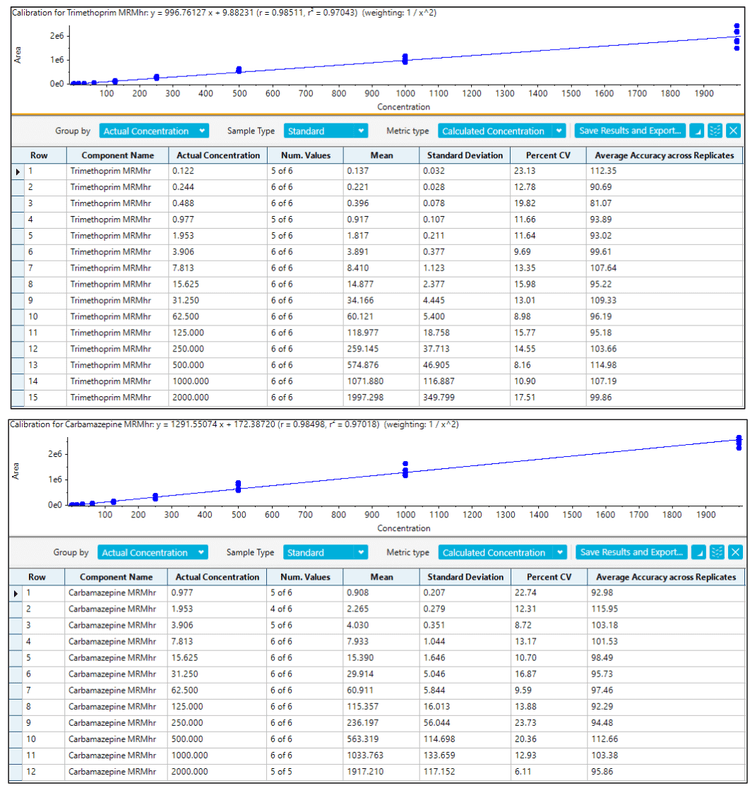
Analytical performance was evaluated using accuracy and precision metrics of ±25% across all concentration levels used in the discovery-stage quantitative assays.2 The assay accuracy was within ±16% of the actual concentration, and the %CV was <25%. The calculated percentage accuracy and %CV values were within the acceptance criteria at each concentration level (Figure 3).
Calibration curves from the analysis of 2 example small molecules were displayed (Figure 3). Overall, an LDR of up to 4.2 orders of magnitude was achieved for small molecule analysis, demonstrating that measurements across a wide concentration range can be easily performed on the Echo® MS+ system with ZenoTOF 8600 system.3
Conclusion
- Up to an 8-fold improvement in LLOQ was observed across 13 small molecule s on the Echo® MS+ system with ZenoTOF 8600 system compared to the Echo® MS+ system with ZenoTOF 7600 system .
- Enhanced sensitivity was achieved for small molecule analysis in matrix on the Echo® MS+ system with ZenoTOF 8600 system, given the improvements in hardware components.
- Highly reproducible quantitative performance was achieved with %CV <25% across a wide range of concentrations.
- Linearity was achieved at concentrations ranging from 0.125 ng/mL to 2000 ng/mL with an r2 >0.97, resulting in an LDR of 4.2 orders of magnitude.
- Simplified data management using SCIEX OS software to support acquisition and quantitation on the Echo® MS+ system with ZenoTOF 8600 system.
References
- ZenoTOF 8600 system. SCIEX webpage, MKT- 35003 -A.
- Fabien F, Luca M, Ken A, Bernard C, Ismael Z, Kevin B. Molecular Structure and Mass Spectral Data Quality –Driven Processing of High -Resolution Mass Spectrometry for Quantitative Analysis. Rapid Commun Mass Spectrom. 2025 Feb 10:e10000. doi: 10.1002/rcm.10000
- Transforming small molecule quantitative sensitivity with a novel quadrupole time of flight mass spectrometer. SCIEX technical note, MKT-33827-A.