Abstract
This technical note highlights comprehensive characterization of an antibody-oligonucleotide (oligo) conjugate (AOC) using orthogonal LC-MS workflows on a single MS platform (Figure 1). Native size exclusion chromatography (SEC)-MS provided rapid assessment of conjugation efficiency through oligo-antibody ratio (OAR) measurement. Electron-activated dissociation (EAD) based peptide mapping delivered high sequence coverage of the antibody and in-depth characterization of post-translational modifications (PTMs) and isomeric peptides. Mass confirmation of the small interfering RNA (siRNA) used for AOC synthesis was achieved using a streamlined ion- pair reverse-phase (IP-RP) LC-MS workflow.
As an emerging class of bioconjugate therapeutics, AOCs consist of an antibody, a linker, and a highly charged nucleic acid payload, combining the targeting specificity of monoclonal antibodies with the gene-regulating function of the oligo payloads.1,2 Due to the complexity and heterogeneity of an AOC, orthogonal analytical strategies are required for comprehensive characterization. Traditionally, multiple assays using different MS platforms are used to achieve a complete characterization of this challenging modality. Here, we present complementary LC-MS workflows for multi-level AOC characterization on a single MS platform (Figure 1).
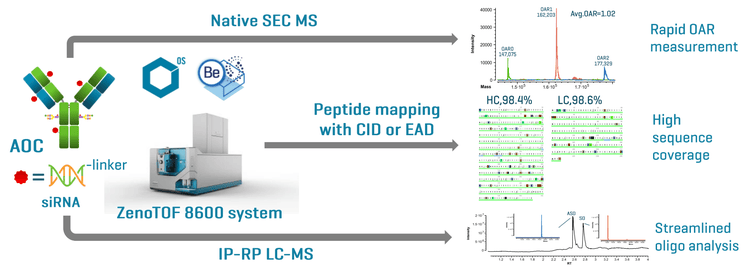
Key features of the ZenoTOF 8600 system for AOC characterization
- High sensitivity: Equipped with the Zeno trap, the system delivers high MS and MS/MS sensitivity for enhanced native SEC-MS and EAD-based peptide mapping analyses
- Versatility: The system allows data-dependent acquisition (DDA) with CID or EAD in positive and negative modes
- EAD advantages: EAD provides informative MS/MS data for labile PTM localization and isomer differentiation
- Streamlined workflow: Native SEC-MS, peptide mapping, and IP-RP LC-MS workflows support comprehensive AOC characterization from chromatographic separation, data acquisition with DDA, to automated data analysis
Methods
Sample preparation: The AOC, mAb, and siRNA samples were kindly provided by the CSPC Nucleic Acid Drug Research Institute. The AOC and siRNA were diluted in water for intact mass analysis. 10 µg of the AOC sample was injected for native SEC-MS, and 100 ng of the siRNA standard was injected for intact mass analysis. For peptide mapping, the mAb and AOC samples were denatured in 7M guanidine hydrochloride prepared in 50 mM Tris buffer, treated under reduced or non-reduced conditions as required, and digested overnight with trypsin.1 µg of each digest was analyzed by LC-MS/MS.
Chromatography: Native SEC-MS of the AOC and mAb was performed on an ExionLC AE system (SCIEX) using a Phenomenex Biozen dSEC - 2 column (150 × 4.6 mm, 1.8 μm) with 50 mM ammonium acetate at a flow rate of 0.2 mL/min. The column temperature was maintained at 25°C.
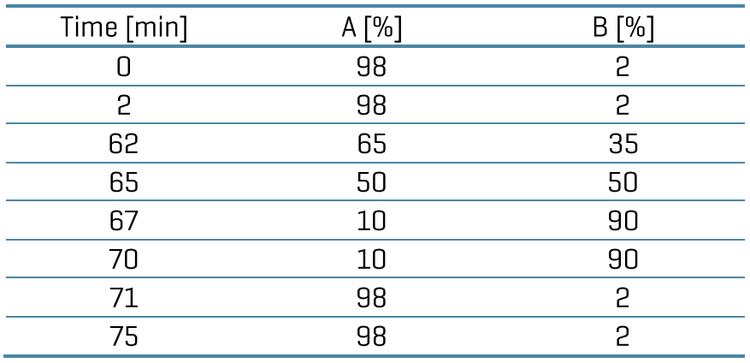
Peptide mapping was performed with a Waters ACQUITY CSH C18 column (150 × 2.1 mm, 1.7 μm) using 0.1% formic acid in water as mobile phase A and 0.1% formic acid in acetonitrile as mobile phase B. The column was maintained at 60°C, and separation was carried out at 0.2 5 mL/min using a 75-minute LC method (Table 1).
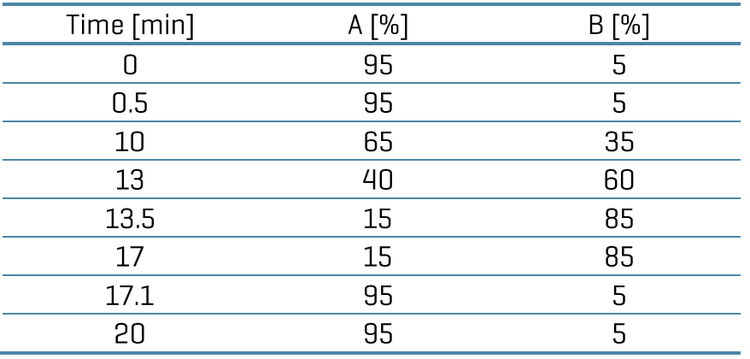
The siRNA standard was separated using IP-RP with a Waters ACQUITY UPLC Oligonucleotide BEH C18 column (100 × 2.1 mm, 1.7 μm) at 50°C. The mobile phases A and B contained 10 mM diisopropylethylamine (DIPEA, Sigma-Aldrich) and 100 mM 1,1,3,3,3-hexafluoroisopropanol (HFIP, Sigma-Aldrich) in water and acetonitrile, respectively. IP-RP separation was performed at a flow rate of 0.3 mL/min using a 20-minute LC method (Table 2).
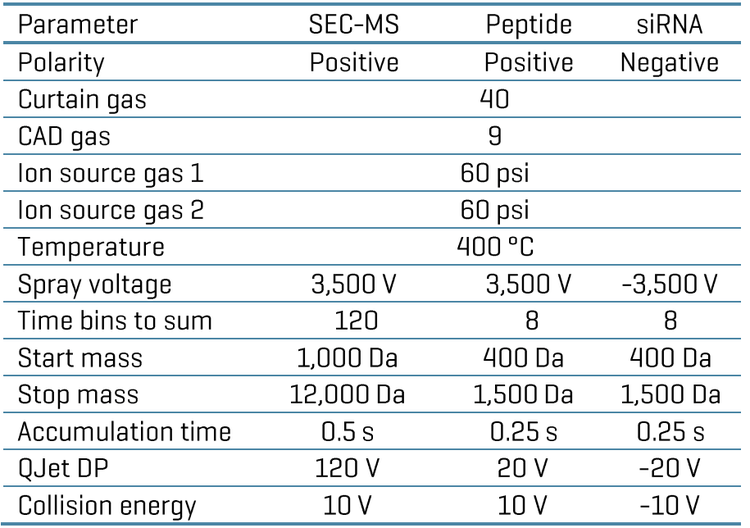
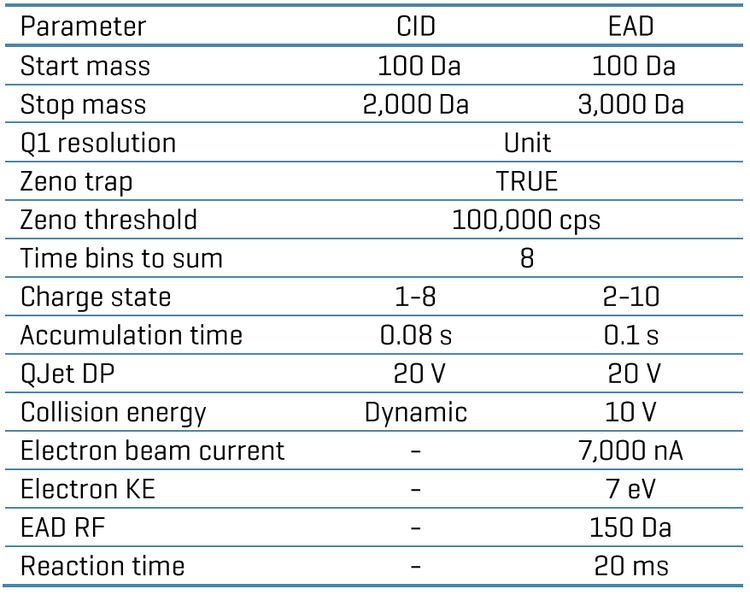
Mass spectrometry: MS data were acquired on the ZenoTOF 8600 system (SCIEX). Native SEC-MS and peptide mapping data were acquired in the positive ion mode while IP-RP LC-MS analysis of the siRNA was performed in the negative ion mode. Key MS and MS/MS parameters are summarized in Tables 3 and 4.
Data analysis: Data processing was performed using Biologics Explorer and SCIEX OS software, as described previously.4
Cysteine-linked mAb-siRNA AOC
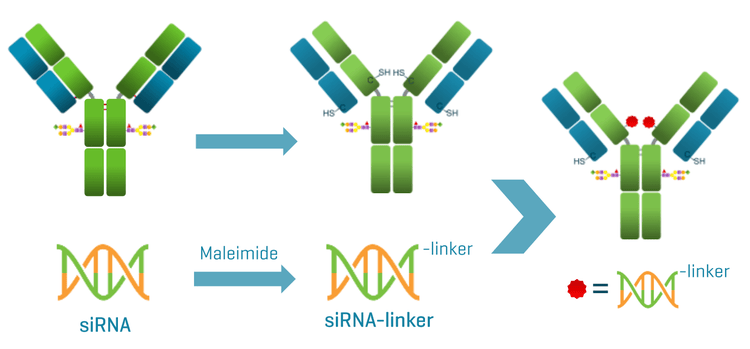
The AOC sample analyzed in this study was synthesized from conjugation of a maleimide-linked siRNA to the Cys residues on the mAb (Figure 2). Partial reduction of the interchain disulfide bonds between the heavy and light chains (HC and LC) of the mAb created reactive thiol groups for conjugation with the siRNA payload through a maleimide- containing linker on its sense oligo (SO) .
Native SEC-MS analysis
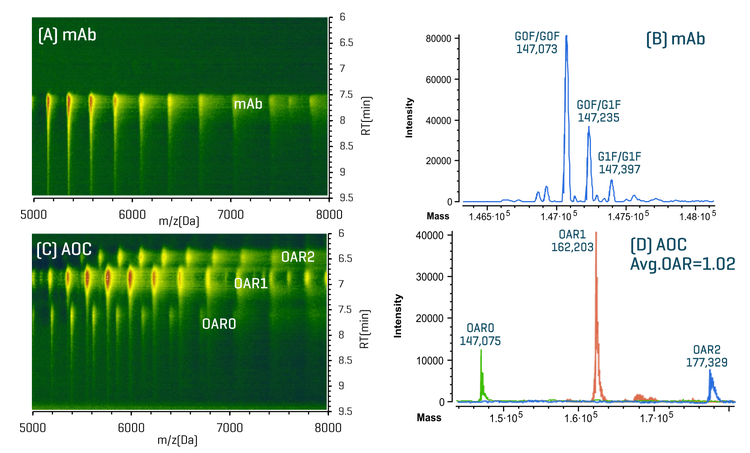
Native SEC-MS is the method of choice for intact mass analysis of Cys-linked AOCs because these modalities contain non-covalent interactions that would be disrupted under denaturing conditions employed in traditional RPLC-MS workflows. Native SEC-MS allows direct detection of intact OAR species, enabling rapid evaluation of conjugation efficiency and sample heterogeneity.
Figure 3 shows the ion maps and deconvoluted spectra from native SEC-MS analysis of the mAb and AOC samples. The ion map in Biologics Explorer provides clear visualization of the native SEC-MS data for the unconjugated mAb (Figure 3A) and the AOC (Figure 3C). In contrast to the unconjugated mAb, the ion map of the AOC reveals a distinct distribution of species assigned t o OAR0, OAR1, and OAR2. Deconvolution of the mAb data (Figure 3B) highlights the major glycoform distribution, whereas deconvolution of the AOC data (Fi gure 3D) confirms the presence of multiple species with different OAR values. Based on the relative abundance of these OAR species, an average OAR of 1.02 was obtained for the AOC sample.
Peptide mapping
Antibody sequence confirmation and PTM characterization are important for understanding the overall quality of the AOC. 5 In this work, peptide mapping was employed for the comprehensive characterization of the antibody portion of the AOC.
A near-complete sequence coverage of the HC (98.4%) and LC (98.6%) of the AOC was obtained in a single injection using the EAD DDA method (Figure 1). A similar sequence coverage was also obtained with the CID DDA method (data not shown).
Compared to collision-based MS/MS approaches, EAD offers unique capabilities for labile PTM localization and amino acid isomer differentiation.3,4 In this study, select modified peptides were used as examples to demonstrate the powerful capabilities of EAD.
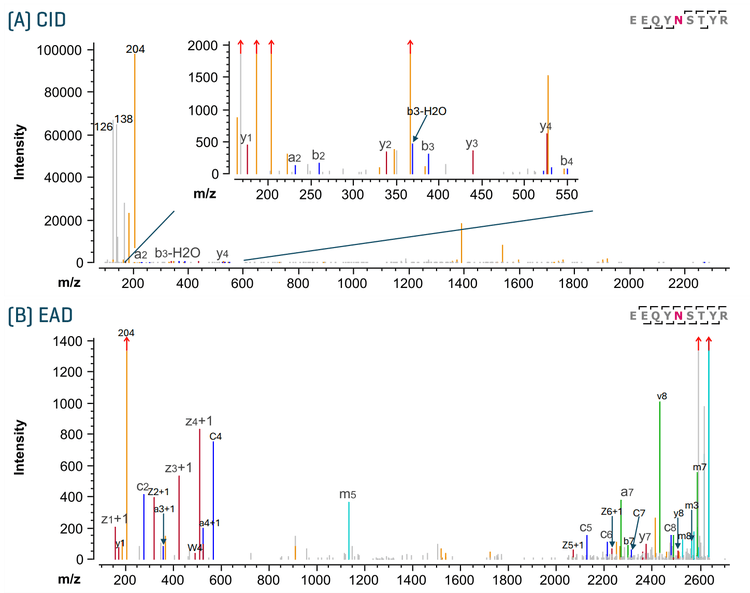
Figure 4 shows representative CID and EAD spectra of a G0F-containing glycopeptide EEQYNSTYR identified in the AOC digest. CID preferentially cleaved the labile glycan, producing abundant oxonium ions (e.g. m/z 138 and 204) in the low m/z region and sequence ions without the glycan (Figure 4A). By comparison, EAD preserved the G0F glycan on the corresponding c- and z-type fragment ions, enabling confident peptide-sequence confirmation together with reliable glycan localization (Figure 4B).
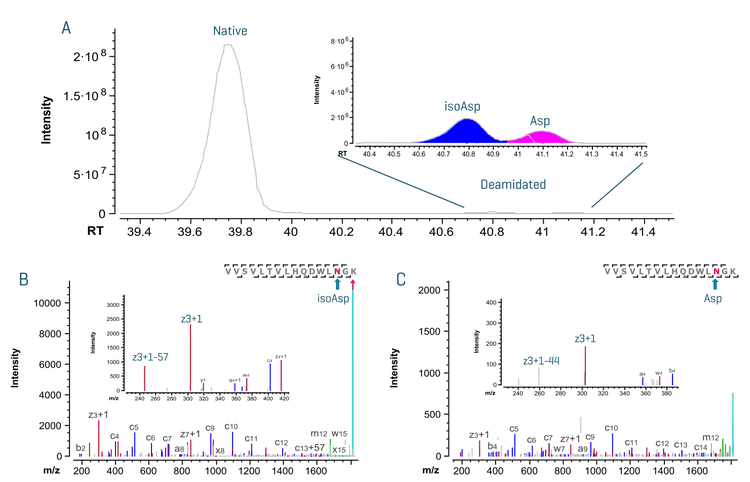
EAD can also generate diagnostic fragment ions for unambiguous differentiation of amino acid isomers. Figure 5 shows the separation, detection, and EAD-assisted assignment of the Asp and isoAsp isomers of the VVSVLTVLHQDWLNGK (VVSV) peptide. Detection of the z3 + 1 − 57 fragment in the EAD spectrum confirmed that the peak at 40.8 min corresponded to the isoAsp form (Figure 5B). In contrast, assignment of the peak at 41.1 min was supported by the absence of the z3 + 1 − 57 ion together with detection of the z3 + 1 − 44 fragment, consistent with the Asp form (Figure 5C).
siRNA mass confirmation
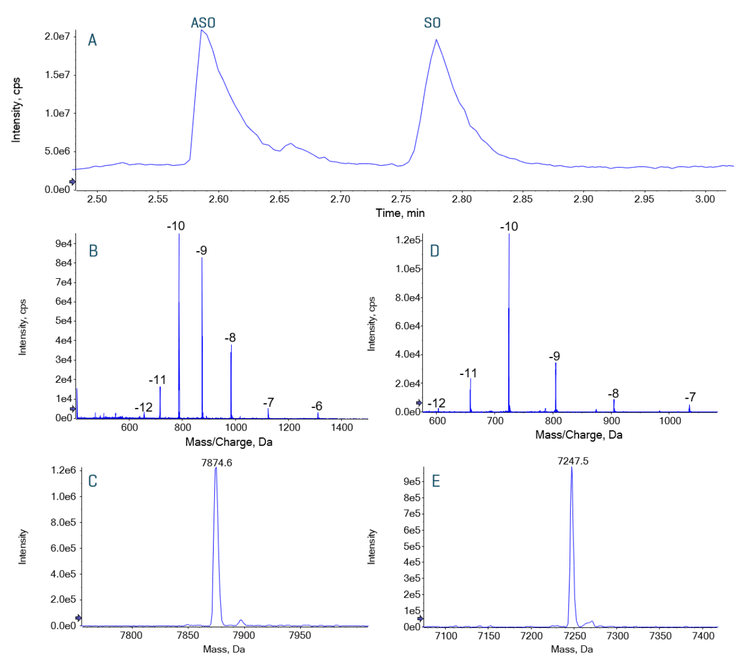
To provide orthogonal support for AOC characterization , the siRNA standard was analyzed separately by IP -RP LC-MS in negative-ion mode using an oligo column. Under the chromatographic conditions used in this study , the duplex siRNA was dissociated into the antisense oligo (ASO) and SO strands, enabling their accurate mass measurements . The total ion chromatogram (TIC) in Figure 6A shows clear chromatographic separation of the 2 strands, indicating that the IP-RP conditions were effective for resolving the denatured siRNA components.
The strand assignments were further supported by the corresponding ion maps and deconvoluted mass spectra. Figures 6B-6C and 6D-6E show the ion map and intact mass confirmation for the ASO and SO strands, respectively. In both cases, the observed charge-state distributions were deconvoluted to generate strand-specific molecular weights, providing direct evidence for the identity of the siRNA components. Together, these results confirm ed the mass of the siRNA standard at the strand level and provided supporting evidence for interpretation of the oligo payload in the AOC sample.
Conclusions
- Multi-level characterization workflows combining the benefits of the ZenoTOF 8600 system and Biologics Explorer software were developed for comprehensive characterization of a mAb–siRNA AOC and its building blocks.
- Native SEC-MS enabled direct assessment of AOC conjugation efficiency through OAR measurement.
- EAD-based peptide mapping provided high sequence coverage of the antibody, accurate localization of labile PTMs, and clear differentiation of isomeric peptide species.
- IP-RP LC-MS analysis confirmed the intact mass of the siRNA standard and provided orthogonal support for AOC characterization.
- These orthogonal workflows were streamlined from chromatographic separation and method creation to data acquisition to result interpretation
References
- Li M, et al. (2025) Advances in the pharmaceutical development of antibody–oligonucleotide conjugates. Eur. J . Pharm. Sci. 215:107292.
- Jiao J, et al. (2024) Overcoming limitations and advancing the therapeutic potential of antibody–oligonucleotide conjugates (AOCs): Current status and future perspectives. Pharm. Res. 209:107469.
- Native mass spectrometry analysis of biotherapeutics and aggregates with enhanced sensitivity. SCIEX technical note, MKT-36146-A.
- A peptide mapping workflow with improved MS sensitivity for enhanced PQA characterization. SCIEX technical note, MKT-35361-A.
- Characterization of an antibody-oligonucleotide conjugate (AOC) using native mass spectrometry and peptide mapping. SCIEX technical note, MKT-37551-A.
- Wang L, et al. (2024) Linker substitution influences succinimide ring hydrolysis equilibrium impacting the stability of attachment to antibody–drug conjugates. RSC Med. Chem. 15:612–622.