Abstract
This technical note demonstrates the capability of imaged capillary isoelectric focusing ( icIEF )-UV/MS and electron-activated dissociation (EAD)–based peptide mapping workflows to characterize 4 USP mAb standards, allowing for proteoform identification at the intact protein level, followed by confirmation and localization of modifications at the peptide level (Figure 1). Monoclonal antibodies (mAbs) often display heterogeneity due to post-translational modifications (PTMs) that alter the isoelectric point ( pI) and generate charge variants, which can impact safety, efficacy, and potency, making them critical quality attributes (CQAs) to monitor. The integrated icIEF -UV/MS workflow enables charge separation, detection, and identification of mAb proteoforms, resolving subtle pI or mass differences that can not be fully distinguished by icIEF or intact LC -MS analysis alone. EAD-based peptide mapping was performed to confirm and localize the observed PTMs. Together, these orthogonal approaches provide deeper insight to support robust mAb characterization.
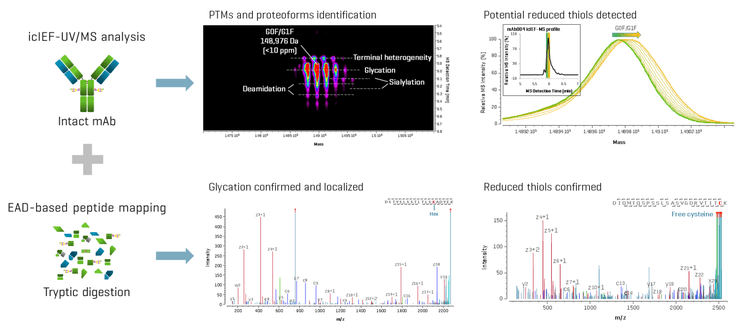
Key features of orthogonal icIEF -UV/MS and peptide mapping workflows for mAb analysis
- icIEF -UV/MS platform method: A single platform method was used to analyze 4 mAb standards spanning pI values from 7.3 to 9.6, significantly reducing method development time while maintaining the flexibility for future optimization tailored to specific samples
- Time-resolved deconvolution: Time-resolved deconvolution enables the differentiation of proteoforms with subtle pI and mass changes that traditional fractionation cannot resolve, such as potential reduced thiols
- Confirmation and localization of PTMs: EAD-based peptide mapping workflow offers high sequence coverage and accurate PTMs confirmation and localization
Introduction
Antibody-based therapeutics are inherently complex. During production and storage, mAbs can develop charge variants due to terminal heterogeneity, deamidation, glycation, and other PTMs.1 Monitoring and characterizing these charge variants are critical because they can affect stability, efficacy, pharmacokinetics, and immunogenicity. Careful control ensures product consistency, regulatory compliance, and patient safety, making charge variant analysis an essential component of biopharmaceutical development and quality control.2
Previously, we demonstrated that the integrated icIEF-UV/MS workflow with the Intabio ZT system enables high-resolution charge variant profiling, confident proteoforms identification, and PTMs localization, on both intact and subunit levels.3-5 Compared to traditional fractionation-based workflows for assessing charge heterogeneity, the integrated icIEF-UV/MS platform offers a faster, more precise, and more confident approach to charge variant analysis and proteoform identification.6
In this technical note, 4 USP mAb standards were analyzed using icIEF -UV/MS with a platform method. The icIEF-UV charge profiles were comparable to those obtained from established standalone icIEF approaches, and multiple PTMs and impurities were successfully detected and identified. In addition, non-reduced EAD-based peptide mapping further confirmed the PTMs identified from icIEF-UV/MSanalysis, providing orthogonal verification and deeper investigation.
Methods
icIEF -UV/MS analysis: Four mAb samples were provided by USP. The samples were desalted using Zeba spin desalting columns (Thermo Scientific) and stored at -80oC until analysis. As a platform screening method, the desalted samples were mixed with the master mix solution to achieve a final protein concentration of 0.4 mg/mL, containing 15 mM arginine (Sigma -Aldrich), 3% of each Pharmalyte 5-8 and 8-10.5 (Cytiva), and 6.3 μg/mL of each pI marker with estimated pI values of 5.52 and 9.68. The master mix for mAb 001 was optimized to 3% of Pharmalyte 8-10.5, 1% of Pharmalyte 3-10, and pI markers 8.40 and 9.99 to improve separation resolution. The icIEF -UV/MS analysis was performed using the Intabio ZT system (SCIEX). UV absorbance was recorded at 1 Hz during analysis. Focusing was performed in 3 steps over a total duration of 6.5 minutes: 60 seconds at 1 ,500 V, 60 seconds at 3,000 V, and 300 seconds at 4 ,500 V. Samples were then mobilized into the ZenoTOF 7600 system at a 3 μL/min flow rate with a tip voltage of 5,500 V and a delta voltage of 3,000 V for 10 minutes. The MS data were acquired using ZenoTOF MS method, with the key parameters described previously.5
Non-reduced peptide mapping: The non-reduced samples were prepared by denaturation with guanidine hydrochloride, followed by enzymatic digestion with trypsin/Lys-C protease (Promega). 1.5-3 μg of digested samples were injected for LC-MS/MS analyses. Chromatographic separation was performed using a Biozen Peptide XB-C18 column (150 x 2.1 mm, 1.7 µm, Phenomenex) with a 0.25 mL/min flow rate and a 60oC column oven temperature on an ExionLC AD system (SCIEX). Mobile phase A was 0.1% formic acid (FA) in water, and mobile phase B was 0.1% FA in acetonitrile. MS data were acquired using the ZenoTOF 8600 system (SCIEX) with data-dependent acquisition (DDA) method. The LC gradient and key EAD MS/MS parameters were described in previous work.7
Data analysis: The data were interpreted using the icIEF -UV/MS analysis and peptide mapping templates within Biologics Explorer software (SCIEX). For icIEF -UV/MS analysis, the proteoforms were identified based on the delta masses and delta pI values compared to the main species. For non-reduced peptide mapping analysis, the disulfide linkages were defined according to the amino acid sequences and corresponding IgG type.
Platform screening method to reduce method development
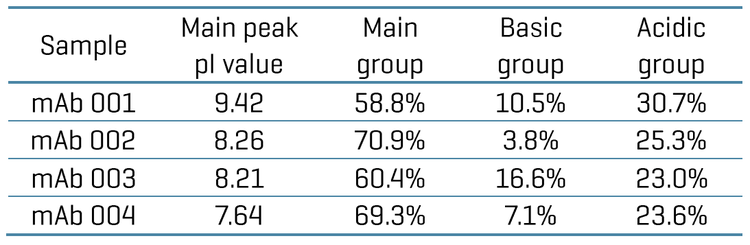
The platform screening method contains equal amounts of 2 narrow range Pharmalytes (5- 8 and 8-10.5) to achieve broad coverage across a wide pI range. This master mix can serve as an effective screening approach, with further matrix optimization performed as needed based on the specific pI of the samples. For the 4 mAb samples analyzed, the pI values span from 7.3 to 9.6, and all were well separated using the platform method. Each charge variant detected in the icIEF-UV profiles (Figure 2A) had a corresponding peak in the icIEF-MS profiles (Figure 2B). Quantitative information on charge variants was obtained from the percent peak area of the icIEF-UV profiles. The compositions of the main, basic, and acidic groups for each mAb are summarized in Table 1. These results are comparable to data generated using standalone icIEF methods (see usp.org). Minor differences in estimated pI values and percent composition are primarily attributed to differences in the master mix formulations used.
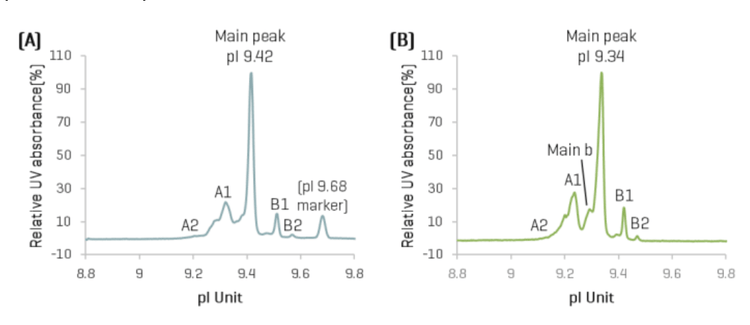
For mAb 001, which has a pI range of 9.0- 9.6, additional matrix optimization was performed to enhance icIEF separation resolution. By adjusting the formulation to a 3:1 ratio of Pharmalyte 8-10.5 and 3-10, improved resolution was achieved. Compared to the icIEF-UV profile generated using the platform method (Figure 3A), the shoulder peak adjacent to the main peak (labeled Main b in Figure 3B) was better resolved with the optimized master mix. The overall profile remained similar between the 2 methods, with only minor differences in the estimated pI values and species composition. The icIEF-MS profiles generated from both methods were comparable (data not shown). All subsequent analyses presented in this technical note were performed using the optimized master mix. These findings demonstrate that a single platform method can substantially reduce method development time while maintaining flexibility for further optimization tailored to specific sample characteristics.
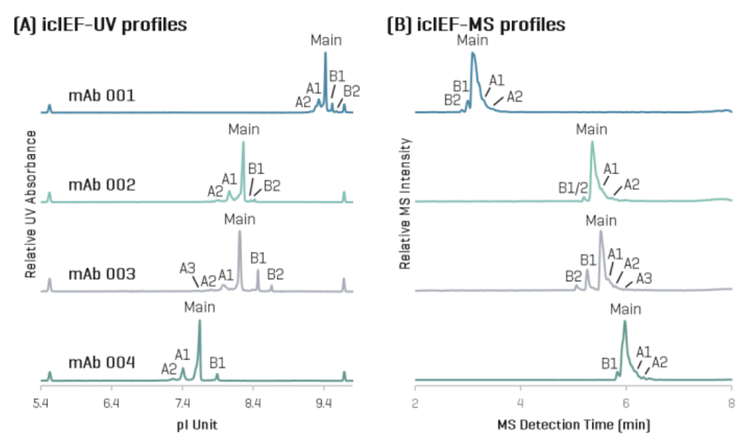
icIEF -UV/MS analysis of 4 mAbs
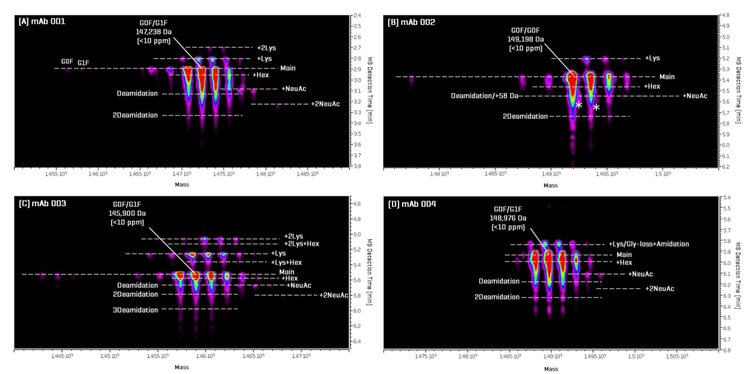
Biologics Explorer software, equipped with a time-resolved deconvolution function, enables scan-by-scan spectral deconvolution and generates deconvoluted mass maps. This capability provides rapid visualization of the overall sample profile and detailed characterization of proteoforms with subtle pI and/or mass differences. Across all 4 mAbs analyzed, mass accuracy was excellent, with the most abundant proteoforms measured within 10 ppm mass error.
For mAb 001, the basic variants were primarily attributed to C-terminal heterogeneity, specifically the presence of 1 or 2 unprocessed C -terminal lysines. Within the main peak, the dominant glycoforms ranged from G0F/G0F to G2F/G2F. Low-abundance species, including the loss of GlcNAc and M5 glycans, were also detected. The overall glycoform distribution aligned well with previously reported N-glycan analysis data. Species with a single aglycosylated heavy chain were observed, consistent with existing reduced CE-SDS results.
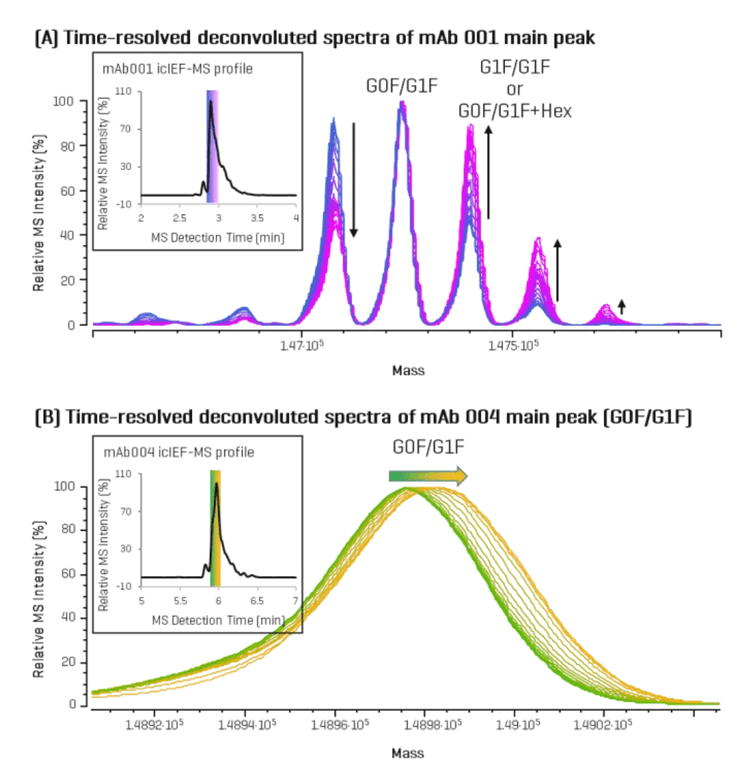
Glycation events were detected in all 4 samples. mAb 001 is presented as a representative example (Figure 5A) to demonstrate the identification of glycation events directly by icIEF -UV/MS analysis, without the need for deglycosylation treatment. The time-resolved deconvoluted spectra showed that, with acidic pI shift (from blue to pink), the intensity of the G1F/G1F signal relative to G0F/G1F signal increased. If this signal corresponded solely to the G1F/G1F glycoform, its relative intensity would not be expected to increase with acidic shift. By monitoring changes in the relative abundance of these glycoforms across the main peak, glycation could be confidently identified without the need for deglycosylation. Additional modifications observed in the acidic region included up to 2 sialic acid additions (+NeuAc) and potential deamidation events, as indicated by corresponding pI shifts.
For mAb 002, the basic variants were also attributed to unprocessed C-terminal lysine. Similar to mAb 001, the overall glycoform distribution and the presence of a single aglycosylated heavy chain species were consistent with prior N-glycan and reduced CE-SDS analyses. In the acidic region, in addition to glycation, sialylation, and potential deamidation, proteoforms exhibiting a +58 Da delta mass were detected (labeled with * in Figure 4B), representing about 1% of the total sample.
mAb 003 contained up to 2 unprocessed C-terminal lysines in the basic region. Glycation events were also observed, including glycated species with 1 or 2 lysine residues. In the acidic region, glycation, sialylation, and up to 3 potential deamidation event s were identified.
For mAb 004, C-terminal heterogeneity included unprocessed lysine as well as glycine loss with leucine amidation shown in the basic variant , which was also confirmed in CID -based paptide mapping (data not shown). As with the other mAbs, the acidic region contained glycation, sialylation, and deamidation variants. Notably, mAb 004 exhibited a mass increase within the main peak (Figure 5B) that was not observed in the other mAbs. One possible explanation is the presence of reduced thiols. The pI shift associated with reduced thiols is smaller than that caused by deamidation, and the detection of a mass shift within a single charge variant indicates the presence of reduced thiols. The direct coupling of icIEF separation with MS detection along with time-resolved deconvolution provides deconvoluted mass spectra for each scan at 2 Hz , enabling confident detection of such minor mass differences. As the antibody remained intact, these species most likely represent intra- chain reduced disulfides.
All 4 samples are relatively pure, with little to no detectable impurities observed outside the intact mAb mass range (data not shown). mAb 001 contained approximately 0.5% impurities, including half antibody species within the main peak, as well as clipped and high molecular weight species observed in the acidic region. mAb 002 showed less than 3% impurities, including half antibody species in the basic region and 2 clipping species in the acidic region. mAb 003 exhibited approximately 1% total impurities, primarily consisting of clipped species and clipped variants retaining C-terminal lysine in the acidic region. mAb 004 did not show detectable impurities outside the intact mAb mass range.
EAD- based peptide mapping
The EAD function is a key feature in the ZenoTOF MS series. EAD-based peptide mapping was performed to confirm and localize the PTMs identified in the icIEF-UV/MS analysis. EAD preserves labile modifications for their accurate localization. In addition, it offers advantages for isomer differentiation and disulfide bond characterization.
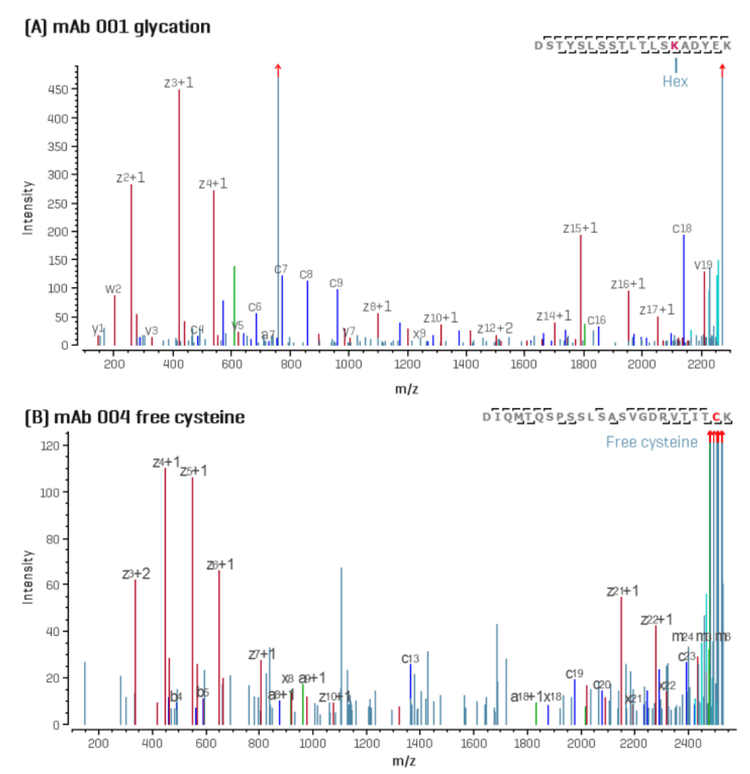
Glycation was first confirmed and localized. The glycated light chain peptide LC[169-187] from mAb 001 was used as a representative example (Figure 6A). The deisotoped EAD MS/MS spectrum showed extensive and fragmentation, enabling confident identification and precise localization of the glycation site.
The presence of reduced thiols in mAb 004 was confirmed by non-reduced peptide mapping using EAD. For example, a cysteine-containing peptide from the light chain, LC[1–24] (Figure 6 B), was detected in its reduced form. Both the disulfide-linked peptide pair and the corresponding reduced single peptide were identified. These findings confirm the presence of free thiols initially indicated by the icIEF -UV/MS analysis.
Two complementary workflows were employed to provide orthogonal analyses of 4 mAbs. The icIEF-UV/MS workflow enabled the detection and identification of PTMs and proteoforms at the intact level, while EAD- based peptide mapping confirmed and further verified their identity and site localization.
Conclusions
- A single icIEF -UV/MSplatform method was employed to characterize 4 mAb standards spanning a pI range of 7.3 to 9.6, significantly reducing method development time while maintaining the flexibility for future optimization tailored to specific samples
- The charge variants in 4 mab standards were majorly attributed to C-terminal heterogeneity, glycation, sialylation, and deamidation
- Direct coupling of icIEF with MS, combined with time-resolved deconvolution, enables resolution of subtle differences in pI and/or mass, allowing for confident identification of glycation events without the need for deglycosylation and detection of reduced thiols at the intact level
- EAD-based peptide mapping further confirmed and localized the PTMs identified by icIEF-UV/MS analysis, including glycation and disulfide linkage
- icIEF-UV/MS analysis and EAD-based peptide mapping allow comprehensive mAbs characterization, with detection of proteoforms at the intact protein level, followed by confirmation and localization of modifications at the peptide level
References
- Khawli, L. A., Goswami, S., Hutchinson, R., Kwong, Z. W., Yang, J., Wang, X., Yao, Z., Sreedhara, A., Cano, T., Tesar, D., Nijem, I., Allison, D. E., Wong, P. Y., Kao, Y. H., Quan, C., Joshi, A., Harris, R. J., & Motchnik, P. (2010). Charge variants in IgG 1: Isolation, characterization, in vitro binding properties and pharmacokinetics in rats. mAbs, 2(6), 613–624.
- Houde, D., Peng, Y., Berkowitz, S. A., & Engen, J. R. (2010). Post-translational modifications differentially affect IgG1 conformation and receptor binding. Molecular & cellular proteomics : MCP, 9(8), 1716–1728.
- In-depth charge heterogeneity analysis of antibody -drug conjugates with a streamlined icIEF -UV/MS and EAD-based peptide mapping workflow. SCIEX technical note, MKT32353-A.
- Ostrowski, M. A., Mack, S., Ninonuevo, M., Yan, J., ElNaggar, M., Gentalen, E., & Michels, D. A. (2023). Rapid multi- attribute characterization of intact bispecific antibodies by a microfluidic chip -based integrated icIEF -MS technology. Electrophoresis, 44(3- 4), 378–386.
- Assessing biotherapeutic stability through forced degradation using intact and subunit icIEF -UV/MS workflows. SCIEX technical note, MKT-36705-A.
- Shah, A., Shah, P., Johnson, A., Bender, J., Gumerov, D., Ding, J., Mack, S., Stone, M. D., & Ostrowski, M. A. (2025). Accelerating Characterization of Therapeutic Antibodies: A Comparative Assessment of icIEF -UV/MS and the Traditional Fractionation Workflow. Journal of the American Society for Mass Spectrometry , 36(8), 1641–1649.
- A peptide mapping workflow with improved MS sensitivity for enhanced PQA characterization. SCIEX technical note, MKT-35361.