Abstract
Gene editing is one of the fastest - growing areas in biotechnology and biopharmaceutical research, with CRISPR - Cas9 (clustered regularly interspaced short palindromic repeats- CRISPR - associated protein 9) leading the field as the primary method. A common strategy involves co -delivering single- guide RNA (sgRNA) and Cas9 mRNA to enhance genome - editing efficiency.1 High-resolution characterization of both sgRNA and Cas9 mRNA in a single analysis for CRISPR/Cas9 applications was previously demonstrated.2 This technical note highlights the capability of the PA 800 Plus system in assessing the quality of sgRNA with single-nucleotide resolution, as well as providing an accurate ratio of sgRNA and Cas9 mRNA for CRISPR -based therapeutics through direct measurements with UV detection.
Key features
- High-resolution separation of n -1 from full -length sgRNA: Enables dose -dependent detection of low levels of n-1 species and accurate purity assessment of sgRNA .
- Excellent assay repeatability in detecting low levels of n -1 spiked in full -length sgRNA: Ensures consistent and reliable analysis for the n -1 species, demonstrating high repeatability with low %RSD in CPA%.
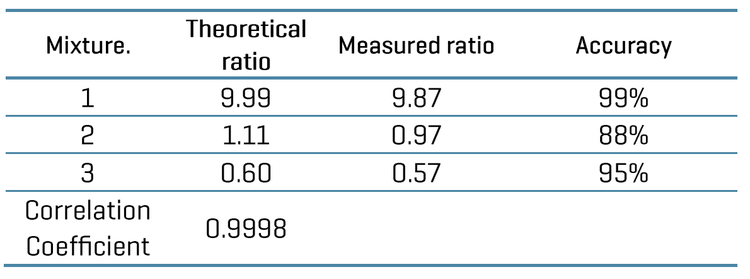
- Accurate ratio determination of sgRNA and Cas9 mRNA: Provides direct measurements of the amounts of sgRNA and Cas9 mRNA by UV detection at 254 nm, demonstrating high correlation between the theoretical and measured ratio of sgRNA to Cas9 mRNA .
- Streamlined operation with ready -to- use, intuitive kits: Ensures simple, efficient workflow with consistent results .
Introduction
CRISPR is an immunological defense mechanism used by bacteria to combat invading pathogens. Cas9 is an RNA - guided DNA endonuclease. Due to its ability to perform site -directed DNA cleavage and trigger homologous recombination, Cas9 has been utilized as a g ene- editing tool to introduce gene inactivation and genome modification. In the pharmaceutical industry, CRISPR can enhance existing therapies, aid in identifying drug targets, and facilitate the testing of drug candidates.1,3
Two RNA molecules are essential for CRISPR: sgRNA and Cas9 mRNA. Purity analysis of sgRNA and Cas9 mRNA is a critical quality attribute for CRISPR -Cas9 -based therapeutics. Accurate purity assessment of sgRNA requires single -nucleotide resolution to separat e n-1 species from the full -length sgRNA. However, common analytical methods , such as liquid chromatography or denaturing agarose gels, have challenges in resolving n -1 species from full-length, long oligos, such as sgRNAs.4.5 Additionally, during the development of CRISPR - Cas9 -based RNA therapeutics, it is often advantageous to co - deliver the sgRNA and the Cas9 mRNA simultaneously.1 In a previous technical note, the capability of the RNA 9000 Purity & Integrity kit in providing high -resolution analysis of both sgRNA and Cas9 mRNA in a single run using a fluorescent dye, SYBR Green II, was demonstrated.2
This technical note highlights the PA 800 Plus system’s capability to assess sgRNA quality at single -nucleotide resolution and to accurately quantitate the sgRNA -to-Cas9 mRNA ratio for CRISPR -based therapies using direct UV measurements .
Methods
Materials: The ssDNA 100 -R kit (P/N: 477480) containing DNA capillary, ssDNA 100 -R Gel (lyophilized), tris -borate buffer, 7M urea, the ssDNA test mix, pd(A) 40- 60 test mix, 0.2 O.D., the RNA 9000 Purity & Integrity kit (P/N: C48231), and the pre-assembled capillary cartridge (P/N: A55625) were from SCIEX (Marlborough, MA). The universal vials (P/N: A62251), universal vial caps (P/N A62250), PCR microvials (P/N: 144709), CE Grade water (P/N C48034), NanoVial (P/N: 5043467), and sample loading solution (SLS, P/N: 608082) were f rom SCIEX. Rainin LTS filter tips were from Mettler Toledo (Oakland, CA). Nuclease -free water (NFW) (P/N: AM9932) was obtained from Thermo Fisher Scientific (Waltham, MA). The Alt -R CRISPR -Cas9 Human HPRT1 single guide RNA (sgRNA) (100 -mer, 10 nmol scale with standard desalting) and the customized 99 -mer HPRT1 sgRNA (2 nmol scale with RNase-free HPLC purification) were obtained from IDT, Coralville, IA.
Tris- borate - urea (TBU) buffer preparation: This step must be performed one or a few days before running samples. To prepare the buffer, 135 mL of 0.2 μm filtered deionized water was added to the bottle containing the dry tris-borate from the ssDNA 100-R kit. The buffer solution was mixed with a clean magnetic stirring bar for about 20 –30 minutes until the boric acid was completely dissolved. The dry 7M urea was then slowly added to the tris-borate buffer while stirring. The urea was dissolved entirely after about 2 hours, and the solution became clear. The tris-borate-urea buffer should remain stable for 30 days at 2 °C to 8 °C after preparation. The entire bottle of buffer should be brought to ambient temperature before use. The required volume for the day was removed and filtered through a 0.2 μm disposable syringe filter into a clean container.
ssDNA 100 - R gel buffer reconstitution: Five millilitres of freshly filtered TBU buffer was added to the bottle with the lyophilized gel. The gel bottle was then placed onto a rotator in a cold room (2°C to 8°C) for 72 hours with gentle rotation or stirred at room temperature for 5 to 6 hours. T he prepared gel buffer can be stored for up to 30 days at 2°C to 8°C and used thereafter. The gel buffer was brought to ambient temperature and filtered through a 0.45 μm disposable syringe filter before use.
Cartridge assembly: A DNA capillary (P/N 477477) from the ssDNA 100 -R kit was installed according to the instructions in the ssDNA 100-R kit application guide.6 The total capillary length was 30.2 cm, with 20 cm as the length to the detection window. A 100 × 200 μm aperture was used to achieve better resolution when using a UV detector. Since the inner wall of the DNA capillary is coated, the cartridge assembly should be carried out promptly. Excessive exposure to air can damage the inner coating and lead to clogging. The capillary ends must be immersed in liquid (water or buffer) when the cartridge assembly is complete to prevent the coating from drying out.
Preparation of sgRNA stock solutions: Filter tips were used for all steps. All buffers were pre - chilled on ice. All sample dilutions were performed on ice. The lyophilized 100 -mer sgRNA was resuspended in 100 μL of buffer containing 10mM Tris, pH 7.5, and 0.1mM EDTA to a concentration of 100 μM (3.246 μg/μL). The lyophilized 99-mer sgRNA was resuspended in 100 μL of buffer containing 2mM Tris, pH 7.5, and 0.02mM EDTA to a concentration of 20 μM or 0.642 μg/μL. Immediately after resuspension in buffers, the sgRNAs were stored at - 80°C in 10 μL aliquots.
Sample preparation for the 99-mer spiked - in experiment: Both the 100-mer and the 99-mer sgRNAs were initially diluted to 100 ng/μL in 50% SLS. Subsequently, the 100-mer sgRNA was further diluted to 37.5 ng/μL in 50% SLS. The 99-mer sgRNA was further diluted to 20 ng/ μL, 2 ng/ μL, and 0.2 ng/ μL in 50% SLS. For the spiked -in experiment, 6 thin -walled PCR tubes were labeled with 0 %, 1%, 2.5%, 5%, 10% , and 20%. The 100-mer sgRNA was added to each at a final concentration of 2 ng/ μL. Then, the 99-mer sgRNA was spiked in at final concentrations of 0 ng/μL, 0.02 ng/ μL, 0.05 ng/ μL, 0.1 ng/ μL, 0.2 ng/ μL, or 0.4 ng/μL. The total volume was adjusted to 20 μL with 50% SLS. Each tube was vortexed for 10 seconds, then briefly spun, and finally transferred to a thermal cycler, where it was heated at 70°C for 5 minutes . The tubes were then chilled in an ice water bath for at least 5 minutes. Samples were then transferred to pre- chilled NanoVials before CE analysis .
The repeatability of the 99-mer spiked-in experiment was tested by six injections from samples containing either 0.1 ng/ μL (5%) or 0.2 ng/μL (10%) of the 99 -mer, with the 100-mer at 2 ng/μL.
Instruments and software: A PA 800 Plus System (P/N A66528) equipped with an ultraviolet (UV) detector was from SCIEX. The UV wavelength used was 254 nm. Data acquisition was performed using the 32 Karat software version 10. Secondary data analysis was performed using the BioPhase software, version 1.2.
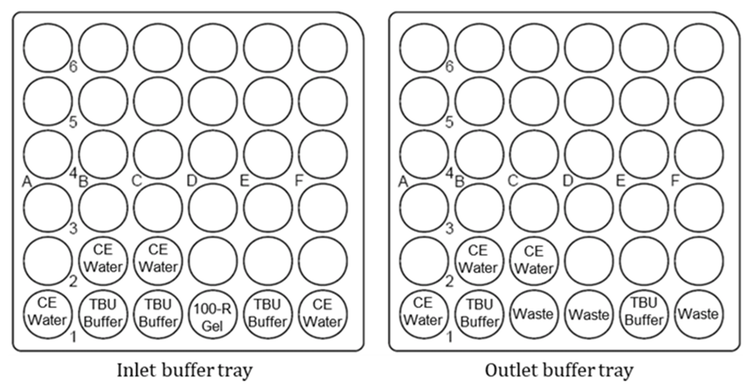
Preparation of buffer trays for sgRNA analysis: Vial positions for buffer trays are indicated in Figure 2. Each CE Water vial was filled with 1.5 mL CE Grade Water. The waste vial was filled with 1.0 mL CE Grade water. The 100-R gel vial was filled with 1.5 mL ssDNA 100 -R gel buffer, and the TBU buffer vials were filled with 1.5 mL TBU buffer.
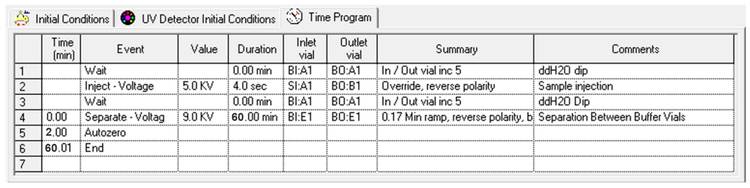
Instrument setup for sgRNA analysis: The Initial conditions and UV detector initial conditions for the experiments with the 100-mer and 99-mer were set up as indicated in the ssDNA 100-R kit application guide.6 The same setup was used for all methods: the new capillary - conditioning method, the gel -filling method, the separation method, and the shutdown method. The time program settings for the capillary – conditioning, shutdown, and gel -filling methods are provided in the ssDNA 100-R kit application guide.6 Time program settings for the separation method are shown in Figure 3.
Co- analysis of sgRNA and Cas9 mRNA: The sgRNA at 1 .8 μg was mixed with 3.0 μg of Cas9 mRNA in the presence of 50% SLS in a total volume of 20 μL. The mixture was heated to 70°C for 5 minutes, then quickly chilled in an ice -water bath for at least 5 minutes. The samples were then transferred to a pre - chilled NanoVial before analysis on the PA 800 Plus system using the RNA 9000 Purity & Integrity k it. The buffer trays were set up as described in the RNA 9000 Purity & Integrity kit application guide for the PA800 Plus system.7 The conditioning, sample separation with pressure injection, and shutdown methods were as described in the application guide, except that a UV detector with a 254 nm filter was used for data collection .
Results and discussions
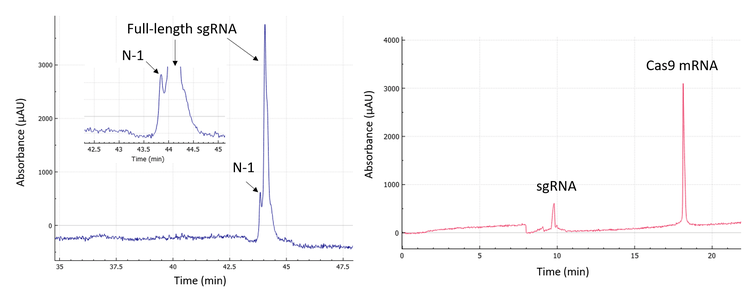
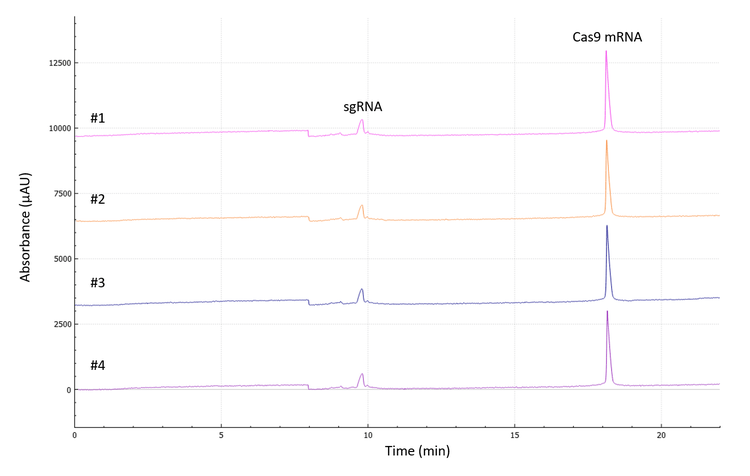
High-resolution sgRNA analysis and co-analysis of sgRNA and Cas9 mRNA on the PA 800 Plus system: In panel A of Figure 1, the 99 -mer sgRNA was added to a 100 -mer sgRNA sample at a concentration of 10.0% by weight. The resulting mixture was analyzed using the ssDNA 100 -R gel and a coated DNA capillary, with UV detection performed at 254 nm. The ssDNA 100 -R gel provides high -resolution separation not only for ssDNA oligos but also for single -stranded RNA oligos. Based on the CPA%, the detected 99-mer percentage was 10.2%, consistent with the theoretical value of 10.0%. In panel B of Figure 1, a mixture containing 1.8 μg of sgRNA and 3.0 μg of Cas9 mRNA was evaluated using the RNA 9000 Purity & Integrity kit and a pre- assembled BFS capillary cartridge, with UV detection at 254 nm. The measured percentage values of sgRNA and Cas9 mRNA were 36.8% and 63.2%, respectively, close to the theoretical values of 37.5% and 62.5%. These results demonstrate the capability of the PA 800 Plus system with UV detection to provide high-resolution purity analysis of the sgRNA and to co- analyze the sgRNA and Cas9 mRNA. Both analyses are crucial for assessing the quality of CRISPR -Cas9 -based gene - editing products.
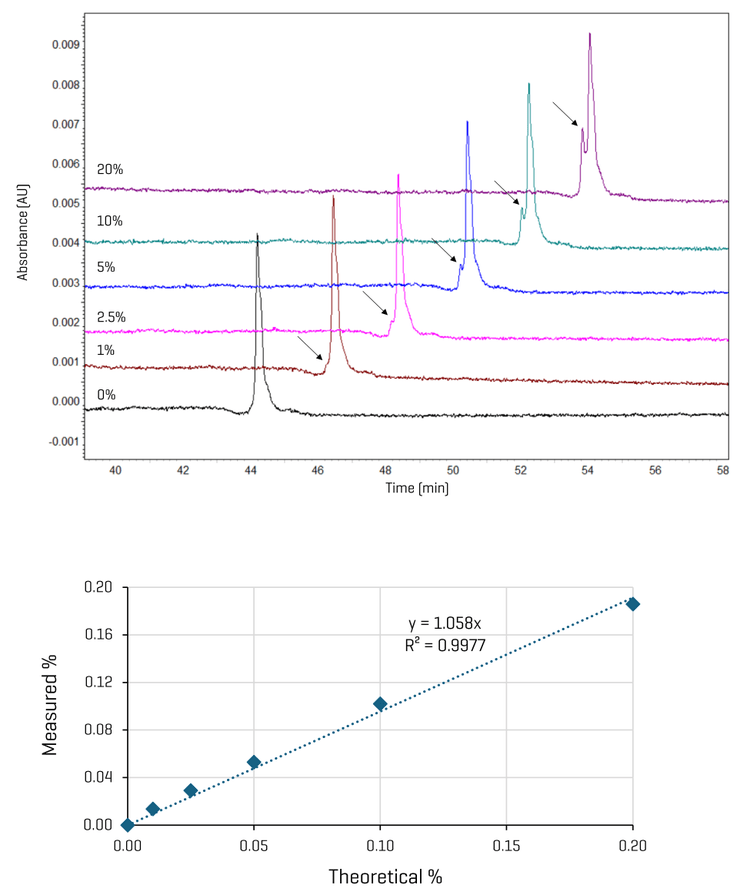
Dose-dependent detection of the 99-mer spiked in the 100-mer sgRNA sample: To assess the accuracy of the analysis of the spiked -in 99-mer, varying amounts of the 99-mer sgRNA were spiked into a 2 ng/μL solution of 100-mer sgRNA, resulting in weight percentages of 0%, 1%, 2.5%, 5%, 10%, and 20%. The samples were analyzed by CE on the PA 800 Plus system using the ssDNA 100 -R kit. As shown in Figure 4A, a dose -dependent increase in the signal of the 99-mer was detected while the signal level of the 100-mer remained constant. The CPA% values for both the 100-mer and 99-mer were used to determine the measured percentages of the 99-mer, which were then plotted against the corresponding theoretical values. As shown in Figure 4B, an excellent correlation was observed between the measured and theoretical values, with an R² value of 0.9977, indicating good assay accuracy.
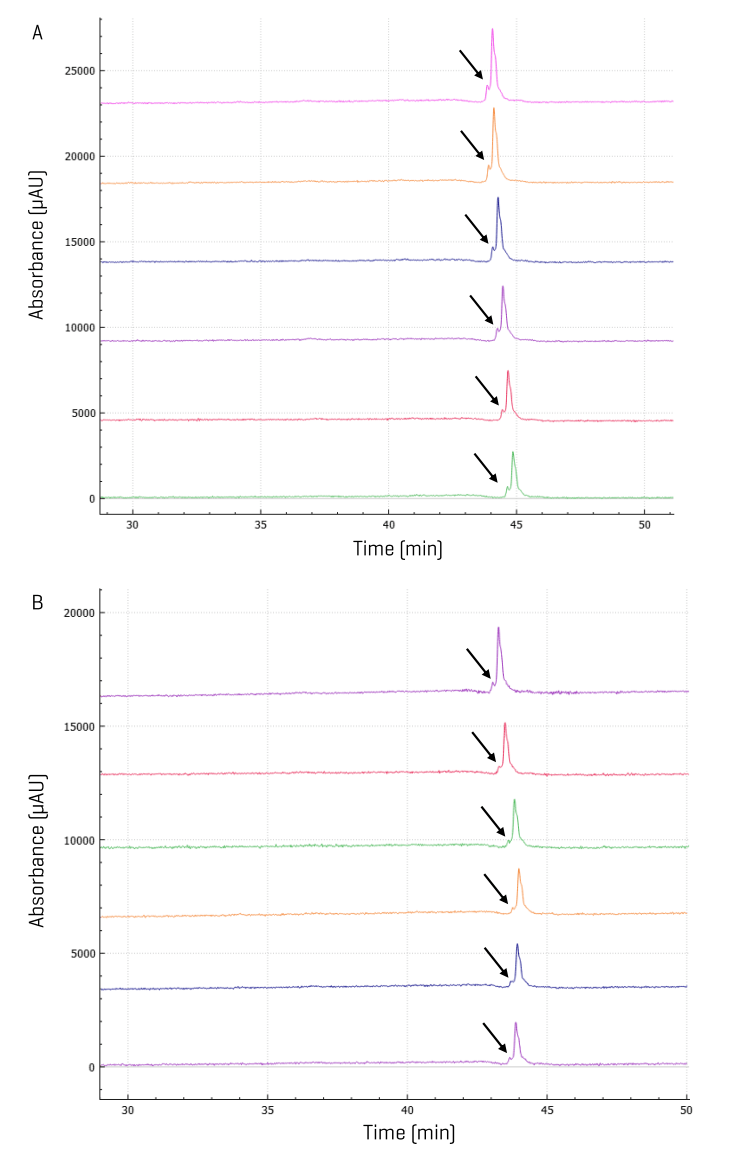
Assay repeatability of the spiked-in study: To test assay repeatability, the 99-mer was added to the 100-mer sgRNA at 10% and 5% concentrations, and each mixture was injected six times on the PA 800 Plus system and separated using the ssDNA 100-R kit. Results are shown in Figure 5, panel A for 10% and panel B for 5% spiked-in 99-mer. In both cases, the peak profiles were consistent across injections, with the 99 -mer shoulder peak clearly visible. The average CPA% values for the 99 -mer peaks were 10.2% and 5.3%, which are consistent with the theoretical values of 10% and 5%, respectively. Furthermore, the %RSD values for the 99 -mer and 100-mer CPA% were 1.9% and 0.2% when the 99-mer was spiked at 10%. The %RSD values for the 99 -mer and 100 -mer CPA% were 5.3% and 0.3 % when the 99-mer was spiked at 5%. These results demonstrate high robustness in detecting the spiked -in 99-mer in the 100-mer sample using the PA 800 Plus system and the ssDNA 100 -R kit.
Conclusions
- High-resolution separation of n -1 from full-length sgRNA was achieved using the ssDNA 100 -R gel and a coated capillary, enabling dose -dependent and accurate detection of n -1 species spiked in the sgRNA sample.
- Assay robustness in detecting low levels of n -1 species was demonstrated by excellent %RSD values of <5.5% and <2.0% for CPA% of the n-1 species spiked into the full -length sgRNA at 5% and 10%, respectively.
- Accurate ratio determination of sgRNA and Cas9 mRNA was achieved using the RNA 9000 Purity & Integrity kit with a pre-assembled BFS capillary cartridge, demonstrating a high correlation coefficient of 0.9998 between the theoretical and measured ratios.
- Streamlined operations were demonstrated with the use of kit-based workflows for both sgRNA alone and co - analysis of sgRNA and Cas9 mRNA .
References
- Seijas A. et al CRISPR/Cas9 Delivery Systems to Enhance Gene Editing Efficiency. Int. J. Mol. Sci . 2025; i . 2025; 26:4420.
- High-resolution characterization of both sgRNA and Cas9 mRNA in a single analysis for CRISPR/Cas9 applications. SCIEX Technical note. RUO-MKT- 02- 14468-B.
- Robert F. et al CRISPR/Cas9 Editing to Facilitate and Expand Drug Discovery . Current gene therapy. 2017; 17(4)275-285.
- Gilar M and Stoll DR Challenges and Solutions in Oligonucleotide Analysis, Part I: An Overview of Liquid Chromatography Methods and Applications . LCGC International. September 4, 2025:2(7).
- Optimization of an RNA electrophoresis workflow for EGel EX agarose gels. ThermoFisher Scientific application note. 2024
- ssDNA 100 -R kit for the PA 800 Plus Pharmaceutical analysis system application guide . RUO-IDV- 05-11137- A.
- RNA 9000 Purity & Integrity kit for the PA 800 Plus Pharmaceutical analysis system application guide. RUO-IDV- 05-13437-D.
Frequently asked questions
Why is capillary electrophoresis important for assessing sgRNA and Cas9 mRNA in CRISPR workflows?
Single‑guide RNA (sgRNA) and Cas9 mRNA differ substantially in size and degradation behavior, yet both are critical determinants of CRISPR performance. Capillary electrophoresis (CE) provides size‑based, high‑resolution separation that enables analytical development scientists to assess RNA purity and integrity with greater specificity than agarose gels or low‑resolution LC methods. CE is particularly well suited for CRISPR RNA analysis because it can resolve closely related RNA species, including truncated sgRNA variants and degraded mRNA fragments, supporting early detection of quality risks before downstream editing studies.
What quality attributes of sgRNA and Cas9 mRNA can be evaluated using this CE‑based workflow?
This workflow enables assessment of several critical RNA quality attributes, including size confirmation, integrity, fragmentation patterns, and relative purity. For sgRNA, CE provides the resolution required to distinguish full‑length material from shorter n‑1 or synthesis‑related truncation products. For Cas9 mRNA, the method supports visualization of degradation and fragmentation across the kilobase size range. Together, these measurements help analytical development teams evaluate RNA suitability and compare preparations during development, optimization, or stability studies.
How does this workflow support analytical development scientists in day‑to‑day CRISPR programs?
During analytical development, scientists must rapidly compare RNA preparations generated under different synthesis, purification, or storage conditions. This CE‑based workflow provides reproducible, quantitative insight that enables direct comparison of sgRNA and Cas9 mRNA quality across samples and studies. By clearly separating analytical variability from true changes in RNA integrity, the method supports faster decision‑making, reduces rework, and helps development teams isolate the impact of process changes on CRISPR reagent quality.
How does capillary electrophoresis achieve high resolution for sgRNA purity assessment?
Capillary electrophoresis separates RNA molecules based on electrophoretic mobility, which is directly influenced by molecular size and conformation. Under optimized separation conditions, small differences in RNA length—such as the loss or addition of a single nucleotide—result in measurable differences in migration time. This enables the resolution of full-length sgRNAs from closely related n-1 species that are difficult to distinguish using slab-gel-based methods. For analytical development scientists, this level of resolution improves confidence when interpreting sgRNA purity data and identifying low‑level synthesis impurities.
What do reproducibility metrics from this CE method indicate for development use?
The technical note demonstrates strong repeatability for both migration time and corrected peak area measurements, indicating that the CE method provides consistent quantitative performance across runs. For analytical development workflows, this reproducibility supports reliable comparisons of sgRNA and Cas9 mRNA samples across studies and time points. Consistent performance is particularly important when monitoring subtle changes in RNA integrity during optimization, forced degradation, or early stability assessments.
How does this method scale from feasibility studies into more structured development workflows?
Because the workflow uses controlled separation conditions and standardized CE‑LIF detection, it can be applied consistently as CRISPR programs mature. Analytical development teams can leverage the same fundamental assay across early feasibility testing, comparability assessments, and stability evaluations, preserving analytical continuity and reducing the need to introduce new RNA assays at each stage of development.
How does CE‑LIF detection improve sensitivity and data confidence for RNA integrity analysis?
Laser‑induced fluorescence (LIF) detection improves sensitivity by using intercalating dyes that bind nucleic acids and generate strong fluorescence signals proportional to RNA content. In CE‑based RNA analysis, this enhanced sensitivity enables clearer visualization of low‑abundance fragments and degradation products that may not be readily detected with UV alone. For analytical development scientists, improved sensitivity supports more confident interpretation of RNA integrity profiles, particularly when evaluating early degradation, process‑related impurities, or low‑level truncated species during development studies.
How does this CE workflow distinguish true RNA degradation from analytical artifacts?
The CE‑based workflow separates RNA species based on controlled, size‑dependent electrophoretic mobility, producing characteristic peak patterns for intact versus degraded RNA. True degradation is observed as a distribution of smaller RNA fragments with progressively shorter migration times, rather than random or inconsistent peaks. Because the method demonstrates strong repeatability in migration time and peak area measurements, analytical variability is minimized, allowing development teams to reliably attribute changes in profiles to sample quality rather than assay artifacts.
What information does the RNA migration profile provide beyond a simple pass/fail purity result?
Rather than delivering a binary purity outcome, CE migration profiles provide a continuous view of RNA size distribution. For sgRNA, this enables visualization of full‑length material alongside shorter synthesis‑related truncations. For Cas9 mRNA, broader peak distributions and raised baselines can indicate progressive fragmentation. This profile‑level information helps analytical development scientists understand degradation mechanisms, compare process conditions, and make informed decisions during optimization or stability assessment instead of relying solely on threshold‑based metrics.
How does this method support comparability assessments across sgRNA or Cas9 mRNA batches?
Because the CE‑LIF workflow provides reproducible sizing and quantitative peak area information, it enables direct comparison of RNA migration profiles across batches or time points. Consistent peak patterns indicate comparable integrity and purity, while shifts in peak distribution or increased fragmentation signal meaningful differences. For analytical development teams, this makes the method well-suited for batch‑to‑batch comparability assessments during synthesis optimization, scale‑up, or changes in storage conditions.