Abstract
This technical note highlights a streamlined ion-pair reverse-phase liquid chromatography-tandem mass spectrometry ( IP-RP LC-MS/MS) workflow for accurate mass measurement, confident sequence analysis, and rapid impurity assessment of a small interfering RNA (siRNA). This workflow combines excellent chromatographic separation and high-quality MS/MS data of oligonucleotides (oligos) with automated data analysis , leading to rapid intact deconvolution and sequencing of oligos and their impurities (Figure 1).
Therapeutic oligos, such as antisense oligos (ASOs) and siRNA, are promising drug modalities targeting a variety of diseases through various mechanisms of action.1 IP-RP LC-MS and MS/MS are commonly used to charac terize oligos and their impurities. A streamlined workflow−from chromatographic separation to data acquisition and analysis−is essential to enable rapid mass measurement, sequence confirmation, and impurity assessment, accelerating the development and decision-making process of therapeutic oligos.2-4
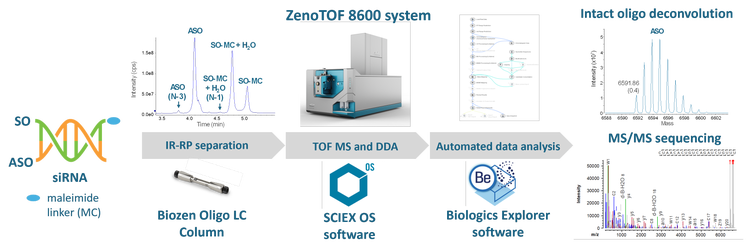
Key features of the streamlined IP-RP LC-MS/MS workflow for oligo analysis
- High performance: Oligos are separated using the efficient Biozen Oligo LC column and characterized using the high-resolution ZenoTOF 8600 system, with automated data analysis performed using intuitive Biologics Explorer software
- Minimal method optimization: SCIEX OS software allows the user to build a data-dependent CID method using a dynamic CE with custom equation, providing balanced MS/MS fragmentation of oligos in different lengths or charge states
- Simplicity: Biologics Explorer software provides easy-to use data analysis workflows for oligo sequence creation, intact deconvolution, mass mapping, and MS/MS sequencing
- Consistent recovery: Biozen Oligo LC column combines core-shell particle technology and bioinert hardware, significantly increasing the chromatographic efficiency
Methods
Sample preparation: siRNA with an MC linker conjugated to the 3’ end of the SO was purchased from VectorBuilder. A stock solution of 1 mg/mL was prepared for the siRNA. This solution was diluted to 10 ng/µL, from which 5 µL (50 ng) was injected for LC-MS analysis.
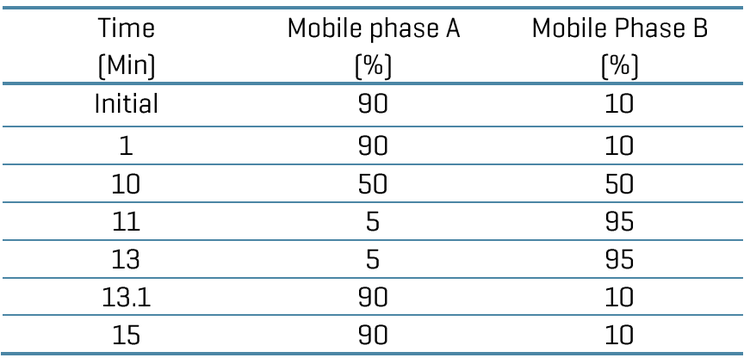
IP-RP LC separation: The oligos were separated based on IR -RP chromatography using a Phenomenex Biozen Oligo LC column (2.6 µm, 50 x 2.1 mm) installed on a Nexera XS inert HPLC system (Shimadzu). The separation was performed using the gradient shown in Table 1 with a column temperature of 60°C and a flow rate of 0.4 mL/min. Mobile phases A and B are water and methanol/water (1:1 v/v), respectively, with 50 mM 1,1,3,3,3-hexafluoroisopropanol (Sigma -Aldrich) and 15 mM diisopropylethylamine (Sigma -Aldrich).
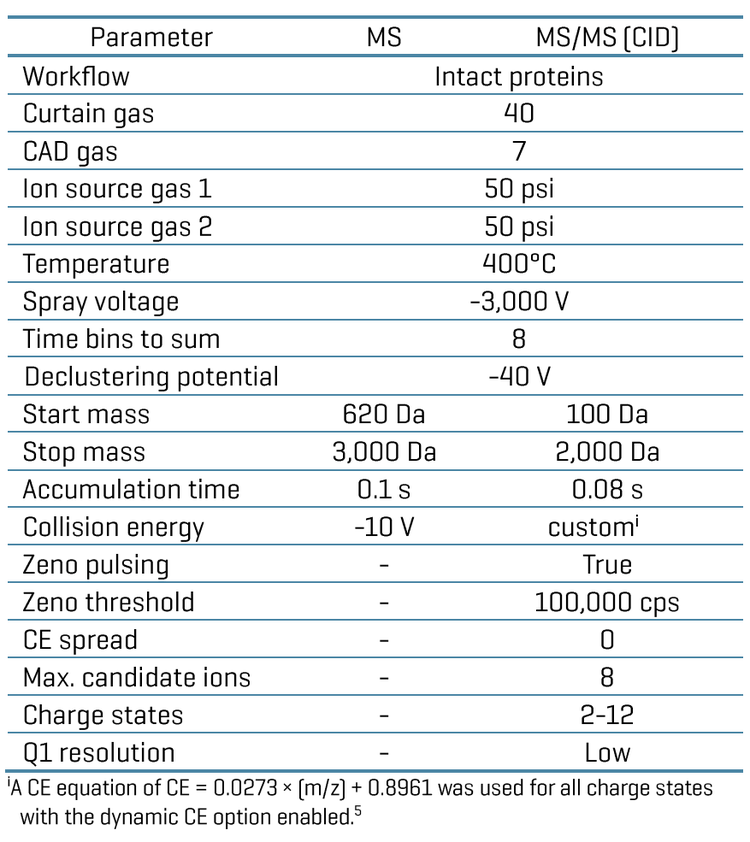
Mass spectrometry: MS data were acquired using a DDA method with CID in the negative mode on a ZenoTOF 8600 system (SCIEX) or a ZenoTOF 7600+ system (SCIEX). The key instrument parameters of the ZenoTOF 8600 system are listed in Table 2. The parameters for the ZenoTOF 7600+ system were described previously.2,3
Data analysis: MS data were processed using the intuitive oligonucleotide data analysis templates within Biologics Explorer software, Version 8.0.3 (SCIEX). The details on oligo sequence creation , intact deconvolution, and MS/MS mapping were described in previous technical notes.2,3 Briefly, the sequences of the SO and ASO were defined as the following:
SO
rA-o-rC-o-rA-o-rG-o-rA-o-rU-o-rC-o-rU-o-rG-o-rA-o-rC-o-rA-o-rG-o-rU-o-rG-o-rU-o-rU-o-rA-o-rG-o-rU-o-rU
ASO
rC-o-rU-o-rA-o-rA-o-rC-o-rA-o-rC-o-rU-o-rG-o-rU-o-rC-o-rA-o-rG-o-rA-o-rU-o-rC-o-rU-o-rG-o-rU-o-rU-o-rU
The localized modifications of MC and MC + H2O were defined to the 3’ end of the oligos. The monoisotopic masses of SO-MC and ASO were used for intact deconvolution. All the fragment ion types, such as a, a-B, w, and y,were selected for MS/MS mapping.
Intact oligo analysis
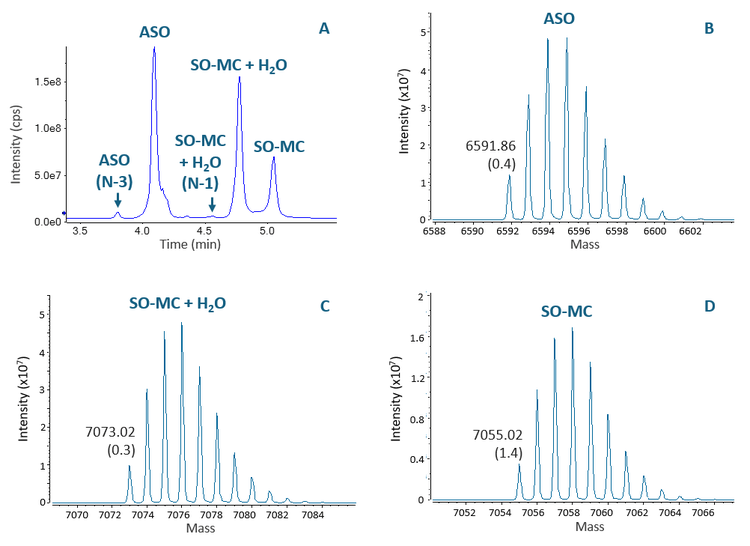
The Phenomenex Biozen Oligo LC column provides excellent separation of oligos and their impurities. Figure 2A shows the IP-RP separation of the oligo species detected in the MC-linked siRNA. The Biozen Oligo LC column provided baseline separation between the ASO, SO-MC, and their low-abundant impurities. In addition, the hydrated species of the SO-MC (SO-MC + H2O) was nicely separated from its native form using this column.
Biologics Explorer software offers the intuitive oligo workflows for automated spectrum deconvolution and MS/MS sequencing.2,3 Intact deconvolution of the siRNA data acquired using the ZenoTOF 8600 system confirmed the identities of ASO, SO-MC, and SO-MC + H2O (Figures 2B - 2D). The measured monoisotopic masses of these species were in excellent agreement with their theoretical values (< 2 ppm). Similar results were obtained using the ZenoTOF 7600+ system (data not shown). The impurities annotated in Figure 2A will be described in the following section.
Oligo sequencing
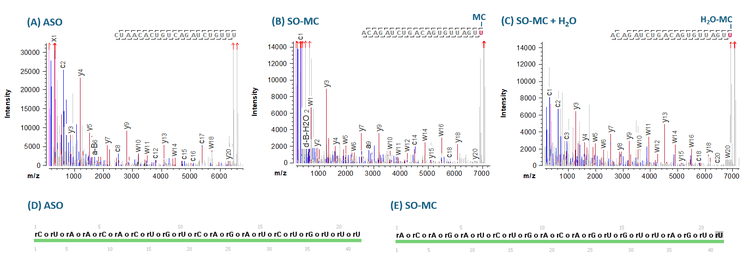
The ZenoTOF 8600 system or the ZenoTOF 7600+ system provides high-quality Zeno CID DDA data of the oligos in the negative mode using fixed CEs with a spread or dynamic CEs with a custom equation.3 The oligo sequencing workflow within Biologics Explorer software allows a quick comparison of the data acquired using different settings, accelerating method optimization for oligo analysis. Figures 3 shows the deisotoped CID spectra and sequence coverage maps of the ASO and SO-MC of the siRNA. Zeno CID DDA with custom dynamic CEs led to excellent fragmentation of these species for their confident sequence confirmation without the need for extensive CE optimization (Figure 3). The MC and MC + H2O modifications on the 3’ end of the SO were confirmed based on the detection of the w- and y-series fragments (Figures 3B and 3C). Similar Zeno CID DDA results were also obtained using the ZenoTOF 7600+ system (data not shown).
Impurity analysis
The siRNA sample analyzed in this study was purified by HPLC and contained a very low level of impurities. However, the separation power of the Biozen Oligo LC column and the high sensitivity of the ZenoTOF 8600 system enabled the detection and confident identification of low-abundant impurities in the siRNA sample.
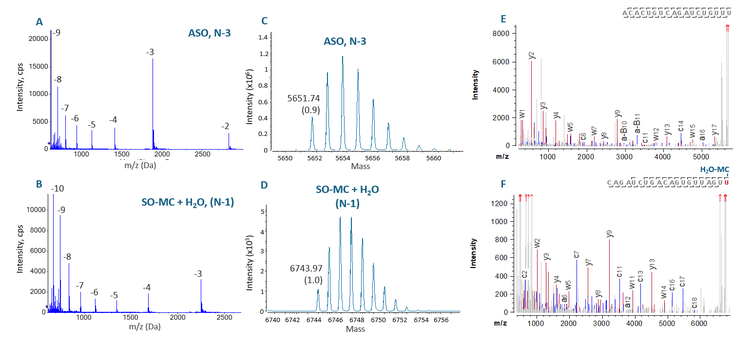
Figure 2A shows the presence of low-abundant impurities eluting earlier than the ASO and SO-MCspecies. Figure 4 shows the raw mass spectra, deconvolution spectra, and annotated MS/MS spectra of 2 selected impurities highlighted in Figure 2 . These 2 species were present at ~2.3% and ~0.3% relative to ASO and SO-MC + H2O, respectively. Intact spectrum deconvolution led to measured masses of 5651.74 Da and 6743.91 Da, in excellent agreement (<2 ppm) with theoretical masses of the 5’ N-3 species of AOS and 5’ N-1 species of SO-MC + H2O, respectively (Figures 3A -3D). The identities of these 2 impurities were further confirmed based on a complete sequence coverage obtained from their high-quality Zeno CID DDA data (Figures 3E and 3F).
In summary, this technical note highlights a streamlined IP-RP LC-MS/MS workflow for accurate mass measurement , MS/MS sequenc ing, and impurity analysis of a synthetic siRNA . The oligo deconvolution and sequencing workflows offered by Biologics Explorer software allow rapid mass measurement, sequence confirmation, impurity analysis, and method optimization, accelerating the development and quality control of oligo therapeutics.
Conclusions
- A streamlined IP-RP LC-MS/MS workflow was developed for intact mass analysis, sequenc e confirmation, and impurity assessment of synthetic siRNA s using the ZenoTOF 8600 system intuitive Biologics Explorer software. This workflow can be easily replicated on a ZenoTOF 7600+ system.
- Accurate mass measurement (<2 ppm) and high-quality Zeno CID DDA data led to confident identification and sequence confirmation of the ASO and SO species in the siRNA sample .
- The N-3 species at ~2.3% of ASO and the N-1 species at ~0.3% of SO-MC + H2O were confidently identified based on accurate mass measurement (<2 ppm) and MS/MS mapping.
- Biozen Oligo LC column provided excellent chromatographic separation of oligos and their impurities to facilitate quality assessment.
References
- Pourshahian S. (2021) Therapeutic oligonucleotides, impurities, degradants, and their characterization by mass spectrometry. Mass Spectrom. Rev. 40:75-109.
- A streamlined LC-MS workflow for intact oligonucleotide analysis with enhanced MS sensitivity. SCIEX Technical Note, MKT-36686-A.
- Oligonucleotide sequencing using a streamlined ion -pair reverse-phase LC-MS/MS workflow with automated data analysis. SCIEX Technical Note, MKT-37808-A.
- Characterization of an antibody-oligonucleotide conjugate (AOC) using native mass spectrometry and peptide mapping. SCIEX Technical Note, MKT-37551-A.
- Karasawa K et al. Method development for metabolite and impurity profiling of oligonucleotide therapeutics. ASMS Conference on Mass Spectrometry and Allied Topics, June 2- 6, 2019, Atlanta, Georgia.