Quantitative analysis of 25-OH-vitamin D3, 3-epi-25-OH-vitamin D3 and 25-OH-vitamin D2 in human serum
Abstract
This technical note demonstrates the sensitive and accurate quantitation of 25-OH-vitamin D3, 3-epi-25-OH-vitamin D3 and 25-OH-vitamin D2 in human serum using a liquid-liquid extraction procedure with analysis using the SCIEX QTRAP 4500 system. Excellent linearity was observed across clinically relevant concentrations with r2 values above 0.99 across the calibration range (1-100 ng/mL). The method showed excellent accuracy (93.5% for 25-OH-vitamin D3, 82.7% for 3-epi-25-OH-vitamin D3, and 119.3% for 25-OH-vitamin D2) at the lowest calibrator level (1 ng/mL), highlighting the assay's strong quantitative performance.
Key benefits of 25-OH-vitamin D3, 3-epi-25-OHvitamin D3 and 25-OH-vitamin D2 analysis from human serum using the QTRAP 4500 system
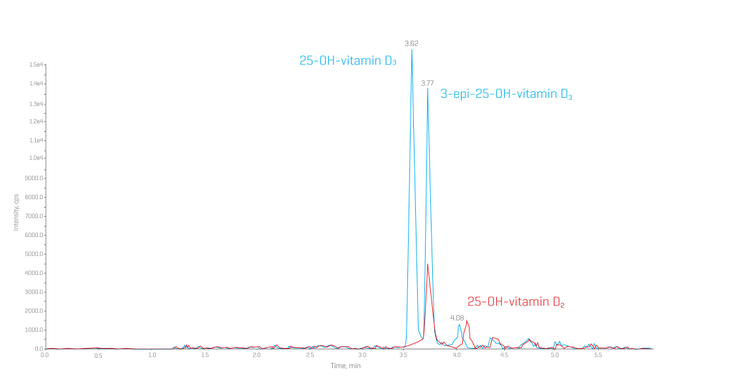
Chromatographic separation: Optimized LC conditions enabled fast, 6 min chromatographic separation of 25-OH-vitamin D3, 3-epi-25-OH-vitamin D3 and 25-OH-vitamin D2
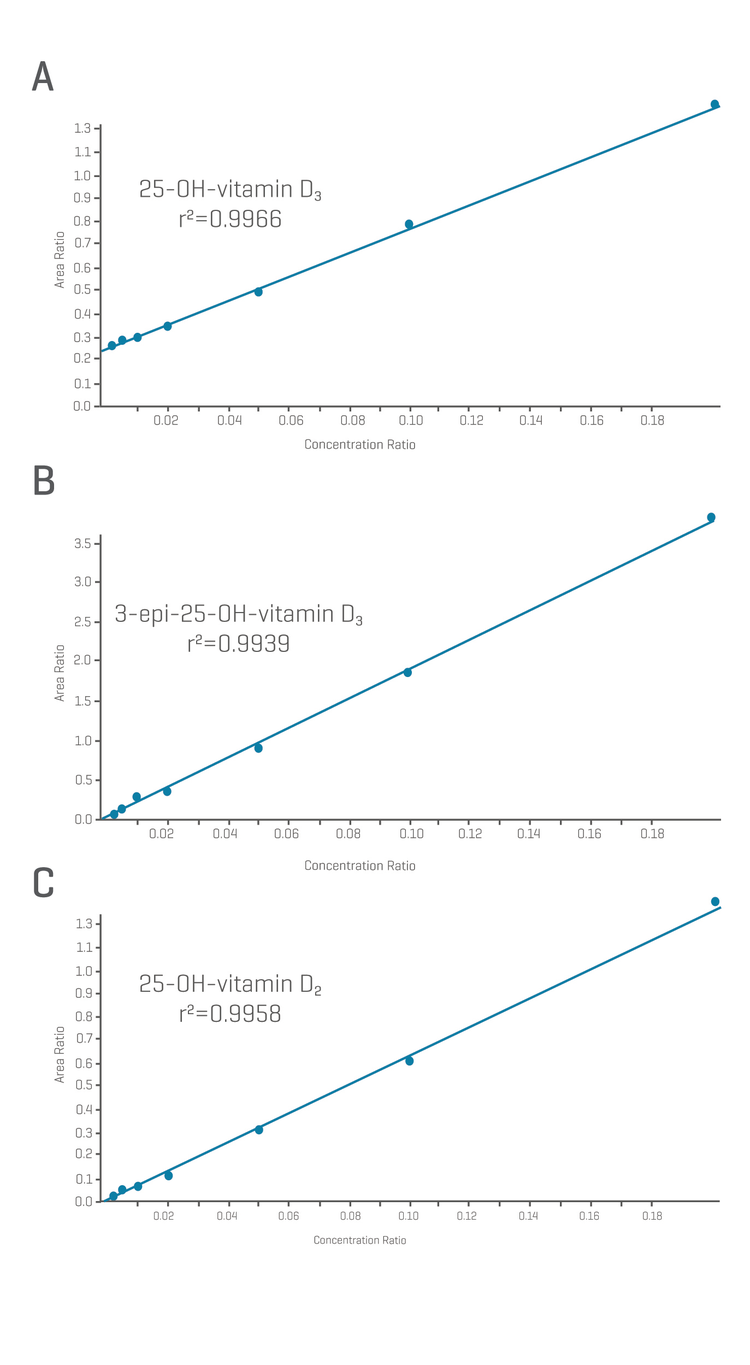
Excellent linearity. Calibration curves for 25-OH-vitamin D3, 3- epi-25-OH-vitamin D3 and 25-OH-vitamin D2 showed r2 values above 0.99 across the calibration range (1-100 ng/mL)
Low-ng/mL level sensitivity and excellent quantitative performance. Sensitive quantitation of 25-OH-vitamin D3, 3- epi-25-OH-vitamin D3 and 25-OH-vitamin D2 was achieved with excellent accuracy (93.5% for 25-OH-vitamin D3, 82.7% for 3-epi-25-OH-vitamin D3 and 119.3% for 25-OH-vitamin D2) at the lowest calibrator levels (1 ng/mL) in human serum
Introduction
5-OH-vitamin D3 and 25-OH-vitamin D2 are the main circulating forms of vitamin D used to assess vitamin D status, with 25-OH-D3 being the predominant and more biologically active form; 3-epi-25-OH-vitamin D3 is a less active epimer that may interfere with accurate measurement in some assays. Deficiencies in these metabolites can lead to impaired calcium absorption and bone demineralization, and, as a result, the ability to accurately quantify vitamin D is critical.
Methods
Sample preparation: 25-OH-vitamin D3, 3-epi-25-OH-vitamin D3 and 25-OH-vitamin D2were extracted from human serum using a liquid-liquid extraction procedure. Briefly, 200 μL of blank serum spiked with 25-OH-vitamin D3, 3-epi-25-OHvitamin D3 and 25-OH-vitamin D2 at seven concentration levels were vortexed and then extracted by a liquid-liquid extraction (LLE) method using methyl-tertiary-butyl ether (MTBE). Following mixing and centrifugation, the organic layer was separated by snap-freezing and evaporated to dryness. It was then reconstituted in 175 μL of methanol/water (80:20, v/v).
Liquid chromatography: Chromatographic separation was achieved using a Phenomenex Kinetex PFP analytical column (100 x 3.0 mm, 2.6 μm, 00D-4477-YO). Mobile phase A was formic acid in water and mobile phase B was formic acid in methanol. The total run time was 6 minutes at a flow rate of 400 μL/min.
Mass spectrometry: Data was collected using a QTRAP 4500 system with an IonDrive Turbo V source and operated in electrospray ionization (ESI) positive mode. The scheduled MRM algorithm was used in SCIEX OS software (version 3.1.6) to collect 10-12 data points to produce robust, quantifiable data. Compound-dependent parameters were optimized by infusion.
Data processing: Data processing was performed using SCIEX OS software (version 3.1.6). Peak integration was achieved using the MQ4 algorithm. Quantitative analysis was conducted in the Analytics module of SCIEX OS, where calibration curves, concentration calculations, assay accuracy statistics were automatically generated.
Results and discussion
Figure 1 shows the chromatographic separation of 25-OH-vitamin D3, 3-epi-25-OH-vitamin D3 and 25-OH-vitamin D2 in a control human serum sample. The combination of the 6 min gradient, selected column, and optimized mobile phase composition enabled baseline separation of the 25-OH-vitamin D3 and 3-epi-25-OH-vitamin D3 epimers.
The quantitative performance of the method was investigated by injecting a series of serum calibrator samples spiked at concentrations ranging from 1-100 ng/mL. Linearity and accuracy were assessed across the calibration ranges for each of the three analytes. Figure 2 shows the calibration curves for A) 25-OH-vitamin D3, B) 3-epi-25-OH-vitamin D3 and C) 25-OH-vitamin D2. The plots show excellent linear responses across the calibration series, with r2 values greater than 0.99 for all three analytes.
The mean accuracy was evaluated in 3 matrix spike replicates at the lowest matrix calibrators measured (1 ng/mL). The accuracy was 93.5% for 25-OH-vitamin D3, 82.7% for 3-epi-25-OH-vitamin D3 and 119.3% for 25-OH-vitamin D2 at the lowest calibrator levels (1 ng/mL).
Conclusion
A fast and sensitive LC-MS/MS method for the detection of 25-OH-vitamin D3, 3-epi-25-OH-vitamin D3 and 25-OH-vitamin D2 extracted from human serum samples was developed using the 4500 system. The method demonstrated:
- Chromatographic separation of 1,25-dihydroxyvitamin D2 and D3
- Excellent linear responses across the calibration series consisting of 7 calibrators, with r2 values greater than 0.99 for all three analytes
- High quantitation performance of the method, resulting in excellent accuracy (93.5% for 25-OH-vitamin D3, 82.7% for 3-epi-25-OH- vitamin D3 and 119.3% for 25-OH-vitamin D2) at the lowest calibrator levels (1 ng/mL)