Quantitative analysis of vitamin B1 and B6 in human whole blood
Abstract
This technical note describes a rapid protein precipitation sample preparation procedure and a robust LC-MS/MS method for the quantitation of vitamins B1 and B6 from human whole blood. Low-nmol/L level sensitivity was shown at the lowest calibrator with signal-to-noise ratios (S/N) of 260:1 for vitamin B1 at 39.0 nmol/L and 45:1 for vitamin B6 at 23.0 nmol/L. The method demonstrated excellent linearity across clinically relevant concentrations as well as excellent precision and accuracy at low-level concentrations, highlighting the assay's quantitative performance.
B vitamins are essential for energy production, brain function, and red blood cell formation. Specifically, neurotropic vitamins such as vitamin B1 (thiamine-diphosphate) and vitamin B6 (pyridoxine-5' phosphate) are crucial micronutrients that support nerve function and overall brain health. Accurate quantitation of these vitamin complexes is vital for identifying potential deficiencies, which are commonly due to malnutrition, gastrointestinal issues, and severe alcoholism.
Key benefits of vitamin B1 and B6 analysis from human whole blood using the QTRAP 4500 system
Chromatographic separation: Optimized LC conditions enabled fast (4 minutes) chromatographic separation of vitamin B1 and vitamin B6
Rapid sample preparation: Vitamin B complexes were extracted from human whole blood samples using a protein precipitation procedure
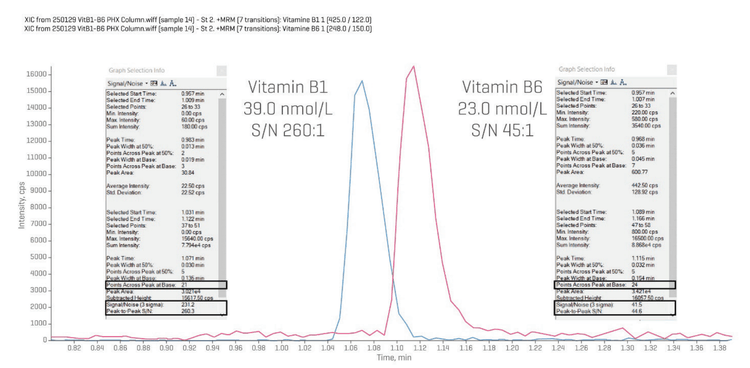
Low-nmol/L level sensitivity: Excellent sensitivity at the lowest calibrator with S/N of 260:1 for vitamin B1 (39.0 nmol/L) and 45:1 for vitamin B6 (23.0 nmol/L)
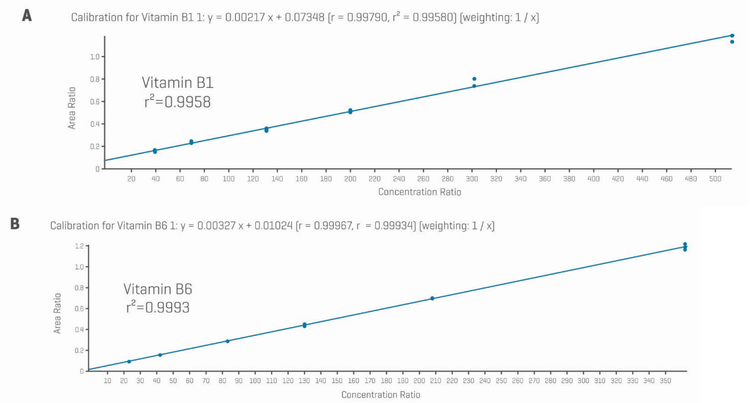
Excellent linearity: Calibration curves for vitamin B1 and vitamin B6 showed r2 values above 0.99 across the calibration range
Excellent quantitative performance: Sensitive quantitation of vitamin B1 and vitamin B6 was performed with excellent precision and accuracy at the lowest calibrator levels
Methods
Sample preparation: VitaminB1 and vitamin B6 were extracted from human whole blood using a protein precipitation procedure. Briefly, 50 µL of blank human whole blood was spiked with vitamin B1 and vitamin B6 at six concentration levels and added to a centrifuge tube containing 50 µL of the deuterated vitamin B1 and vitamin B6 internal standards. 400 µL of a 12% (v/v) trichloroacetic acid deproteinization solution was added to the tube and vortexed for 30 seconds. The tube was immediately shaken for 30 min and centrifuged for 5 min at 10,000g. 200 µL of the supernatant was transferred to a vial for analysis.
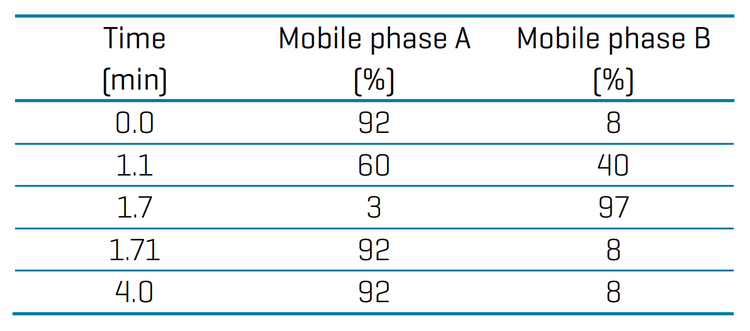
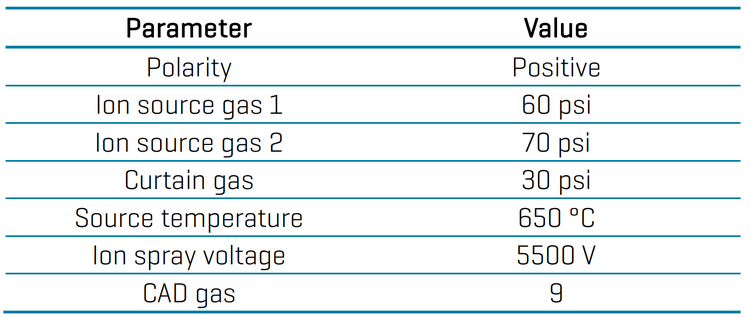
Liquid chromatography: Chromatographic separation was achieved using a Phenomenex Kinetex Luna Omega Polar C18 column (100 x 2.1 mm, 1.6 µm, 00D-4748-AN). Mobile phase A was water, and mobile phase B was methanol. The LC flow rate was 400 μL/min, and the total run time was 4 minutes. The injection volume was 20 μL. The LC gradient program is presented in Table 1.
Results and discussion
Figure 1 shows the chromatographic separation of vitamin B1 and vitamin B6 into a control human whole blood sample at a final concentration of 39 nmol/L for vitamin B1 and 23 nmol/L for vitamin B6, respectively. The 4 min gradient, in combination with the column selection and mobile phase composition, resulted in baseline separation of vitamin B1 and vitamin B6. The extracted ion chromatograms showed a S/N of 260:1 for vitamin B1 and 45:1 for vitamin B6, at the lowest matrix calibrator measured (39.0 nmol/L for vitamin B1 and 23.0 nmol/L for vitamin B6), as calculated using a peak-to-peak algorithm.
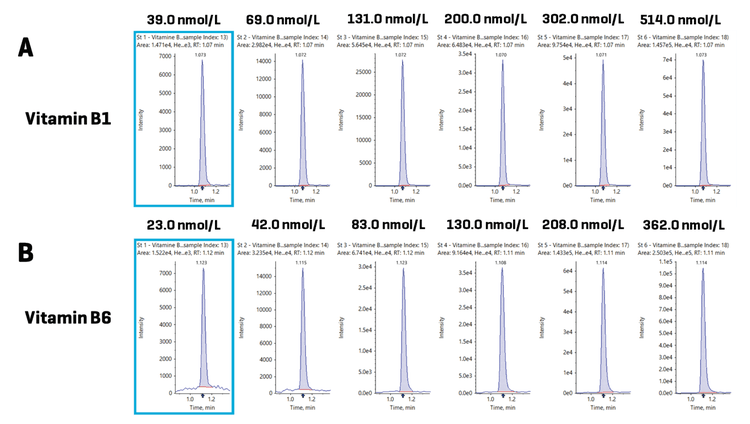
Figure 2 shows the representative extracted ion chromatograms (XICs) for A) vitamin B1 and B) vitamin B6 across their respective concentration ranges (39.0-514.0 nmol/L for vitamin B1 and 23.0-362.0 nmol/L for vitamin B6).
The quantitative performance of the method was investigated by injecting a series of calibrator samples spiked at concentrations ranging from 39.0 to 514.0 nmol/L for vitamin B1 and 23.0 to 362.0 nmol/L for vitamin B6, respectively. Linearity, accuracy, and precision were assessed across the calibration ranges for each of the two analytes. Figure 3 shows the calibration curves for vitamin B1 (top) and vitamin B6 (bottom) over the analytes’ respective calibration ranges. The plots show excellent linear responses across the calibration series, with r2 values greater than 0.99 for both analytes. The accuracy and precision values were calculated by 3 replicates in matrix at the lowest matrix calibrators measured (39 nmol/L for vitamin B1 and 23.0 nmol/L for vitamin B6).
The accuracy was 96.9% for vitamin B1 and 99.4% for vitamin B6, respectively. The precision (%CV) was 4.7% for vitamin B1 and 2.3% for vitamin B6, respectively.
Conclusion
A fast and sensitive LC-MS/MS method for the detection of vitamin B1 and B6 extracted from human whole blood samples was developed. The method demonstrated:
- Fast sample preparation, which consisted of a simple protein deproteination, requiring 50 μL of human whole blood sample
- Chromatographic separation of vitamin B1 and vitamin B6
- Excellent sensitivity at the lowest calibrator level, resulting in S/N of 260:1 for vitamin B1 (39.0 nmol/L) and 45:1 for vitamin B6 (23.0 nmol/L)
- Excellent linear responses across the calibration series consisting of 6 calibrators, with r2 values greater than 0.99 for both analytes
- High quantitation performance of the method, resulting in excellent precision (4.7% for vitamin B1 and 2.3% for vitamin B6) and accuracy (96.9% for vitamin B1 and 99.4% for vitamin B6) at the lowest calibrator levels (39.0 nmol/L for vitamin B1 and 23.0 nmol/L for vitamin B6)