Abstract
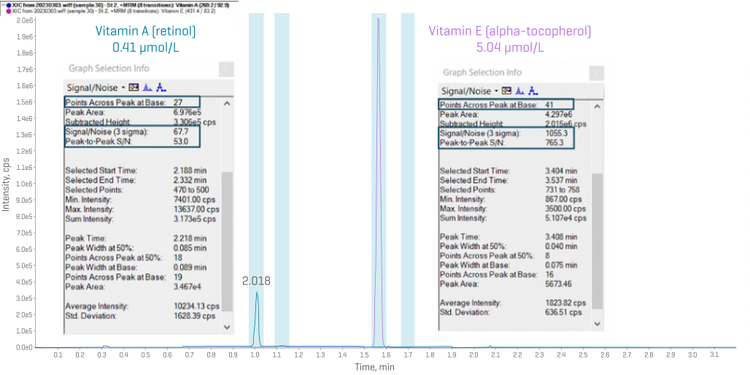
This technical note describes a rapid protein precipitation sample preparation procedure and a robust and sensitive LC-MS/MS method using the QTRAP 6500+ system for the quantitation of vitamin A and E in human serum. Excellent linearity was observed across clinically relevant concentrations. Low-µmol/L level sensitivity was achieved at the lowest calibrator with signal-to-noise ratios (S/N) of 53:1 for vitamin A at 0.41 µmol/L and 753:1 for vitamin E at 5.04 µmol/L. In addition, the method showed excellent precision and accuracy at low-level concentrations, demonstrating the quantitative performance of the assay.
Key benefits of vitamin A and E analysis from human serum using the QTRAP 6500+ system
- Rapid sample preparation: The two fat-soluble vitamins were extracted from human serum samples using a protein precipitation procedure
- Low-µmol/L level sensitivity: Excellent sensitivity at the lowest calibrator with S/N of 53:1 for vitamin A (0.41 µmol/L) and 753:1 for vitamin E (5.04 µmol/L)
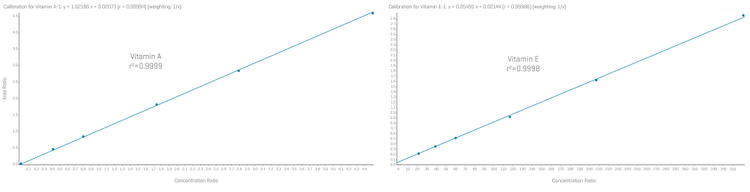
- Excellent linearity: Calibration curves for vitamin A and vitamin E showed r2 values above 0.99 across the calibration range
- Excellent quantitative performance: Sensitive quantitation of vitamin A and vitamin E was achieved with excellent precision (2.7% for vitamin A and 3.4% for vitamin E) and accuracy 105.4% for vitamin A and 102.9% for vitamin E at the lowest calibrator levels (0.41 µmol/L for vitamin A and 5.04 µmol/L for vitamin E)
Introduction
Vitamins A and E are fat-soluble vitamins that play an essential role in various bodily functions such as vision, antioxidant protection, and immune system support. Deficiencies in these vitamins are typically caused by malnutrition or underlying health conditions. As a result, the ability to accurately quantify these vitamins is critical to diagnose deficiencies.
Methods
Sample preparation:Vitamin A and vitamin E were extracted from human serum using a protein precipitation procedure. Briefly, 25 µL of blank serum was spiked with vitamin A and vitamin E at six concentration levels and added to a centrifuge tube. Then, 975 µL of an organic deproteinization solution was spiked with deuterated vitamin A and vitamin E internal standards. The tube was vortexed and centrifuged for 5 minutes at 10,000 x g. The supernatant was transferred to a UPLC vial for analysis.
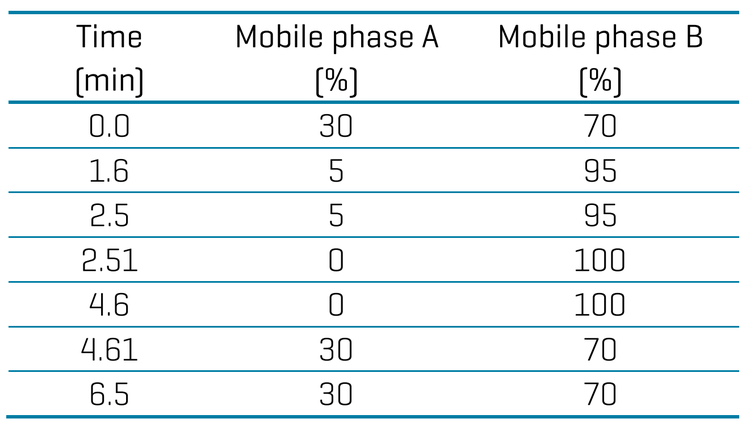
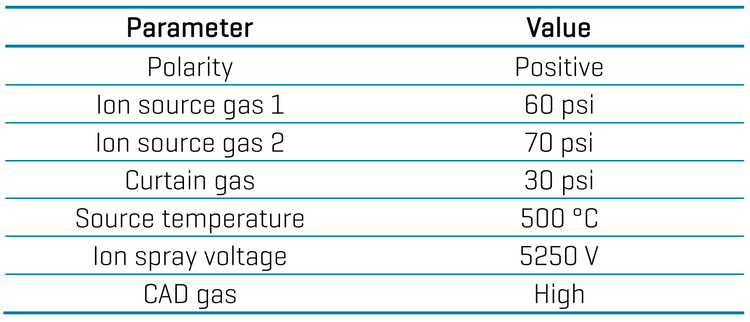
Liquid chromatography: Chromatographic separation was achieved using a Phenomenex Kinetex Luna Omega Polar C18 column (50 x 2.1 mm, 1.6 µm, 00B-4748-AN). Mobile phase A was water, and mobile phase B was methanol. The total run time was 6.5 min, and the flow rate was 600 μL/min. The injection volume was 15 μL. The LC gradient program is presented in Table 1.
Results and discussion
Figure 1 shows the chromatographic separation of vitamin A and E in a control human serum sample at a final concentration of 0.41 µmol/L for vitamin A and 5.04 µmol/L for vitamin E, respectively. The extracted ion chromatograms showed a S/N of 53:1 for vitamin A and 753:1 for vitamin E, at the lowest matrix calibrator measured (0.41 µmol/L for vitamin A and 5.04 µmol/L for vitamin E), as calculated using the peak-to-peak algorithm.
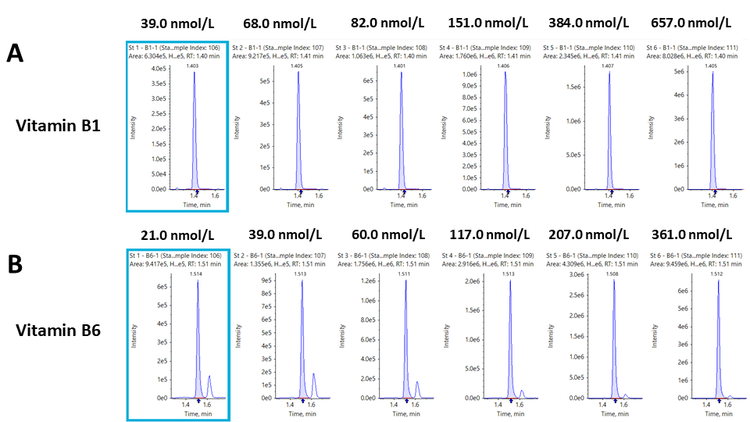
Figure 2 shows the representative extracted ion chromatograms (XICs) for A) vitamin A and B) vitamin E across their respective concentration ranges (0.41-4.51 µmol/L for vitamin A and 5.04-49.50 µmol/L for vitamin E). The signals shown for the lowest matrix calibrators measured (0.41 µmol/L for vitamin A and 5.04 µmol/L for vitamin E) are well above the blank signal for both analytes.
The quantitative performance of the method was investigated by injecting a series of calibrator samples spiked at concentrations ranging from 0.41-4.51 µmol/L for vitamin A and 5.04-49.50 µmol/L for vitamin E, respectively. Linearity, accuracy, and precision were assessed across the calibration ranges for the two analytes. Figure 3 shows the calibration curves for vitamin A (left) and vitamin E (right) over the analytes’ respective calibration ranges. The plots show excellent linear responses across the calibration series, with r2 values greater than 0.99 for both analytes.
The accuracy and precision values were calculated using 6 replicates of the lowest matrix calibrators analyzed (0.41 µmol/L for vitamin A and 5.04 µmol/L for vitamin E). The accuracy was 105.4% for vitamin A and 102.9% for vitamin E, respectively. The precision (%CV) was 2.7% for vitamin A and 3.4% for vitamin E, respectively.
Conclusions
A fast and sensitive LC-MS/MS method for detecting vitamin A and E extracted from human serum samples was developed using the QTRAP 6500+ system. The method demonstrated:
- Fast sample preparation, which consisted of a simple protein deproteination, requiring 25 μL of human serum sample
- Excellent sensitivity at the lowest calibrator level, resulting in S/N of 53:1 for vitamin A at 0.41 µmol/L and 753:1 for vitamin E at 5.04 µmol/L
- Excellent linear responses across the calibration series consisting of 5 calibrators, with r2 values greater than 0.99 for both analytes
- High quantitation performance of the method, resulting in excellent precision (2.7% for vitamin A and 3.4% for vitamin E) and accuracy 105.4% for vitamin A and 102.9% for vitamin E at the lowest calibrator levels (0.41 µmol/L for vitamin A and 5.04 µmol/L for vitamin E)