Analysis of food colors and illegal dyes in spices using LC-QTOF with SWATH data independent acquisition (DIA)
Abstract
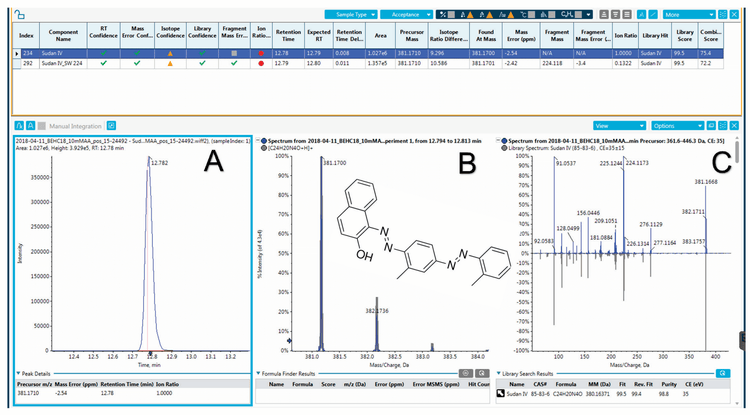
This technical note demonstrates a screening method for the analysis of 98 food colors and illegal dyes in spices using the X500R QTOF system. The SWATH acquisition method collected MS/MS spectra for all precursor compounds, and detection confidence was increased through MS/MS spectral matching against an in-house library database in the SCIEX OS software. The validation study showed a false negative rate of 0%, except for two analytes (<10%). Further, low precursor mass error and good intra-day repeatability was observed. The method was applied to >80 real-world spice samples and showed positive detections for Sudan IV in a paprika sample (Figure 1) and bixin in a couscous spice blend sample (Figure 4).
Key benefits of SWATH DIA acquisition for the analysis of food dyes using X500R QTOF system
- MS/MS data collected for all compounds using SWATH acquisition. Comprehensive MS/MS data for every precursor, even in complex spice samples
- Confidently identify target dyes and food colours. MS/MS library matching used to increased detection confidence
- Fast, efficient data processing and review. “Traffic light” qualitative rules used for rapid results filtering for positive hits
- Custom-built MS/MS libraries. User-generated libraries constructed using standards and the SCIEX OS software
Introduction
Natural and artificial colors are added to many foods to enhance their attractiveness and compensate for the endogenous color losses that occur during processing or storage. Due to their low cost, effectiveness and excellent stability, artificial colors are usually preferred by the food
industry over natural ones.1,2 Sudan dyes are a class of lipophilic azo dyes that are widely used for different industrial and scientific applications, such as coloring of fuels, waxes or oil, staining for microscopy, because of their colorfastness and low price. Sudan dyes are also attractive as food dyes as they can improve their appearance. However, due to the carcinogenicity of their metabolites, they are regulated banned for food usage in most countries, including the European Union (EU).3 Nevertheless, over the last years, these dyes have been found in
various foodstuffs, including spices and tomato sauces.4 In the case of spices, the Swiss legislation does not allow for the addition of food colors except for quinoline yellow (E104), which can be added to curry and tandoori foods.
A sensitive and confident analytical screening method, amenable to both the lipophilic Sudan-type illegal dyes and hydrophilic artificial dyes, is required for their fast detection and identification. The use of SWATH DIA acquisition for MS/MS collection with the X500R QTOF allows for simultaneous targeted (suspect screening) and non-targeted screening. The exact mass and MS/MS fragmentation data provide additional data to confidently identify the analytes of interest and also identify unknown chemicals present in the sample.
Methods
Sample preparation. 1 g of spice was weighed and extracted for 30 min with a quaternary solvent mixture of 9:1:5:5 (v/v/v/v) water/methanol/acetonitrile/tetrahydrofuran. The solution was centrifuged for 5 min at 2500 rpm and an aliquot of the supernatant was then filtered using a 0.2 µm PTFE filter into an amber LC vial containing the three internal standards (Sudan Id5, Sudan III-d6, Congo Red-d8).
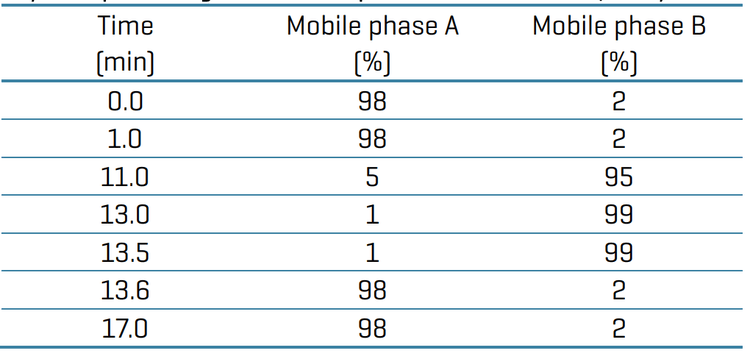
Liquid chromatography. Chromatography was performed with an ExionLC AD system using a Waters BEH UPLC column (1.7 µm, 2.1 x 100 mm). The mobile phases were water with 10mM ammonium acetate (A) and methanol (B), and gradient conditions are in Table 1. The injection volume was 2 µL, the flowrate was 0.5 mL/min and the column oven was 50°C.
Mass spectrometry. Samples were analyzed using an X500R QTOF system equipped with a TurboV ion source and TwinSpray electrode operated in both negative and positive electrospray ionization (ESI) mode. The source temperature was set at 500°C, the ion source gases 1 and 2 were both 45 psi, the curtain gas was 35 psi and the CAD gas was 7 psi. For the positive mode, the ion spray voltage was set at 5500 V and for the negative mode at -4500 V.
The TOFMS survey scan was performed from 120 to 1200 Da using the following parameters for positive mode: declustering potential (DP) was 50 V, the accumulation time was 0.1 s and the collision energy (CE) was 10 V. For the negative mode, the DP was -80 V, the accumulation time was 0.1 s and the collision energy was -10 V.
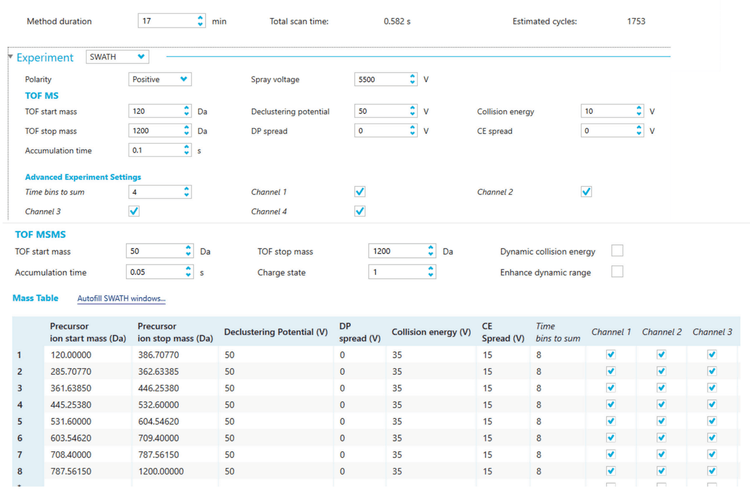
The MS/MS spectra were collected using SWATH DIA acquisition with 8 variable-width windows according to the table presented in Figure 2. The following parameters were used in positive mode: the DP = 50 V and CE = 35 V with a CE spread = 15 V. For the negative mode, the DP = -80 V and CE = -35 V with a CE spread = 15 V. The accumulation time for both modes was 0.05 s. The variable-width SWATH windows were optimized by evaluating the ion density over the whole chromatographic range of twelve different spices (paprika, curcuma, sweet
paprika, hot chili) and spice blends (curry, satay, tandoori, garam masala, couscous ras-el-hanout, Cajun and a “seven spices” mix).
MS/MS spectral library. Most dyes had purity levels below 95% and therefore the in-house MS/MS spectral library was generated by injecting the standards using the LC method described above. However, the data was acquired using data dependent acquisition to ensure the highest purity MS/MS spectra were collected. The MS/MS libraries were acquired at six different collision energies: 20 V, 30 V, 40 V, 50 V and 35 +/- 15 V and 40 +/-20 V. For instances in which the compounds could be ionised in both positive and negative modes, both polarities were added to the library.
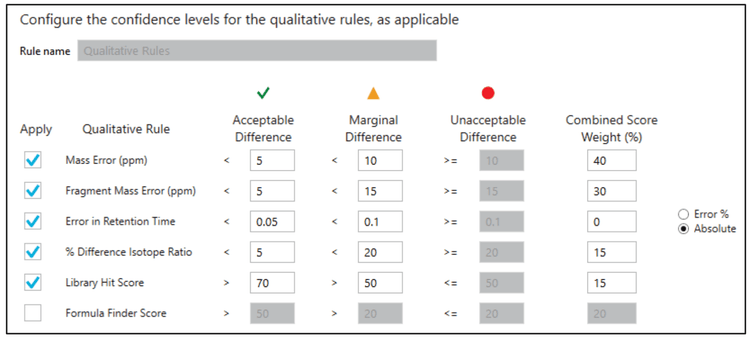
Data Processing. Data was processed using the Analytics module in the SCIEX OS software. The criteria for the traffic lights which allow for data review and filtering can be seen in Figure 3.
Validation study results
Forty-one compounds were selected for the validation based on their color and their relevance to the study. The selected compounds were mostly Sudan-type dyes and artificial dyes. Two spices were used for validation: ground paprika and curry. Both extracts were spiked such that they contained between 1 and 32 compounds. In total, 40 vials were prepared with each analyte added randomly in 20 of them.
Selectivity and specificity as well as the false positive and false negative rates were determined in the study. The vials were injected onto the X500R system using, throughout the sequence, the integrated calibrant delivery system (CDS) with the TwinSpray electrode to maintain the mass accuracy.
After data processing the false positive rate was determined as 0% for all compounds whereas the false negative rate was 0%
except for Amaranth (E123) and Reactive Red 195 with rates of 10% and 5%, respectively. These results highlight the excellent identification capabilities of the instrument. The mass error of the precursor ion did not exceed +/- 2 ppm for 81% of the 494 total measurements in the negative mode and 63% in the 646 total measurements in positive mode. Only 2% of the negative mode measurements, and 3% of the positive mode measurements, showed mass accuracies between +/- 5 and +/- 10 ppm and none were above +/- 10ppm.
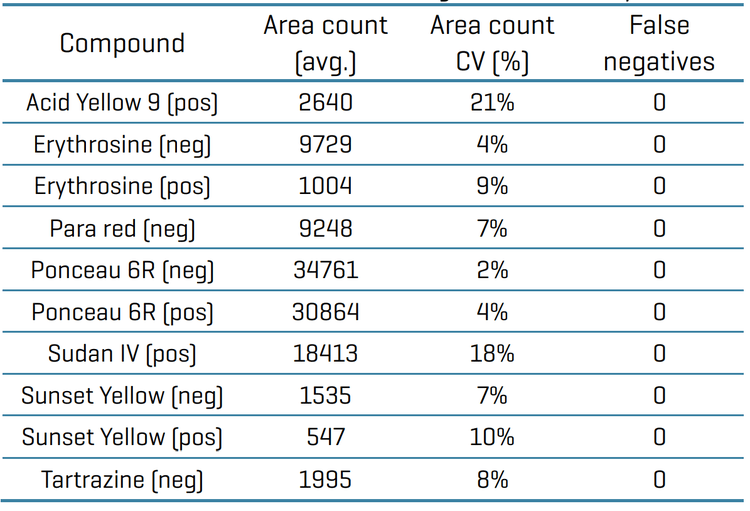
Intra-day repeatability was assessed using both curry and paprika extracts and a representative subset of compounds through 10 successive replicate injections of the same vial in each mode (Table 2). The parameters monitored were the retention time (RT), the raw area, the mass error and the false negative rate at the detection level. The average coefficients of variation (CV) for the RT were <1% for all compounds, except for Tartrazine and Acid Yellow, which were nonetheless lower than 5%. With respect to false negative results, Para Red did not meet the criteria for detection (n=10) in one instance, as the mass error was higher than 5 ppm (-6.4 ppm) in the negative mode. Similar results were obtained in the paprika extract.
Analysis of real-world spice samples
More than 80 spice samples were purchased by local authorities from various markets and supermarkets. The spices were extracted and analyzed using the sample preparation and SWATH acquisition method described above. The in-house MS/MS spectral database was used for library matching and the “traffic light” qualitative rules were used to filter the data for a quick and efficient review (Figure 2).
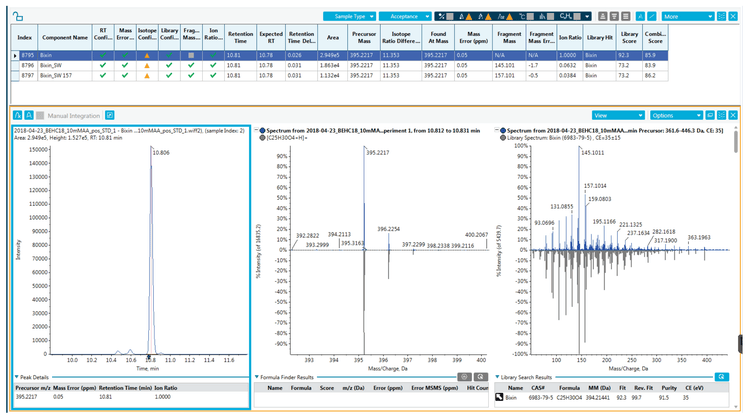
Positive detections were observed for Sudan IV in a paprika sample (Figure 1) and bixin in a couscous spice blend sample (Figure 4). Considering the paprika sample (Figure 1), Sudan IV detection was confirmed through good mass error for the precursor (-2.5 ppm) and m/z 224.118 Da fragment (-3.4 ppm), good agreement to the theoretical isotope pattern, and positive hit for Sudan IV with a “Fit” score of 99.5 against the in-house MS/MS library. For the couscous spice blend sample (Figure 4), bixin detection was confirmed through excellent mass error for the precursor (0.05 ppm), m/z 145.101 Da fragment (-1.7 ppm) and m/z 157.101 Da fragment (-0.5 ppm), good agreement to the theoretical isotope pattern, and positive hit for bixin against the in-house library (“Fit” score = 92.3). Further, the bixin fragment ion ratio was within the acceptable ±20% tolerance. These results demonstrate the ability of the X500R QTOF system, using SWATH acquisition and SCIEX OS data processing, to confidently detect illegal dyes in spices.
Conclusion
The technical note demonstrated:
- A novel screening method to detect and identify 98 dyes in spices using the X500R QTOF system, encompassing both
lipophilic Sudan-type and hydrophilic artificial dyes - The validation study included 41 dyes and colors in 2 spices and showed a high degree of mass accuracy
- The screening method was applied to 80 spice samples purchased from local supermarkets. Sudan IV, an illegal dye, was identified with a high confidence level in a paprika sample and a natural food colour, bixin, was detected in a couscous spice blend.
- Compound identification confidence was improved through concurrent SWATH acquisition and TOFMS data; criteria used included precursor and fragment accurate mass error, fragment ion ratios, precursor isotopic distribution and MS/MS library match
References
-
Oplatowska-Stachowiak, M.; Elliott, C.T. Food colors: Existing and emerging food safety concerns. Crit. Rev. Food Sci. Nutr. 2017, 57 (3), 524-548. DOI: 10.1080/10408398.2014.889652
2. Colour additives for foods and beverages, 1st ed.; Scotter, M.J., Ed. Woodhead Publishing, 2015. DOI: 10.1016/C2013-0-16427-6
3. European Food Safety Authority. Food colours. Last reviewed date: 29 April 2025.
https://www.efsa.europa.eu/en/topics/topic/food-colours4. European Food Safety Authority. Opinion of the scientific panel on food additives, flavourings, processing aids and materials in contact with food on a request from the commission to review the toxicology of a number of dyes illegally present in food in the EU. The EFSA Journal, 2005, 263, 1-71. DOI: 10.2903/j.efsa.2005.263