Abstract
This technical note demonstrates that ZT Scan DIA 3.0 on the ZenoTOF 8600 system delivers strong protein identification and quantitative robustness from complex lysate digests at throughputs of up to 500 samples-per-day (SPD). Precise control of sliding Q1 precursor isolation window widths—down to 1 Da—improves quantitative accuracy and enables method optimization to balance proteome depth and throughput across diverse analytical needs. Using ZT Scan DIA 3.0 on the ZenoTOF 8600 system, 5,793 protein groups and 60,791 precursors were identified from 50 ng of a commercial human lysate digest at 500 SPD, with minimal reduction in total and quantifiable protein groups and precursors observed across throughputs ranging from 60-500 SPD. Collectively, these results highlight ZT Scan DIA 3.0 on the ZenoTOF 8600 system as a powerful platform for deep, reliable protein biomarker identification and quantitation across large-scale cohorts.
Key features of high-throughput proteomics using ZT Scan DIA 3.0 on the ZenoTOF 8600 system
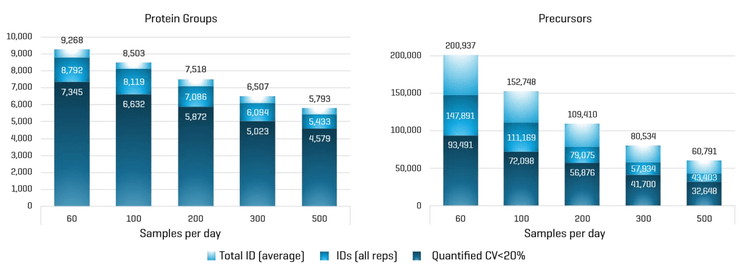
- Deep protein identification across throughput conditions: ZT Scan DIA 3.0 delivered deep proteome profiling from 50 ng of commercial K562 digest, identifying 9,268 protein groups at 60 SPD and 5,793 protein groups even at 500 SPD.
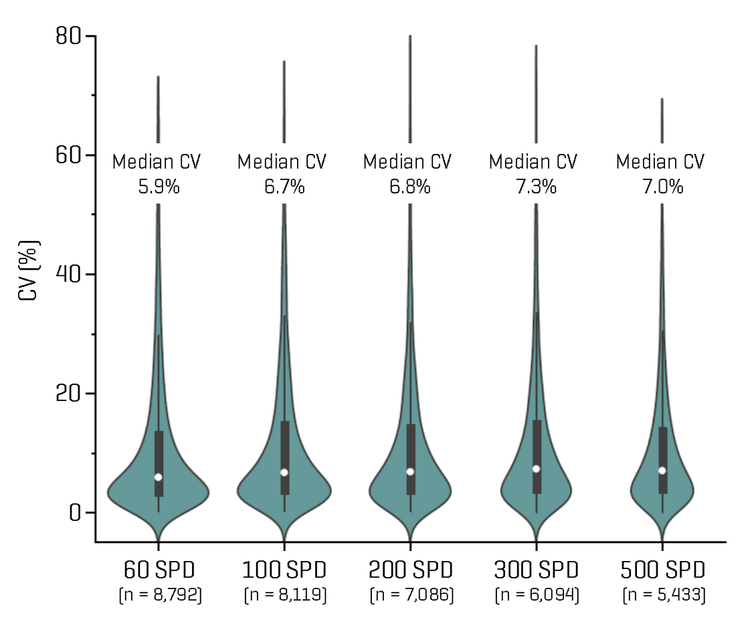
- Superior quantitative precision and performance: Quantify as many as 4,579 protein groups at 500 SPD and 7,345 protein groups at 60 SPD from 50 ng of K562 digest using ZT Scan DIA 3.0, yielding median CVs of ≤7% for all identified protein groups across all throughputs.
- Ultra-selective DIA to support deeper proteome coverage: ZT Scan DIA 3.0 supports sliding Q1 isolation window isolation window widths as low as 1 Th, reducing spectral interference from co-isolated precursors while adding a high-order 4th dimension of precursor to fragment relationship to preserve or increase identification confidence and quantitative accuracy.
Introduction
As discovery proteomics pushes toward larger studies, faster decisions, and broader biological insight, high-throughput high-resolution mass spectrometry (HRMS) workflows are becoming essential. However, increasing throughput remains challenging: shorter chromatographic separations compress peptide peaks, increase precursor co-elution, and make it more difficult to maintain both proteome depth and quantitative robustness.
Preserving proteome depth at higher throughput is important because deeper coverage expands access to low-abundance proteins, strengthens pathway-level biological interpretation, and increases the likelihood of detecting clinically or biologically relevant biomarkers across large sample cohorts. In DIA workflows, these constraints can also increase spectral complexity and interference, limiting confident identification and quantitation in complex samples.
The ZenoTOF 8600 system helps address these challenges through advanced ion transmission and duty cycle efficiency, supporting sensitive, high-confidence analysis and broad proteome coverage even under demanding high-throughput conditions (1). ZT Scan DIA, launched by SCIEX in 2024 (3), uses a continuously scanning quadrupole window for precursor isolation combined with Zeno trap-activated MS/MS, enabling higher qualitative and quantitative performance compared with conventional discrete-window DIA methods, such as Zeno SWATH DIA. In 2025, this acquisition method was expanded to ZT Scan DIA 2.0, which covers a broader mass range and enables greater flexibility in method optimization (2). Although ZT Scan DIA 2.0 already allowed users to customize Q1 window widths, ZT Scan DIA 3.0, introduced in this technical note, extends that customization further. This added flexibility is especially valuable for high-throughput studies, where maintaining depth while increasing sample turnover is critical for maximizing biological insight per unit time.
ZT Scan DIA 3.0, supporting Q1 scan widths as low as 1 Th, further reduces the chimeric nature of DIA MS/MS spectra. The resulting spectra are easier to interpret and provide more accurate, reliable quantitation by minimizing interference from neighboring precursor fragments. This is particularly important in complex samples and high-throughput biomarker studies, where preserving both proteome depth and quantitative precision determines how effectively broad discovery translates into confident, scalable measurement. By allowing users to customize the Q1 window width, researchers can dial in selectivity and optimize acquisition methods to achieve the best balance of proteome coverage, quantitation, and sample throughput.
Methods
Sample preparation: Human K562 lysate tryptic digest was purchased from Promega and diluted in water containing 0.1% formic acid.
Chromatography: Chromatographic separations were performed using a Vanquish Neo LC system (Thermo, USA) with an Evosep EV1107 (4 cm x 0.15 mm C18 1.9 µm) or EV1109 (8 cm x 0.15 mm C18 1.5 µm) column, and mobile phase A consisting of water + 0.1% formic acid and mobile phase B consisting of acetonitrile with 0.1% formic acid. Gradients used for the different sample- per- day throughput methods were all linear from 1 to 30% B, with a column wash at 99% B. Gradient times, flow rates, and other parameters are summarized in Table 1. The injection volume was 1 µL, and the column temperature was 45 °C. Four replicate injections of 50 ng K562 lysate digest were performed for each LC-MS method.
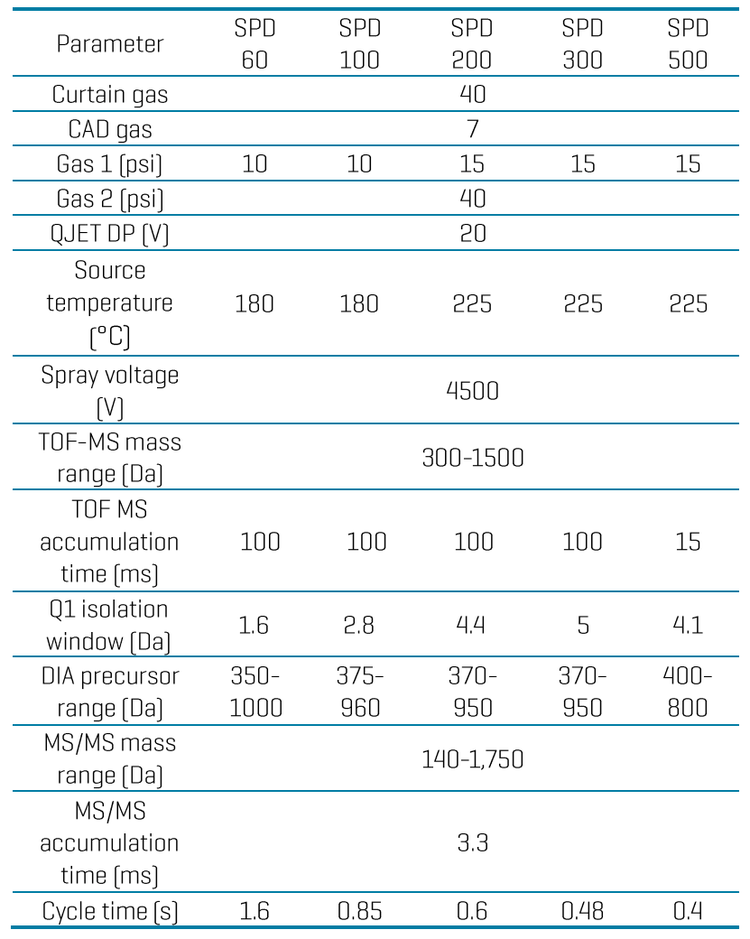
Mass spectrometry: Sample analysis was performed on a ZenoTOF 8600 system, using the microflow probe. ZT Scan DIA 3.0 methods were optimized for each throughput, keeping the MS/MS accumulation time at 3.3 ms and ensuring an average of approximately 5 scans per chromatographic peak to achieve optimal quantitation. Ion source and MS method parameters for the different throughput methods are listed in Table 2. Collision-induced dissociation fragmentation was used with the SCIEX OS software default dynamic collision energy calculation for peptides based on charge state 2. All data was acquired with Zeno trap pulsing enabled.
Data processing: Data were processed with PEAKS Studio software (version 13.5), using a K562/HeLa spectral library and DIA search settings as previously described (4). Only replicate data files for a given loading/experiment were searched together. The number of quantifiable protein groups and precursors with a CV ≤ 20% were calculated for those identified across all 4 replicate injections.

Scaling proteome depth and throughput with ZT Scan DIA 3.0
Figure 1 summarize s the numbers of identified and quantified protein groups and precursors, respectively,from 50 ng of K562 digest using ZT Scan DIA 3.0 MS methods optimized for each SPD throughput. For optimization, the MS/MS accumulation time was set to 3.3 ms , and the sliding Q1 precursor isolation window width was adjusted to maintain a cycle time low enough to achieve an average of 5 scans per chromatographic peak for precise quantitation. Figure 1 shows that the narrower isolation widths used in the lower-throughput methods resulted in the highest numbers of identified and quantifiable proteins. However, throughput could be increased by> 8-fold with only a minimal decrease in the number of proteins identified and quantified. At 500 SPD, 5,793 protein groups were identified, of which 4,579 were quantifiable at ≤ 20% CV, while 60,791 precursors were identified, of which 32,648 were quantifiable across all replicate injections.
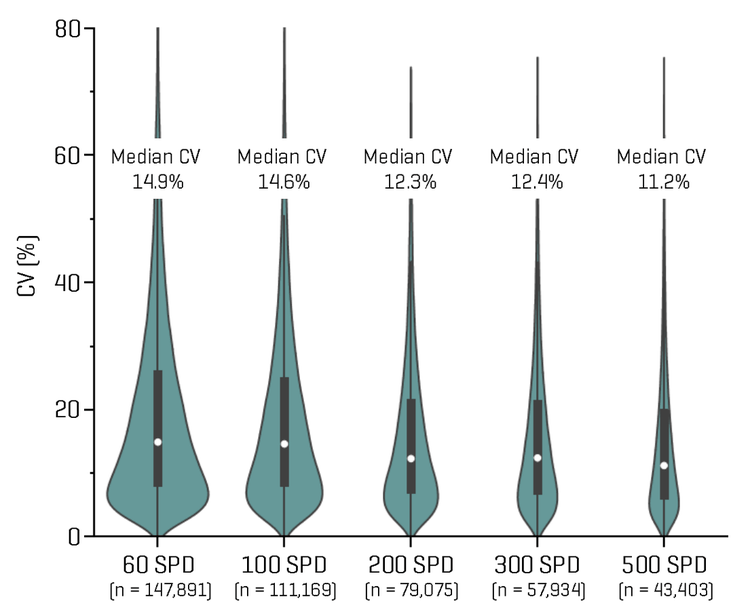
Figures 2 and 3 show the distribution of % CVs for both protein groups and precursors, respectively,across the different throughput methods. The low median % CVs illustrate the precision and reproducibility of the ZenoTOF 8600 system with ZT Scan DIA 3.0 acquisition, even at very high throughput.
Conclusions
In high-throughput workflows, the goal is not just speed—but depth normalized to instrument time. Using ZT Scan DIA 3.0, the results in this technical note show that high -throughput discovery proteomics no longer requires the same trade-off between speed and data quality, enabling faster, large-scale studies with strong proteome coverage and reproducible quantitation.
- ZT Scan DIA 3.0 on the ZenoTOF 8600 system supports scalable method optimization across high-throughput conditions, using Q1 scanning isolation widths from 1.6 to 5.0 Th to balance proteome depth, selectivity, and quantitative performance.
- Across the 60–500 SPD throughput range, ZT Scan DIA 3.0 preserved deep proteome coverage for identified protein groups at 500 SPD ( 5,793 vs. 9,268 at 60 SPD) with a potential >8-fold increase in throughput.
- Increasing throughput from 60 to 500 SPD maintained broad quantifiable proteome depth, with 4,579 quantifiable protein groups at CV ≤ 20% across four technical replicates compared with 7,345 at 60 SPD.
- Narrow, scanning Q1 isolation windows down to 1 Th reduces spectral interference and supports the preservation of proteome depth together with reproducible precursor- and protein-level quantitation across acquisition speeds.
- ZT Scan DIA 3.0 provides a scalable path from deep discovery proteomics to high-throughput quantitative workflows, helping large-cohort and translational studies increase sample turnover with deep biological insights.
References
- Achieving deep quantitative proteome coverage from sub-nanogram sample loadings using Whisper Zoom and Zeno SWATH DIA on the ZenoTOF 8600 system. SCIEX technical note, MKT-35259-A
- Advances in high-throughput quantitative proteomics powered by high-sensitivity data-independent acquisition on the ZenoTOF 8600 system. SCIEX technical note, MKT34848-A
- Continuing the data independent acquisition (r)evolution: Introducing ZT Scan DIA for quantitative proteomics. SCIEX technical note, MKT-31819-A
- Unlocking deeper DIA performance with empirical spectral libraries generated using ZT Scan DIA 3.0 on the ZenoTOF 8600 system. SCIEX technical note, MKT-39246-A.