Abstract
This technical note demonstrates the performance of the ZenoTOF 8600 system for short gradient, high-throughput label-free proteomics, as evaluated within a community-driven LFQ benchmark framework. The study directly compares Zeno SWATH DIA and ZT Scan DIA 2.0 across different LC flow rates using sub-15-minute gradients, revealing differences in proteome coverage and quantitative performance. Using just 50 ng of input material, the results highlight robust quantitative accuracy, precision, and reproducibility, underscoring the suitability of the ZenoTOF 8600 system for reliable LFQ analyses beyond simple identification metrics.
Key features of the ZenoTOF 8600 system supporting DIA- based LFQ proteomics
- Exceptional sensitivity: Zeno trap-activated methods available on the ZenoTOF 8600 system enable efficient ion utilization and high MS/MS duty cycle. By using ZT Scan DIA 2.0 on a 50 ng loading of hybrid proteome digest, >10,900 protein groups and >121,000 precursors were identified using a 15-minute nanoflow gradient.
- Superior quantitation: ZT Scan DIA 2.0 boosts quantifiable protein groups and precursors by 10% compared to traditional variable-window DIA methods, while improving quantitative accuracy and precision.
- Simplified flow-rate flexibility: The SCIEX Optiflow Pro ion source on the ZenoTOF 8600 system accommodates multiple LC flow regimes through simple probe switching .
Introduction
The reliable identification and accurate quantification of protein biomarkers are essential for elucidating disease mechanisms and understanding changes in biological pathways. Data-independent acquisition (DIA) workflows implemented on high-resolution mass spectrometry (HR -MS) platforms have become widely adopted in proteomics due to their ability to deliver comprehensive, reproducible qualitative and quantitative information across complex samples. DIA is well-suited for label-free quantitation (LFQ) workflows, which offer practical advantages over protein or peptide labeling strategies.
While the number of peptide and protein identifications is often used as a primary performance metric, quantitative precision and accuracy are equally critical—especially for the reliable measurement of low-abundance proteins. In many workflows, limited MS/MS sensitivity and inefficient ion utilization constrain quantitative performance, resulting in reduced accuracy and increased variability at lower signal levels.
The ZenoTOF 8600 system addresses these challenges through enhanced ion transmission and improved duty cycle efficiency, which have been shown to substantially improve protein identification, quantitative performance, and overall proteome coverage, enabling the detection and robust quantification of low-abundance proteins that were previously inaccessible (1). ZT Scan DIA methods on the ZenoTOF platforms employ a continuously scanning quadrupole for precursor isolation, preserving precursor–fragment correlation while improving ion utilization efficiency (2). This approach has been demonstrated to deliver improved qualitative and quantitative performance compared with discrete, variable-window DIA methods, including Zeno SWATH DIA (3,4).
Methods
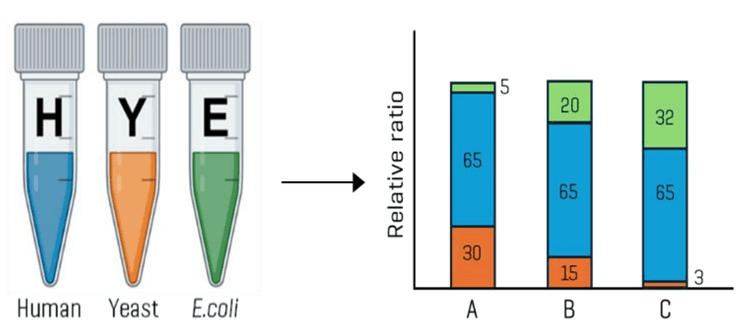
Sample preparation: Human K562 (Promega), yeast (Promega) and E.coli (Waters) lysate tryptic digests were diluted in buffer containing 0.1% formic/5% acetonitrile in water. Following the approach described by Navarro et al. (5), two master samples (A and B), were prepared. Sample A consisted of human, yeast, and E. coli digests mixed at 65%, 30%, and 5% weight /weight (w/w), respectively (Figure 2). Sample B was formulated by combining human, yeast, and E. coli protein digests at 65%, 15%, and 20% w/w, respectively. Additionally, a third mixture, Sample C, was created with human, yeast, and E. coli protein digests at 65%, 3%, and 32% w/w, respectively, to assess the impact of larger ratio differences on analytical performance. Sample injection order was performed using a standardized scheme, in which replicates of the same sample were intentionally interspersed rather than measured consecutively to minimize batch effects .
Chromatography: Chromatographic separations at all flow rates were performed using a Waters M Class system (Waters Corporation, USA), with six replicate injections acquired for each condition.
Nanoflow (0.25 µL/min) chromatography
An IonOpticks Aurora XS Ultimate C18 nanoflow column (25 cm × 75 µm ID) (IonOpticks, Australia), maintained at 50 °C, was used for all nano analyses. The LC gradient was applied as follows: an initial hold at 3% mobile phase B for 18 min, followed by a linear increase from 3% to 35% mobile phase B over either 15- or 30-min. Mobile phase B was then ramped to 65% over 2 min and further increased to 80% over 1 min. The column was washed at 80% mobile phase B for 4 min and subsequently re-equilibrated at 1% mobile phase B for 15 min.
Microflow (1.5 µL/min) chromatography
An Evosep EV1109 (Evosep, Denmark) column (8 cm × 150 µm ID), maintained at 40 °C, was used for the 1.5 µL/min analyses. The LC gradient was applied as follows: an initial hold at 1% mobile phase B for 4 min, a linear gradient from 1% to 30% mobile phase B was applied over 11.5 min. Mobile phase B was then ramped to 80% over 0.5 min. The column wash at 80% mobile phase B was maintained for 2 min and followed by re-equilibration at 1% mobile phase B for 2 min.
Microflow (5 µL/min) chromatography
A Kinetex XB- C18 (Phenomenex, USA) column (15 cm × 300 µm ID), maintained at 35 °C, was used for the 5 µL/min analyses. Following an initial hold at 3% mobile phase B for 1 min, a linear gradient from 3% to 30% mobile phase B was applied over either 5- or 15-min. Mobile phase B was then ramped to 80% over 1 min. The column wash at 80% mobile phase B was maintained for 2 min and followed by re-equilibration at 3% mobile phase B for 7min.
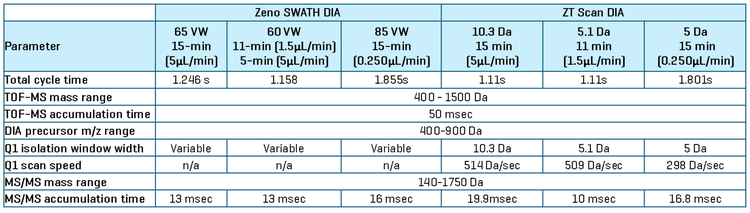
Mass spectrometry:Sample analysis was performed on a ZenoTOF8600 and ZenoTOF 7600+ system, using the vertical microflow probe (1–10 µL/min) for microflow experiments and the horizontal nanoflow probe for nanoflow experiments. Ion source parameters differed depending on the applied flow rate. Three different Zeno trap-enabled DIA methods were tested with precursor isolation range 400 -900 Da: (A) Zeno SWATH DIA (using 85 variable SWATH windows), (B) a ZT Scan DIA 2.0 method with a Q1 isolation window of 5.3 Da, and (C) a ZT Scan DIA 2.0 method with a Q1 isolation window of 10.8Da. The DIA method parameters are described in Table 1. Zeno trap-activation was used for all MS/MS experiments.
Nanoflow (0.25 µL/min) mass spectrometry
Source parameters included a g as 1 setting of 10 psi, a curtain gas setting of 35, an ionspray voltage setting of 2100 V, and an interface temperature of 250 °C.
Microflow (1.5 µL/min) mass spectrometry
Source parameters included a g as 1 setting of 10 psi, Gas 2 setting of 20 psi, a curtain gas setting of 35, an ionspray voltage setting of 5000 V, and an interface temperature of 100 °C.
Microflow (5 µL/min) mass spectrometry
Source parameters included a g as 1 setting of 20 psi, Gas 2 setting of 60 psi, a curtain gas setting of 35, an ionspray voltage setting of 5000 V, and an interface temperature of 200 °C.
Data processing:The wiff data files were processed with DIA-NN software v1.9.1 (6) and PEAKS Studio v13.1, using a library-free, i.e. a predicted spectral library, search with DIA search settings as previously described (7). All replicate data files for a given experiment/flow rate were searched together. The resulting output files were analyzed using custom -made scripts (7), to determine the total quantifiable protein groups and precursors.
ZT Scan DIA unlocks deeper, more precise quantification with increased accuracy
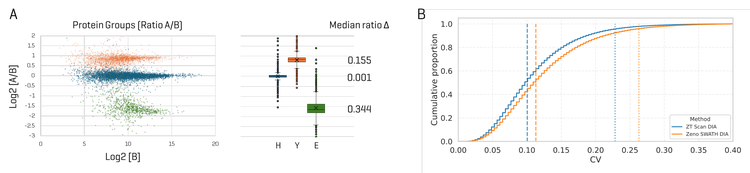
Figure 3A compares the quantitative performance of Zeno SWATH DIA and ZT Scan DIA using a 15-minute nanoflow LC gradient at 250 nL/min on the ZenoTOF8600 system. In Figure 3A, the MA plot for the ZT Scan DIA data illustrates the expected quantitative behavior of the hybrid proteome containing the 3-species mixture. Protein groups originating from Human are centered around a log₂FC of approximately 0, reflecting equal abundance between Conditions A and B, while E. coli proteins cluster around a log ₂FC of approximately −2 and Yeast proteins around +1, consistent with the predefined mixing ratios. The clear separation of these species across the intensity range demonstrates accurate ratio discrimination. The inset further summarizes this performance by showing that the median deviation of the observed log₂FC values from the expected ratios is close to zero, indicating that ZT Scan DIA accurately quantifies fold change differences between Conditions A and B without introducing systematic bias across species or abundance levels .
Figure 3B illustrates the impact of the DIA acquisition strategy on quantitative precision, expressed as the coefficient of variation (%CV) for quantified precursors, measured using 15-minute nanoflow LC gradients. The cumulative %CV distributions show a clear shi ft toward lower variability for ZT Scan DIA compared to Zeno SWATH DIA, indicating improved precision across quantified precursors. 50% of measurements obtained with ZT Scan DIA 2.0 exhibit %CV values lower than 10%, demonstrating more consistent quantification across replicates than Zeno SWATH DIA (11%). These results highlight that, in addition to increasing quantitative depth, ZT Scan DIA 2.0 delivers enhanced precision, supporting more reliable and reproducible LFQ measurements.
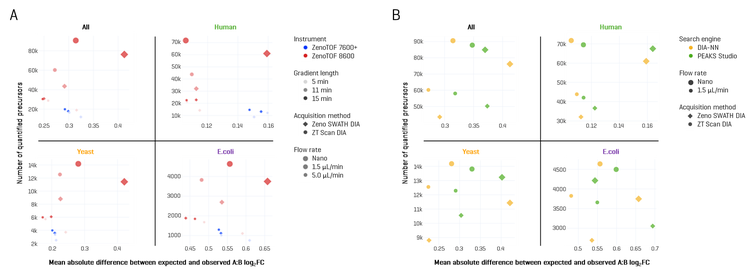
Figure 1A examines the relationship between the number of quantified precursors and quantitative accuracy, across the ZenoTOF 7600+ and ZenoTOF 8600 systems at different flow rates using a consistent evaluation framework. Quantitative accuracy is defined as the me an absolute deviation from the expected log₂ fold change (log₂FC) between Conditions A and B, calculated separately for each species and as an average across all species. ZT Scan DIA 2.0 quantifies more precursors than Zeno SWATH DIA, with improved quantitative accuracy across all flow rates, demonstrating that increased quantitative depth is accompanied by enhanced agreement with expected ratios rather than increased error.
Figure 1B compares the number of quantified precursors and quantitative accuracy for data obtained with the ZenoTOF 8600 system with 15-minute nanoflow gradients, using either DIA-NN software v1.9.1 or PEAKS Studio software v13.1. Slight variations between the numbers of quantified precursors and the quantitative accuracies are observed, owing to the different algorithms employed by these software packages.
The ZenoTOF 8600 system supports multiple LC flow rates through straightforward probe switching
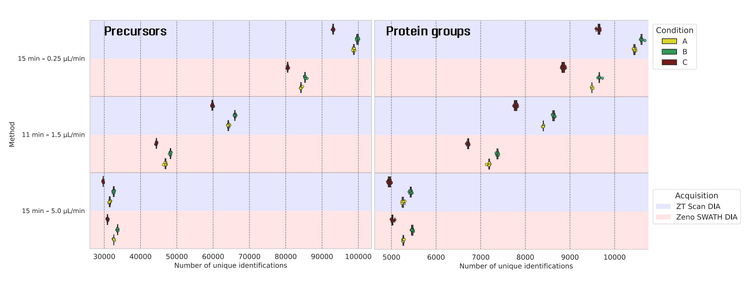
Figure 4 illustrates how both LC flow rate and DIA acquisition strategy influence identification performance on the ZenoTOF8600 system. Across all conditions, a clear inverse relationship is observed between flow rate and the number of identified precursors and protein groups, with performance improving as flow rate decreases from microflow (5.0 µL/min) to low microflow (1.5µL/min) and further to nanoflow conditions (250 nL/min).
This trend is consistent for both Zeno SWATH DIA and ZT Scan DIA, demonstrating that reduced flow rates enhance identification efficiency independent of the DIA methodology employed. Notably, when moving from 5.0 to 1.5µL/min, ZT Scan DIA shows a pronounced increase, with approximately 100% more precursors and 50% more protein groups identified.
Further reducing the flow rate to 250 nL/min results in substantially larger gains: Zeno SWATH DIA yields approximately 160% more precursors and 80% more protein groups, while ZT Scan DIA achieves even greater improvements, with 210% more precursors and 9 5% more protein groups compared to microflow at 5.0 µL/min on the same system . These gains are most pronounced at the precursor level, consistent with improved ionization efficiency and reduced ion suppression at lower flow rates, while increases at the protein group level are more moderate due to redundancy in peptide to protein mapping.
Conclusions
- Robust DIA-based LFQ under high throughput conditions: The ZenoTOF8600 system delivers accurate and reproducible DIA-based label-free quantification using 15-minute microflow or nanoflow gradients and just 50 ng of input material.
- Quantitative depth without compromise: Gains in quantified precursors and protein groups achieved, especially with ZT Scan DIA 2.0 on the ZenoTOF 8600 system, are accompanied by stable or improved quantitative precision and accuracy, enabling confident LFQ beyond simple identification metrics.
- Flow rate-dependent performance gains: Reducing LC flow rates from microflow to nanoflow conditions significantly increases precursor and protein group identifications, with ZT Scan DIA 2.0 consistently delivering the largest gains across all flow regimes.
References
- Heymann, T., et al. (2026). Scanning DIA on the ZenoTOF 8600 system enables ultra-sensitive and quantitative proteomics from single cells to post-translational modifications in a compact platform. bioRxiv, https://doi.org/10.64898/2026.03.12.711261.
- Continuing the data independent acquisition (r)evolution: Introducing ZT Scan DIA for quantitative proteomics. SCIEX technical note, MKT-31819-A.
- Achieving deep quantitative proteome coverage from sub - nanogram sample loadings using Whisper Zoom and Zeno SWATH DIA on the ZenoTOF 8600 system. SCIEX technical note, MKT-35259-A.
- Advances in high -throughput quantitative proteomics powered by high-sensitivity data-independent acquisition on the ZenoTOF 8600 system. SCIEX technical note, MKT34848-A.
- Navarro, P., et al. (2016). A multicenter study benchmarks software tools for label-free proteome quantification. Nature Biotechnology, 34:1130-1136.
- Demichev et al. (2020). DIA-NN: neural networks and interference correction enable deep proteome coverage in high throughput. Nature Methods, 17:41- 44.
- Van Puyvelde, B., et al. (2026). LFQ Benchmark Dataset - Generation Beta: Assessing Modern Proteomics Instruments and Acquisition Workflows with High-Throughput LC Gradients. bioRxiv, https://doi.org/10.64898/2026.01.29.702266.