Abstract
This technical note describes label-free quantitation (LFQ) proteomics analysis of complex lysate digest mixtures using a narrow-window ZT Scan DIA 3.0 workflow on the ZenoTOF 8600 system. Utilizing a scanning Q1 precursor isolation window of 2 Da width, >13,600 total protein groups and >290,000 precursors were identified from 200 ng injections of a mix of human/yeast/E. coli lysate digests with a 38-minute active nanoflow gradient, representing a 16% and 39% increase in identifications, respectively, compared to discrete-window DIA methods on the same system. ZT Scan DIA 3.0 demonstrates exceptional quantitative reproducibility and improved LFQ accuracy, underscoring the ZenoTOF 8600 system’s strength for quantitative analysis of complex proteomics samples in biomarker research.
Key features of FQ proteomics using ZT Scan DIA 3.0 on the ZenoTOF 8600 system
- Deeper proteome coverage: Using ZT Scan DIA 3.0, >1 3,600 protein groups and >290,000 precursors were identified from 200 ng of hybrid proteome lysate mixtures, representing increases of 16% and 39%, respectively, over discrete-window DIA methods.
- Superior quantitative precision and accuracy: ZT Scan DIA 3.0 improved the quantitative accuracy with respect to expected LFQ ratios, with extremely high precision, enabling both the confident identification AND quantitation of protein/peptide biomarkers.
- Exceptional versatility: ZT Scan DIA 3.0 enhances the established flexibility of ZT Scan DIA methods available on the ZenoTOF 8600 system, allowing precursor isolation window widths to be set as narrow as 1 Da.
Introduction
Disease biomarker research involves the investigation of complex biological pathways, where proteins are key functional components. Accurate and precise methods for identifying and quantifying proteins and peptides are therefore critical to these efforts. Data-independent acquisition (DIA) using mass spectrometry (LC-MS) is a widely used technique for proteomics research and is ideally suited for the label-free quantitation (LFQ) of proteins and peptides. LC-MS instrument sensitivity and dynamic range influence the limits of quantitative identification of proteins and peptides in complex samples. As such, researchers continuously seek ways to optimize their workflows and acquisition strategies to improve identification depth and quantitative performance.
ZT Scan DIA is a method that combines the Zeno trap and a continuously scanning quadrupole for precursor isolation, improving both qualitative and quantitative performance relative to discrete-window DIA methods, i.e., Zeno SWATH DIA (1). Recent innovations expanded the utility of ZT Scan DIA by increasing flexibility in mass range and scan speed (ZT Scan DIA 2.0) (2-4).
ZT Scan DIA 3.0 further expands the scope and flexibility of these methods by enabling precursor isolation windows as narrow as 1 Da. Selectivity is increased by narrowing the scanning Q1 precursor isolation window and reducing the number of chimeric MS/MS spectra, resulting in higher-confidence peptide sequence assignments (5,6).
This work demonstrates the application of narrow-window ZT Scan DIA 3.0 methods for label-free quantitation of complex lysates. Using 2 Da isolation windows, significant improvements are shown in protein group and precursor identifications, as well as quantitative accuracy, compared with discrete-window DIA methods.
Methods
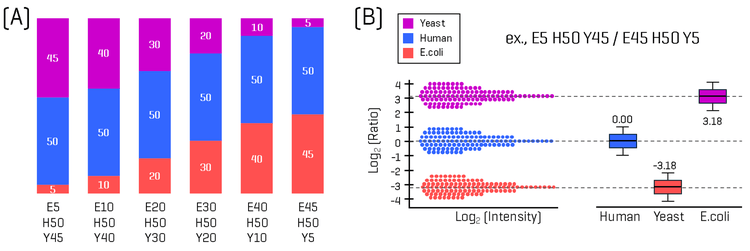
Sample preparation:Human K562 and yeast lysate tryptic digests were purchased from Promega. E. coli lysate tryptic digest was purchased from Waters. Lysates were diluted in buffer containing 0.1% formic acid in water and mixed at defined ratios to create 6 sample mixtures (F igure 1). The total protein concentration of each mixture was 200 ng/ µL.
Chromatography: Chromatographic separations were performed on a Waters M-Class UHPLC system with an IonOpticks Aurora Ultimate XS C18 nanoflow column (25 cm x 0.075 mm), using direct-injection mode. Mobile phase A was 0.1% formic acid in water, and mobile phase B was 0.1% formic acid in acetonitrile. The flow rate used was 250 nL/min. The chromatographic gradient used was as follows: initial sample loading for 20 minutes at 3% B, 3-8% B over 2 minutes, 8-28% B over 32 minutes, 28-45% B over 4 minutes, 45-85% B over 2 minutes, holding 85% B for 5 minutes, 85-3% B over 3 minutes, followed by re-equilibration at 3% B for 17 minutes (total run time 85 minutes). The LC column was heated to 50°C for all analyses. Injection volumes were 1 µL (200 ng injection loads). Each sample mixture was analyzed in triplicate for each DIA method.
Mass spectrometry: Sample analysis was performed on a ZenoTOF 8600 system, using the horizontal nanoflow probe. Ion source parameters included a gas 1 setting of 10, curtain gas setting of 35, ionspray voltage setting of 2100 V, and interface temperature of 250 °C. Samples were analyzed using either Zeno SWATH DIA (85 variable-width windows) or ZT Scan DIA 3.0. Both methods used a TOF-MS scan from 400-1500 Da (50 msec) and MS/MS with precursor isolation ranges 400-900 Da and TOF MS/MS mass ranges 140-1,750 Da. The Zeno SWATH DIA method used 18 msec for the MS/MS accumulation times. The ZT Scan DIA 3.0 method used a Q1 window width of 2 Da with a scan rate of 296 Da/sec, and MS/MS accumulation times of 6.8 msec. The overall scan cycle time for both methods was 1.8 sec. Dynamic collision energy and Zeno trapping were used for all MS/MS experiments.
Data processing: Data files (.wiff2) were processed with PEAKS Online software 13, using library-free searches against a FASTA database comprising canonical human, yeast, and E. coli protein sequences downloaded from Uniprot.org. Combined data files for a given DIA method (i.e. 18 files each for Zeno SWATH DIA and ZT Scan DIA 3.0, resp ectively) were searched together, with MBR enabled and normalization turned off.
Enhancements in quantifiable protein group and precursor identifications using ZT Scan DIA 3.0
To demonstrate the LFQ workflowon the ZenoTOF 8600 system, 6 different mixtures of human, yeast, and E. coli digests were prepared (Figure 1). Each mixture contains the same proportion of human lysate digest, while varying in the proportion of yeast and E. coli digest present, all while maintaining the same tota l amount of protein (200 ng/µL). The goal of the experiment is to analyze each mixture to determine (i) the number of identifiable and quantifiable protein groups, by species and in aggregate, (ii) the number of identifiable and quantifiable precursors, and (iii) to calculate protein group abundance ratios for each species from defined mixture pairs. Protein group abundance ratios are plotted as the Log2(Ratio) against the Log2(Intensity). Ideally, the distribution of Log2(Ratio) should be as narrow as possible, with the median value as close as possible to the theoretical ratio value to demonstrate high LFQ accuracy. LFQ accuracy is reported as the deviation of this median value from the expected ratio for each species in each pairwise comparison. Figure 1 shows an idealized example of the Log2(Ratio)/Log2(Intensity) plot, for the pairwise comparison of sample E5 H50 Y45 versus E45 H50 Y5. In this case, the expected Log2(Ratio) for yeast, human, and E. coli should be +3.18, 0.00, and -3.18, respectively.
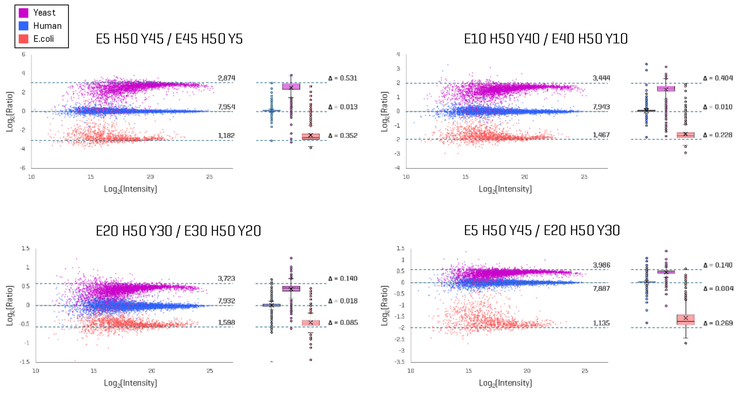
The other pairwise sample comparisons were E10 H50 Y40 versus E40 H50 Y10 (having the expected Log2(Ratio) for yeast, human, and E. coli as +2.00, 0.00, and -2.00, respectively), E20 H50 Y30 versus E30 H50 Y20 (having the expected Log2(Ratio) for yeast, human, and E. coli as +0.58, 0.00, and -0.58, respectively), and E5 H50 Y45 versus E20 H50 Y30 (having the expected Log2(Ratio) for yeast, human, and E. coli as +0.58, 0.00, and -2.00, respectively). By having multiple pairwise comparisons, LFQ accuracies can be determined across different dynamic ranges.
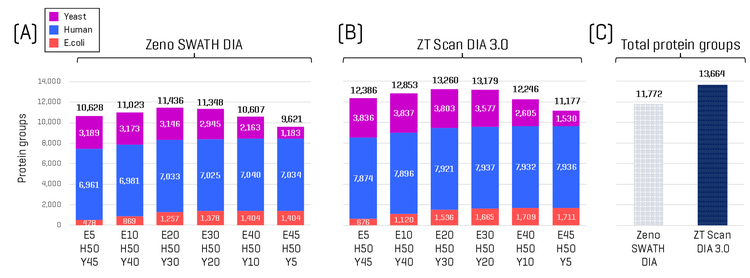
Figure 2 summarizes the number of protein groups identified in each mixture (by species, or aggregate), using either ZenoSWATH DIA or ZT Scan DIA 3.0. The numbers shown in the bar graphs represent protein groups identified in all 3 replicates for each sample with no missing values. Identifications increased substantially for all mixtures and all species within each mixture using ZT Scan DIA 3.0, with gains ranging from 13-17% for human, 16-49% for yeast, and 21-49% for E. coli. Aggregate protein groups (i.e. identified across all replicates and samples) also increased from 11,772 to 13,664 using ZT Scan DIA 3.0, an increase of 16%.
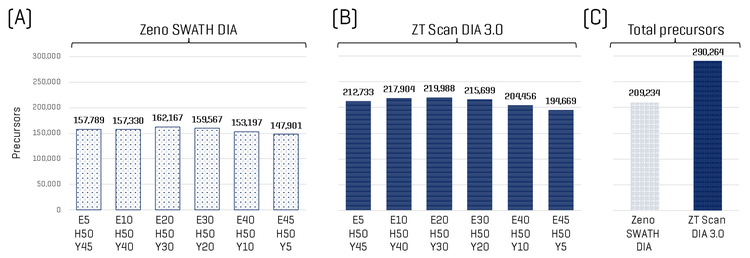
The gains in precursor identifications using ZT Scan DIA 3.0 versus Zeno SWATH DIA are even more apparent (Figure 3). For the different mixtures, gains ranged from 31% to 66%. Aggregate precursors (i.e. identified across all replicates and samples) also increased from 209,234 to 290,264 using ZT Scan DIA 3.0, an increase of 39%.
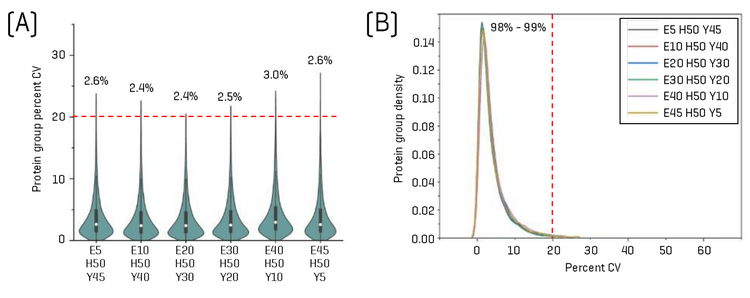
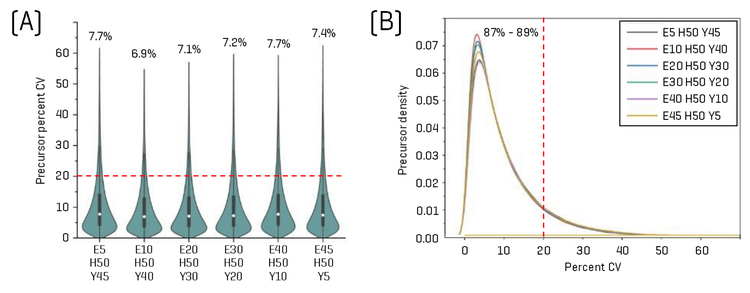
The high numbers of protein groups and precursors identified per mixture were achieved while maintaining exceptionally high quantitative reproducibility. Figures 4 and 5 show the CV distributions for identified protein groups and precursors, respectively. Both the violin plots (Figures 4A and 5A) and CV density plots (Figures 4B and 5B) show that most CVs are well below the accepted quantitation standard of 20%. For the identified protein groups, the median CV values ranged from 2.4% to 3.0%. For identified precursors, the median CVs ranged from 6.9% to 7.7%. The proportion of quantifiable protein groups and precursors—defined as those quantified in all 3 replicates per mixture with no missing values—was 98-99% and 87-89%, respectively. Together, these results strongly demonstrate the extremely high depth and quantitative precision achievable using ZT Scan DIA 3.0.
ZT Scan DIA 3.0 delivers outstanding quantitative accuracy for LFQ proteomics workflows
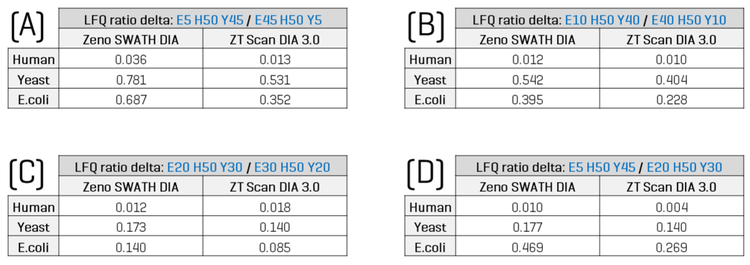
Figure 6 shows the protein group LFQ ratio plots for the 4 pairwise mixture comparisons (E5 H50 Y45 versus E45 H50 Y5; E10 H50 Y40 versus E40 H50 Y10; E20 H50 Y30 versus E30 H50 Y20; and E5 H50 Y45 versus E20 H50 Y30). The theoretical ratios for each species in each of the 4 plots are indicated. For each plot, the number of protein groups quantified in that pairwise comparison (defined as those quantified in all 6 replicates with no missing values) is shown. The box-and-whisker plots summarize the LFQ ratio distributions and median values. The deviation of the median value from the theoretical ratio value is shown for all species, representing the observed LFQ accuracies. The results demonstrate that high numbers of quantifiable protein groups were achieved across all replicates.
Conclusions
- ZT Scan DIA 3.0 delivers gains in identifiable protein groups and precursors of 16% and 39%, respectively, compared with discrete-window DIA methods, when analyzing 200 ng loadings of complex proteome mixtures.
- The increased depth of proteomic identifications using ZT Scan DIA 3.0 is achieved while maintaining exceptional quantitative reproducibility, with median CV values <3.0% for protein groups and <8.0% for precursors in this study.
- The high selectivity of using narrow Q1 isolation windows (2 Da width) with ZT Scan DIA 3.0 improves quantitative accuracy for LFQ workflows relative to discrete-window DIA methods on the ZenoTOF 8600 system.
- ZT Scan DIA 3.0 enables users to create optimized methods for a broad range of applications by defining the desired Q1 window widths, scan speeds, and mass ranges.
References
- Continuing the data independent acquisition (r)evolution: Introducing ZT Scan DIA for quantitative proteomics. SCIEX technical note, MKT-31819-A.
- Achieving deep quantitative proteome coverage from sub-nanogram sample loadings using Whisper Zoom and Zeno SWATH DIA on the ZenoTOF 8600 system. SCIEX technical note, MKT-35259-A.
- Advances in high-throughput quantitative proteomics powered by high-sensitivity data-independent acquisition on the ZenoTOF 8600 system. SCIEX technical note, MKT-34848-A.
- Van Puyvelde, B., et al. (2026). LFQ Benchmark Dataset - Generation Beta: Assessing Modern Proteomics Instruments and Acquisition Workflows with High-Throughput LC Gradients. bioRxiv, https://doi.org/10.64898/2026.01.29.702266.
- ZT Scan DIA 3.0: A data-independent acquisition (DIA) method with high resolution precursor selection improves protein identification and quantitation for proteomics research. SCIEX technical note, MKT-38093-A.
- Heymann, T., et al. (2026). Scanning DIA on the ZenoTOF 8600 system enables ultra -sensitive and quantitative proteomics from single cells to post -translational modifications in a compact platform. bioRxiv, https://doi.org/10.64898/2026.03.12.711261.