Abstract
This technical note demonstrates how the combination of gas-phase fractionation and ZT Scan DIA 3.0 on the ZenoTOF 8600 system enables faster generation of deep empirical spectral libraries that enhance the performance of downstream DIA data analysis. By supporting Q1 isolation widths as narrow as 1 Da, ZT Scan DIA 3.0 delivers exceptional precursor selectivity and high-quality MS/MS spectra, maximizing peptide and protein identifications. When coupled with gas-phase fractionation, this approach provides a streamlined alternative to traditional offline fractionation workflows, enabling the efficient creation of high-coverage spectral libraries with no additional sample preparation. The resulting libraries substantially improve protein group and precursor identifications compared with library-free processing approaches, allowing researchers to achieve deeper proteome coverage, greater quantitative confidence, and maximum analytical performance from the ZenoTOF 8600 system.
Key features of spectral libraries generated using ZT Scan DIA 3.0 on the ZenoTOF 8600 system
- Ultra-selective DIA for deeper library generation: ZT Scan DIA 3.0 supports Q1 isolation widths as narrow as 1 Da, delivering unit-resolution precursor selectivity to maximize peptide and protein identifications.
- Rapid generation of deep empirical spectral libraries: By combining gas-phase fractionation with narrow-window ZT Scan DIA 3.0, researchers can build high-coverage spectral libraries efficiently, eliminating the need for labor-intensive off-line fractionation workflows.
- Improved DIA data processing performance: Empirical spectral libraries generated using gas-phase fractionation and ZT Scan DIA 3.0 increased protein group and precursor identifications by up to 48% compared to library-free DIA processing approaches, enabling deeper and more confident proteome characterization.
Introduction
Mass spectrometry using data-independent acquisition (DIA) has become a cornerstone technology for quantitative proteomics, offering simplified method development, comprehensive proteome coverage, and robust qualitative and quantitative measurements. While advances in DIA acquisition continue to expand analytical performance, the software tools and data processing strategies used to interpret DIA data remain critical determinants of the final results. DIA datasets are commonly processed using either library-free workflows or spectral library-based approaches. Library-free searching tools and algorithms continue to evolve rapidly and offer the convenience of eliminating the need for pre-existing spectral libraries. However, empirical spectral libraries—built from experimentally observed precursor and fragment ion evidence—are widely recognized for providing greater depth, confidence, and consistency in peptide and protein identification (1).
A key challenge associated with empirical spectral libraries is the effort required to generate them. Traditional workflows often rely on time- consuming off-line fractionation strategies, such as high-pH fractionation, followed by multiple LC-MS analyses to achieve sufficient depth. Gas-phase fractionation (GPF) provides an attractive alternative by dividing the precursor m/z space into multiple narrower windows and analyzing each range separately across sequential runs , thereby reducing spectral complexity and enabling deeper coverage without additional sample preparation steps (2).
In this technical note, GPF is combined with ZT Scan DIA 3.0 on the ZenoTOF 8600 system to generate deep empirical spectral libraries for DIA data processing. ZT Scan DIA uses a continuously scanning quadrupole for precursor isolation, combined with Zeno trapping for enhanced MS/MS sensitivity (3). With ZT Scan DIA 3.0, Q1 isolation widths can be configured as narrow as 1 Da, delivering exceptional precursor selectivity and DDA-like MS/MS spectral quality to maximize peptide and protein identifications (4-6). Using this approach, deep spectral libraries were generated for both human lysate digests (K562 and HeLa) and a hybrid human/yeast/E.coli (HYE) proteome. The resulting libraries were evaluated using multiple DIA datasets acquired across different sample loadings, chromatographic configurations, and instrument platforms, including both the ZenoTOF 8600 and ZenoTOF 7600+ systems. When used for data processing in PEAKS Studio software, these empirical spectral libraries consistently increased the number of identified and quantified protein groups and precursors compared with library-free approaches. The results demonstrate a practical workflow for rapidly generating deep, application-specific spectral l ibraries using GPF and ZT Scan DIA 3.0, enabling users to maximize proteome coverage and quantitative performance without the need for labor-intensive off-line fractionation.
Methods
Sample preparation: Human K562 and yeast lysate tryptic digests were purchased from Promega. E.coli lysate tryptic digests were purchased from Waters. Human HeLa lysate tryptic digest was purchased from Pierce. Lysate digest dilutions were prepared in buffer containing 0.1% formic acid in water. Human (K562)/Yeast/E.coli (HYE) hybrid proteome lysates were mixed in 3 different weight-percent ratios as previously described ( 7). The hybrid proteome mixtures were pooled to create a standard reference sample and diluted to a concentration of 200 ng/ µL. For spectral library generation using gas-phase fractionation, 200 ng of sample was loaded for all injections .
Chromatography: For spectral library generation, separations were performed using a Waters M-Class UPLC system (Waters). An IonOpticks Ultimate Elite XS C18 nanoflow column (25 cm x 0.075 mm) was used, heated to 50 ºC. Samples were analyzed in direct-inject mode with a 38-min active gradient (85-min total run time) as described previously (4).
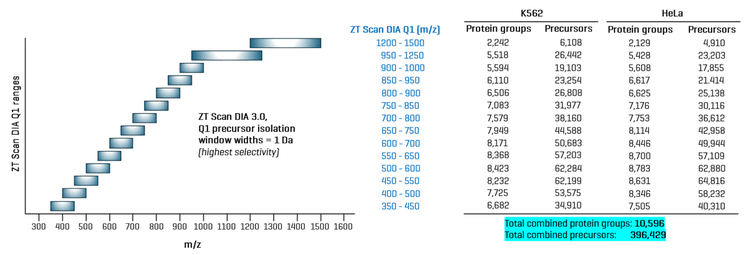
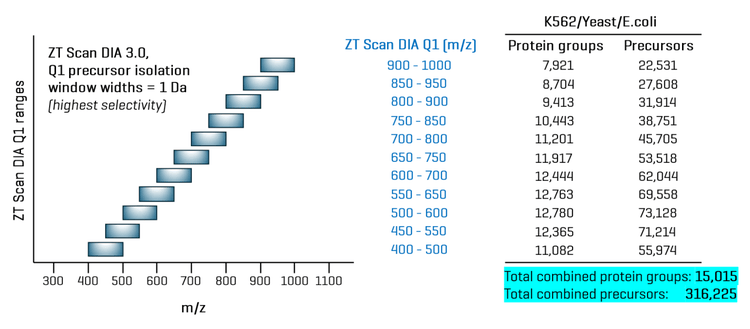
Mass spectrometry: Spectral libraries were generated using the ZenoTOF 8600 system equipped with the horizontal nanoflow probe. The ion source settings and ZT Scan DIA acquisition parameters used for library generation are summarized in Table 1. To perform gas- phase fractionation (GPF), the precursor mass range was divided into a series of discrete m/z windows. The GPF schemes used for the K562/HeLa digest and HYE hybrid proteome mixture are shown in Figures 1 and 2, respectively. The resulting spectral libraries were subsequ ently evaluated using previously acquired K562 and HYE datasets. These datasets were generated either on the ZenoTOF 8600 system coupled to the Evosep Eno system ( 8) or on the ZenoTOF 7600+ system coupled to the Waters M- Class UPLC system ( 9), as indicated for each experiment. These data were then used to assess the performance of the newly generated GPF spectral libraries for protein and precursor identification and quantitation.
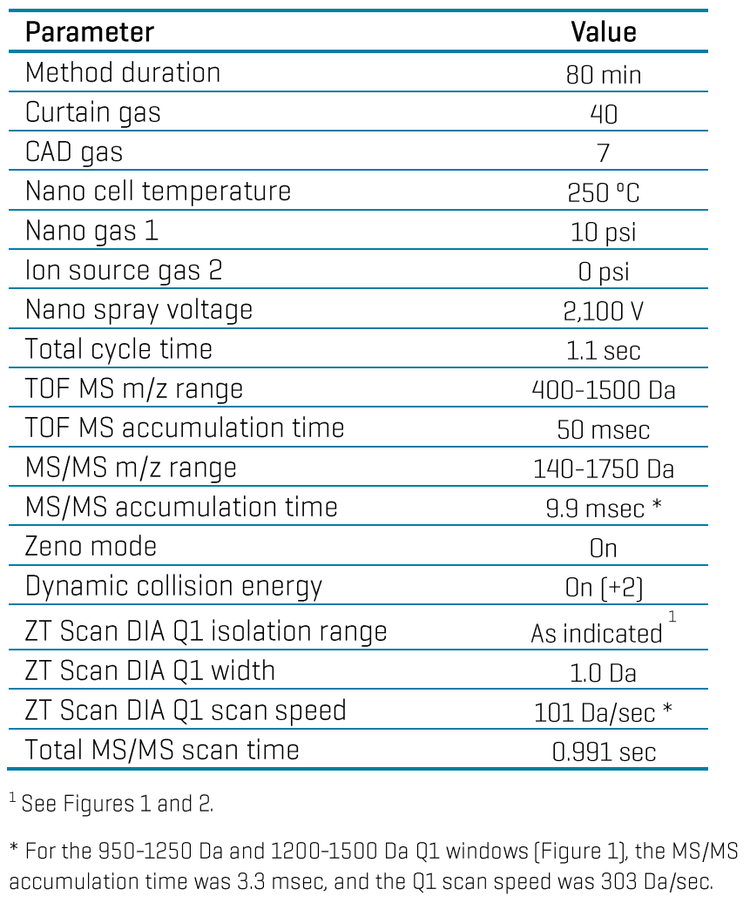
Data processing:PEAKS Studio software version 13.5 was used for all data processing.
Construction of Human and HYE spectral libraries from acquired ZT Scan DIA 3.0 data (1 Da Q1 window widths): Human K562 and HeLa ZT Scan DIA 3.0 GPF data were searched together against a FASTA containing canonical Human protein sequences, while HYE data were searched together against a FASTA comprising canonical Human, Yeast and E.coli protein sequences, all downloaded from Uniprot (https://www.uniprot.org/). For all searches, carbamidomethylation C was set as a fixed modification, while deamidation N/Q and oxidation M were set as variable modifications. Match Between Runs (MBR) was enabled for all analyses, and LFQ normalization was turned off.
Evaluation of the novel Human and HYE spectral libraries: Previously acquired K562 or HYE hybrid proteome mixture data was used to evaluate the novel spectral libraries ( 8,9). For a given instrument/on- column loading/sample concentration, triplicate data files were searched together, using either (i) the FASTA for the given sample (i.e., DB searches), (ii) the novel GPF spectral libraries appropriate for that sample (i.e., Lib searches), or (iii) combined library and FASTA (i.e., Lib + DB searches). Fixed and variable modifications were set as above. MBR was used, and LFQ normalization mode was set to TIC (RT dependent). The numbers of identified and quantified protein groups and precursors were determined from the exported Protein and Feature Vector LFQ exports, respectively.
Generation of deep spectral libraries using gas - phase fractionation and ZT Scan DIA 3. 0
K562 and HeLa lysate digests were analyzed using ZT Scan DIA 3.0 with 1 Da Q1 window widths to generate a deep empirical spectral library for downstream DIA data processing. To increase precursor coverage while reducing sample complexity per acquisition, a GPF strategy was used to divide the 350 -1,500 Da precursor range into the segments shown in Figure 1. The combined fractions (28 total) were processed together in PEAKS Studio software version 13.5 using a FASTA comprising canonical human protein sequences do wnloaded from Uniprot. Figure 1 summarizes the protein groups and precursors identified in each fraction. Across all runs, this workflow identified 10,596 protein groups and 396,429 precursors, which were exported as a spectral library for further testing.
A second empirical spectral library was generated using a pooled sample of HYE digest analyzed with ZT Scan DIA 3.0, again using methods with 1 Da Q1 window widths. For this hybrid proteome sample, the 400-1,000 Da precursor mass range was divided into 100 Da-wide fractions (11 total), as shown in Figure 2. The 11 fractions were processed together in PEAKS Studio software version 13.5 using a FASTA comprising canonical Human, Yeast, and E.coli protein sequences. Figure 2 summarizes the protein groups and precursors identified in each fraction. In total, 15,015 protein groups and 316,225 precursors were identified and exported as a second spectral library.
DIA data processing using empirical spectral libraries improves overall identifications in protein groups and precursors
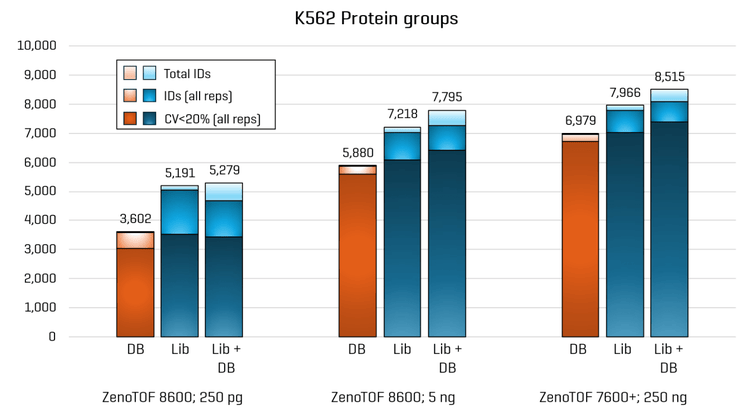
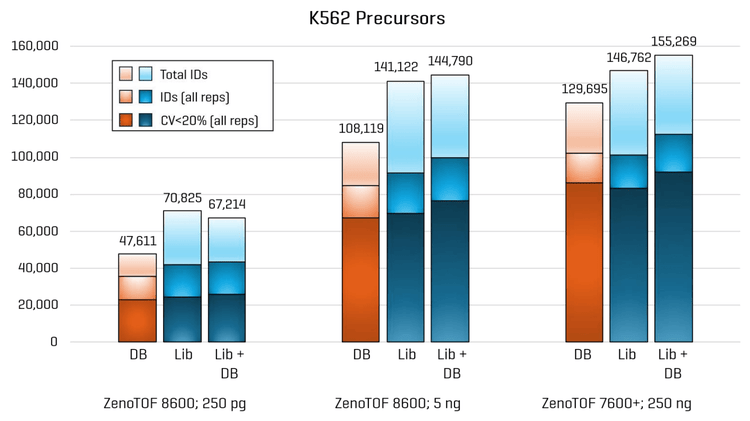
The novel K562/HeLa gas-phase fractionation spectral library was evaluated across multiple previously acquired K562 DIA datasets to assess its impact on protein group and precursor identifications. These datasets included (i) K562 data, either 250 pg or 5 ng loadings, previously acquired with the Whisper Zoom 40 SPD method on the Evosep Eno system and ZT Scan DIA (9.8 Da Q1 window widths) on the ZenoTOF 8600 system (8), and (ii) K562 data, 250 ng loadings, previously acquired using a nanoflow gradient on the Waters M-Class UPLC system and ZT Scan DIA (6.4 Da Q1 window widths) on the ZenoTOF 7600+ system (9). All datasets were processed in PEAKS Studio software version 13.5 using 3 different search modes: DB searches, Lib searches, and combined Lib + DB searches. The results are summarized in Figures 3 and 4.
Across all datasets, the use of the empirical spectral library increased the number of protein groups and precursors identified compared to DB-only searches. This improvement was observed across total IDs, IDs in all 3 replicates, and IDs quantified in all 3 replicates with CVs<20%. The combined Lib + DB searches generally provided the highest identification depth, increasing total protein groups by 22-47% and precursors by 20-41% compared to DB-only searches. Quantifiable protein groups and precursors were also generally highest with Lib + DB searches, with increases relative to DB searches ranging from 7-15%.
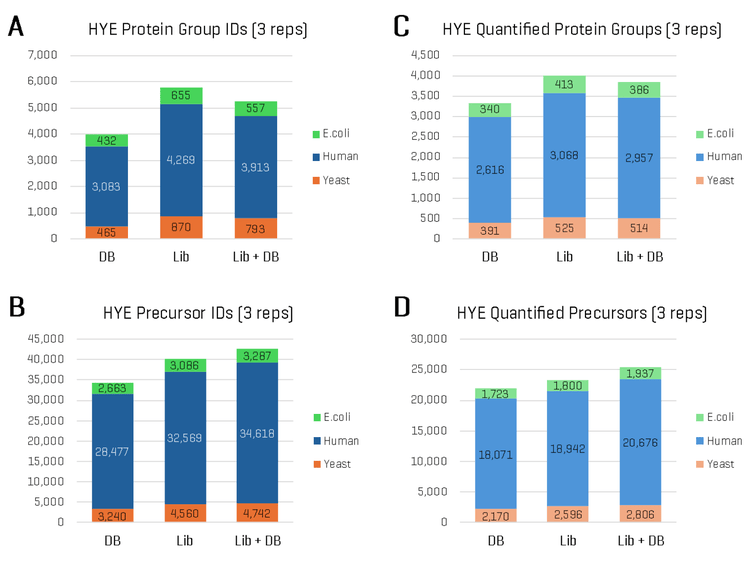
The HYE gas-phase fractionation spectral library was evaluated separately using a different previously- acquired dataset (8): a 250 pg loading of human/yeast/E.coli (65%/15%/20% proportional w/w/w mixture), acquired with the Whisper Zoom 40 SPD method on the Evosep Eno system and ZT Scan DIA (9.8 Da Q1 window widths) on the ZenoTOF 8600 system. As above, this dataset was searched using DB, Lib, and Lib + DB approaches. The results are shown in Figure 5. Protein groups and precursors identified in all 3 replicates, broken down by species, are shown in Figures 5A and 5B, respectively, while protein groups and precursors quantified with CVs<20% (broken down by species) are shown in Figures 5C and 5D.
Consistent with the K562/HeLa library evaluation, use of the HYE spectral library resulted in substantial gains in both identified and quantified protein groups/precursors compared to DB searches, with gains observed across all species in the hybrid proteome. Identified/quantified protein groups were highest with Lib searches, while identified/quantified precursors were highest with Lib + DB searches, highlighting the value of empirical spectral libraries for improving DIA data processing performance across complex proteomic samples.
Conclusions
The results presented here provide a practical framework for generating deep empirical spectral libraries, enabling researchers to maximize protein and precursor identifications and extract greater biological insight from DIA datasets through enhanced data processing depth and confidence.
- Deep spectral libraries generated without off-line fractionation: Gas- phase fractionation combined with 1 Da ZT Scan DIA 3.0 produced libraries containing 10,596 protein groups and 396,429 precursors (for K562/HeLa) and 15,015 protein groups and 316,225 precursors (for HYE hybrid proteome)
- Improved identification performance: Use of empirical spectral libraries consistently increased protein group and precursor identifications compared with library-free searches across all tested datasets
- Maximum gains with combined Lib + DB searches: The Lib + DB approach generally delivered the highest performance, providing 22–47% increases in total protein groups, 20 –41% increases in precursors, and 7 –15% improvements in quantifiable protein groups and precursors relative to DB- only searches
References
- Koudelka T., et al. (2025). Benchmarking of Quantitative Proteomics Workflows for Limited Proteolysis Mass Spectrometry. Molecular & Cellular Proteomics, 24:100945.
- Pino, L., et al. (2020). Acquiring and Analyzing Data Independent Acquisition Proteomics Experiments without Spectrum Libraries. Molecular & Cellular Proteomics, 19:1088.
- Continuing the data independent acquisition (r)evolution: Introducing ZT Scan DIA for quantitative proteomics. SCIEX technical note, MKT-31819-A.
- ZT Scan DIA 3.0: A data-independent acquisition (DIA) method with high-resolution precursor selection improves protein identification and quantitation for proteomics research. SCIEX technical note, MKT-38093-A.
- Narrow-window scanning DIA for unbiased label-free quantitation: Improved protein group ratio accuracy with ZT Scan DIA 3.0 on the ZenoTOF 8600 system. SCIEX technical note, MKT-38229 -A.
- Accelerating discovery proteomics: ZT Scan DIA 3.0 powers improved high-throughput proteomics identification and quantitation. SCIEX technical note, MKT-38277-A.
- Accurate label-free quantitative (LFQ) proteomics benchmarking using data-independent acquisition (DIA) on the ZenoTOF 8600 system. SCIEX technical note, MKT-38149-A.
- Pushing performance for low-input proteomics applications using Enhanced Sensitivity Mode on the ZenoTOF 8600 system. SCIEX technical note, MKT-39244-A.
- ZT Scan DIA 3.0 optimizes protein identification and quantitation on the ZenoTOF 7600+ system. SCIEX technical note, MKT-39320-A.