Unlocking sensitivity for low-sample-input quantitative proteomics using ZT Scan DIA on the ZenoTOF 8600 system
Abstract
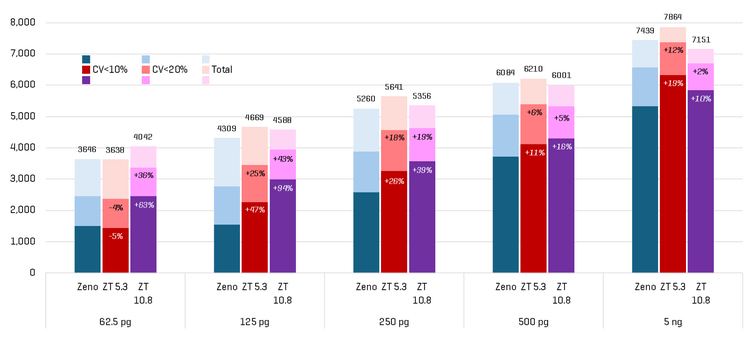
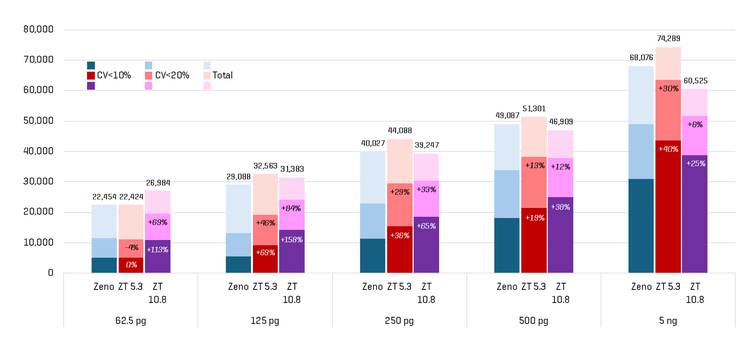
This technical note demonstrates how the ZenoTOF 8600 system, powered by ZT Scan DIA 2.0, enables high-depth quantitative proteomics from sub-nanogram sample amounts using data-independent acquisition (DIA) on the ZenoTOF 8600 system. Using ZT Scan DIA 2.0, more than 4,000 protein groups (nearly 27,000 precursor ions) were identified from as little as 62.5 pg of commercial human digest at a sample throughput of 40 SPD (samples per day), >83% of which were quantifiable with coefficients of variation (CVs) <20%. ZT Scan DIA 2.0 delivers enhanced biomarker quantitation for low-input proteomics, unlocking new possibilities in single-cell analysis.
Key benefits of low-sample-input quantitative proteomics using ZT Scan DIA 2.0 on the ZenoTOF 8600 system
- Exceptional sensitivity: Leveraging Whisper Zoom 40 SPD separation, ZT Scan DIA 2.0 identifies >4,000 protein groups and 27,000 precursors from just 62.5 pg of human digest—demonstrating unmatched performance on the ZenoTOF 8600 system.
- Superior quantitation: ZT Scan DIA 2.0 boosts quantifiable protein groups and precursors by as much as 94% compared to traditional discrete-window DIA methods, enabling deeper insights from minimal sample input.
- Broad method flexibility: Designed for versatility, ZT Scan DIA 2.0 adapts seamlessly across diverse analyte mass ranges and scan speeds, supporting a wide spectrum of workflows.
Introduction
Single-cell proteomics is a cutting-edge field that studies protein expression at the level of individual cells, transforming the understanding of various complex biological systems. The quantitative analysis of samples at low-input levels requires instrumentation and methods with high sensitivity and reproducibility, while balancing the need for sample throughput.
The enhanced ion transmission and duty cycle efficiency of the ZenoTOF 8600 system has been shown to dramatically improve protein identification, quantitation and proteome coverage, enabling the detection of low-abundance proteins that were previously inaccessible (1). ZT Scan DIA 2.0 utilizes a continuously scanning quadrupole for precursor isolation in DIA and has been demonstrated to improve qualitative and quantitative performance relative to discrete-window DIA methods (i.e. Zeno SWATH DIA) (2,3). In this work, the sensitivity and quantitative power of ZT Scan DIA 2.0 on the ZenoTOF 8600 system are highlighted for the analysis of complex protein digests at sub-nanogram loadings.
Methods
Sample preparation: Human K562 lysate tryptic digest was purchased from Promega and diluted in buffer containing 0.1% formic/0.015% N-dodecyl β-D-maltoside detergent in water. Samples were prepared in Evotips (Evosep, Denmark) at the indicated amounts using the instructions provided by Evosep.
Chromatography: Chromatographic separations were performed using an Evosep Eno system (Evosep, Denmark) with an IonOpticks Aurora Elite XS C18 nanoflow column (15 cm x 0.075 mm), using the Whisper Zoom 40 SPD method. The LC column was heated to 65°C for the analysis. Samples were analyzed in triplicate for each loading and method.
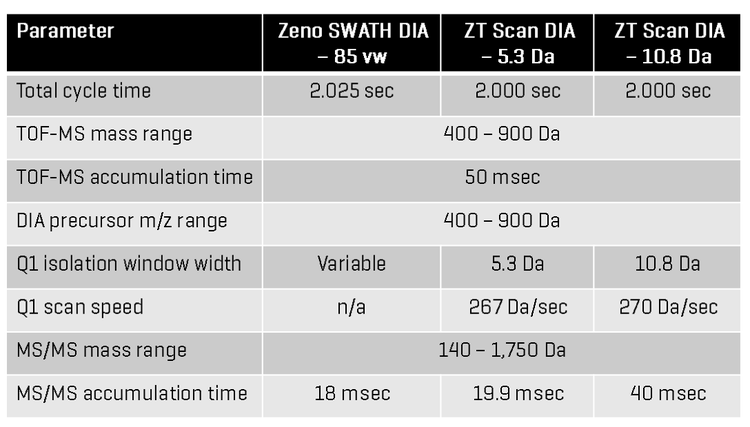
Mass spectrometry: Sample analysis was performed on a ZenoTOF 8600 system, using the horizontal nanoflow probe. Ion source parameters included using a gas 1 setting of 10, a curtain gas setting of 35, an ionspray voltage setting of 2300 V, and an interface temperature of 300 °C. Three different SWATH DIA methods were tested with precursor isolation range 400-900 Da: (1) Zeno SWATH DIA (using 85 variable SWATH windows), (2) a ZT Scan DIA 2.0 method with a Q1 isolation window of 5.3 Da, and (3) a ZT Scan DIA 2.0 method with a Q1 isolation window of 10.8 Da. The DIA method parameters are described in Table 1. Zeno trapping was used for all MS/MS experiments.
Data processing: WIFF data files were converted to indexed centroided mzML format using the SCIEX MS Data Converter software. The resulting files were processed with DIA-NN software (version 1.9.1) (4), using a K562/HeLa spectral library and DIA search settings as previously described (5,6). Total and quantifiable protein groups and precursors were determined from the “pg_matrix.tsv” and “pr_matrix.tsv” output files. Triplicate data files for a given loading/experiment were searched together. Additionally, peptide quantitative accuracy, precision and linearity across the sub-nanogram concentration range were determined using SCIEX OS Analytics software.
ZT Scan DIA 2.0 increases quantifiable identifications of protein groups and precursors
Figures 1 and 2 summarize the numbers of identified and quantified protein groups and precursors, respectively, across a range of K562 digest sample loadings from 5 ng to 62.5 pg. Two different ZT Scan DIA 2.0 methods (with either 5.3 Da or 10.8 Da Q1 isolation windows) were compared to an 85 variable window Zeno SWATH DIA method. The overall cycle times for all methods were approximately 2 seconds. The effective MS/MS accumulation times for the two ZT Scan DIA 2.0 methods were therefore either 19.9 msec (for the 5.3 Da Q1 window method) or 40 msec (for the 10.8 Da Q1 window method) (see Table 1). Assuming the overall method cycle times (and therefore,relatively lower MS/MS accumulation times) typically improve the overall number of identifications points across the chromatographic peaks) are consistent between methods, methods with narrower Q1 isolation windows (with relatively lower MS/MS accumulation times) typically improve the overall number of identifications.
Comparatively, methods with wider Q1 isolation windows (with relatively longer precursor MS/MS accumulation times) typically improve quantitative reproducibility.
Figures 1 and 2 show that the 5.3 Da ZT Scan DIA 2.0 method generally improved both total and quantifiable protein group and precursor identifications relative to Zeno SWATH DIA, across most of the tested sample loading range. At the lowest sample loadings tested, the 10.8 Da ZT Scan DIA 2.0 method yielded the highest number of quantifiable protein groups and precursors. The gains in quantifiable protein groups (i.e. with CVs either <10% or <20% across triplicate values) for each loading, relative to Zeno SWATH DIA, are also summarized. These results show that while the wider-window ZT Scan DIA 2.0 method is most ideal at extremely low sample loadings, the narrow-window ZT Scan DIA 2.0 method had the greatest overall utility in terms of total and quantifiable identifications across the mid- to higher sample loadings.
The ZenoTOF 8600 system exhibits superior MS/MS spectral quality and quantitative performance at the sub-nanogram concentration range
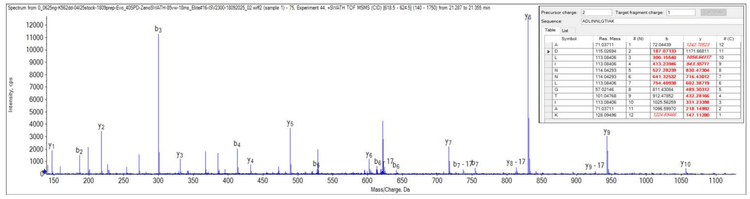
Figure 3 shows an example MS/MS spectrum for peptide ADLINNLGTIAK (from HS90A_HUMAN protein) at the 62.5 pg level using Zeno SWATH DIA. Excellent MS/MS spectral quality is observed, with nearly the entire series of matching b- and y-ion fragments seen for this peptide.
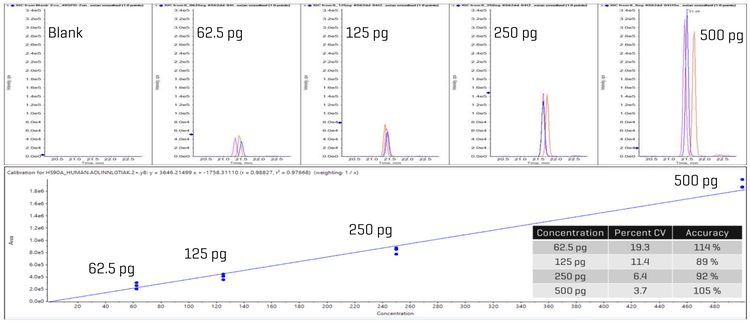
To further evaluate quantitative performance, peak areas for the y8 fragment ion from the MS/MS of this peptide were calculated across the sample loading range from 500 pg to 62.5 pg. The results are summarized in Figure 4. The plot shows the linearity of fragment ion peak areas, while the inset table shows that the CVs between replicates were all <20% and accuracies within +/- 15% across this range.
These findings demonstrate that the ZenoTOF 8600 system delivers exceptionally high-quality, quantifiable peptide identifications even at sub-nanogram sample loadings using DIA – empowering researchers with unmatched confidence in their data. These results underscore the ZenoTOF 8600 system’s ability to deliver ultra-sensitive, high-confidence quantitative results for single-cell proteomics applications.
Conclusion
- ZT Scan DIA 2.0 on the ZenoTOF 8600 system confidently identified 4,042 total protein groups from K562 digest loadings as low as 62.5 pg—mirroring single-cell protein levels—at a rapid throughput of 40 SPD.
- ZT Scan DIA 2.0 delivers up to 94% more total and quantifiable protein groups and precursors across sample loadings from 5 ng down to just 62.5 pg—dramatically outperforming discrete-window DIA methods.
- ZT Scan DIA 2.0 delivers outstanding MS/MS spectral quality and robust quantitative performance—maintaining linearity, ±15% accuracy, and <20% CV precision even at sub-nanogram peptide loadings.
References
- Achieving deep quantitative proteome coverage from sub-nanogram sample loadings using Whisper Zoom and Zeno SWATH DIA on the ZenoTOF 8600 system. SCIEX technical note, MKT-35259-A
- Advances in high-throughput quantitative proteomics powered by high-sensitivity data-independent acquisition on the ZenoTOF 8600 system. SCIEX technical note, MKT-34848-A
- Continuing the data independent acquisition (r)evolution: Introducing ZT Scan DIA for quantitative proteomics. SCIEX technical note, MKT-31819-A
- Demichev et al., Nature Methods, 2020, https://www.nature.com/articles/s41592-019-0638-x
- Large scale protein identification using microflow chromatography on the ZenoTOF 7600 system. SCIEX technical note, RUO-MKT-02-14415-A