Abstract
This technical note demonstrates that the ZenoTOF 8600 system, using ZT Scan DIA 3.0, redefines quantitative proteomics by achieving deep proteome coverage from 50-250 ng of sample with sliding Q1 isolation windows (as low as 1 Da), enhancing selectivity and experimental precision. 9,214 protein groups (94,974 precursors) were identified from 250 ng of a commercial human cell (K562) lysate digest using a 38-min nanoflow gradient. Notably, 92% of these proteins were robustly quantified with coefficients of variation ≤20%, underscoring the reproducibility and quantitative strength of the approach. Together, the ZenoTOF 8600 system and ZT Scan DIA 3.0 further expand the depth and reliability of biomarker identification and quantitation, enabling high-confidence proteomics that support the advancement of transformative medicine.
Key features of ZT Scan DIA 3.0 on the ZenoTOF 8600 system
- Superior quantitation: In this study, ZT Scan DIA 3.0 boosts quantifiable protein groups and precursors by 11.5% and 21.4%, respectively, compared with variable-window Zeno SWATH DIA.
- Improved protein identification: ZT Scan DIA 3.0 with a 2 Da Q1 width allows for 8.5 % gain in protein identification in a human cell lysate digest relative to variable-window Zeno SWATH DIA.
- Ultra-selective DIA for precision proteomics: ZT Scan DIA 3.0 extends the usable design space of DIA experiments by enabling Q1 isolation widths as low as 1 Da—unlocking a new regime of selectivity and quantitative confidence beyond traditional flexible DIA.
Introduction
The ZenoTOF 8600 system's advanced ion transmission and duty cycle efficiency have significantly increased protein identification, quantitation, and proteome coverage (1). ZT Scan DIA, launched by SCIEX in 2024 (3), uses a continuously scanning quadrupole for precursor isolation, enabling superior qualitative and quantitative performance compared with conventional discrete-window DIA methods, such as Zeno SWATH DIA. In 2025, this acquisition method was expanded to ZT Scan DIA 2.0, which covers a broader mass range and enables greater flexibility in method optimization (2). Although ZT Scan DIA 2.0 already allowed users to customize Q1 window widths, ZT Scan DIA 3.0, introduced in this technical note, fundamentally extends that customization—opening up experimental possibilities previously inaccessible.
In this technical note, ZT Scan DIA 3.0 is introduced, enabling Q1 window widths as low as 1 Da and further reducing the chimeric nature of DIA MS/MS spectra. The resulting spectra are easier to interpret and provide more accurate, reliable quantitation by minimizing fragment interference from neighboring precursors. In cases where samples are complex or have a high dynamic range, interferences can impact peptide identification and quantitation. By allowing users to customize the sliding Q1 window width, researchers can dial in selectivity based on the biological question, enabling trade-offs between coverage, specificity, and quantitative rigor.
In this work, we demonstrate that the increased precursor selection resolution enabled by ZT Scan DIA 3.0 further improves protein identification and delivers more accurate, reliable quantitation, as selectivity, not just sensitivity, is a key limiting factor in DIA performance.
Methods
Sample preparation: Human K562 lysate tryptic digest was purchased from Promega and diluted in water containing 0.1% formic acid.
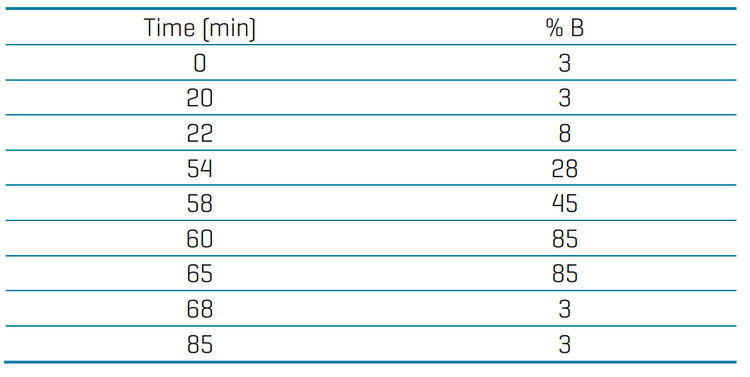
Chromatography: Chromatographic separations were performed using an ACQUITY M-Class LC system (Waters, USA) with an IonOpticks Aurora Ultimate XS C18 nanoflow column (25 cm x 0.075 mm), using the gradient described in Table 2, with mobile phase A consisting of water + 0.1% formic acid and mobile phase B consisting of acetonitrile with 0.1% formic acid. Flow rate was 250 nL/min, and the injection volume was 1 µL for the 50 ng injections and 2 µL for the 250 ng injections. The column was heated to 50 °C. Four replicate injections were performed for each loading and MS acquisition method.
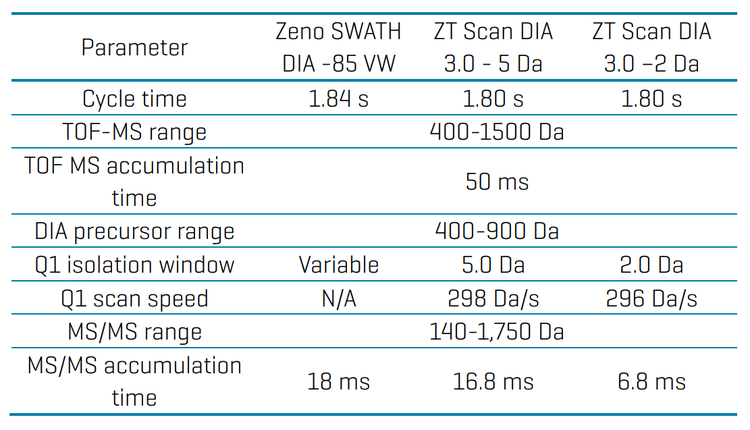
Mass spectrometry: Sample analysis was performed on a ZenoTOF 8600 system, using the horizontal nanoflow probe. Ion source parameters were set to gas 1 at 10 psi, curtain gas at 35 psi, ionspray voltage at 2100 V, and interface temperature at 250 °C. A SWATH DIA method with a precursor isolation range of 400-900 Da and 85 variable-width SWATH windows was compared with ZT Scan DIA 3.0 methods with Q1 isolation windows of 5 Da and 2 Da. The DIA method parameters are described in Table 1. Zeno trapping was used for all MS/MS experiments.
The number of quantifiable proteins and peptides with a CV ≤ 20% were calculated for those identified across all 4 replicate injections. Unless mentioned otherwise, results listed are from the DIA-NN searches.
ZT Scan DIA 3.0 increases peptide/protein identifications and quantitation
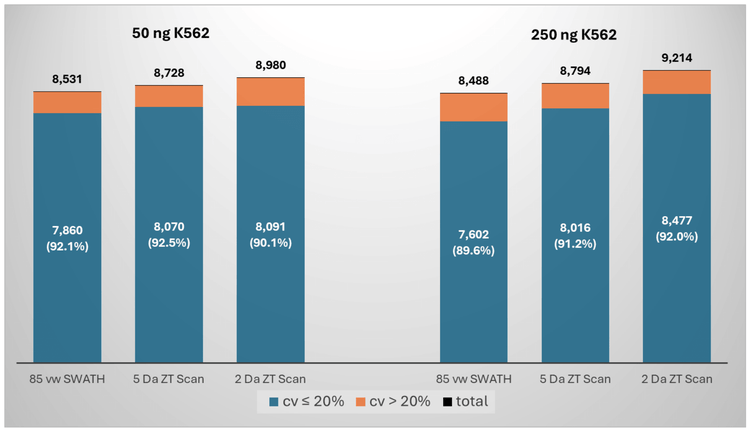
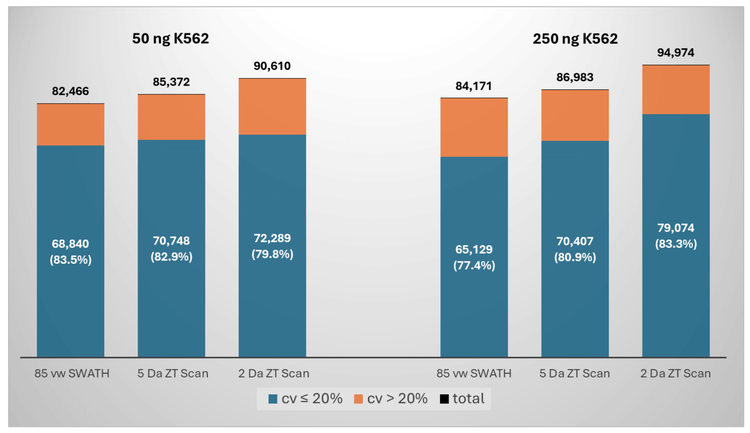
Figures 1 and 2 summarize the numbers of identified and quantified protein groups and precursors, using DIA-NN v1.9.1, for 50 ng and 250 ng K562 digest loads, comparing variablewindow Zeno SWATH DIA and ZT Scan DIA 3.0 using a 2- or 5 Da Q1 window widths.
The overall cycle times for all acquisition methods were approximately 2 seconds. MS/MS accumulation time for the variable-window Zeno SWATH DIA method was 18 ms, while ZT Scan DIA 3.0 methods used accumulation times of 16.8 ms and 6.8 ms for the 5 Da and 2 Da Q1 windows, respectively (Table 1).
The results demonstrate that despite using a shorter MS/MS accumulation time than the other 2 acquisition methods used, ZT Scan DIA 3.0 with a 2 Da Q1 window achieved the highest number of protein groups and peptide identifications, as well as the greatest number of proteins and peptides quantified with CVs ≤20%.
At the 250 ng load, the number of protein group identifications increased by 8.5 % compared with Zeno SWATH DIA, while quantifiable protein groups and precursors increased by 11.5 % and 21.4 %, respectively.
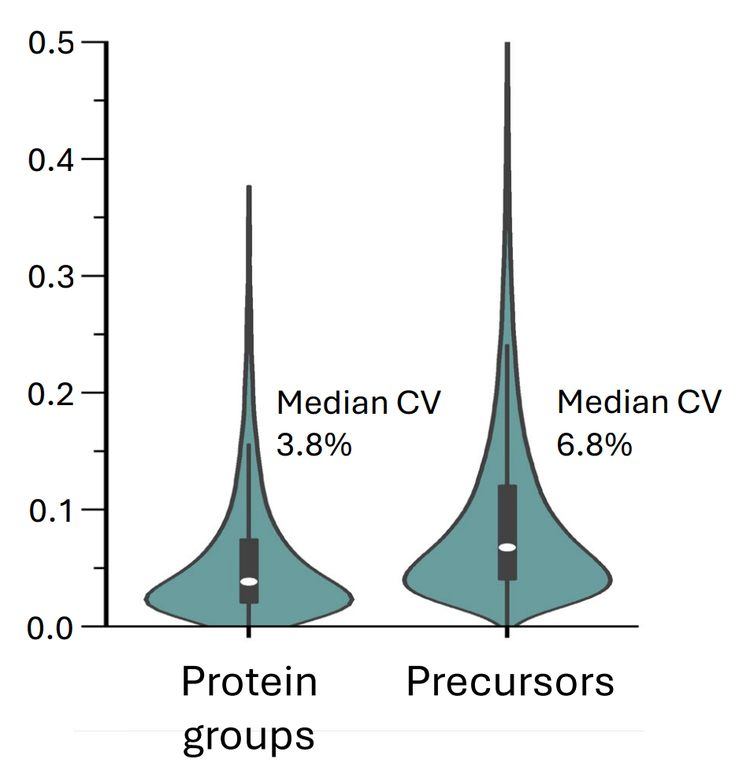
Figure 3 shows the distribution of % CVs for both protein groups and precursors for the 250 ng injections of K562 using the 2 Da ZT Scan DIA 3.0 acquisition method. The very low median % CVs illustrate the quantitative capabilities of the ZenoTOF 8600 system with ZT Scan DIA 3.0 acquisition.
PEAKS Studio database search results
The acquired data was also searched using PEAKS Studio software version 13.1, with a library-free approach. The relative increases in identified and quantified protein groups between the variable-window Zeno SWATH DIA and ZT Scan DIA 3.0 methods were the same as those observed with the DIA-NN software processing results. Table 3 compares the library-based search using DIA-NN software and the library-free search using PEAKS Studio software for the 250 ng K562 data acquired with the 2 Da ZT Scan DIA method. Although the number of identified protein groups was 9% lower with PEAKS Studio software, the number of quantified protein groups was nearly identical. The number of identified and quantified precursors using PEAKS Studio software was significantly higher (almost 2x) than the results determined using DIA-NN software.
ZT Scan DIA 3.0 improves the specificity of MS/MS spectra
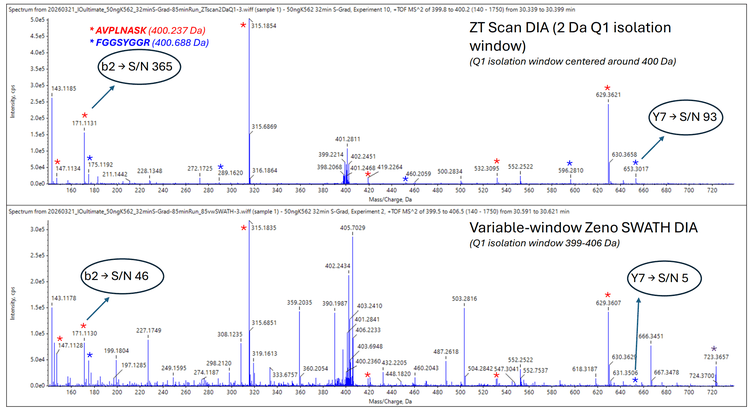
To illustrate the reduction in spectral complexity achieved with narrow Q1 windows in ZT Scan DIA 3.0, Figure 4 compares MS/MS spectra from the variable-window Zeno SWATH DIA and 2 Da ZT Scan DIA 3.0 experiments. The ZT Scan DIA spectrum that is centered at 400 Da is compared with the spectrum from the 399-406 Da precursor window from the Zeno SWATH DIA experiment. The ZT Scan DIA MS/MS spectrum comprises fragment ions from two peptides with similar precursor ion m/z values, co-isolated in the 2 Da Q1 isolation window. The Zeno SWATH DIA MS/MS spectrum exhibits greater complexity, containing fragment ions from the same two peptides, as well as additional fragment ions from other peptides co-isolated within the wider 5 Da Q1 isolation window. The improved selectivity of the narrower Q1 isolation window also yields higher signal-to-noise (S/N) ratios for the resulting fragment ions, which can significantly enhance quantitative analysis.

Conclusions
Overall, the results of this study demonstrate that ZT Scan DIA 3.0, when employed on the ZenoTOF 8600 system, enables robust, high-performance operation under demanding high-load nano-LC conditions. By maintaining fast scan speeds, consistent ion transmission, and stable quantitative performance, the system effectively addresses the challenges associated with increased sample complexity and throughput requirements. The results highlight the ZenoTOF 8600 system's ability to support deep proteome coverage without sacrificing sensitivity or reproducibility, even as analytical load increases.
Collectively, these findings underscore the suitability of the ZenoTOF 8600 system for high-throughput nano-scale workflows, where reliability and data quality are critical. The added capability of ZT Scan DIA 3.0 positions the system as a practical and scalable solution for advanced proteomics applications, supporting confident decision-making across discovery and large-scale studies.
- Quantifiable protein groups and precursors increased by 11.5% and 21.4%, respectively, when using ZT Scan DIA 3.0, compared with variable-window Zeno SWATH DIA.
- By enabling highly selective Q1 isolation, ZT Scan DIA 3.0 on the ZenoTOF 8600 system improves protein identification by 8.5% compared with Zeno SWATH DIA – providing deeper, more confident proteome coverage.
- Spectral quality improves significantly with ZT Scan DIA 3.0 compared with Zeno SWATH DIA, due to the ability to select precursors with higher resolution. The improved spectral quality increases both the number of protein identifications and the precision of quantitation.
- Library-free searches using PEAKS Studio software v13.1 resulted in almost the same number of quantified proteins as found when searching using DIA-NN software v1.9.1 with a spectral library. The number of identified and quantified precursors almost doubled using PEAKS Studio software, resulting in more confident identifications and quantitation.
References
- Achieving deep quantitative proteome coverage from sub-nanogram sample loadings using Whisper Zoom and Zeno SWATH DIA on the ZenoTOF 8600 system. SCIEX technical note, MKT-35259-A
- Advances in high-throughput quantitative proteomics powered by high-sensitivity data-independent acquisition on the ZenoTOF 8600 system. SCIEX technical note, MKT-34848-A
- Continuing the data independent acquisition (r)evolution: Introducing ZT Scan DIA for quantitative proteomics. SCIEX technical note, MKT-31819-A
- Demichev et al., Nature Methods, 2020, https://www.nature.com/articles/s41592-019-0638-x
- Large scale protein identification using microflow chromatography on the ZenoTOF 7600 system. SCIEX technical note, RUO-MKT-02-14415-A