Abstract
Quantification for nine nitrosamine impurities on SCIEX QTRAP 5500+ LC-MS/MS System provides LOQs that easily meet and surpass the current criteria proposed by the regulatory authorities (0.03 µg/g) as well as all other relevant criteria such as accuracy, precision and linearity. UV detection has also been utilized as a quick method to ensure no co-elution with the API.
Introduction
Esomeprazole is a proton pump inhibitor that is used to mitigate the symptoms of gastroesophageal reflux disease (GERD) and other conditions which occur due to excess gastric acid by inhibiting acid production in the stomach.1 Since 2018, an increasing number of drug products have been tested and recalled due to nitrosamine contamination, starting with several angiotensin II receptor blockers (ARBs) which includes “sartan” products before moving to ranitidine and metformin.2 Therefore, this is a problem which is unlikely to be alleviated soon, with seemingly more and more drug products being implicated as time goes on.
While the current FDA position on esomeprazole products is that testing for nitrosamine compounds is not necessary, this position could change in the future. Therefore, we have developed a method that is able to easily achieve and surpass the current established limit of 0.03 µg/g (ppm) for multiple nitrosamine compounds. This limit comes from the recently released FDA document for the “control of nitrosamine impurities in human drugs” where a limit of 26.5 ng/day is stipulated if the drug product is thought to contain more than one nitrosamine impurity. If the maximum daily dose of the drug is below 880 mg/day then the final limit in the product stands at 0.03 µg/g, which is the case for esomeprazole.2
Key features of SCIEX 5500+ System for nitrosamine analysis
- Delivers ultra-low-level MRM detection allowing for LOQ values which are an improvement on current regulations (0.03 µg/g (ppm))
- Excellent precision and accuracy values at both the LOQ of the method, but also at the specification limit
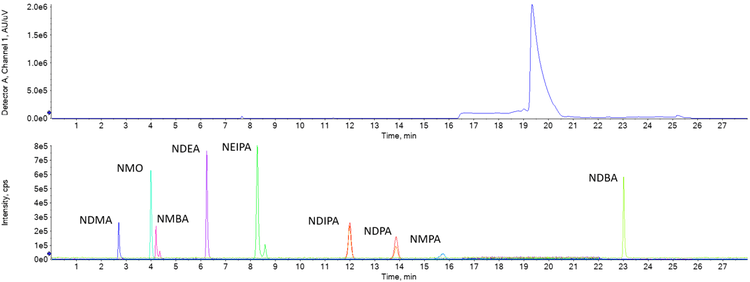
- Additional UV detection to allow for easy assessment of API and excipient elution
- Efficient and accessible data processing using SCIEX OS Software
Methods
Standard preparation: Each nitrosamine impurity was weighed and diluted to achieve mixed standard solutions with concentrations ranging between 0.08 - 40 ng/mL.
Sample preparation: A sufficient quantity of API was weighed and diluted to 40 mg/mL with water. The solution was vortexed to mix for 5 minutes followed by centrifugation for 15 minutes. The supernatant was removed and filtered before analysis.
Chromatography: Chromatographic separation was performed using the ExionLC™ AD System which provides very low carryover and full UHPLC capabilities (Figure 2). The column used was a Phenomenex biphenyl 2.6 µm, 150 x 3 mm. Details of the chromatography are outlined in the Supplementary Information.3
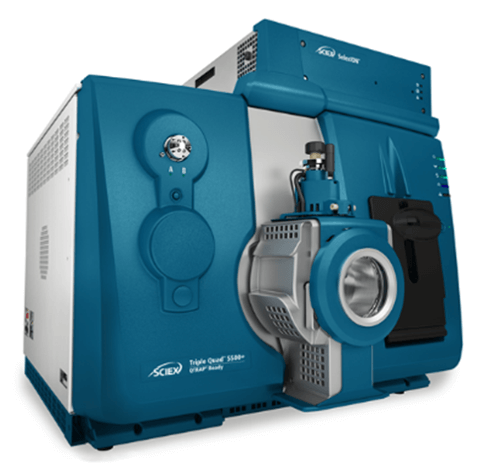
Mass spectrometry: These experiments were performed using the SCIEX 5500+ System. The system was operated in positive ionization mode using the atmospheric pressure chemical ionization (APCI) probe on the IonDrive™ Turbo V Ion Source. Data was acquired using Analyst® Software. Details of the MS conditions are outlined in the Supplementary Information.3
Data processing: Data was processed using SCIEX OS Software.
Quantitative sensitivity, precision and accuracy
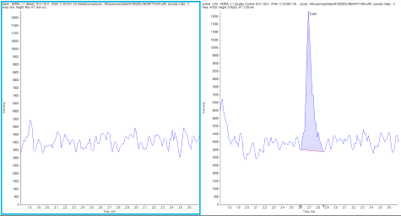
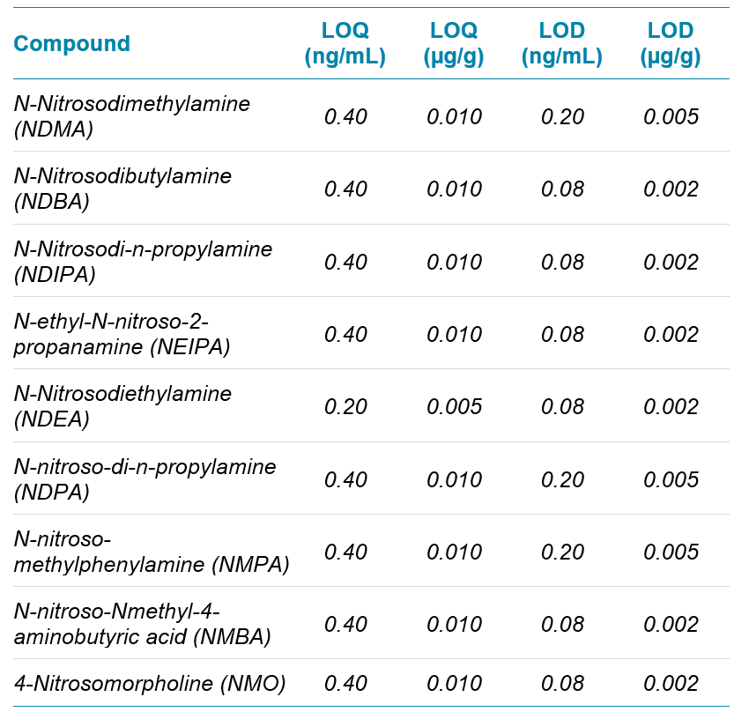
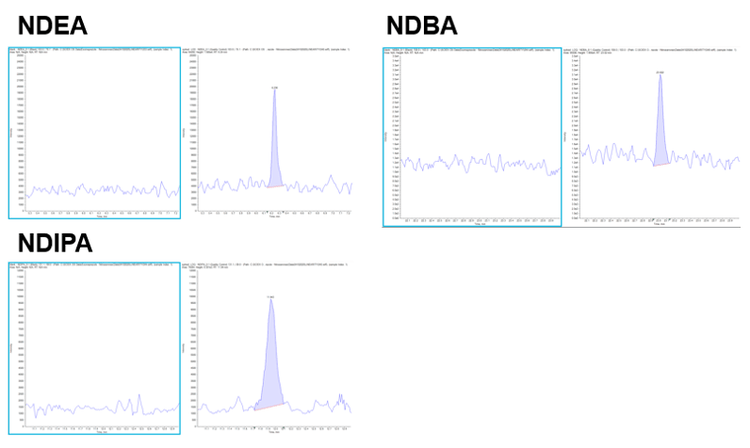
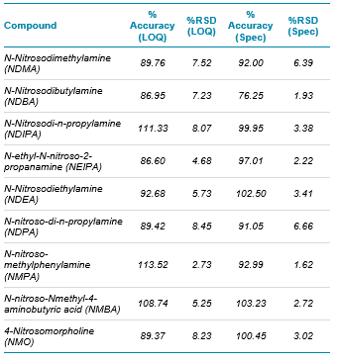
The LOQ and LOD achieved using this method are shown in Table 1, both in solution and in sample so a clear comparison can be made with the current 0.03 µg/g limit. It therefore highlights the sensitivity that can be achieved with this method and even leaves room to expand as several methods for nitrosamine quantification outline a sample preparation of 100 mg/mL, whereas a 40 mg/mL preparation has been used here to limit the amount of API, improving column lifetime and method robustness. However, if necessary, this could be further optimized to provide a lower LOQ in sample.
Linearity and range
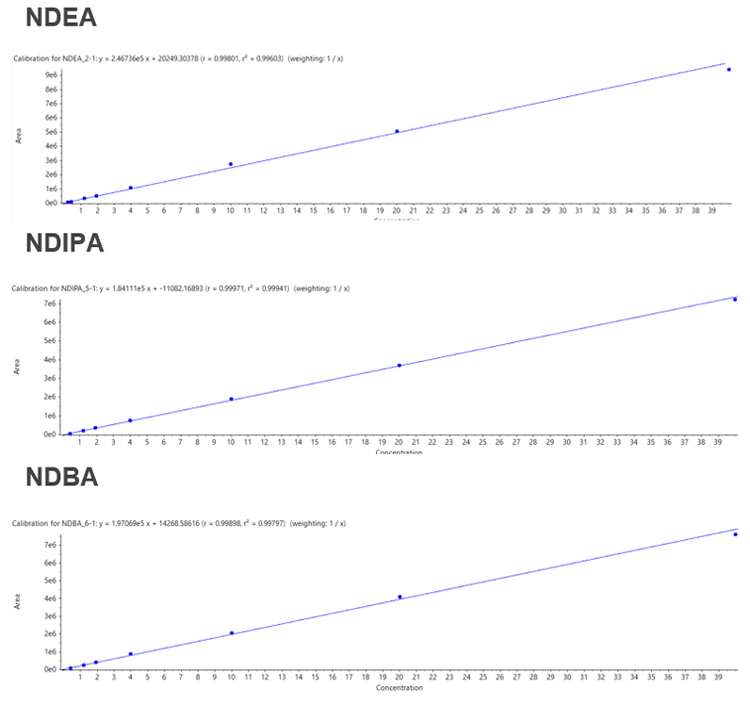
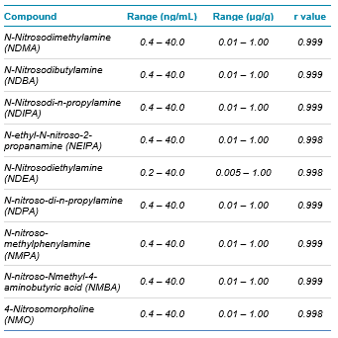
Calibration curve ranges for each analyte have been outlined in Table 3 along with the r value achieved, showing that accurate quantification for each of the nine nitrosamine impurities is easily possible using this method. An example of three respective calibration curves has been outlined in Figure 4, showing a visual representation of the linearities, with each curve providing an r value >0.99.
Conclusions
An accurate and precise quantification method for nine nitrosamine impurities has been developed using the SCIEX 5500+ System. The LOQs achieved can easily meet and surpass the current criteria proposed by the regulatory authorities (0.03 µg/g) as well as all other relevant criteria such as accuracy, precision and linearity. UV detection has also been utilized as a quick and straight-forward assessment of API elution, to ensure there is no co-elution and therefore suppression of the nitrosamine impurities analyzed.
References
- NHS, Medicines A to Z: esomeprazole.
- Control of nitrosamine impurities in human drugs – guidance for industry, FDA, September 2020.
- Download the Supplementary method information.