Streamlining large-scale MRM database development through automated software tools and aeMRM on the novus V55 system
Abstract
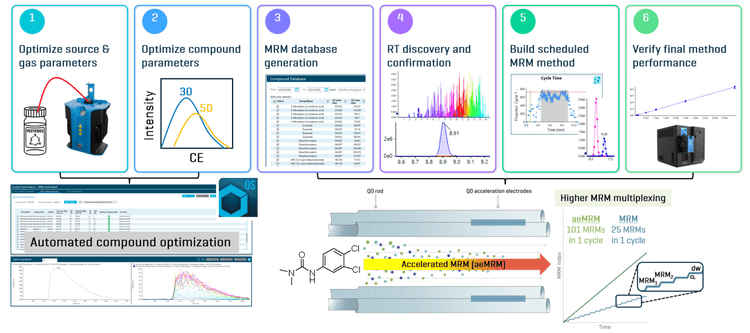
This technical note describes a streamlined workflow for the development of a large-panel MRM database comprised of >700 pesticides. Software features in SCIEX OS software, such as automated compound optimization (ACO), accelerated the optimization and creation of a database with >2,100 MRM transitions. These MRM transitions were further authenticated using high-resolution HR-MS/MS spectra, providing additional confidence in precursor and product ion selection. Leveraging accelerated MRM (aeMRM) on the novus V55 system, sub-to-low ms pause and dwell times and fast polarity switching enabled unscheduled MRM acquisition of the entire panel in a single injection, significantly expediting retention time (RT) discovery and conserving reference materials and /or analytical standards (Figure 1).
Key benefits of SCIEX OS ACO and aeMRM for large-panel MRM method development
- Automated method development: SCIEX OS ACO rapidly determined optimal MRM transitions, while minimizing manual tuning of compound parameters.
- Large-panel pesticides MRM library: A final MRM database, comprised of 1975 positive and 127 negative transitions, was curated and validated against HR-MS/MS fragmentation data.
- Accelerated RT discovery: aeMRM on the novus V55 system enabled unscheduled monitoring of all transitions in a single injection, significantly speeding up RT discovery.
- Optimized sMRM cycle time with SCIEX OS: Software visualization of MRM concurrency helped preserve cycle time for higher analyte coverage without data quality trade-off.
Introduction
The demand for comprehensive targeted analysis in food testing continues to grow due to the discovery of new analytes and regulatory updates. Laboratories are also under increasing pressure to improve throughput and sustainability initiatives, driving the adoption of large-panel methods that consolidate multiple assays into a single run and reduce instrument time and operational costs. Multiple reaction monitoring (MRM) remains the gold standard approach for targeted quantitation, but developing and managing large panels with hundreds of analytes, such as those recently emerged in the food testing community1-3, presents significant challenges. For example, identifying optimal MRM transitions and source and compound-specific parameter optimization become increasingly cumbersome with larger panels.
Software tools, such as automated compound optimization (ACO) in SCIEX OS, can streamline these processes by automating the iterative ramping of each parameter and adding the optimized values to an existing or a new in-house MRM database. Here,the use of aeMRM on the novus V55 system4 enabled rapid RT discovery of >2,100 transitions in a single injection, which were then authenticated by HR-MS/MS fragmentation data. The final pesticides MRM library enabled scalable method development with optimized parameters for 1,975 positive and 127 negative transitions that can be readily incorporated into targeted scheduled MRM (sMRM) assays.
Methods
Standards: The Smart SolutionsTM v700 LC PestiMix Kit 3 from LGC Standards was used to prepare 10 individual intermediate stock standards at 1 μg/mL in acetonitrile. Intermediate mixes were prepared either in acetonitrile or methanol, while calibration standards were prepared with the same solvent composition as mobile phase A.
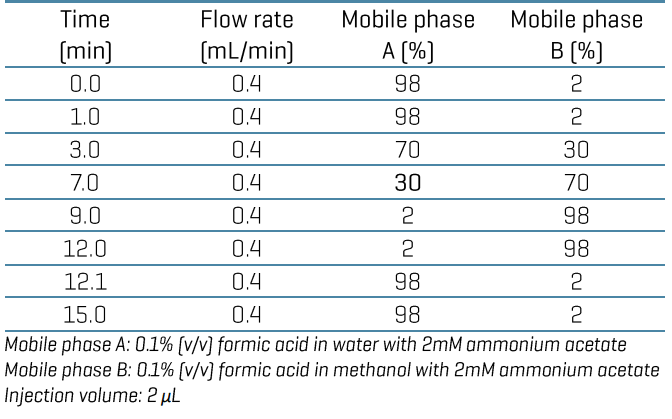
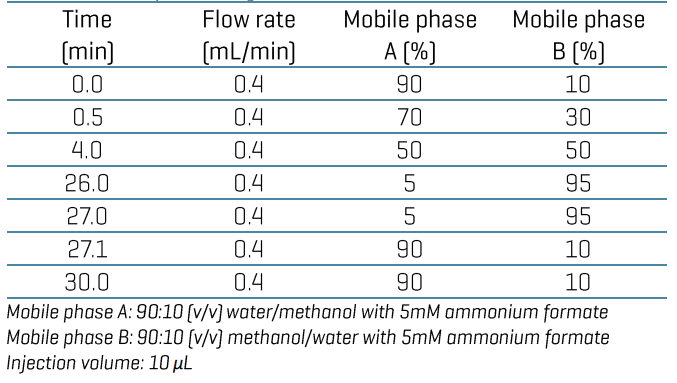
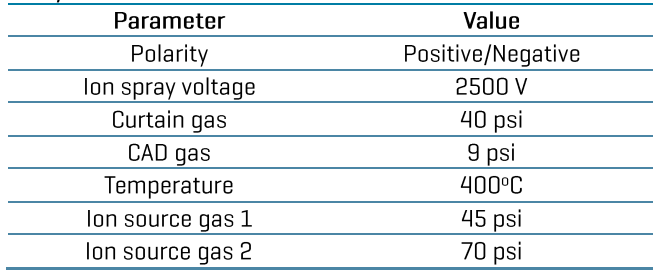
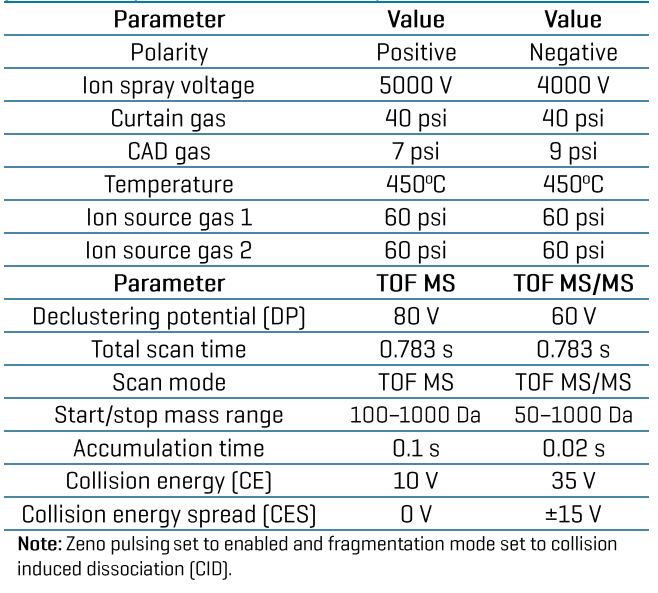
Chromatography: Two separate gradients were developed for RT discovery on the novus V55 system and MRM authentication on the ZenoTOF 7600+ system (Tables 1 and 2). Chromatographic separation was performed on an ExionAE LC system using the Phenomenex Luna Omega Polar C18 column in 2 different configurations (RT discovery: 100 x 2.1 mm, 1.6 µm, P/N: 00D- 4748-AN; MRM authentication: 100 x 2.1 mm, 3 µm, P/N: 00D- 4760-AN).
Automated compound optimization in SCIEX OS
Conventional compound optimization is a largely manual process involving iterative tuning of parameters for each analyte, creating a significant bottleneck for large-panel MRM method development. This typically starts with a precursor ion scan to confirm the presence of the target precursors and their m/z during which the declustering (DP) and entrance (EP) potentials are ramped to find the optimal values. Next, a product ion scan is performed to identify the most intense fragments for each precursor, followed by optimization of the collision energy (CE) and collision exit potential (CXP). Once the precursor and product ion pairs have been identified for an analyte, an MRM scan can be used to optimize the source and gas parameters.
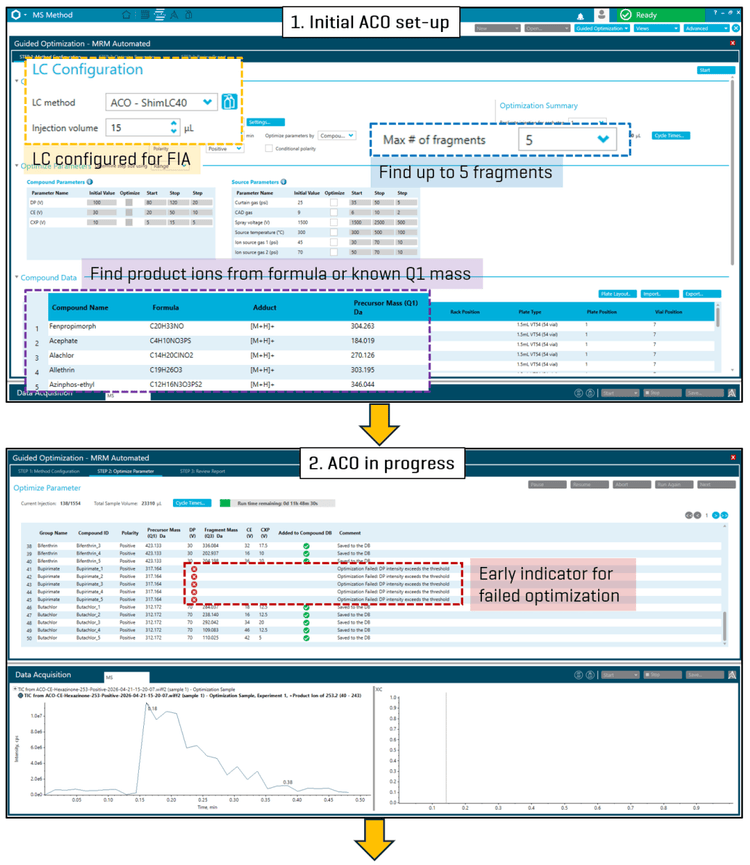
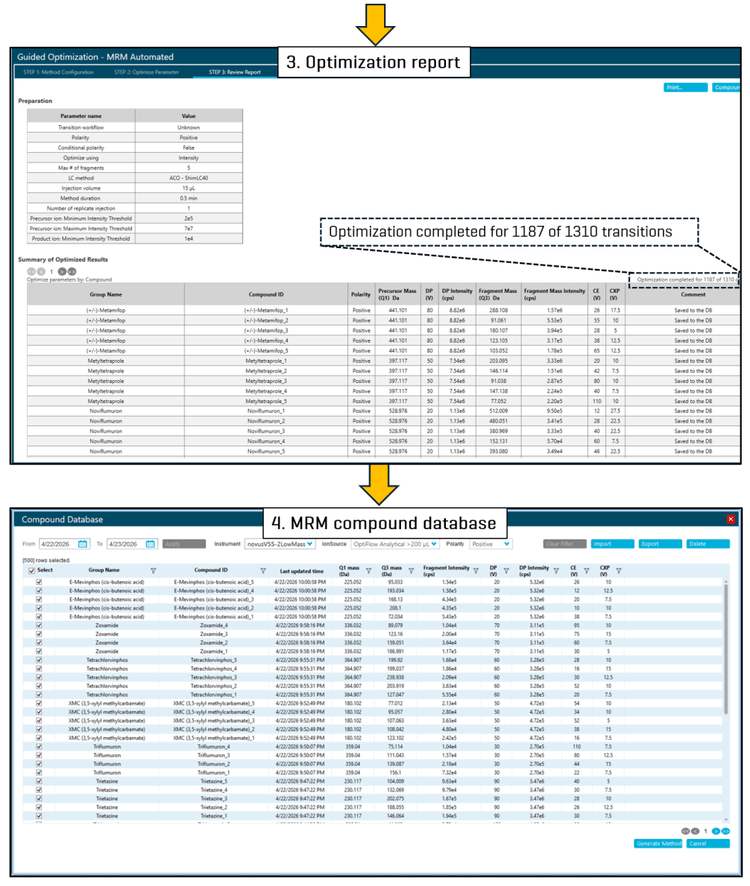
The ACOfeature in SCIEX OS software combines these steps in an automated workflow by performing sequential optimization of the precursor ion conditions, fragment ion selection and compound-dependent parameters, with the results stored in a database for subsequent method creation (Figure 2). The precursor masses of the target analytes are either entered manually or calculated from the molecular formula, with the optimization set to find up to 5 fragments per precursor. Using flow injection analysis (FIA), the analytes are injected directly into the mass spectrometer without chromatographic separation, generating a broad peak during which the precursor/fragment ions and compound parameters are optimized based on signal intensity. Based on the parameter ramp settings, such as the start/stop range and the step interval, ACO provides the total injection count or the total sample volume required to optimize all the analytes, allowing the user to prepare sufficient amounts of standards in advance. Upon completion of ACO, the summary report shows how many transitions are successfully optimized and added to the compound database, enabling the user to revisit those that failed during optimization.
Here, ACO was used to identify up to 5 transitions and optimize their parameters for each of the 724 pesticides in the Smart Solutions v700 LC PestiMix Kit 3. An MRMdatabase, consisting of 3882 positive and 180 negative transitions, was initially generated, then further authenticated using HR-MS/MS fragmentation data.
MRM authentication by HR-MS/MS
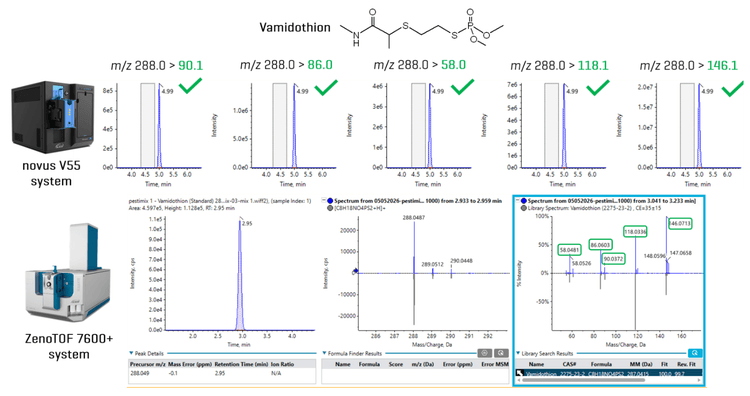
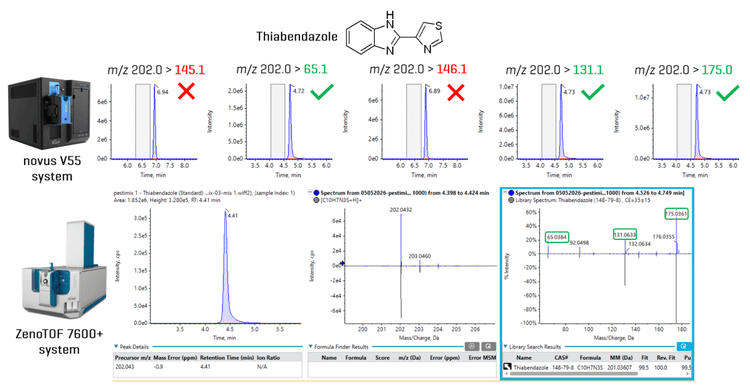
Orthogonal HR-MS/MS data were used to authenticate the MRM database by confirming the exact masses and fragmentation patterns of precursor/fragment ion pairs, providing increased confidence of the MRM assignment. Figures 3 and 4 demonstrate this workflow for 2 example pesticides, vamidothion and thiabendazole. In addition to exhibiting the same RT of 4.99 min, all 5 transitions identified for vamidothion during ACO were found to be present in the HR-MS/MS spectrum (Figure 3). The isotopic pattern and library confirmation further corroborated the transition assignment. In contrast, the 5 transitions of thiabendazole exhibited 2 different RTs of 4.7 min and 6.9 min (Figure 4). Comparison against the MS/MS spectrum confirmed the 3 transitions (m/z 202 > 65, 202 > 131 and 202 > 175) , eluting at 4.7 min, were correct.
Using this authentication workflow, the final MRM database was revised to 1975 positive and 127 negative transitions, with 2–3 fragments assigned to each pesticide. The availability of multiple transitions here strengthens method robustness by providing alternative ions for analyte confirmation and interference mitigation across diverse sample matrices. This database provides a starting point for food laboratories seeking to develop and expand multi-residue screening methods.
High-throughput RT discovery
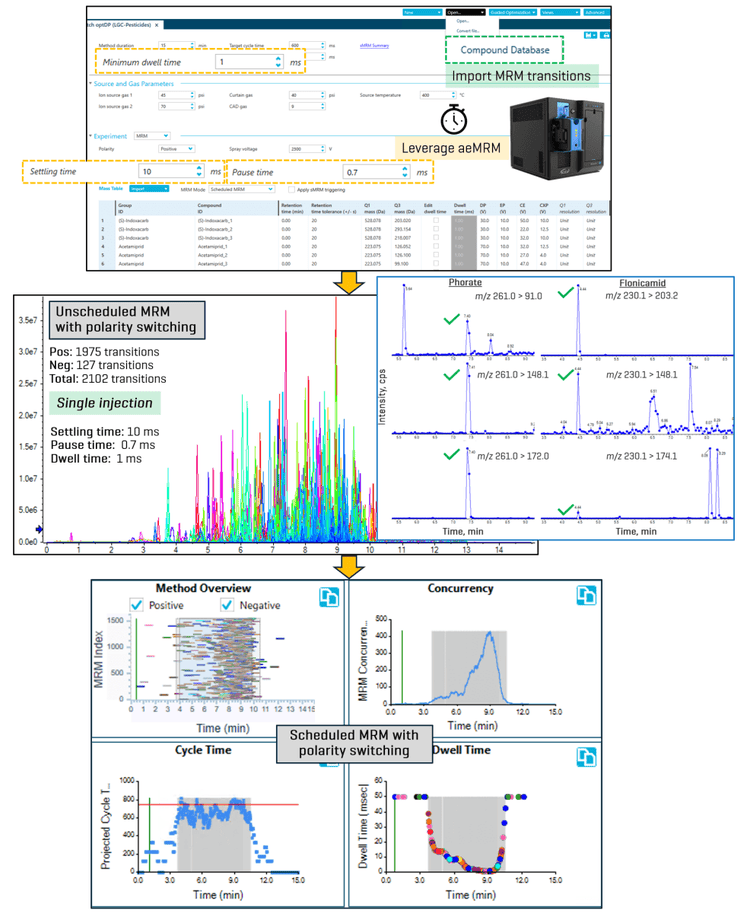
Conventional large-panel MRM method development requires labour-intensive preparation of numerous standards, while RT verification of thousands of transitions across a single run necessitates multiple injections. The LGC PestiMix kit simplifies standards preparation with pre-mixed multi-analyte solutions, reducing analyst time and risk of error. By coupling the comprehensive analyte coverage of the PestiMix standards with the high-speed acquisition of aeMRM on the novus V55 system,5 RT discovery for thousands of transitions was determined in a single injection, significantly accelerating method development while conserving analytical standards.
Figure 5 demonstrates the creation of an unscheduled MRM method comprised of the 2,102 transitions imported from the ACO MRM database. Coupling a pause time of 0.7 ms and a dwell time of 1 ms from aeMRM acquisition with fast polarity switching enabled RT identification of the entire panel, including 2–3 transitions for each pesticide .
Conclusion
This work features an end-to-end workflow, involving ACO and aeMRM, to help streamline MRM method development for food laboratories seeking to expand their multi-residue panels.
- ACO in SCIEX OS alleviated a major method development bottleneck by automating fragment selection and parameter optimization, generating a large-panel pesticides database.
- HR-MS/MS-based authentication strengthened the database quality by confirming the transition assignments based on mass error, fragmentation patterns and library searching.
- Sub-to-low ms pause and dwell times used for aeMRM RT discovery helped reduce previous multi-injection workflows into a single-injection method, greatly reducing time and standards consumption normally required for large-panel method development.
- SCIEX OS visualization tools further streamlined final sMRM method creation by enabling real-time optimization of concurrency and cycle time
References
- Steiner, D.; Sulyok, M.; Malachová, A.; Mueller, A.; Krska, R. Realizing the simultaneous liquid chromatography-tandem mass spectrometry based quantification of >1200 biotoxins, pesticides and veterinary drugs in complex feed. J. Chrom. A. 2020, 1629, 461502.
- Bessaire, T.; Savoy, M-C.; Ernest, M.; Christinat, N.; Badoud, F.; Desmarchelier, A.; Carrères, B.; Chan, W-C.; Wang, X.; Delatour, T. Enhanced Surveillance of >1100 Pesticides and Natural Toxins in Food: Harnessing the Capabilities of LC-HRMS for Reliable Identification and Quantification. Foods. 2024, 13, 3040.
- Kenjeric, L.; Sulyok, M.; Bueschl, C.; Malachová, A.; Krska, R. Exploring the limits of UPLC-MS/MS with polarity switching towards the quantification of 931 mycotoxins and other secondary metabolites in cereal-based food. J. Food Comp Anal. 2026, 151, 108908.
- The SCIEX novus V55 system. SCIEX brochure. MKT-38393-A.
- Folkerson, A.; Lee, H.; Cox, D.; Deng, M.; Butt, C.; Biggerstaff, D.; Stavros, H.; Cheshire, K.; Lackey, J. Maximizing throughput with accelerated MRM (aeMRM) on the novus V55 system. SCIEX technical note. MKT-38088-A.