
Quantitative pharmaceutical guide
Discover trusted LC-MS solutions from SCIEX, designed to streamline and accelerate analysis of pharmaceuticals, their potential impurities, and biological processes.

Workflows and solutions
SCIEX How
SCIEX How is your launchpad for exploration - charting SCIEX technologies with step‑by‑step analytical methods, precise acquisition parameters (MRM/HRMS, source/ion optics), and validated materials lists. Navigate from hypothesis to high‑confidence, reproducible results - faster.

Eshani Nandita Galermo
Staff Scientist – Pharma/Biopharma Quant Lead

Ebru Selen
Staff Scientist, Pharmaceuticals

Todd Stawicki
Senior Global Market Development Manager

Tilak Chandrasekaran
Senior Market Development Manager, Americas

Mandana Fasth
Senior Manager, Pharma/Biopharma Market Development, EMEA

Co-Founder, President and CEO
Bioanalytical quantitation FAQ
Why is LC-MS widely used for bioanalytical quantitation?
LC-MS/MS provides high sensitivity, selectivity, and reproducibility, making it well suited for quantifying low-abundance compounds in complex biological matrices. It enables reliable detection of analytes across a wide dynamic range, helping bioanalytical laboratories generate robust and consistent data.
Can LC-MS be used for both small and large molecule bioanalysis?
Yes, LC-MS/MS supports both small and large molecule quantitative bioanalysis. It provides flexibility for analyzing diverse therapeutic modalities, from traditional small molecule drugs to complex biologics such as peptides, proteins, and antibody-based therapies.
How does LC-MS compare with ligand binding assays for large molecule analysis?
LC-MS offers an orthogonal approach to ligand binding assays, providing high specificity and the ability to distinguish closely related molecular species. It can improve confidence in quantitation, particularly for complex biologics and modified proteins.
Which LC-MS technology is most commonly used for bioanalysis?
Triple quadrupole LC‑MS/MS is the most commonly used technology for bioanalysis, as it enables highly sensitive and selective quantitation using multiple reaction monitoring (MRM), making it the gold standard for measuring drugs and biomarkers in complex biological samples. High-resolution mass spectrometry is becoming more popular as the quantitative performance has improved, which allows bioanalytical chemists to test larger analytes and separate them from the background.
How do SCIEX solutions support regulated bioanalysis and compliance requirements?
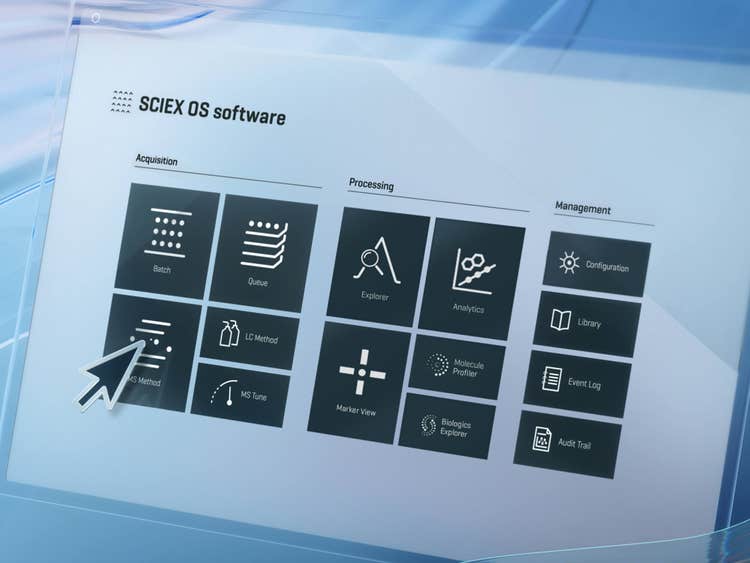
SCIEX solutions are designed for regulated environments, supporting compliance with requirements such as 21 CFR Part 11. Built-in features include audit trails, role-based access, and electronic signatures, helping ensure data integrity, traceability, and regulatory readiness.
How can LC-MS workflows improve reproducibility in bioanalytical assays?
Reproducibility is achieved through robust chromatography, stable ionization, and consistent data processing workflows. SCIEX solutions combine reliable hardware with integrated software to reduce variability and ensure consistent performance across runs and laboratories.
How do SCIEX solutions improve sensitivity in quantitative bioanalysis?
SCIEX LC-MS systems are designed to deliver high sensitivity for detecting low-abundance analytes in complex biological matrices. Advanced mass spectrometry technologies, combined with optimized workflows, enable reliable quantitation at low concentration levels, supporting confident decision-making.