Abstract
This technical note demonstrates the application of MRM3 to improve the specificity of detecting aflatoxin G2 (AFG2) in complex matrices such as plant-based meats. Using the QTRAP functionality on the SCIEX 7500 system, the MS/MS/MS (MS3) fragmentation of an AFG2 precursor ion provided dual mass filtering through monitoring the transition comprised of first- and second-generation product ions. AFG2 was not detected during MRM monitoring of the commonly used m/z 331 > 313 transition due to coeluting interferences in the plant-based chicken extract. However, during MRM3 acquisition, these interferences were removed, resulting in cleaner baselines and improved signal-to-noise (S/N) (Figure 1).
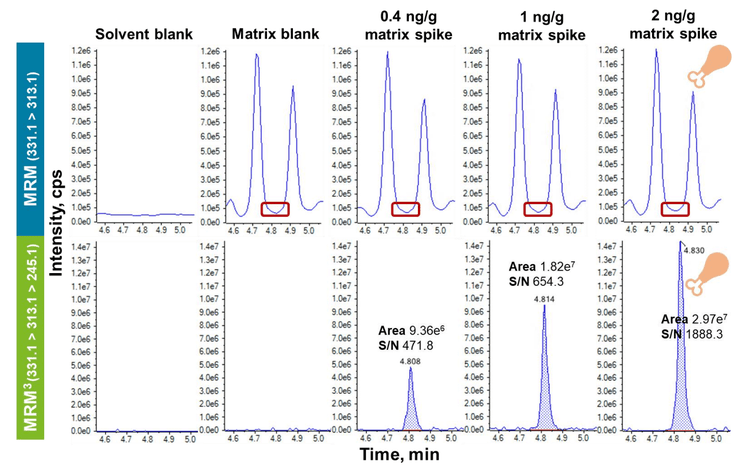
Key benefits of the MRM3 workflow for complex food analysis
- Reduced background interferences: The dual fragmentation in an MS3 scan provided a more compound-specific transition for monitoring, resulting in cleaner MRM3 chromatograms without any co-eluting interferences.
- Increased S/N from improved specificity. S/N enhancements in MRM3 enabled more reliable peak integration and potentially lower limits of quantitation (LOQs), especially for transitions prone to matrix interferences in MRM.
- Software tools for easy MRM3 optimization: The SCIEX OS software provided automated and guided optimization for parameter tuning during MRM3 method development.
Introduction
Aflatoxins represent a family of mycotoxins (AFB1, AFB2, AFG1 and AFG2), primarily produced from molds in the Aspergillus species.1 They are recognized as cytotoxic, genotoxic, hepatotoxic and immunosuppressive agents.1 Although aflatoxins have been reported in animal- and plant-based foods, higher levels are often found in the latter due to direct exposure from fungal growth on agricultural commodities. This is worth noting, given the recent expansion of plant-based meat alternatives in response to a shift in dietary preferences based on health and sustainability reasons. While the European Commission has established maximum residue levels (MRLs) for mycotoxins in some raw ingredients of plant-based foods,2 the final plant-based products are not yet regulated. As such, sensitive methods are needed to ensure the safety of plant-based meats.
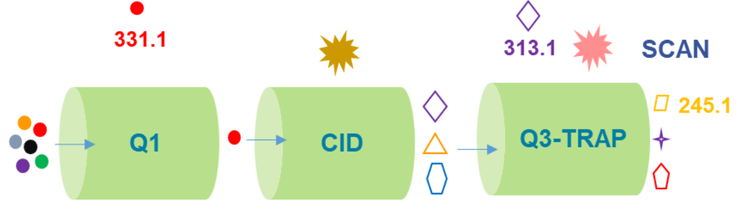
MRM acquisition is commonly used for targeted quantitation due to the high sensitivity and selectivity from monitoring compound-specific precursor-product ion transitions. However, MRM quantitation can be challenging in complex food matrices like plant-based meat, which contain highly processed ingredients, such as plant protein, fats and polysaccharides, to mimic the organoleptic properties of meat.3 These components can contribute to high background interferences, compromising LOQs. Sample clean-up and chromatographic optimization can help reduce these interferences but are time-, labour- and consumable-intensive. Here, MRM3 offered a more selective approach to improving the detection of AFG2 in plant-based meats. Figure 2 demonstrates how the second in-trap fragmentation produced unique and compound-specific MS3 transitions comprised of 2 generations of product ions for increased specificity.4
Methods
Standard stock preparation: A neat standard of AFG2 was purchased from Evolution Life Sciences. A stock solution of 25 µg/mL was prepared in acetonitrile.
Sample preparation: : After adding 10 mL of water to 5 g of homogenized plant-based meat, the sample was vortexed for 3 minutes. 10 mL of acetonitrile was added, vortexed for 10 min and the solution was transferred to a 50 mL tube containing 4 g of MgSO₄ and 1 g of NaCl, and vortexed for 10 min. The mixture was centrifuged at 4500 rpm for 10 min, and the supernatant was diluted 1:1 with 50:50 (v/v), acetonitrile/water, followed by spiking with AFG2 at 100 pg/mL, 250 pg/mL and 500 pg/mL for analysis.
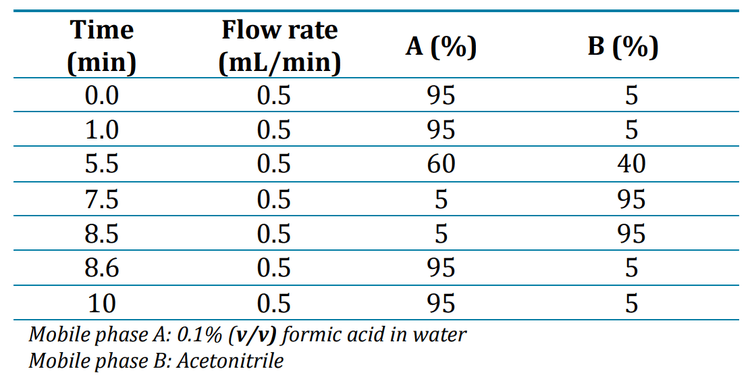
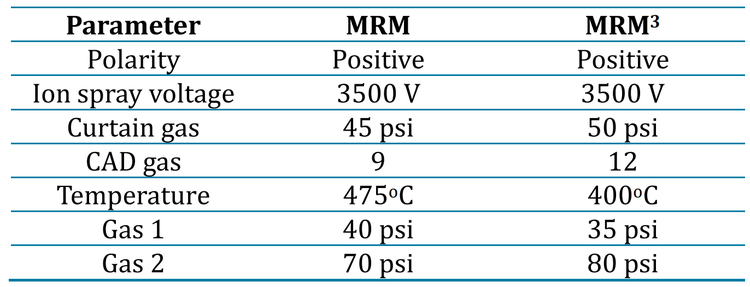
Chromatography: A Shimadzu Nexera Prominence LC system was used with a Phenomenex Kinetex C18 column (100 x 2.1 mm, 2.6 µm, 100 A , P/N: 00D-4462-AN). The gradient conditions used are shown in Table 1. The injection volume was 5 μL and the column oven temperature was 40°C.
Automated and guided optimization of MS3 parameters
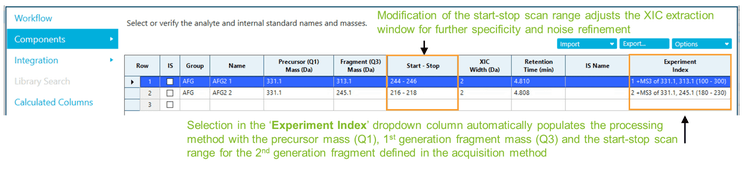
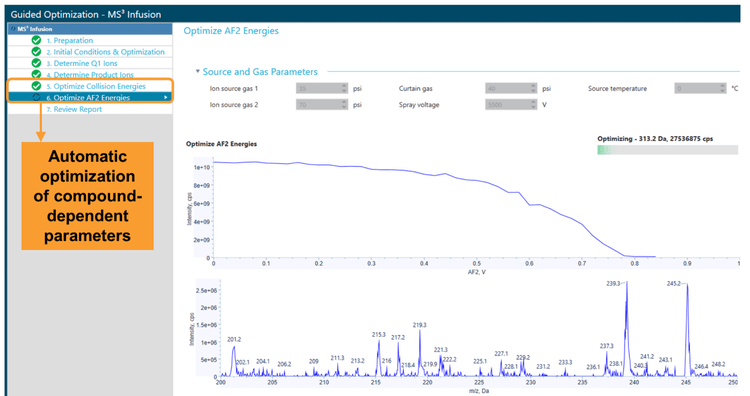
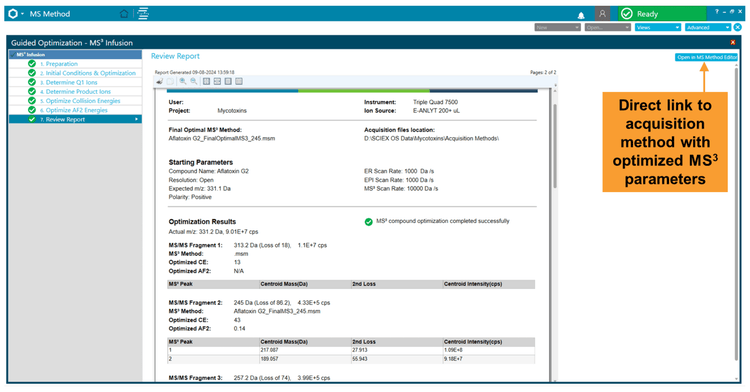
The SCIEX OS software offers an infusion-based guided workflow for automated MS3 method development through the MS Method Editor workspace (Figure 4). The workflow consists of the automated determination of the Q1 and product ions for the mass range specified. Compound-dependent parameters such as collision energy (CE) and auxiliary frequency 2 energy (AF2) are also automatically optimized for the first- and second-generation product ions. The final tuned parameters are summarized in a report presented at the end of the workflow for user review (Figure 5). The software also provides a direct link to the MS Method Editor workspace where an MS3 experiment with the optimized parameters is automatically created (Figure 5). This software feature streamlines the method development process with minimal user intervention and produces a baseline MS3 method that can be further optimized.
Enhanced specificity and sensitivity in MRM3
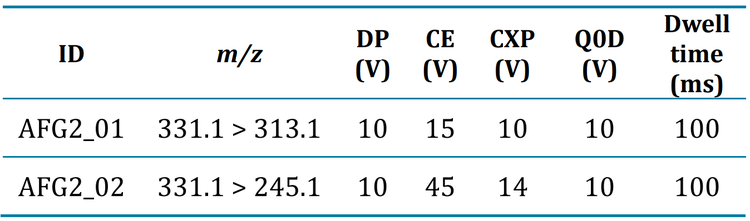
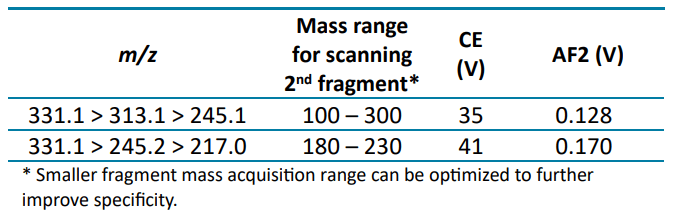
Compared to the single-level fragmentation in MRM, the MRM3 workflow comprises 2 steps, starting with the fragmentation of the precursor ion to an initial fragment, followed by further fragmentation into secondary fragments. In this work, the precursor ion of interest for AFG2 at m/z 331.1 was first isolated in Q1, followed by fragmentation in the Q2 collision cell to produce a range of product ions, including m/z 313.1 and m/z 245.2. These product ions (or second precursor ions) were then trapped in the Q3 linear ion trap (LIT) before undergoing secondary fragmentation by AF2 excitation (Figure 2). Using this QTRAP functionality on the SCIEX 7500 system, two MS3 transitions, m/z 331.1 > 245.1 > 217.0 and m/z 331.1 > 313.1 > 245.1, were optimized and compared against the corresponding MRM transitions, m/z 331.1 > 245.1 and m/z 331.1 > 313.1, that are commonly monitored for the analysis of AFG2 in plant-based meat.
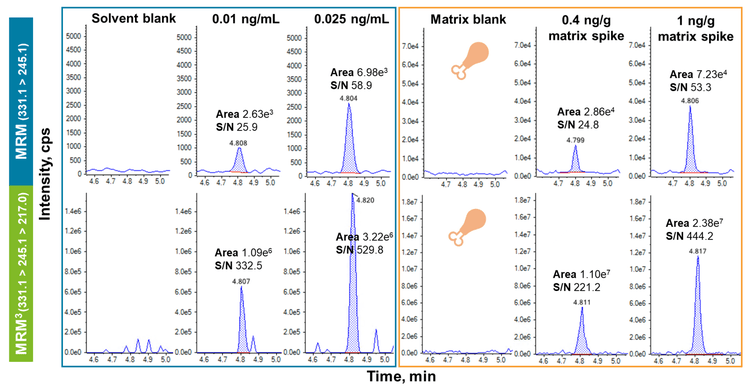
The m/z 331.1 > 245.1 MRM transition is often selected for AFG2 monitoring due to its high intensity and specificity, as it corresponds to the loss of a C3H2O3 fragment from the coumarin lactone ring structure common to the aflatoxins.5
This MRM transition exhibited good S/N responses (S/N >10) at concentrations as low as 0.01 ng/mL in solvent (Figure 6), which demonstrates the capability of the SCIEX 7500 system to achieve sub-ppb instrumental LOQs for AFG2.6 However, the increased specificity of MRM3 resulted in improved S/N responses in both the solvent standards and matrix spikes (Figure 6). Higher S/N values typically result in increased reproducibility, which can greatly facilitate the experimental determination of method LOQs in low-level matrix spikes.
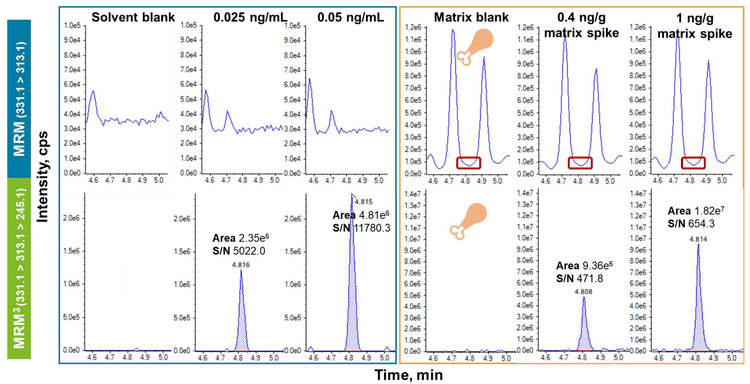
Due to its high abundance, the m/z 331.1 > 313.1 MRM transition has been extensively used as the quantifier transition for AFG2.5,7 However, this M-18 fragment is formed from the non-specific loss of water, which is observed in many compounds, rendering it prone to interferences. Using the m/z 331 > 245 and m/z 331 > 189 transitions have been shown to reach LOQs as low as 25 ppt for AFG2 on the SCIEX 7500 system,6 and are generally recommended when maximum sensitivity is required. However, multiple transitions may not always be available for some analytes and even then, ion ratios may still fail in the presence of challenging matrix interferences. Here, the nonspecific m/z 331.1 > 313.1 MRM transition was used as a proof-of-concept to showcase the power of MRM3 to obtain more specific XIC traces for more confident identification.
Figures 1 and 7 highlight significant interference of the m/z 331.1 > 313.1 MRM transition in the plant-based chicken matrix, obscuring the AFG2 detection, even at higher spiked levels. In contrast, MRM3 removed these interferences, which enabled the detection of AFG at concentrations as low as 0.4 ng/g against a significantly cleaner baseline in the matrix extracts.
Figure 7 also demonstrates the improved sensitivity in MRM3 for the m/z 331.1 > 313.1 > 245.1 transition in which reliable detection (S/N > 10) occurred in the 0.025 ng/mL solvent standard. While at the same concentration in solvent, the high MRM baseline for the m/z 331.1 > 313.1 transition suggests the non-specificity of this transition and the need to monitor for more compound-specific transitions. However, these data demonstrate that MRM3 may provide a viable alternative when MRM monitoring is challenged by the lack of stable and unique fragments, or complex matrices which show high background interferences.
Conclusion
- The increased specificity of the MRM3 workflow provided an alternative approach to MRM quantitation for analytes that suffer from high background or matrix interferences.
- S/N improvement of AFG2 in MRM3 enabled easier peak integration and potentially lower LOQs, especially for transitions encumbered by matrix interferences during conventional MRM acquisition.
- The guided optimization feature in SCIEX OS software streamlined the infusion-based tuning of MRM3 parameters and enabled the easy transfer of the optimized values to the final acquisition method.
References
-
- Ismail, A.; Gong, Y.Y.; Riaz, M.; Akhtar, S.; Sun, J. Aflatoxins in Plant-Based Foods: Phytochemistry and Molecular Aspects. In: Ozturk, M., Hakeem, K. (eds) Plant and Human Health, Volume 2 Springer, Cham.
- Commission regulation (EU) 2023/915 of 25 April 2023 on maximum levels for certain contaminants in food and repealing Regulation (EC) No 1881/2006. OJ L 119 5.5.2023, p. 103.
- Ogilvie, O.J.; Bennie, R.Z.; Trlin, H.J.F.; Loo, L.S.W.; Zhou, H.; Jin, A.; Oh, J.K.; Dobson, R.C.J.; Yu, H.; Domigan, L.J. Interdisciplinary methods for analysing food matrix structures of hybrid cell-based meats: A review. Food Structure. 2024, 39, 100361.
- Hunter, C. MRM3 quantitation for highest selectivity in complex matrices. SCIEX technical note. RUO-MKT-02- 2739-A.